
Vitrified Tiles Sizes: Complete Size Chart in mm, Inches And Feet
In This Article
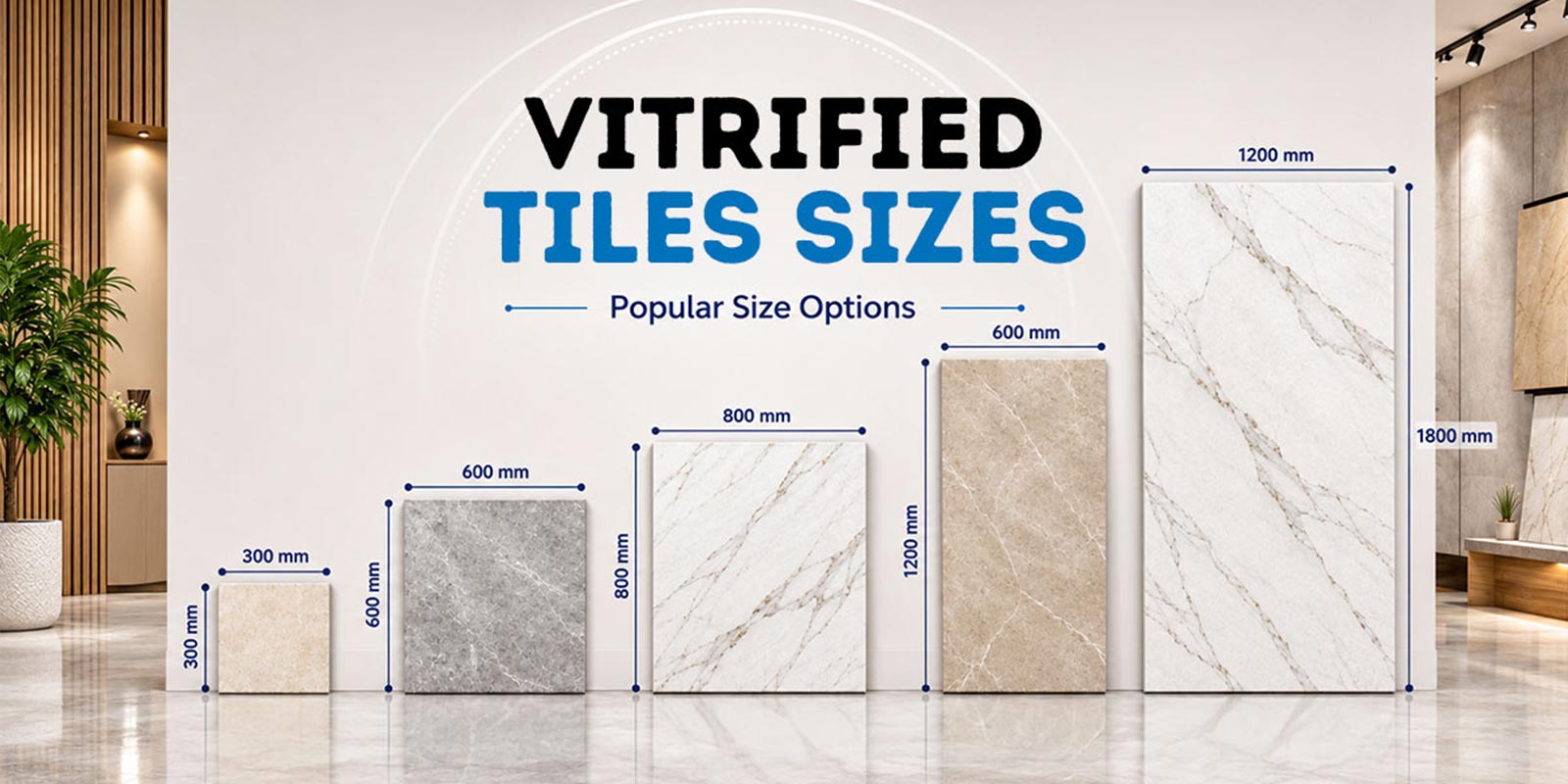
Vitrified tiles in India are available in standard floor sizes such as 600×600 mm, 600×1200 mm and 800×800 mm, as well as larger formats and slabs. Smaller 300×300 mm and 400×400 mm sizes are also found in anti-skid, parking and paver ranges, so check the product specification to confirm that a tile is vitrified, with water absorption of ≤0.5%.
This page lists:
- every size in millimetres, inches and feet,
- shows thickness by size,
- gives pieces and coverage per box,
- explains why a “2×2” tile is not two feet,
- matches sizes to rooms and surfaces.
Key Takeaways
- Vitrified tiles in India range from standard 600×600 mm floor formats to larger slabs, with 600×600 mm remaining a widely stocked floor size.
- A “2×2” tile is 600×600 mm, which is 1.97×1.97 ft and 3.875 sq ft, not 4 sq ft.
- Nominal size is the trade name; actual size is what the tile measures, within the deviation IS 15622:2017 permits.
- Pick tile size by room proportion, and read pieces and coverage per box from the carton.
- Larger tiles mean fewer joints, but they need a flatter substrate and a higher wastage allowance.
Vitrified Tiles Sizes: Complete Size Chart in mm, Inches and Feet
| Size (mm) | Nominal Size (inches) | Trade Name |
| 300×300 | 11.8×11.8 | 1×1 ft |
| 400×400 | 15.7×15.7 | 16×16 in |
| 600×600 | 23.6×23.6 | 2×2 ft |
| 600×1200 | 23.6×47.2 | 2×4 ft |
| 800×800 | 31.5×31.5 | 32×32 in |
| 800×1200 | 31.5×47.2 | 32×48 in |
| 800×1600 | 31.5×63.0 | 32×64 in |
| 1200×1800 | 47.2×70.9 | 4×6 ft |
| 800×2400 | 31.5×94.5 | 32×96 in |
| 800×3000 | 31.5×118.1 | 32×120 in |
This table covers the listed vitrified floor formats. The 300×300 mm and 400×400 mm sizes are also commonly found in ceramic, anti-skid and paver ranges. Check the product specification to confirm that a tile is vitrified, with water absorption of ≤0.5%.
How to Read a Tile Size: mm, Inches and Trade Names
Indian tile sizes are specified in millimetres. The inch figure is a rounded conversion, and the feet figure is a trade name rather than a measurement. One tile therefore carries three names. A 600×600 mm tile is approximately 23.6×23.6 inches, is called “2×2” in the trade, and measures approximately 1.97×1.97 ft. That is why the coverage column shows 3.88 sq ft for a 600×600 mm tile rather than 4.
Why a “2×2” Vitrified Tile Is Not Actually Two Feet?
A 2×2 ft tile is actually 600×600 mm (1.97×1.97 ft), covering 3.875 sq ft instead of 4. For a 1,000 sq ft floor, the exact calculation requires 259 tiles, or 65 boxes at four tiles per box. Calculating at 4 sq ft per tile gives only 250 tiles, or 63 boxes, leaving you short by nine tiles. Always calculate using the exact tile dimensions and carton coverage.
Standard Vitrified Tile Sizes
Standard vitrified tile sizes in India are:
- 600×600 mm
- 600×1200 mm
- 800×800 mm
- 800×1200 mm.
600×600 mm, commonly called 2×2, remains the most widely stocked floor size. 600×1200 mm is increasingly common in new homes because it reduces the number of joints.
- 600×600 mm (2×2 ft) — The Default Indian Floor Size: Fits most rooms with minimal cutting waste. Can be handled by a single installer. High joint density looks cluttered in large spaces.
- 600×1200 mm (2×4 ft) — The Modern Standard: Halves joint counts for a cleaner look. Most specified in new homes. Requires a flatter floor to avoid edge deviation.
- 800×800 mm and 800×1200 mm — Larger Squares and Rectangles: Calmer, spacious look for large halls. Unsuitable for rooms under 120 sq ft, where perimeter cuts make the floor look fragmented.
Large Format and Slab Vitrified Tile Sizes
There is no single universal threshold for large format tiles: US installation standards apply stricter rules from a 15-inch (381 mm) edge, while in India the term usually means 600×1200 mm and larger, up to slabs. See our guide to large format tiles.
What Counts as Large Format?
The main options in stores are 800×1600 mm, 1200×1800 mm, 800×2400 mm, and 800×3000 mm. These formats are generally chosen to reduce visible joint lines and create a more continuous surface. However, their larger dimensions require careful planning, accurate cutting and a sufficiently flat substrate.
The Largest Vitrified Tile Sizes Available in India
Indian manufacturers, mostly in Morbi, now make slabs up to 1600×3200 mm, and 1200×2400 mm is widely available. For homes, 800×1600 and 1200×1800 mm are the largest formats in common use. Slabs need a very flat substrate, full adhesive coverage, at least two people to handle and specialist cutting tools.
Table 2: Large format and slab vitrified tile sizes, with coverage, pieces per box and practical constraints.
| Size (mm) | Trade name | Coverage per tile (sq ft) | Pieces per box | Typical application | Practical constraint |
| 800×1600 | 32×64 | 13.78 | 2 | Living areas, cladding | Flat substrate, two-person handling |
| 1200×1800 | 4×6 | 23.25 | 2 | Seamless floors and walls | Full-bed support, two-person handling |
| 800×2400 | 32×96 | 20.67 | 1 | Slab floors, feature walls | Full-bed support, special cutting tools |
| 800×3000 | 32×120 | 25.83 | 1 | Slab floors and walls | Specialist cutting, costly if damaged |
Vitrified Tile Thickness by Size
Tile thickness is influenced by size, intended application and product construction. Larger formats need careful handling and adequate support during installation to reduce the risk of bending-related damage and breakage. While extra-thick slabs are produced for high-traffic or outdoor zones, exact measurements vary by brand and format. Always check the specific product data sheet.
Why Thickness Increases With Tile Size
Larger formats may require different thickness specifications depending on their construction and intended application. Handling and installation support are also important to reduce the risk of damage.
15 mm and Heavy-Duty Vitrified Tile Formats
Selected vitrified tile formats are available in 15 mm thickness for applications that require a heavier-duty product. Suitability depends on the tile’s technical specifications, intended load and installation conditions. Confirm the available sizes and recommended applications with the product datasheet before specifying them.
Table 3: Vitrified tile thickness by size and application, with heavy-duty 15 mm variants.
| Size (mm) | Typical thickness (mm) | Heavy-duty variant | Typical application |
| 300×300 | Confirm from datasheet | Not made in 15 mm | Compact bathroom and utility floors |
| 400×400 | Confirm from datasheet | Not available | Balconies and utility floors |
| 600×600 | Confirm from datasheet | 15 mm | Living areas, outdoor floors |
| 600×1200 | Confirm from datasheet | None listed | Living areas, corridors |
| 800×800 | Confirm from datasheet | None listed | Halls, larger rooms |
| 800×1200 | Confirm from datasheet | None listed | Halls, commercial floors |
| 800×1600 | Confirm from datasheet | None listed | Large-format floors |
| 1200×1800 | Confirm from datasheet | 15 mm | Seamless floors and walls |
| 800×2400 | Confirm from datasheet | 15 mm | Slab floors and walls |
| 800×3000 | Confirm from datasheet | 15 mm | Slab floors and walls |
Thickness varies by manufacturer and by format within the same size. Always confirm from the product datasheet.
Nominal Size vs Actual Size: What the Standard Allows
The size on the box is a commercial name, not the exact millimeter measurement.
The box name is the Nominal Size (like 600×600 mm). The factory targets a slightly smaller Work Size (like 598×598 mm) to allow for joints, resulting in the final Actual Size.
The Bureau of Indian Standards code IS 15622:2017 regulates these variations. It sets limits on length, width, thickness, straightness, and rectangularity. It also controls surface flatness (center curvature, edge curvature, and corner warpage), with limits varying by tile size and water absorption.
Rectified vs Non-Rectified: What It Does to the Joint
Rectified tiles are ground square after firing to improve dimensional consistency. Their more uniform edges allow installers to use narrower grout joints, subject to the manufacturer’s installation recommendations. However, rectified tiles still require grout joints. Non-rectified tiles have slightly less uniform edges and may need wider joints to accommodate dimensional variation. Always check the edge finish and recommended joint width before buying, as both affect the appearance of the finished floor.
Which Vitrified Tile Size Suits Which Room?
The right vitrified tile size depends on the room’s dimensions, layout and intended use. A suitable format helps reduce narrow perimeter cuts, maintain balanced proportions and create a consistent floor pattern. Consider the location of doorways, fixtures, drains and fixed furniture before finalising the tile size.
Small bathrooms: Use 300×300 mm or 400×400 mm.
Bedrooms and kitchens: Use 600×600 mm or 600×1200 mm.
Living rooms over 180 sq ft: Use 600×1200 mm or larger.
Smaller tiles can also make it easier to create the floor slope needed to direct water towards a drain. This is particularly useful in compact bathrooms and shower areas.
The main goal is to lay full tiles across the center of the floor. Any cut tiles along the edges should be at least one-third of a full tile wide so the floor looks clean and balanced.
These recommendations are general layout guidelines, not fixed size rules. The final choice depends on the room’s length and width, tile orientation, doorways, fixtures and the manufacturer’s installation guidance.
Table 4: Recommended vitrified tile size by room and room area, with the proportion reason for each.
| Room | Typical area band | Recommended size(s) | Why |
| Compact bathroom | Under 40 sq ft | 300×300, 400×400 | Small face keeps perimeter cuts usable |
| Standard bathroom | 40–60 sq ft | 300×300 floor, larger wall formats | Small floor tile, fewer cuts near drains |
| Kitchen floor | 80–120 sq ft | 600×600, 600×1200 | Fits counter runs without slivers |
| Bedroom | Under 130 sq ft | 600×600 | Full tiles across most of the floor |
| Bedroom | Over 130 sq ft | 600×1200 | Fewer joints across a wider floor |
| Living room | Under 180 sq ft | 600×600, 600×1200 | Cuts stay above a third of a tile |
| Living room | Over 180 sq ft | 600×1200, 800×1200, 800×1600 | Large floor carries a larger face |
| Hall or open plan | Over 250 sq ft | 800×1600, 1200×1800 | Fewest joints across a long sightline |
| Balcony | Under 60 sq ft | 400×400, 600×600 | Small span, simple layout |
| Terrace | Over 100 sq ft | 600×600, 600×1200 | Manageable size for large areas |
| Corridor | Narrow, long | 600×1200 or plank formats | Long tile follows the long axis |
| Commercial and showroom | Over 300 sq ft | 800×1600, 1200×1800 | Few joints across wide floors |
Wall-Safe vs Floor-Safe Vitrified Tile Sizes
Whether a tile can go on a floor depends on its body and rating, not its size. In India, 300×450 mm and 300×600 mm formats are almost always ceramic wall tiles. They are generally more porous, have lower breaking strength and may have glazes that are not rated for foot traffic or wet-floor slip resistance.
Wall-only formats: 300×450 mm and 300×600 mm are commonly used for ceramic wall tiles and should not be assumed suitable for flooring.
Floor and wall suitability: Larger vitrified formats may be suitable for both applications, depending on their technical rating, weight, substrate and installation requirements.
If you install heavy, large-format tiles on walls, you must hire a professional. Big tiles need specialized wall prep and high-strength adhesives to stop them from sliding or falling off.
Table 5: Vitrified tile sizes by surface suitability, floor and wall.
| Size (mm) | Floor | Wall | Note |
| 300×300 | Yes | Yes | Light-duty wall use |
| 400×400 | Yes | Yes | Light-duty wall use |
| 600×600 | Yes | Yes | Dual-use |
| 600×1200 | Yes | Yes | Dual-use |
| 800×800 | Yes | Yes | Dual-use |
| 800×1200 | Yes | Conditional | Wall needs flat, supported substrate |
| 800×1600 | Yes | Conditional | Large format, two-person handling |
| 1200×1800 | Yes | Conditional | Large format, full-bed support |
| 800×2400 | Conditional | Conditional | Slab handling and support needed |
| 800×3000 | Conditional | Conditional | Slab handling and support needed |
The 300×450 mm and 300×600 mm formats are wall tiles, not vitrified floor sizes, and are not part of this table.
Tiles Per Box and Coverage: How Much One Box Covers
A box of 600×600 mm vitrified tiles typically holds 4 pieces covering 15.50 sq ft, or 1.44 sq m. A box of 600×1200 mm holds 2 or 3 pieces depending on the manufacturer. Pieces per box vary by range, so always confirm coverage from the carton before ordering.
Table 6: Pieces per box and coverage per box for common vitrified tile sizes, in square feet and square metres.
| Size (mm) | Pieces per box | Coverage per box (sq ft) | Coverage per box (sq m) |
| 300×300 | 8 | 7.75 | 0.72 |
| 300×300 (alternate pack) | 10 | 9.69 | 0.90 |
| 300×450 (wall tile) | 6 | 8.72 | 0.81 |
| 300×600 (wall tile) | 5 | 9.69 | 0.90 |
| 400×400 | 5 | 8.61 | 0.80 |
| 600×600 | 4 | 15.50 | 1.44 |
| 600×600 (15 mm) | 2 | 7.75 | 0.72 |
| 600×1200 | 2 or 3 | 15.50 or 23.25 | 1.44 or 2.16 |
| 800×800 | 3 | 20.67 | 1.92 |
| 800×1200 | 2 | 20.67 | 1.92 |
| 800×1600 | 2 | 27.56 | 2.56 |
| 1200×1800 | 2 | 46.50 | 4.32 |
| 800×2400 (15 mm) | 1 | 20.67 | 1.92 |
| 800×3000 (15 mm) | 1 | 25.83 | 2.40 |
| 200×1200 (plank) | 5 | 12.92 | 1.20 |
Pieces per box vary by manufacturer and by range. Always confirm from the carton. The 300×450 mm and 300×600 mm rows are wall formats, listed because they are packed alongside vitrified ranges.
How to Calculate How Many Tiles You Need?
A 600×600 mm tile covers approximately 3.875 sq ft, not 4 sq ft. For a 1,000 sq ft floor, the calculation requires approximately 259 tiles. At four tiles per box, this means 65 boxes. Calculating at 4 sq ft per tile gives only 250 tiles, or 63 boxes. This creates a shortage of nine individual tiles before accounting for whole-box ordering and wastage.
How Much Extra to Order for Wastage and Cuts?
Add extra tiles for cutting waste, and buy everything from a single batch.
Simple rooms: Add 5% to 8% extra.
Large formats: Add 10% to 12% extra.
Rooms with corners or pillars: Add 12% to 15% extra.
The Batch Rule: Buy the full quantity at once. Later batches may show differences in shade and calibre. Match the batch, shade and calibre numbers on the cartons before installation.
How Tile Size Changes Joints, Layout and Levelling?
Larger tiles reduce joint lines but demand perfectly flat floors and produce more waste.
- Joint Count: Covering 100 sq ft takes approximately 26 tiles at 600×600 mm, 13 tiles at 600×1200 mm, 8 tiles at 800×1600 mm and 5 tiles at 1200×1800 mm. Larger tiles reduce the number of grout lines, creating a more continuous surface.
- Substrate Flatness: Longer tile edges show floor unevenness instantly. The bigger the tile, the flatter the floor underneath must be to avoid uneven edges.
- Cut Waste: Larger tiles create bigger, unusable waste pieces. A leftover piece from a 1200×1800 mm tile is much harder to reuse than one from a 600×600 mm tile.
How to Choose a Vitrified Tile Size?
Choosing a vitrified tile size involves more than matching the tile to the room’s floor area. Consider the room dimensions, layout, surface suitability, substrate flatness, tile thickness, grout joints and carton coverage. Work through the following checks before finalising the format and calculating the order quantity.
- Measure the room in feet, then convert to the millimetre size that leaves the largest perimeter cuts, using Table 4.
- Decide how visible you want joints to be, and check whether the tile is rectified if you want a narrow joint.
- Confirm the size is rated for the surface you are tiling, floor or wall, using Table 5.
- Check substrate flatness before committing to a large format.
- Confirm thickness from the product datasheet, not from the size alone.
- Read pieces and coverage per box from the carton, not from a general chart.
- Calculate area from actual coverage per tile, not from the trade name.
- Order the full quantity plus wastage from a single batch.
Does Tile Size Affect Price?
Larger vitrified tile formats generally cost more per square foot than standard sizes. They use more material, require tighter manufacturing controls and can have higher production rejection rates. Handling, transportation and installation may also add to the overall cost, particularly for large slabs.
The final cost depends on more than tile size. Compare the tile’s thickness, finish, surface characteristics and coverage per box. For larger formats, also consider the additional handling and installation requirements. This helps you assess the overall cost rather than comparing tiles on size alone.
Vitrified Tile Sizes Available from Aparna Enterprises
Aparna Enterprises manufactures vitrified tiles across sizes from 600×600 mm to 800×3000 mm slab formats, including 600×1200 mm, 800×800 mm, 800×1200 mm, 800×1600 mm and 1200×1800 mm. Availability of a given finish varies by size, so confirm the specific combination against the current range.
The table below lists the vitrified sizes in current production and the formats each is made in. Wall tile and paver sizes are separate product lines and are not listed here.
Table 7: Vitrified tile sizes from Aparna Enterprises and the formats each size is made in.
| Size (mm) | Available Formats | Notes |
| 600×600 | Double charge, GVT, PGVT, full body | Includes a 15 mm full-body variant |
| 600×1200 | Double charge, GVT, PGVT, full body | None |
| 800×800 | Double charge | None |
| 800×1200 | Double charge, full body | None |
| 800×1600 | GVT, PGVT | None |
| 1200×1800 | GVT, PGVT | Includes a 15 mm variant |
| 800×2400 | Full body | 15 mm |
| 800×3000 | Full body | 15 mm |
| 200×1200 | GVT | Plank format |
To get more information on tile sizes, get in touch with the Aparna Enterprises team.
Frequently Asked Questions On Vitrified Tiles Sizes
The standard vitrified tile size in India is 600×600 mm, sold as 2×2 feet. 600×1200 mm and 800×800 mm are the other widely used standard sizes, while 800×1200 mm is common in larger rooms. Together, these four cover most residential flooring.
A 600×600 mm vitrified tile measures 1.97×1.97 feet and is traded as 2×2. A 600×1200 mm tile is 1.97×3.94 feet, traded as 2×4. An 800×800 mm tile is 2.62×2.62 feet. The trade name is rounded; the actual dimension is slightly smaller.
In Indian production, vitrified slab formats reach 1200×1800 mm and 800×3000 mm. Some international producers make slabs up to 1600×3200 mm. Sizes this large are used for seamless floors and walls, and need a very flat substrate and two-person handling.
No. A 2×2 vitrified tile is 600×600 mm, which is 1.97×1.97 feet and covers 3.875 sq ft, not 4. Calculating at 4 sq ft per tile gives 250 tiles instead of 259, leaving a shortage of nine tiles, or approximately two boxes.
A box of 600×600 mm tiles typically holds 4 pieces covering 15.50 sq ft. A 600×1200 mm box holds 2 or 3 pieces, and an 800×800 mm box holds 3. Pieces per box vary by manufacturer and range, so confirm from the carton.
For a compact bathroom under about 40 sq ft, 300×300 mm or 400×400 mm tiles keep perimeter cuts reasonable. Larger sizes leave narrow, awkward offcuts around fixtures and drains. Confirm the tile is rated for floor use rather than wall-only.
Vitrified tile thickness varies by size, intended application and product construction. Selected formats are also available in 15 mm variants. Always check the product datasheet for the exact thickness and recommended use.
Yes, 600×1200 mm tiles can be used in small rooms, provided the layout is planned carefully. However, they generally work better in rooms over about 130 sq ft or in long, narrow spaces such as kitchens and corridors. In compact rooms, their longer edges can create narrow perimeter cuts and more unusable offcuts.
Nominal size is the trade name, such as 600×600 mm; actual size is what a tile measures. The two differ slightly, and IS 15622:2017 permits a defined deviation between them. The work size, the manufacturing target, sits between the two.
Order extra tiles to account for cutting waste, breakages and the room layout. For a simple rectangular room, add 5–8% extra. For large-format tiles, add 10–12%. For rooms with alcoves or many cut-outs, add 12–15%.
Start Your Project with the Right Materials
We provide everything you need for modern construction. Connect with our experts to discuss your requirements and get the best solution for your project. Submit your details and our team will contact you soon.
CORPORATE OFFICE
8-2-293/82/A, Plot No-1214, Road No-60,
Jubilee Hills, Hyderabad-500 033.