
Advantages of Ready Mix Concrete (RMC): Benefits & Key Considerations
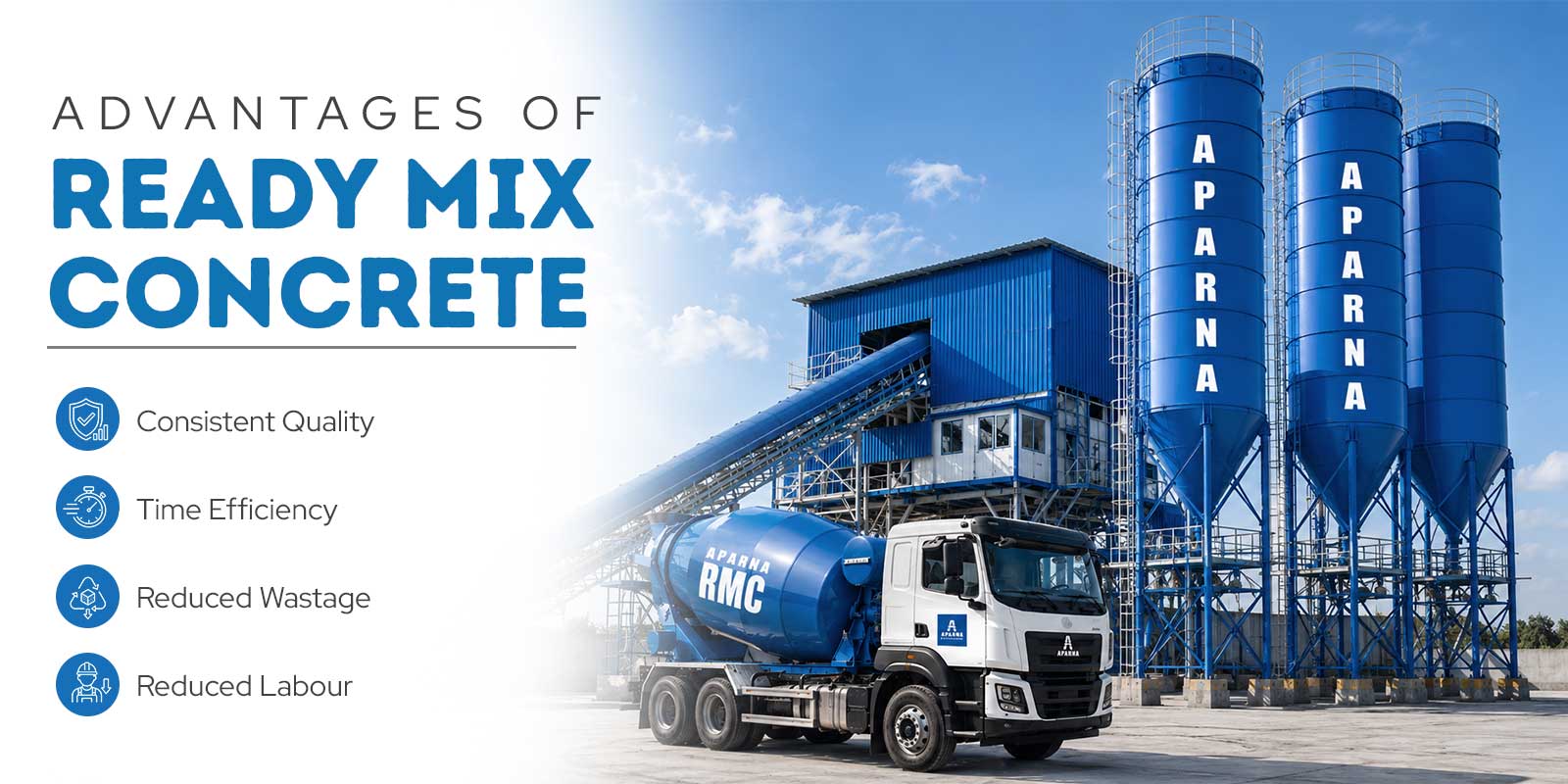
Ready mix concrete (RMC) is concrete batched to a precise mix design in an automated plant and delivered to site ready to pour. Its main advantages are consistent, factory-controlled quality, faster construction, lower labour and material wastage, precise mix customisation, and a cleaner, safer, more sustainable site. This guide explains each benefit in detail and shows where RMC delivers the most value.
Key advantages of RMC at a glance:
- Consistent, lab-controlled quality in every batch
- Faster construction — arrives ready to pour, no on-site mixing
- Lower on-site labour and equipment needs
- Reduced material wastage through computerised batching
- Precise, made-to-order mixes across a wide grade range
- Higher durability from correct water-cement ratio and compaction
- Cleaner, safer, less congested worksite
- Reliable, scheduled supply — including pumping for high-rise work
- Lower environmental impact and better resource use
- Lower total project cost once speed and reduced waste are counted
What Is Ready Mix Concrete (RMC)?
Ready mix concrete is concrete manufactured in a batching plant to a specified mix design — a set grade, water-cement ratio, aggregate proportion and admixture dosage — under controlled conditions, then transported to the construction site in transit mixers, ready to place. It differs from traditional site-mixed (or conventional) concrete, where cement, sand, aggregate and water are proportioned and mixed by hand on site.
Because every batch follows a tested, repeatable recipe rather than manual on-site judgement, RMC delivers far more reliable strength and consistency. In practice it is produced across a range of grades (commonly M5 to M80) to suit everything from residential slabs to high-performance infrastructure, and its quality is governed by established standards such as IS 4926 (the code of practice for ready-mixed concrete) and IS 456 for structural concrete.
Key Advantages Of Ready Mix Concrete
-
Consistent, controlled quality
This is RMC’s single biggest advantage. Each batch is produced to an exact mix design in a computerised plant and tested in a laboratory, so strength and consistency stay uniform from one delivery to the next. On-site mixing, by contrast, varies with the labour, weather and supervision on any given day. Consistent concrete means fewer structural risks and more predictable long-term performance — which matters most on quality-critical work like bridges, high-rises and infrastructure.
-
Faster construction and on-time delivery
RMC arrives at site ready to pour, so crews skip the slow, manual steps of proportioning and mixing. Concrete can be placed as soon as it is delivered, at high volumes, keeping projects on schedule. Scheduled, just-in-time delivery also means teams are not waiting on material or managing mixing bottlenecks.
-
Lower labour needs and cost
Because mixing happens off-site, projects need far less on-site labour and mixing equipment. That reduces manpower costs and frees the workforce to focus on placing, finishing and other critical tasks rather than batching.
-
Reduced material wastage
Manual on-site mixing relies on estimation, which leads to spillage, over-ordering and inconsistent batches — an expensive problem at scale. RMC is proportioned by computerised batching, so materials are used precisely, wastage drops sharply, and less waste means both lower cost and a smaller environmental footprint.
-
Precise, made-to-order mix customisation
RMC can be engineered to the exact needs of a project — a specific grade, workability, setting time or durability requirement. Beyond standard grades, suppliers can provide specialised mixes such as self-compacting concrete, high-performance concrete, fibre-reinforced concrete and mixes using GGBS or fly ash. This flexibility is difficult to achieve reliably with site mixing.
-
Higher durability and strength
A correct, consistently maintained water-cement ratio and proper mix design give RMC better compressive strength and durability than most site-mixed concrete. Properly designed mixes also pump and compact well, which improves the finished structure’s resistance to weather, chemicals and load over its service life.
-
A cleaner, safer, less congested site
With mixing handled off-site, there is little need to store large volumes of cement, sand and aggregate on the plot. That means a tidier, safer worksite with fewer material-handling hazards — a significant benefit on tight urban sites where space is limited.
-
Reliable supply and logistics
Established RMC suppliers manage the full supply chain — transit mixers for delivery and boom pumps for placing concrete in high-rise and hard-to-reach areas — so material is available exactly when needed. Dependable logistics reduce delays and let construction teams plan pours with confidence.
-
Lower environmental impact
Precise batching reduces material waste and over-consumption, and many suppliers incorporate supplementary materials such as fly ash and GGBS, recycled aggregates and water-conservation practices. Less on-site mixing also means less dust and noise, supporting cleaner, more sustainable construction.
-
Lower total project cost
The per-unit price of RMC can be marginally higher than site-mixed concrete, but that misses the full picture. Faster placement, reduced labour and equipment, minimal wastage and less rework typically make RMC the more cost-effective choice overall — especially on medium-to-large projects where those savings compound.
Where Ready Mix Concrete Is Used?
RMC suits a wide range of applications, particularly where quality, speed or site conditions are demanding:
- Foundations, rafts and footings that need consistent, reliable strength
- High-rise buildings, where pumpable concrete reaches upper floors efficiently
- Roads, pavements, bridges and flyovers requiring high-volume, uniform pours
- Metro rail, expressways and other large infrastructure projects
- Commercial, industrial and institutional buildings
- Residential projects, from independent homes to large apartment developments
Points To Plan For With RMC
RMC’s advantages are strongest with a little forward planning. None of the following are drawbacks so much as things to schedule for:
- Placement window: concrete must be placed within its workable time, so choose a supplier with a plant near your site and coordinate delivery timing.
- Site access: transit mixers and pumps need reasonable access to the pour area.
- Order volume: RMC is most economical at medium-to-large volumes, so it is worth planning pours to make full use of each delivery.
- Supplier choice: quality varies between suppliers, so an established, certified producer with in-house testing is the safest route to the benefits above.
How To Choose A Ready Mix Concrete Supplier?
Use this checklist when selecting an RMC partner:
- Quality certification — ISO-certified processes and conformity to standards such as IS 4926.
- In-house testing — a laboratory that verifies each batch against the specified mix design.
- Grade range and specialty mixes — the ability to supply the exact grades and special concretes your project needs.
- Plant proximity and fleet — nearby plants plus enough transit mixers and pumps to deliver on time.
- Production capacity — the scale to meet your volumes without interruption.
- Delivery reliability and tracking — dependable scheduling, ideally with real-time delivery visibility.
Takeaway
Ready mix concrete has become the default choice for serious construction because it solves the core weaknesses of site mixing: inconsistent quality, slow placement, high labour and avoidable waste. For medium-to-large and quality-critical projects, it delivers stronger, more durable, more predictable results — usually at a lower total cost.
Aparna Enterprises produces ready mix concrete through a network of fully automated Schwing Stetter batching plants across five states, in grades from M5 to M80, backed by ISO-certified processes, in-house testing and digitally tracked delivery. Explore ready mix concrete solutions from Aparna Enterprises to match the right mix and supply to your project.
Frequently Asked Questions
RMC is supplied across a wide range of grades — commonly M5 through M80 — along with specialised mixes such as self-compacting concrete, high-performance concrete and fibre-reinforced concrete. The right grade depends on the structural element and load it must carry.
RMC is most economical at medium-to-large volumes, where its savings on labour, wastage and time are greatest. Very small pours can still use it, but they may attract minimum-order or delivery considerations, so it is worth planning pours to make full use of each load.
RMC has a limited workable window after batching, so it should be placed and compacted promptly. This is why plant proximity and delivery scheduling matter; admixtures can be used to extend workability where longer transit or placement times are expected.
Ready-mix concrete is delivered wet and cast in place at the site. Precast concrete is cast and cured into finished elements in a factory, then transported and installed. RMC offers on-site flexibility; precast offers factory-finished components.
The main things to plan for are its limited placement window, the need for site access for transit mixers and pumps, and its stronger economics at larger volumes. With a nearby supplier and basic scheduling, these are easily managed.
RMC supports more sustainable construction through precise batching that cuts waste, the use of supplementary materials like fly ash and GGBS, and reduced on-site dust and noise.
Start Your Project with the Right Materials
We provide everything you need for modern construction. Connect with our experts to discuss your requirements and get the best solution for your project. Submit your details and our team will contact you soon.
CORPORATE OFFICE
8-2-293/82/A, Plot No-1214, Road No-60,
Jubilee Hills, Hyderabad-500 033.