
Vitrified Floor Tiles: Types, Designs & How to Choose
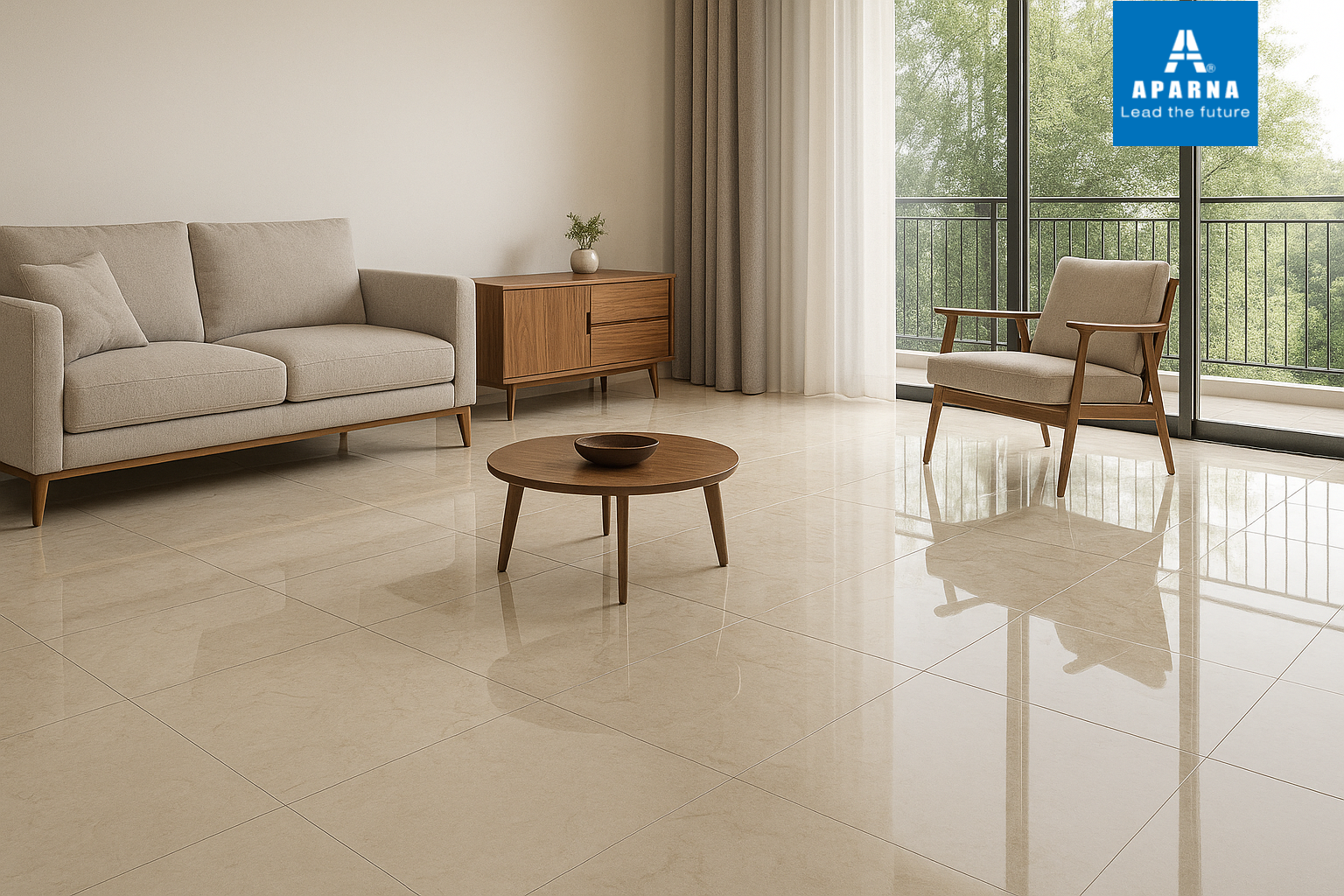
Vitrified floor tiles are pressed floor tiles that are made by firing clay and silica at temperatures over 1,200°C. They are fired until the body fuses into a dense, glass-like mass with water absorption below 0.5%. The density and baking temperature are what separate them from ordinary ceramic tiles. Vitrified tiles can resist stains, scratches, and moisture, and they need no sealing and retain their finish for several years.
In India, they are a popular choice for living rooms, bedrooms, kitchens, balconies, and commercial floors alike.
What matters more than brand name is the tile type, finish, and tile specifications that suit the room.
This guide covers different types of vitrified floor tiles, design and finish options, applications, their comparison with materials like wood, marble, granite, vinyl, and ceramic, and how to lay and maintain them.
Types of Vitrified Floor Tiles
Mostly, five types of vitrified floor tiles are available in India. Tile durability depends on how they are made.
Tile Type |
How it is Made |
How it Wears |
Best Rooms / Uses |
| Full Body | Same colour all the way through the tile | Scratches do not show | Parking, stairs, factories |
| Double Charge | Two layers pressed to make a thick pattern | Very tough. Lasts a long time | Busy homes, offices, shops |
| Glazed (GVT) | Digital design printed under a glass layer | Design can scratch if abused | Living rooms, bedrooms |
| Polished (PGVT) | Glazed tile with an extra shiny polish | Shiny like marble. Avoid rough use | Luxury rooms, main lobbies |
| Soluble Salt | Design printed 1–2 mm into the top | Wears out the fastest | Low-use rooms, rental homes |
Note: Both porcelain and vitrified are the same thing. Both words mean the tile absorbs very little water. Also, DGVT stands for Digital Glazed Vitrified Tile (printed design), and not a double charge tile.
Vitrified Floor Tile Designs And Finishes
A modern GVT or PGVT tile can use digital printing to copy natural materials like Italian marble, wood, concrete, or stone at a lower cost and without the need for high maintenance. When selecting tiles, you need to consider the look and finish (shiny or matte).
Design families in production
- Marble-Look: The most popular choice for Indian homes because it replicates luxury stones like Statuario, Carrara, and Onyx with a high-gloss polished finish.
- Wood-Look Planks: Made in long plank shapes instead of squares to mimic real wood flooring. They are suitable for humid bedrooms and balconies where real timber generally warps.
- Stone & Rustic: Mimics textures like slate, sandstone, and Kota stone with a matt finish. They are mostly available in full-body tiles to prevent outdoor wear from showing.
- Terrazzo: This design features retro, speckled aggregate patterns. They are digitally printed in both matt and polished finishes.
- Concrete & Cement-Look: Industrial grey and taupe tones in a flat matt finish. Perfect for minimalist homes because the texture naturally hides dust.
- Biophilic & Organic: Natural stone and earth textures that look organic rather than printed. Mostly used in contemporary living rooms and hotels.
- Solid & Super-White: Plain tones ranging from standard ivory to high-tech neutral white. Light shades make small rooms look larger, while dark shades ground open spaces.
- Metallic & 3D Fossil: Distinctive, sparkling textures with raised dimensions. Best suited for small accent zones and grand entrance lobbies.
Finishes And Where Each One Belongs
Tile finish decides how slippery, shiny, or safe a tile is. The same design comes in many finishes. The finish tells you where you can safely put the tile.
Finish |
What It Looks Like |
Where to Use |
Where to Avoid |
| Polish | Shiny & reflective | Living rooms, bedrooms | Wet areas (slippery) |
| High-Gloss | Mirror-like shine | Lobbies, formal spaces | Bright, high-glare rooms |
| Super Polish | Ultimate shine | Luxury spaces, hotels | Wet areas, homes with kids |
| Satin | Soft, low sheen | Bedrooms, hallways | — |
| Matt | Flat, slip-resistant | Kitchens, bedrooms | Dark rooms |
| Digi-Matt | Sharp, detailed matt | Patterned floors | Wet areas |
| Carving | Textured matt & gloss mix | Accent walls, floors | Wet areas |
| Punch Matt | Rough, textured grip | Balconies, utility rooms | Formal living rooms |
| Rustic | Earthy & uneven | Courtyards, patios | Modern, sleek spaces |
| Crystal / Sugar | Subtle grainy sparkle | Feature floors, accents | Huge open floors |
| Fossil 3D | Raised, stony texture | Feature walls, accents | Busy hallways |
| Plank | Wood-look strips | Balconies, bedrooms | Tiny square rooms |
Matt and anti-skid tiles are just as high-quality and priced comparably with glossy tiles. They use the same vitrified base. Never prefer a shiny look over safety in wet areas.
Best Vitrified Floor Tiles for Each Room
This simple table helps you choose the right tile for each room based on traffic, moisture, and light:
Room |
Recommended Type |
Finish |
Why |
| Living Room | GVT / PGVT | Glossy / Satin Matt | Moderate traffic; focus on design |
| Bedroom | GVT | Matt / Satin Matt | Lowest traffic; wood-look designs create a warm, natural appearance |
| Kitchen | Double Charge / GVT | Matt | High wear; gloss is slippery with oil/water |
| Bathroom | GVT | Matt / Textured | Wet floor safety; needs good slip rating |
| Balcony | GVT / Full Body | Punch Matt / Rustic | Resists rain, sun, and weather swings |
| Staircase | Full Body | Matt / Textured | Edge chipping is invisible on full body |
| Parking | Full Body | Rustic / Textured | Suitable for parking |
| Shop / Office | Double Charge | Matt / Polished | Best high-traffic wear resistance per rupee |
Vitrified Floor Tiles vs Wooden, Marble, Granite, Vinyl and Ceramic Flooring
Vitrified tiles compared against five flooring alternatives like wood, marble, granite, vinyl/SPC, and ceramic:
Alternative |
Where It Wins |
Where Vitrified Wins |
| Wood | Warmth, authentic texture | Highly water- and termite-resistant; no refinishing |
| Marble | Luxury depth, unique veins | More stain-resistant than natural marble, zero polishing; lower cost |
| Granite | Maximum raw hardness | More designs; lighter; cheaper installation |
| Vinyl / SPC | Softer, quieter, easy DIY | Better dent resistance; won’t fade; lasts 20–30 years |
| Ceramic | Lower price; Matte finish provides better grip than polished finishes grip | Low water absorption; lasts longer with proper installation |
How to Choose Vitrified Floor Tiles: Eight Checks
Besides considering water absorption below 0.5%, you have to consider wear ratings, rectified edges, thickness of tile, breaking strength, slip resistance, IS standards, and a single order from the same batch.
-
Water absorption below 0.5%
Vitrified tiles must absorb less than 0.5% water by weight. If any tile absorbs more than 0.5% water, then it is a standard tile.
-
Wear Ratings
Choose tiles with a wet-area slip rating of R10+. Look for PEI Class 4 or 5 for glazed tiles, or Deep abrasion below 175 mm³ for unglazed tiles.
-
Rectified edges
Choose machine-cut tiles after firing because it allows you to lay tiles with grout joints of just 2- 3 mm.
-
Tile thickness
Most vitrified floor tiles are available in 8–10 mm thickness, which is suitable for homes and most commercial spaces. For heavy-duty applications, choose thicker full-body tiles.
-
Breaking strength
Check tested values in newtons to ensure how much pressure the tile handles. Do not depend on words like heavy-duty or other marketing terms.
-
Slip resistance
Request the R rating, which measures tile slip resistance. Tiles are rated R9 to R13 on the ramp test, and a higher number means more grip.
- R9: Dry areas only (bedrooms, living rooms).
- R10: Home wet areas (bathrooms, balconies).
- R11+: Heavy-duty wet areas (commercial floors, ramps)
-
Single batch, single order
Purchase the entire requirement, including a 10% wastage allowance, in a single batch. Tiles produced in different batches may have slight shade variations, making later purchases difficult to match.
-
IS 15622:2017 Standards
Check for IS 15622:2017 standards, as it is the quality benchmark code for pressed tiles in India. Also request test reports on the same.
How Vitrified Floor Tiles Are Laid?
Vitrified tiles are dense and non-porous tiles. This means the traditional cement-mortar bed tiles do not bond reliably to them. A proper installation requires a thin-bed polymer-modified adhesive.
- Surface preparation: The surface must be levelled and free from dust and loose material. Uneven surfaces need proper levelling, and they must not be levelled with extra adhesive.
- Adhesive: Thin-bed polymer-modified adhesive is applied with a matched trowel. For large format tiles, tiles are fully back-buttered before they are pressed down to avoid hollow spots.
- Joints: A spacer of 2–3 mm is left for rectified tiles, and wider spacers for non-rectified. Tiles must not be laid tight against each other because they need gaps to expand and contract with temperature changes.
- Grouting: For dry areas, cement-based grout can be used. But for kitchens and bathrooms, epoxy grout must be used because it can resist staining and does not absorb water.
- Curing and use: Do not walk on the tile until the adhesive cures. Strictly follow the manufacturer’s stated time. You need to wipe away the grout haze before it hardens.
How To Clean And Maintain Vitrified Floor Tiles?
A vitrified floor needs minimal maintenance to keep it clean. Because the body is non-porous, it doesn’t soak, making cleaning easy. You can just clean them with a mop and mild detergent. They also need no sealing, waxing, or polishing.
- Daily: You can sweep or vacuum grit, then mop with water and a pH-neutral cleaner.
- Avoid: Do not use acidic cleaners, bleach, or abrasive pads, which can damage the glaze on GVT and PGVT and dull the surface permanently.
- Stains: Most of the spills can be wiped off. Stubborn marks on matt finishes can be cleaned with a soft nylon brush and a neutral cleaner. As mentioned, do not use harsh cleaners.
- Scratch prevention: Protect vitrified floors from grit scratches with felt pads under furniture legs, and doormats at entrances.
Vitrified Floor Tiles From Aparna Enterprises
Aparna Enterprises manufactures all five types of vitrified tile — glazed (GVT), polished glazed (PGVT), double charge, full body and soluble salt from its two plants (Kakinada in Andhra Pradesh and Morbi in Gujarat).
The range runs from 300×300 mm through 600×600, 600×1200, 800×800, 800×1200 and 800×1600 mm to large-format slabs at 1200×1800 mm. Finishes in production cover polish, high-gloss polish, super polish, satin, matt, digi-matt, carving, punch matt, rustic, crystal and 3D fossil, and the outdoor range includes an R10-rated slip-resistant series.
Planning a floor and confused which tile type suits each room? Share your requirement, and our team will help you specify it.
Frequently Asked Questions On Vitrified Floor Tiles
Yes. Vitrified tiles are the most widely used tiles for flooring in India because their water absorption below 0.5% makes them resistant to stains, moisture, and wear. Also, a correctly laid vitrified floor lasts 20–30 years with only routine mopping. The one requirement is matching the tile type and finish to the room — anti-skid in wet areas, double charge or full body where footfall is heavy.
Floor tile describes where a tile is used; “vitrified” describes how it is made. A vitrified floor tile is a floor tile whose body has been fired until it fuses into a dense, low-porosity mass. Ceramic floor tiles are also floor tiles, but they absorb 3–6% water, compared to under 0.5% for vitrified.
For most Indian homes, glazed vitrified (GVT) offers the widest design range for living rooms and bedrooms, while double charge is the better choice for kitchens, passages and any area with constant footfall. Full body is generally more tile than a home needs, except on staircases and in parking areas.
They resist scratching well, but they are not scratch-proof. The realistic risk is grit tracked in from outside acting as an abrasive underfoot. Doormats at entrances and felt pads under furniture prevent nearly all of it. On full body and double charge tiles, any scratch that does occur is far less visible because the colour continues below the surface.
Polished and high-gloss vitrified tiles are slippery when wet, so they should not be used in bathrooms, balconies or kitchens. Matt and anti-skid finishes use the same vitrified body with a textured surface and provide reliable wet grip at a similar price.
Yes, they can be used outdoors. But specify anti-skid, textured, or rustic finish tiles with an adequate thickness. Their almost zero water absorption allows them to handle rain and temperature swings well. Make sure not to use polished finishes outdoors.
When installed properly, vitrified floor tiles last over 20 years in residential use and over 10 years in heavy traffic. More than tiles, grout lines wear faster than the tiles themselves.
Yes, vitrified tiles can be laid on an existing floor using a polymer-modified tile-on-tile adhesive. This avoids the cost and demolition mess. Before you lay new tiles, the existing floor must be solid, clean, and glued tight. Also, you need to consider whether the doors get stuck.
Start Your Project with the Right Materials
We provide everything you need for modern construction. Connect with our experts to discuss your requirements and get the best solution for your project. Submit your details and our team will contact you soon.
CORPORATE OFFICE
8-2-293/82/A, Plot No-1214, Road No-60,
Jubilee Hills, Hyderabad-500 033.