
Ready Mix Concrete vs Site Mix: Which Is Actually Better for Your Project?
In This Article
Ready mix concrete (RMC) is plant-manufactured, mix-designed and delivered by transit mixer under IS 4926:2003 ((Reaffirmed 2021), giving consistent strength, faster pours and lower wastage. Site-mixed (manual) concrete is batched by hand on site at a lower quoted rate, but quality varies with labour skill, and hidden costs add up. For most slabs, high-rises and infrastructure in India, RMC wins on true landed cost and reliability. Site-mixing only makes sense for very small pours or sites with no plant within roughly 90 minutes’ haul (untreated concrete).
Choosing how your concrete is made is one of the highest-leverage decisions on any construction project. It quietly determines structural strength, schedule and budget long after the pour is forgotten. In India, the choice almost always comes down to two methods: ready mixed concrete and site mixed (manual) concrete. This guide compares them honestly on quality, cost and time, anchored to the Indian Standards that actually govern concrete, so you can match the right method to your project rather than the cheapest line item.
What is Ready Mix Concrete?
Ready mix concrete (RMC) is concrete batched to a specific mix design in an automated plant and delivered to site in a transit mixer, ready to place. Under IS 4926:2003 (Reaffirmed 2021), the Code of Practice for Ready Mixed Concrete, it is defined as concrete delivered in a tailor-made condition that requires no further treatment before placing. Cement, graded aggregates, water and admixtures are proportioned by weight under computerised control, so the same mix lands on site load after load.
Indian RMC typically comes in three forms: central mixed (fully mixed at the plant), transit mixed (dry-batched and mixed in the drum en route) and shrink mixed (partially mixed at the plant, completed in transit).
What is Site-Mixed (Manual) Concrete?
Site-mixed concrete, also called manual or on-site concrete, is batched and mixed at the construction site itself, usually with a small drum mixer or by hand. Cement, sand, aggregate, and water are proportioned on site, often by volume (head pans or boxes) rather than by weight. It is the traditional method still common on small and remote jobs, and its quality depends almost entirely on the discipline of the crew and the engineer supervising the ratios.
Ready Mix vs Site Mix Concrete: Side-by-Side Comparison
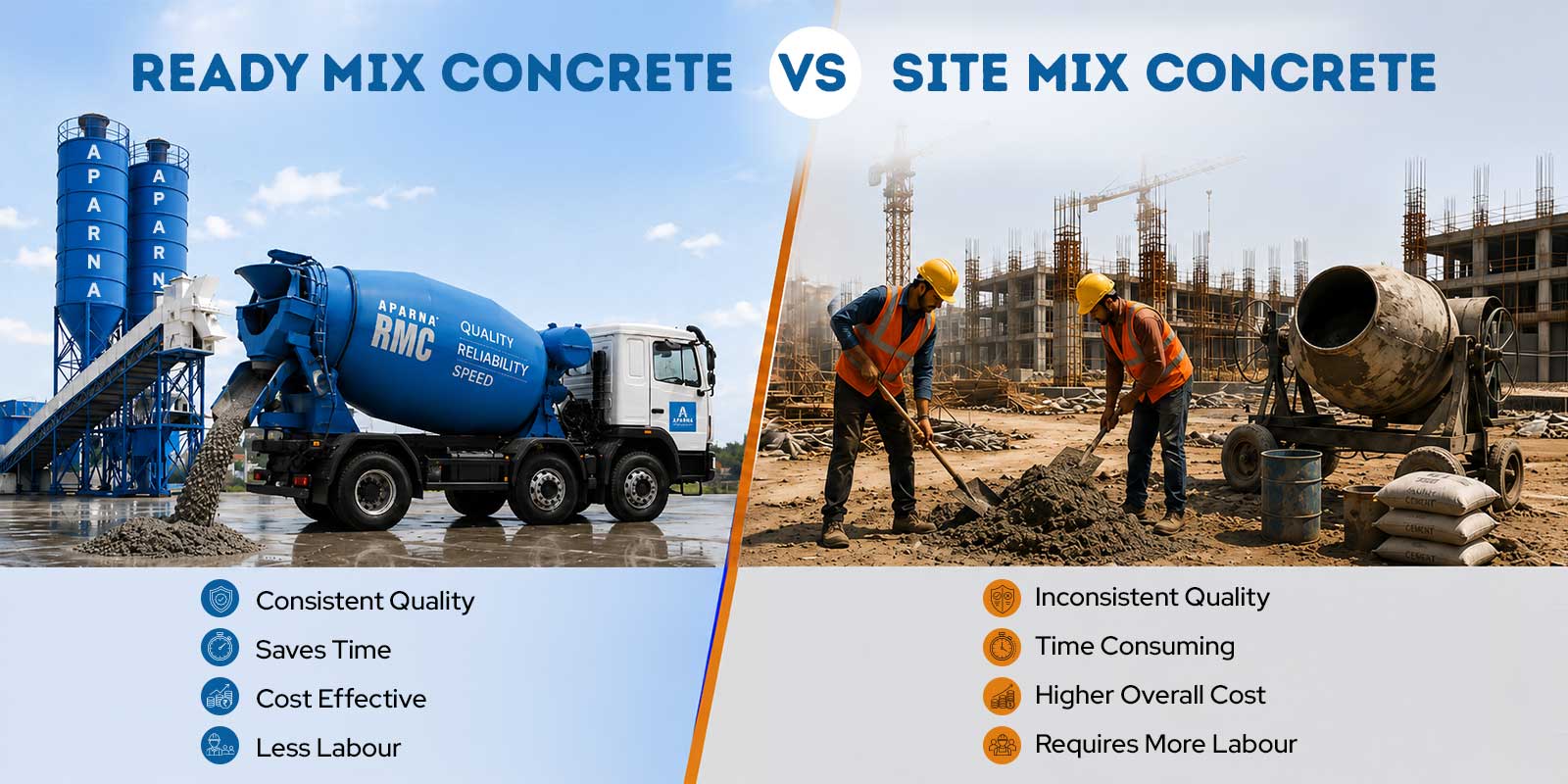
The difference between ready mix concrete and site mix concrete is easiest to see factor by factor. The table below reflects typical Indian site conditions and IS-code requirements.
Factor |
Ready Mix Concrete (RMC) |
Site-Mixed / Manual Concrete |
| Quality consistency | Batched in a SCADA/computer-controlled plant; every load is mix-designed and lab-tested. Batch-to-batch variation is minimal. | Depends on labour skill and on-site supervision. Water-cement ratio drifts by the bucket, so strength varies pour to pour. |
| Governing standard | Produced and supplied under IS 4926:2003 (Reaffirmed 2021); strength assessed against IS 456:2000 (Reaffirmed 2021). | No formal production code on site — quality rests on the engineer’s vigilance, not a certified system. |
| Compressive strength reliability | Target mean strength is designed in; sampling at 1 cube set per 50 m³ (per IS 4926 – Reaffirmed 2021) gives traceable proof. | Cube results are inconsistent; under-strength pours are often discovered only after casting. |
| Speed / pour rate | 30–60+ m³ per hour with transit mixers and pumps. No on-site batching downtime. | A few m³ per hour with a site mixer. Large slabs become multi-day pours. |
| On-site labour & space | Minimal — a small crew to place and compact. No raw-material stockyard needed. | Heavy — separate crews for batching, plus storage for cement, sand and aggregate. |
| Wastage | 2–4% typical; you pay for ordered volume. | Often 8–12% through spillage, over-ordering and rejected batches. |
| Headline cost (per m³) | Higher quoted rate (plant, transport, admixtures included). | Lower quoted rate, but excludes labour, wastage, rework and supervision. |
| True landed cost | Lower for medium-to-large pours once wastage, labour and rework are counted. | Can overtake RMC on large jobs once hidden costs surface. |
| Best-fit project | Slabs, high-rises, rafts, infrastructure, any pour above ~5–8 m³ or with strict quality needs. | Tiny repairs, single-room slabs, and remote sites with no plant within ~90 minutes’ haul. |
Note: Ranges are representative of Indian projects and vary with grade, location, haul distance and contractor practice.
Quality & Consistency: Where the Real Difference Lies
Concrete is only as good as its weakest batch. In a plant, the water-cement ratio — the single biggest driver of strength — is locked by the mix design and monitored digitally. On site, that ratio is the first thing to slip: an extra bucket of water for workability can quietly cut compressive strength by a full grade.
RMC quality is also provable. IS 4926:2003 (Reaffirmed 2021) sets a minimum sampling frequency of one sample for every 50 m³ of production (or every 50 batches), with cube strength assessed against IS 456:2000 (Reaffirmed 2021). That gives you a documented strength trail. Site-mixed concrete is rarely sampled at this discipline, so under-strength pours are often discovered only when a structural test fails — after the slab has set.
Two IS 4926 (Reaffirmed 2021) rules worth knowing as a buyer, because they protect you:
- Discharge window: Concrete should be discharged within 90 minutes of adding water to the mix, or before the drum completes 300 revolutions — whichever comes first. This is why plant-to-site distance matters.
- Slump tolerance: Delivered slump should be within ±25 mm of the ordered slump (for slump ≤ 100 mm). A load outside that band is grounds for rejection — leverage you simply don’t have with a site mixer.
Cost: Why the Cheaper Quote Often Costs More
Site-mixed concrete almost always wins on the quoted rate per cubic metre. But the quote is not the cost. The honest comparison counts everything the two methods actually consume:
Hidden Costs Of Site-mixing
- Wastage of 8–12% from spillage, over-ordering and rejected batches, versus 2–4% with RMC.
- Dedicated batching labour and mixer hire, plus a stockyard for cement and aggregate.
- Rework when a pour fails strength — the most expensive line item of all.
- Slower pours that stretch schedules, raising financing and overhead costs on the whole project.
On small pours, site-mixing can still be cheaper all-in. But as volume rises, RMC’s lower wastage, faster cycle and reduced labour typically make it the lower true landed cost — the number that actually hits your budget.
Time & Speed: Pour Rate Decides Your Schedule
A transit mixer paired with a pump places 30–60 m³ or more per hour. A site mixer manages a fraction of that, turning a large slab into a multi-day pour with cold joints and supervision risk. On schedule-critical work — high-rises, infrastructure, anything with a tight crane or labour window — RMC’s pour rate is often the deciding factor regardless of cost.
When Site-Mixed Concrete Is Actually the Right Choice?
RMC is not automatically correct for every job, and any supplier who tells you otherwise is selling, not advising. Site-mixing is the sensible call when:
- The pour is very small — a single-room slab, a boundary wall footing, a minor repair — where mobilising a transit mixer isn’t economical.
- The site is genuinely remote, with no batching plant within roughly 90 minutes’ haul, making the IS 4926 (Reaffirmed 2021) discharge window impossible to meet.
- Access is so constrained that a transit mixer or pump simply cannot reach the pour point.
For everything else — and certainly for any structural element where strength is non-negotiable — RMC is the lower-risk choice.
How to Decide: A Quick Framework
- Volume: Above ~5–8 m³ in a single pour, RMC usually wins on landed cost and quality.
- Criticality: Structural slabs, columns and rafts demand the consistency only plant-batched concrete reliably gives.
- Haul distance: Confirm a plant can reach you inside the 90-minute / 300-revolution window.
- Site space: No room for a stockyard and mixer? RMC removes the need for both.
- Schedule: If the pour is on the critical path, RMC’s speed protects your timeline.
The Aparna Enterprises Perspective
Aparna Enterprises has spent decades supplying building materials across India’s residential, commercial and infrastructure sectors. That experience shapes how we look at the RMC-versus-site-mix question: not as a fixed rule, but as a match between the method and the demands of each pour. Where consistency, speed and a documented strength trail matter, plant-batched concrete produced under IS 4926 (Reaffirmed 2021) discipline and tested against IS 456:2000 (Reaffirmed 2021) is the lower-risk path.
The right method always depends on the project in front of you. A small or remote pour may be perfectly served by site-mixing. A structural slab, a high-rise or any element where strength is non-negotiable is exactly where ready mix concrete earns its place — protecting your structure for its full design life.
Looking for IS 4926 (Reaffirmed 2021)-compliant ready mix concrete for your project? Contact Aparna Enterprises today to match the right grade and mix to your pour, and get a quote built around your project’s volume, schedule and strength requirements.
Frequently Asked Questions
For most structural and medium-to-large pours in India, yes. RMC delivers consistent, IS 4926 (Reaffirmed 2021)-compliant strength, faster pours and lower wastage. Site-mixed concrete can still be the right choice for very small or remote jobs where mobilising a plant isn’t practical.
Its quoted rate per cubic metre is higher, but its true landed cost is often lower once you count wastage, labour, rework and schedule savings. On larger pours RMC frequently works out cheaper overall.
RMC is batched by weight in an automated plant under IS 4926:2003 (Reaffirmed 2021) and delivered ready to place. Manual (site-mixed) concrete is proportioned and mixed by hand or a small mixer on site, so its quality depends on the crew rather than a certified system.
IS 4926:2003 (Reaffirmed 2021) is the Indian code of practice for RMC. Key buyer-relevant rules: discharge within 90 minutes of adding water (or 300 drum revolutions), delivered slump within ±25 mm of ordered slump for slump up to 100 mm, and sampling at one set per 50 m³.
For a typical residential roof slab, RMC is usually the better choice — the pour is large enough that consistent strength and a single continuous pour outweigh the higher quoted rate. Very small slabs may still suit site-mixing.
Start Your Project with the Right Materials
We provide everything you need for modern construction. Connect with our experts to discuss your requirements and get the best solution for your project. Submit your details and our team will contact you soon.
CORPORATE OFFICE
8-2-293/82/A, Plot No-1214, Road No-60,
Jubilee Hills, Hyderabad-500 033.