
Is a South Facing House Good as per Vastu? Entrance, Layout & Remedies
In This Article
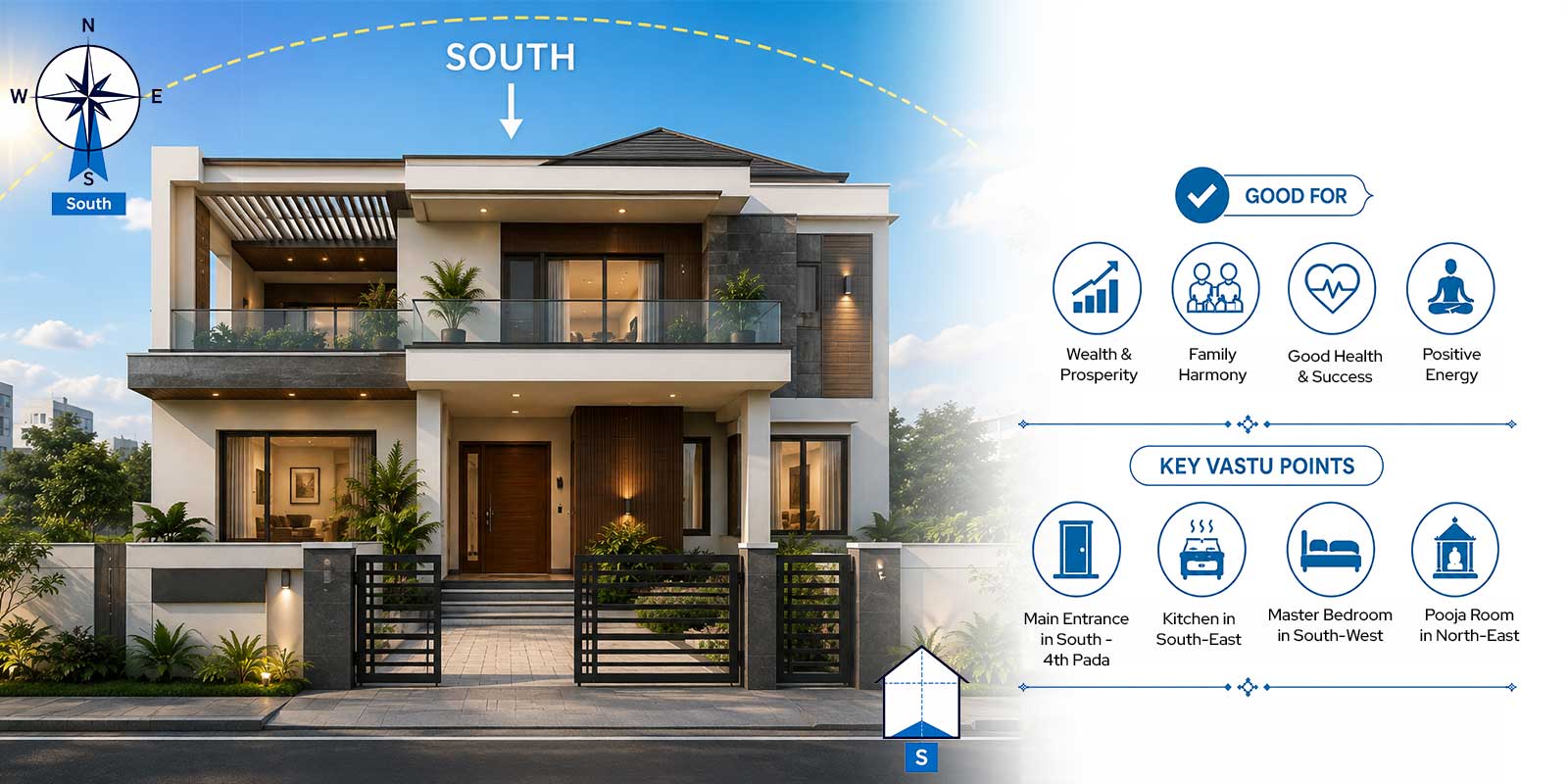
A south facing house is not inauspicious in Vastu Shastra. What matters is where the main door sits. Divide the south wall into nine equal parts starting from the south-east corner and place the entrance in the fourth part — the Gruhakshata pada. Keep the kitchen in the south-east, master bedroom in the south-west, pooja room in the north-east, and the south-west heavy.
Vastu in south facing house planning carries more anxiety than any other orientation in India, and most of that anxiety is inherited rather than earned. Buyers walk away from good properties over it, and resale values genuinely soften because of a belief that no classical Vastu text actually states. This guide separates what Vastu says from what folklore added, gives you the entrance rule as a measurement you can take with a tape, and covers the full layout, the remedies and the climate reality of living behind a south wall in India.
Key Takeaways
- No classical Vastu text declares any facing direction inauspicious. The south’s reputation comes from its association with Yama, not from a rule about houses.
- The entrance decides most of it. The fourth of nine parts of the south wall, measured from the south-east corner, is the recommended position.
- Keep the south and south-west heavy, high and closed; keep the north and north-east light, low and open.
- The south-west corner is for the master bedroom, the south-east for the kitchen, the north-east for the pooja room and water.
- Most correctable problems in a south facing house are entrance-position problems, and most remedies are cheaper than people expect.
What Counts as a South Facing House?
Stand inside your home, walk out through the main door, and note the direction you are facing. If you are facing south, you live in a south facing house. The direction the building looks at from the road is what determines the facing — not the direction the plot is longest in, and not the direction your balcony points.
- South road facing house vastu: If the road runs along the southern edge of your plot, you have a south road facing property, and south facing road vastu rules apply to the approach. The house built on it is normally south facing, though the entrance can still be positioned within the south wall.
- South facing plot, different facing house: A south facing plot does not force a south facing house. On a wide plot the entrance can sometimes be turned to the east while the plot itself fronts south.
- South-east and south-west are separate: If your compass reads between 157.5° and 202.5° you are south facing. Outside that band you are south-east or south-west facing, and the entrance rules are different. Those are covered in their own guides.
South Facing House Vastu Good or Bad? The Direct Answer
Asking whether south facing house vastu is good or bad has one honest answer: neither, by itself. No classical Vastu text — not the Mayamatam, not the Manasara, not the Vishwakarma Prakash — declares any of the four facings inauspicious. What the texts specify is where openings, weights and functions go within the building. A south facing house that follows those rules is considered auspicious; a north facing house that breaks them is not.
Where the fear actually comes from?
Vastu Shastra south facing house guidance never says otherwise. The south is the direction of Yama, the god of death and of dharma, in the dikpala system that assigns a guardian to each direction. Over time, popular usage compressed ‘the direction associated with Yama’ into ‘the direction of death’, and then into ‘a house that faces death’. That is a folk elision, not a Vastu rule. In the same system the south is also governed by Mangal — Mars — and is associated with strength, discipline, authority and endurance, which is why traditional guidance considers it well suited to people in law, medicine, defence, administration and manufacturing.
| What people believe | What Vastu actually holds |
| A south facing house brings misfortune or early death. | No text says this. The south is Yama’s direction; Yama is the lord of dharma and justice as much as of death. |
| South facing houses cause financial loss. | Financial guidance in Vastu attaches to the north (Kubera’s direction) staying open and light, and to water placement — not to the facing. |
| You should avoid buying a south facing property outright. | The texts direct attention to the entrance position, the slope, the weight distribution and the placement of water and fire. Facing is one variable among many. |
| Nothing can be done once the house faces south. | The entrance pada, the boundary wall height, the slope and the internal zoning are all adjustable, and most of them are inexpensive. |
| A south facing house is harder to sell. | This one is true, and it is the only real cost. The belief is widespread enough to affect resale demand in many Indian markets — which also means south facing plots often carry a price advantage when buying. |
Please note: The observation about resale demand describes a widely reported market perception, not a valuation or a forecast. Property prices depend on many factors. This is not property, investment or financial advice — speak to a qualified valuer or property adviser before making a purchase decision.
South Facing House Entrance Vastu and Main Door Vastu: The Nine-Pada Rule
This is the part that decides most of the outcome, and it is the part that almost every general article skips. Main door vastu for south facing house layouts is not ‘somewhere in the south wall’ — Vastu specifies which portion of that wall, and the difference between the right portion and the wrong one is a few feet.
How to find the right position?
- Measure the full south wall. Take the total length of the wall that faces south, corner to corner.
- Divide it into nine equal parts. Each part is a pada — an energy field with its own presiding deity in the Vastu Purusha Mandala.
- Count from the south-east corner. Always start at the south-east end, not the south-west.
- Place the main door in the fourth part. The fourth pada, Gruhakshata, is the most auspicious entrance position for a south facing house. The third, Vitatha, is the accepted second choice.
- Keep the door out of parts five to nine. These run towards the south-west and are the positions traditional guidance advises against, with the Yama and Pitru padas the most firmly discouraged.
Worked Example
- A south wall 30 feet long divides into nine parts of 3 ft 4 in each.
- The fourth pada runs from 10 ft 0 in to 13 ft 4 in, measured from the south-east corner. That 3 ft 4 in strip is where the main door should sit.
- On a 45 ft wall each pada is 5 ft, so the fourth pada runs from 15 ft to 20 ft from the south-east corner.
| Pada | Name | Position from SE corner | Suitability for the main door |
| 1 | Anila | 0 – 1/9 | Avoid |
| 2 | Pusha | 1/9 – 2/9 | Avoid |
| 3 | Vitatha | 2/9 – 3/9 | Favourable — second choice |
| 4 | Gruhakshata | 3/9 – 4/9 | Most auspicious — first choice |
| 5 | Yama | 4/9 – 5/9 | Strongly avoid |
| 6 | Gandharva | 5/9 – 6/9 | Avoid |
| 7 | Bhringaraja | 6/9 – 7/9 | Avoid |
| 8 | Mriga | 7/9 – 8/9 | Avoid |
| 9 | Pitru | 8/9 – 9/9 | Strongly avoid |
Other entrance rules that matter
- The main door should be the largest door in the house, and should open inwards and clockwise.
- Do not place the entrance exactly at the centre of the south wall — the centre falls in the fifth pada, which is the Yama position.
- Avoid an entrance in the south-west corner entirely. This is the one entrance position on which all four competing sources and the classical guidance agree.
- Keep the threshold raised slightly and the approach well lit and free of clutter.
- Avoid a T-junction or a road ending directly at the south entrance.
- Two doors in a straight line from the entrance through the house should be avoided.
Please note: Pada names, counts and boundaries vary between Vastu schools and regional traditions. The nine-part division above is the most widely used method, not a single authoritative standard. On an irregular or non-rectangular plot the divisions should be set out on site by a qualified practitioner rather than scaled off a drawing.
If Your Door Is Already In The Wrong Pada
In a finished house you rarely need to move the structural opening. The usual approach is to shift the effective entry point — repositioning the gate in the boundary wall so the approach path enters through the correct zone, or adding a porch or portico that redirects the walking line. Where nothing structural can change, the standard remedies are listed later in this guide.
South Facing House Vastu Plan: Zone-by-Zone House Plan for South Facing Plots
The organising principle of any house plan for south facing plots — and of south facing house plans per vastu generally — is simple enough to state in one line: keep the south and west heavy, high and closed; keep the north and east light, low and open. Every rule below follows from it. Use this table as the vastu chart for a south facing house — it covers every element of a normal plan.
| Element | Ideal zone | Acceptable alternative | Avoid |
| Main entrance | South wall, 4th pada | 3rd pada | 5th–9th pada; south-west corner |
| Living room | North, north-east | East | South-west |
| Kitchen | South-east | North-west | North-east; south-west |
| Master bedroom | South-west | South, west | North-east |
| Children’s bedroom | West, north-west | East | South-west |
| Guest bedroom | North-west | West | South-west |
| Pooja room | North-east | East, west | South; under a staircase; next to a toilet |
| Dining room | West | East, north | South-west corner |
| Study | North-east, east | North | South-west |
| Staircase | South, south-west, west | North-west | North-east; centre (Brahmasthan) |
| Toilet / bathroom | West-north-west | North-west | North-east; south-east; centre |
| Overhead water tank | South-west, west | South | North-east |
| Underground tank, sump, borewell | North-east, north | East | South; south-west |
| Septic tank | South of south-west, or north-west | West | North-east; south-east; centre |
| Car parking, garage | North-west, north-east | East | South-west; south-east |
| Open space and garden | North, east | South-east | South-west corner |
| Centre of the house (Brahmasthan) | Left open and light | Light furniture only | Staircase, toilet, heavy structure, pillar |
Six principles behind the table
- Weight goes south-west. The heaviest walls, the tallest structure, the storage and the master bedroom belong in the south and south-west. Vastu frames this as stability; structurally it also puts mass on the hottest facades.
- Openness goes north-east. Maximum window area, the lightest construction, the open yard and the water source belong in the north and north-east.
- Fire goes south-east. The kitchen, the gas connection, the electrical panel, the inverter and the geyser.
- Water goes north-east. Sump, borewell and underground storage. Never in the south or south-west.
- The centre stays empty. The Brahmasthan should carry no staircase, no toilet, no heavy column and ideally no wall.
- The ground slopes north-east. The plot level should fall from south-west down towards north-east, and the boundary wall should be higher on the south and west than on the north and east.
Room-by-Room Vastu in South Facing House Interiors
Pooja Room Vastu for South Facing House
Pooja room vastu for south facing house plans puts the room in the north-east, as it does in every other facing. A south facing house vastu plan with pooja room in the north-east is the arrangement most often drawn. Face north or east while praying. Where a dedicated room is not possible, a north-east corner of the living room works. Keep it on the ground floor, keep it out from under a staircase, and never share a wall with a toilet. White, off-white, pale yellow and light blue are the recommended colours.
Kitchen Vastu for South Facing House
Kitchen vastu for south facing house plans places the kitchen in the south-east, the fire zone. Stand facing east while cooking. Keep the sink and the stove apart rather than adjacent — water and fire are opposing elements and Vastu separates them, which also happens to be sound kitchen ergonomics. The north-west is the accepted second position. The north-east and the south-west are both ruled out.
Master Bedroom Vastu for South Facing House
Master bedroom vastu for south facing house plans points to the south-west corner, on the highest floor if there is more than one. This is the zone of stability and it is assigned to the head of the household. Within the room, the bed belongs in the south-west portion with the head pointing south. Children’s rooms go west or north-west, guest rooms north-west. Avoid a bedroom in the north-east, which is meant to stay light and open.
Living Room Vastu for South Facing House
Living room vastu for south facing house plans favours the north and north-east first, east second. Heavy furniture and storage units go against the south and west walls; keep the north and east sides of the room lighter and more open. Mirrors are best placed on a north or east wall.
Staircase Vastu for South Facing House
Staircase vastu for south facing house plans allows the south, south-west or west, rising clockwise. An internal staircase should not sit in the north-east and should never be placed in the Brahmasthan at the centre of the plan. Avoid creating a room, a toilet or a pooja space in the void under the stairs. External staircases follow the same zoning, and spiral staircases are discouraged.
Toilet Vastu for South Facing House (and Bathroom)
Toilet vastu for south facing house plans favours the west-north-west zone, with the north-west as an alternative. Keep toilets out of the north-east, out of the south-east and out of the centre. No water outlet or drainage should discharge on the southern side of the plot.
Utilities, Parking and Outdoor Zones
These are the elements that get decided late in a build and are the hardest to move afterwards, which is exactly why they are worth fixing on the drawing.
- Borewell and sump. North-east or north. Water in the south or south-west is one of the more firmly stated prohibitions in south facing house vastu.
- Overhead tank. South-west or west — the opposite rule to the sump, because the overhead tank is treated as weight rather than water.
- Septic tank. South of south-west, or north-west. Not north-east, not south-east, not the centre.
- Sewage and drainage. Outflow towards the north or east, following the natural slope. Not across the south.
- Car parking and garage. North-west or north-east. Keep the south-west corner free of it, and keep the parking slab lower than the house plinth.
- Garden and open space. North and east. Avoid heavy trees directly in front of the entrance or in the north-east; large trees belong to the south and west where they also shade the hottest walls.
- Boundary wall. Higher and thicker on the south and west, lower on the north and east.
Vastu Remedies for South Facing House
Most articles list vastu remedies for south facing house problems as an undifferentiated jumble. In practice you want to know what to do first and what it costs. These are ordered by effort, not by importance — start at the top and stop when the problem is resolved.
Level |
Remedy |
Addresses |
| Free — do this week | Clear all clutter from the south and south-west zones. Keep the entrance approach swept, lit and unobstructed. Remove any water feature from the south. Move heavy storage into the south-west. | Weight distribution and entrance energy — the two most commonly cited defects |
| Free — do this week | Keep the centre of the house open. Remove furniture, storage or clutter sitting in the Brahmasthan. | Blocked centre |
| Low cost | Fit a bright light at the main entrance and keep it on after dark. Add a raised threshold. Hang a Swastika or Om at the entrance if that fits your practice. | A weak or wrongly positioned entrance |
| Low cost | Vastu colors for south facing house facades run light and warm — cream, light yellow, terracotta, light orange. Avoid black, dark grey and heavy blue on the south wall and main door. | Colour balance for the fire element |
| Low cost | Add a lead or copper strip, or a Vastu pyramid, at the defective zone. Widely used, though this is a practitioner remedy rather than something the classical texts specify. | Zone-specific defects that cannot be structurally fixed |
| Moderate | Reposition the gate in the boundary wall so the approach path enters through the fourth pada, even if the door itself cannot move. Raise the south and west boundary walls. | Wrong entrance pada — the most effective non-structural fix available |
| Moderate | Reassign rooms rather than rebuild. Swap the master bedroom into the south-west and the study or living space into the north-east. | Wrong internal zoning |
| Renovation level | Add a porch or portico that redirects the entry line. Relocate the kitchen to the south-east. Correct the plot slope so it falls towards the north-east. | Entrance position, fire zone and slope defects |
A note on proportion: remedies in Vastu are corrective, not transactional. Be sceptical of anyone selling an expensive proprietary object as the only fix for a structural problem — the adjustments that do most of the work here are clutter, lighting, weight distribution and the approach path, and all of them are close to free.
Please note: Remedies are traditional corrective practices. They are not guaranteed to produce any particular result for health, wealth, relationships or wellbeing. Any remedy involving structural work — moving an opening, altering a wall, changing plot levels — must be assessed by a licensed structural engineer or architect before it is carried out.
Benefits and Challenges of Living in a South Facing House
Benefits |
Challenges |
| Long, consistent daylight through the day, and the most predictable sun path of any orientation — which makes shading easy to design for. | Higher solar heat gain on the south facade through summer, particularly in the afternoon. |
| Traditionally associated with strength, discipline and endurance, and considered well suited to people in law, medicine, defence, administration and manufacturing. | The entrance rule is narrower than for other facings — the correct pada band is only about a ninth of the wall. |
| Often available at a lower price than an equivalent north or east facing property, because of the very belief this guide is correcting. | Resale demand is genuinely softer in many Indian markets, so the discount works against you when you sell. |
| Warm, bright interiors in winter with very little artificial lighting needed. | Requires deliberate attention to the south-west zone, which is easy to get wrong in a small plot. |
The Climate Reality of a South Facing House in India
Vastu tells you to make the south wall thicker and higher and to keep the south zone closed. Building science arrives at a similar instruction from a completely different direction, and it is worth understanding why, because this is the part of south facing house vastu that has measurable consequences for your electricity bill.
- The south facade is the easiest one to shade. Through the hottest part of the day the sun sits high in the southern sky across most of India. That means a simple horizontal projection — a chajja, an overhang, a deep balcony — cuts most of the direct radiation on a south wall. East and west facades get low-angle morning and evening sun that horizontal shading cannot block, which is why west-facing rooms overheat far more than south-facing ones.
- A south facing house is not the hot one. The west facade is. If heat is your real concern, the orientation to be wary of in the Indian climate is west, not south — which is close to the opposite of the popular belief.
- Thermal mass on the south wall works. Vastu’s instruction to build thicker in the south has a genuine thermal effect: a heavier wall lags the heat, so peak indoor temperature arrives later and lower.
- Glazing is where the money is. Once the wall is built, the window is the weak point in the envelope. Sealed, multi-chambered frames and appropriate glass do more for comfort on a south facade than any amount of wall thickness.
None of this replaces Vastu, and it is not offered as proof of it. It is simply that a south facing house planned along Vastu lines — heavy and closed to the south, open to the north and east, shaded at the entrance — also happens to be a well-oriented house for the Indian climate. Where the two frameworks agree, you can act with some confidence.
Please note: This section describes general principles of building orientation and shading. It is not a site-specific thermal or energy assessment. Actual performance depends on your location, plot, construction and materials, and should be evaluated by a qualified architect or building services consultant.
Common Mistakes in South Facing House Vastu and Design
Mistake |
Fix |
| Main door in the centre of the south wall | The centre is the fifth pada, the Yama position. Shift the door to the fourth pada, measured from the south-east corner. |
| Main door in the south-west corner | The most firmly discouraged entrance position. Relocate the door, or redirect the approach through the gate. |
| Sump, borewell or water storage in the south | Move underground water to the north-east. Keep the overhead tank in the south-west. |
| Kitchen in the north-east | Relocate to the south-east. If the kitchen cannot move, keep the cooking position facing east and the north-east corner of the room clear and light. |
| Toilet in the north-east | The single most cited defect in Indian homes. Where relocation is impossible, keep it dry, well ventilated, unused where possible, and the door shut. |
| Master bedroom in the north-east | Swap it with a study, living space or pooja area and move the master bedroom to the south-west. |
| Staircase in the centre or the north-east | Relocate to the south, south-west or west. Keep the Brahmasthan clear. |
| Plot sloping down towards the south or south-west | Correct the levels so the ground falls towards the north-east. Raise the south-west. |
| Heavy trees directly in front of the south entrance | Move planting to the sides or the rear. Keep the entrance approach open. |
| Dark colours on the south facade and main door | Repaint in cream, light yellow, terracotta or light orange. |
Vastu Tips for South Facing House: The Short List
These are the key vastu principles for south facing houses, compressed. Follow them in order and you have done most of what can be done to design a south facing house to attract positive energy.
- Put the main door in the fourth of nine parts of the south wall, counting from the south-east corner. Everything else is secondary to this.
- Never place the entrance in the south-west corner. The one rule every source agrees on.
- Keep the south and west heavy, high and closed. Thicker walls, taller boundary, heavier furniture, storage.
- Keep the north and east light, low and open. Maximum glazing, open yard, lighter construction.
- Kitchen south-east, master bedroom south-west, pooja room north-east. The three placements that carry the most weight after the entrance.
- Water underground in the north-east, water overhead in the south-west. The two rules people most often get backwards.
- Leave the centre of the house open. No staircase, no toilet, no heavy column in the Brahmasthan.
- Slope the ground towards the north-east. And keep the south-west the highest point of the plot.
- Use light, warm colours on the south facade. Vastu colors for south facing house exteriors run to cream, light yellow and terracotta. Avoid black and dark grey.
- Shade the south wall with a horizontal projection. The one intervention that pays for itself in comfort and running cost.
South Facing House Vastu Checklist
- The main door sits in the fourth pada of the south wall, measured from the south-east corner.
- The entrance is not at the centre of the south wall and not in the south-west corner.
- The main door is the largest in the house and opens inwards, clockwise.
- The kitchen is in the south-east, with the cooking position facing east.
- The master bedroom is in the south-west, on the top floor if there is more than one.
- The pooja room is in the north-east, not under a staircase and not against a toilet wall.
- The living room is in the north or north-east.
- The staircase is in the south, south-west or west, and rises clockwise.
- Toilets are out of the north-east, the south-east and the centre.
- The sump and borewell are in the north-east; the overhead tank is in the south-west.
- The septic tank is south of south-west or north-west.
- The centre of the plan is open — no staircase, toilet, column or heavy structure.
- The plot slopes down towards the north-east, and the south-west is the highest point.
- The boundary wall is higher on the south and west than on the north and east.
- The south facade is shaded by an overhang or chajja.
- The south and south-west zones are free of clutter and free of water features.
Getting a South Facing House Right at Design Stage
Almost everything in this guide is cheap on a drawing and expensive once concrete has been poured. If you are building rather than buying, these are the decisions to settle before the plan is frozen.
- Set the entrance pada first: Mark the nine divisions on the south elevation before the internal layout is drawn, not after. Every other room position flows from where the door lands.
- Fix the slope and plinth levels early: Correcting a plot that falls the wrong way is earthwork, and earthwork is the one thing you cannot retrofit cheaply.
- Plan the south facade for shade: A chajja depth decided at design stage costs almost nothing and works for the life of the building.
- Size the north and east glazing generously: This is where Vastu’s ‘open to the north-east’ and good daylight design agree completely.
- Locate the sump and septic tank on the drawing: These are the two elements most often placed by the contractor on site, in the wrong zone, because nobody marked them.
- Decide the kitchen and utility zone with the plumbing layout: A south-east kitchen affects gas, drainage and electrical routing.
- Choose flooring for a bright, warm house: Light, low-glare surfaces suit south-facing interiors that receive strong daylight.
Summary
South facing house vastu comes down to one decision made well and a handful made sensibly. Put the main door in the fourth of nine parts of the south wall, counting from the south-east corner, and keep it out of the centre and out of the south-west. Then keep the south and west heavy and closed, the north and east light and open, the kitchen south-east, the bedroom south-west, the pooja room north-east and the centre of the house empty. The south’s reputation is inherited, not textual — and a south facing house planned this way is a well-oriented house by the standards of both Vastu and the Indian climate.
References
https://www.wisdomlib.org/definition/vitatha
Frequently Asked Questions
Neither by itself. No classical Vastu text declares any facing inauspicious. What determines whether a south facing house is auspicious is the position of the main entrance, the internal zoning, the slope and the placement of water and fire.
Yes, provided the entrance and internal zoning follow the rules. No classical Vastu text declares the south facing inauspicious. The entrance pada, the slope, the weight distribution and the placement of water and fire are what decide the outcome.
Traditional guidance considers the south particularly well suited to people in law, medicine, defence, administration, manufacturing and public-facing professions, because the direction is governed by Mangal and associated with strength and discipline. It is not considered unsuitable for anyone.
Divide the south wall into nine equal parts starting from the south-east corner and place the main door in the fourth part — the Gruhakshata pada. The third part, Vitatha, is the accepted second choice.
Not the centre, not the south-west corner. Roughly a third to four-ninths of the way along the south wall, measured from the south-east end.
Padas five to nine, counting from the south-east corner. The Yama pada (fifth, which falls at the centre of the wall) and the Pitru pada (ninth, at the south-west end) are the two most firmly discouraged.
A south face building plan keeps the south and west heavy, high and closed, and the north and east light, low and open. Entrance in the fourth pada of the south wall, kitchen south-east, master bedroom south-west, pooja room north-east, staircase south or west, centre left open.
Yes. A vastu shastra plan for south facing house designs follows the zone table in this guide. Plot-size specific drawings — 30×40, 20×30 and so on — are a separate exercise, because the same zoning has to be fitted to different plot proportions.
Entrance in the fourth pada of the south wall, kitchen in the south-east, master bedroom in the south-west, pooja room in the north-east, living room in the north, staircase in the south or west, and the centre of the plan left open.
The north-east, facing north or east while praying. Keep it on the ground floor, out from under a staircase, and not sharing a wall with a toilet.
The south-east, which is the fire zone, with the cooking position facing east. The north-west is the accepted alternative. Avoid the north-east and the south-west.
The south-west corner, on the highest floor if the house has more than one. Within the room, place the bed in the south-west portion with the head pointing south.
South, south-west or west, rising clockwise. Keep it out of the north-east and never place it in the Brahmasthan at the centre of the plan.
The west-north-west zone, with the north-west as an alternative. Avoid the north-east, the south-east and the centre.
The north-east or north. Underground water in the south or south-west is one of the more firmly stated prohibitions. The overhead tank follows the opposite rule and belongs in the south-west.
Start with the free ones: clear the south and south-west of clutter, light the entrance, remove water features from the south, move heavy storage to the south-west. If the entrance pada is wrong, repositioning the boundary gate so the approach path enters through the correct zone is the most effective non-structural fix.
Identify which defect you actually have before applying remedies. Most south facing problems trace to entrance position, water in the south, a blocked centre or a toilet in the north-east. Each has a specific fix, and the cheap ones should be exhausted before any structural work.
Light, warm tones on the south facade — cream, light yellow, terracotta, light orange. Avoid black, dark grey and heavy blue on the south wall and the main door.
No. They are different facings with different entrance rules, and treating them as one is a common error in published guides. If your compass reads between 157.5° and 202.5° you are south facing; outside that band you are south-east or south-west facing.
The south facade receives more direct sun than the north, but it is also the easiest facade to shade because the midday sun is high. In the Indian climate the orientation that overheats most is west, not south.
Long, consistent daylight; a predictable sun path that makes shading simple to design; warm bright interiors in winter; and often a lower purchase price than an equivalent north or east facing property.
In many Indian markets, yes — the belief is widespread enough to soften resale demand. That is the one genuine cost of a south facing property, and it is the flip side of the price advantage when buying.
Not for the general rules in this guide. A consultant is worth it when you are fixing an existing house with several interacting defects, or when you need the pada divisions marked precisely on a site with an irregular plot boundary.
Start Your Project with the Right Materials
We provide everything you need for modern construction. Connect with our experts to discuss your requirements and get the best solution for your project. Submit your details and our team will contact you soon.
CORPORATE OFFICE
8-2-293/82/A, Plot No-1214, Road No-60,
Jubilee Hills, Hyderabad-500 033.