
uPVC Full Form: What Is uPVC? Meaning, Composition and Properties
In This Article
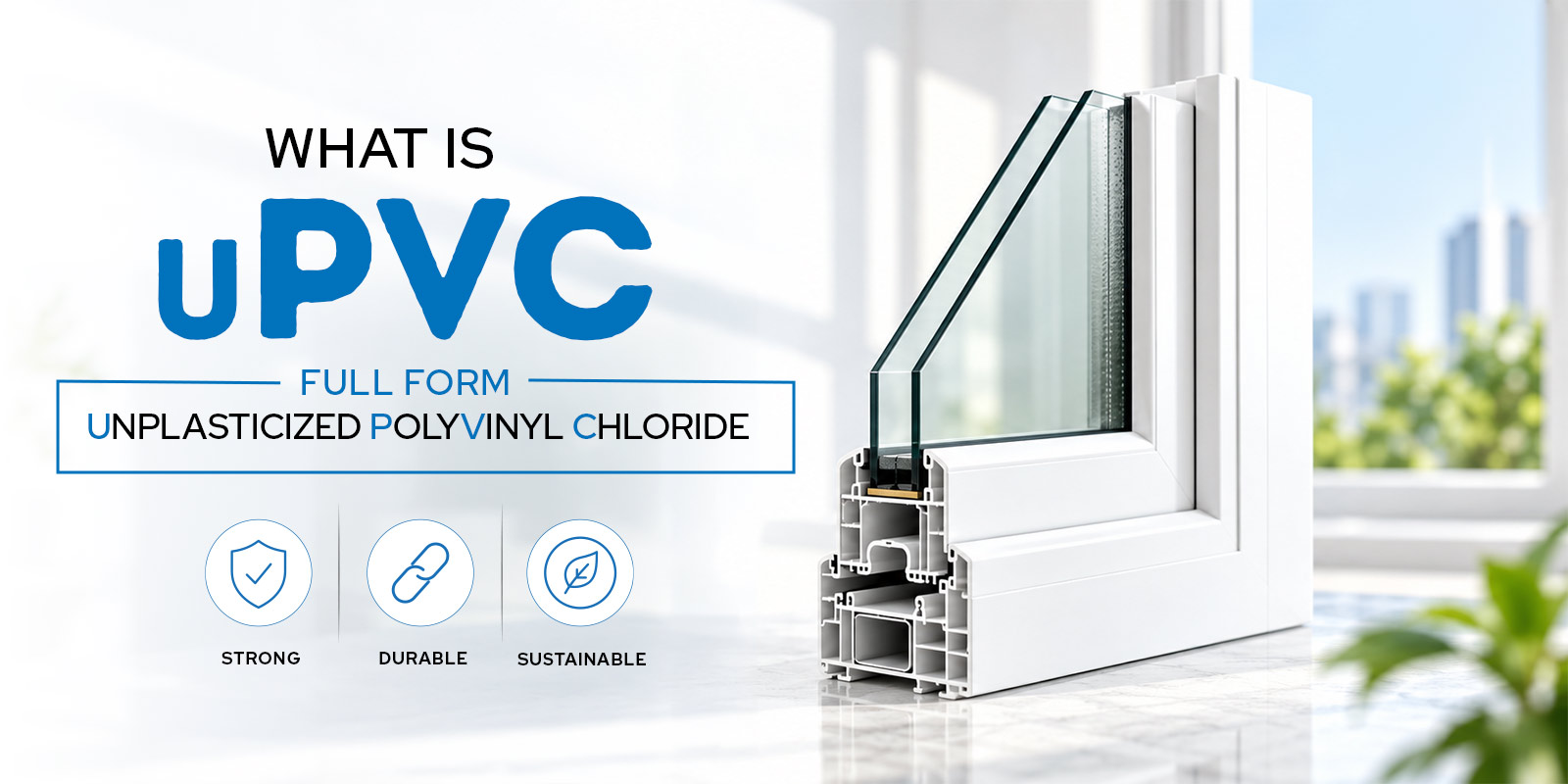
uPVC stands for unplasticised polyvinyl chloride. uPVC is a rigid form of PVC made without plasticisers, so it remains hard and stable. It is commonly used to make window and door frames. Unlike uPVC, PVC is soft and flexible because it contains plasticisers or softening agents.
| Full form | Unplasticised polyvinyl chloride |
| Also written | uPVC, UPVC, PVC-U, PVCu, rigid PVC, unplasticized polyvinyl chloride (US) |
| Material class | Rigid thermoplastic |
| Base polymer | Polyvinyl chloride (C₂H₃Cl) |
| Key distinction | Contains no plasticisers |
| Indian standard (windows/doors) | IS 17953:2023 |
This guide discusses what uPVC is, what it is made of, its full form, comparison with other materials, properties, and others.
What Is The Full Form Of uPVC?
The abbreviation of uPVC is unplasticised polyvinyl chloride. The ‘u’ stands for unplasticised, which means the material is made without plasticisers. PVC stands for polyvinyl chloride, the base polymer.
u — unplasticised (no plasticiser additives)
P — poly (many repeating units)
V — vinyl (from vinyl chloride, the monomer)
C — chloride
uPVC’s full form is the same in every context. uPVC pipe, uPVC windows and uPVC sheet all refer to the same base material — unplasticised polyvinyl chloride — formulated differently for each application.
What Is uPVC?
uPVC is a rigid thermoplastic made from polyvinyl chloride resin. It is combined with stabilisers, processing aids and fillers, but does not contain plasticisers.
The absence of plasticisers keeps uPVC stiff and helps it maintain its shape. It also gives the material good resistance to weather, chemicals, and moisture.
In construction, uPVC is extruded into hollow, multi-chamber profiles. These profiles are commonly used for window and door frames.
uPVC is a compound, not a single substance. It is made using a specific formulation, so two uPVC profiles from different manufacturers may perform differently depending on the materials used in the mix.
uPVC softens when heated and hardens when cooled, so it can be reshaped over and over again. This property allows uPVC profiles to be heat-welded at the corners to make frames. It also makes the material suitable for reprocessing at the end of its life.
uPVC is not a coating or surface finish; it is a solid material throughout the profile. It also has low thermal conductivity, which helps the frame provide better insulation.
A material is uPVC if it:
- is based on polyvinyl chloride resin
- contains no plasticisers
- remains rigid at normal service temperatures
- is supplied as a compounded, extruded, or moulded rigid product
What is uPVC Made Of? Composition of a uPVC Compound
uPVC is made from polyvinyl chloride resin combined with different additives. These include heat stabilisers, impact modifiers, processing aids, lubricants, pigments and fillers.
PVC resin makes up most of the uPVC compound by weight. Each additive has a specific purpose. They help improve heat stability during extrusion, impact strength, colour, and resistance to ultraviolet (UV) light.
Component |
Role |
Why is it used |
| PVC resin | Base material | Gives uPVC its rigid structure |
| Heat stabiliser | Protects against heat | Prevents damage during extrusion |
| Impact modifier | Improves strength | Helps prevent cracking from impact |
| Titanium dioxide (TiO₂) | Pigment and UV protection | Improves colour and weather resistance |
| Calcium carbonate | Filler | Adds stiffness and helps control cost |
| Processing aids / lubricants | Improve processing | Helps with smooth and stable extrusion |
| Plasticiser | Not used | Keeps uPVC rigid and stable |
The exact amount of each component in uPVC varies by manufacturer and application, such as window and door profiles or others. Manufacturers generally do not publish these formulations because they are proprietary. For exact composition, refer to the product’s relevant standard, such as IS 17953:2023 for uPVC window and door profiles.
The vinyl chloride repeat unit, C₂H₃Cl, has a molar mass of about 62.5 g/mol. Chlorine makes up roughly 57% of this mass. This relatively high chlorine content contributes to uPVC’s resistance to ignition and its tendency to self-extinguish after the external ignition source is removed.
Why Unplasticised Matters: What Plasticisers Actually Do
Plasticisers are additives that make PVC soft and flexible. They work by creating space between the long PVC polymer chains, which allows them to move more easily.
uPVC does not contain plasticisers. Without them, the polymer chains remain tightly packed. This keeps uPVC hard and dimensionally stable.
In flexible PVC products, plasticisers can slowly move to the surface and leave the material over time. This may cause products such as cable insulation, hoses, and some flooring to become harder and more brittle as they age.
uPVC does not have this issue because there are no plasticisers to migrate out. This is one reason uPVC is commonly used for long-lasting building components such as window and door frames, while flexible PVC is used where flexibility is needed.
Feature |
Flexible PVC |
uPVC |
| Plasticisers | Present | None |
| At room temperature | Soft and flexible | Hard and rigid |
| Common uses | Cable insulation, flooring, hoses, inflatables | Window and door profiles, pipes, cladding |
| Ageing | Can harden as plasticisers migrate out | No plasticiser migration |
| Structural framing | Not suitable | Suitable |
uPVC vs PVC vs CPVC vs PVC-U: What are these names
PVC is the general name for polyvinyl chloride. It can be made either flexible or rigid, depending on the formulation.
uPVC is the rigid form of PVC made without plasticisers. PVC-U and PVCu refer to the same material and are commonly used in European standards.
CPVC stands for chlorinated polyvinyl chloride. It is PVC that has undergone additional chlorination, which gives it higher heat resistance than uPVC.
Term |
Full Form |
What It Means |
Common Usage |
| PVC | Polyvinyl chloride | General PVC family, including flexible and rigid types | General use |
| uPVC / UPVC | Unplasticised polyvinyl chloride | Rigid PVC without plasticisers | India, UK, Middle East |
| PVC-U | Unplasticised polyvinyl chloride | Same material as uPVC; standards-based name | EN and ISO standards |
| PVCu | Unplasticised polyvinyl chloride | Same material as uPVC; common UK term | UK fenestration industry |
| Rigid PVC | — | Another name for rigid, unplasticised PVC | US usage and ASTM standards |
| CPVC | Chlorinated polyvinyl chloride | PVC with additional chlorine for higher heat resistance | Hot-water and industrial pipes |
Properties of uPVC
uPVC offers high resistance to moisture, salt air, and most common chemicals, and no susceptibility to rust, rot, or termite attack. uPVC is electrically insulating and generally resists ignition. It can also self-extinguish once the external ignition source is removed. Its fire behaviour is influenced partly by its chlorine content and should be assessed using the applicable fire classification standard.
Property |
Typical Value |
Test Method / Standard |
Why It Matters |
| Density | Manufacturer’s TDS / IS 17953:2023 | ISO 1183 | Affects profile weight and handling |
| Vicat softening temperature | Manufacturer’s TDS / IS 17953:2023 | ISO 306 | Indicates the temperature limit for service |
| Impact strength | Manufacturer’s TDS | ISO 179 / ISO 180 | Shows resistance to impact and cracking |
| Thermal expansion | Manufacturer’s TDS | ISO 11359 | Helps determine expansion gaps and fixing requirements |
| Thermal conductivity | Manufacturer’s TDS | ISO 8301 / ISO 8302 | Indicates the frame’s insulation performance |
| Water absorption | Manufacturer’s TDS | ISO 62 | Indicates resistance to moisture-related changes |
| Weathering / colour retention | Accelerated weathering test | ISO 4892 / EN 513 | Helps assess long-term colour and weather resistance |
| Reaction to fire | Self-extinguishing | Applicable fire classification standard | Indicates how the material behaves after the ignition source is removed |
uPVC Compared With Other Framing Materials
uPVC has lower thermal conductivity, which helps reduce heat transfer. It does not corrode or rot, so it does not require protective coatings.
Compared with wood, it is more stable in changing humidity but expands and contracts more with temperature changes.
Material |
Corrosion / Rot |
Thermal Conductivity |
Protective Coating |
| uPVC | Does not corrode or rot | Low | Not required |
| Timber | Can rot and attract termites | Low | Paint or sealant |
| WPC (Wood Plastic Composite) | Resists rot | Low | Generally not required |
Standards That Define uPVC
uPVC used in windows and doors is governed by published specifications rather than manufacturer claims.
In India, IS 17953:2023 specifies requirements for uPVC profiles for windows and doors.
In Europe, EN 12608 classifies PVC-U profiles for the same purpose.
ASTM D1784 provides the cell-classification system for rigid PVC compounds.
Standard |
Issuing Body |
Scope |
| IS 17953:2023 | Bureau of Indian Standards | Specification for uPVC profiles used in windows and doors |
| BS EN 12608-1:2016+A1:2020 | BSI / CEN | Classification, requirements, and test methods for non-coated PVC-U profiles |
| ASTM D1784 | ASTM International | Classification of rigid PVC and CPVC compounds |
| ISO 1043-1 | ISO | Symbols and abbreviated terms for plastics, including PVC-U |
When specifying uPVC profiles in India, ask the supplier for documentation of conformance to IS 17953:2023 and for the test certificates behind it. A profile that cannot produce them has not been independently verified against any requirement.
Is uPVC Safe and Recyclable?
uPVC is chemically stable during normal use. It does not release gases at normal service temperatures and does not provide a food source for mould or insects. As a thermoplastic, it can also be reground and reprocessed.
The safety of uPVC depends partly on the stabilisers used in its formulation. Some older formulations used lead-based stabilisers, while many manufacturers now use calcium–zinc systems. The stabiliser system can vary, so check the manufacturer’s technical data sheet.
uPVC is recyclable in principle, but collection and recycling of used building profiles can be limited in India. Its fire behaviour is also influenced by its chlorine content. It generally does not easily sustain combustion and can self-extinguish after the ignition source is removed. For specific projects, refer to the applicable fire classification.
uPVC Full Form in Indian Languages
The full form of uPVC is the same in every language: unplasticised polyvinyl chloride. Here is how it is transliterated in other languages.
Language |
uPVC full form |
| Hindi | अनप्लास्टिसाइज़्ड पॉलीविनाइल क्लोराइड (uPVC — यूपीवीसी) |
| Tamil | அன்பிளாஸ்டிசைஸ்டு பாலிவினைல் குளோரைடு (uPVC) |
| Telugu | అన్ప్లాస్టిసైజ్డ్ పాలీవినైల్ క్లోరైడ్ (uPVC) |
| Bengali | আনপ্লাস্টিসাইজড পলিভিনাইল ক্লোরাইড (uPVC) |
| Marathi | अनप्लास्टिसाइज्ड पॉलिव्हिनाइल क्लोराइड (uPVC) |
| Kannada | ಅನ್ಪ್ಲಾಸ್ಟಿಸೈಸ್ಡ್ ಪಾಲಿವಿನೈಲ್ ಕ್ಲೋರೈಡ್ (uPVC) |
| Malayalam | അൺപ്ലാസ്റ്റിസൈസ്ഡ് പോളിവിനൈൽ ക്ലോറൈഡ് (uPVC) |
Where uPVC Is Used?
uPVC is used where a rigid, weather-resistant, and low-maintenance material is needed. It is commonly used in construction for windows, doors, pipes, cladding, electrical conduit, roofing sheets, and fencing.
- Windows and doors — A major construction application, especially for frames.
- Pipes and plumbing — Used for water supply and drainage systems.
- Cladding and sheets — Used for wall cladding and roofing applications.
- Electrical conduit — Used for rigid, electrically insulating conduits.
- Fencing — Used for durable, weather-resistant outdoor fencing.
Aparna Enterprises manufactures 100 per cent lead-free uPVC window and door profiles using German machinery to ensure precision. If you are looking for a uPVC profiles manufacturer or a fabricator, get in touch with Aparna Enterprises to explore our RoHS-certified uPVC profile range.
Disclaimer: This information is for general knowledge only. Product specifications and performance can vary by manufacturer and formulation. Always refer to the relevant product documentation and applicable standards before making material or product decisions.
Frequently Asked Questions
uPVC stands for unplasticised polyvinyl chloride. It is a rigid form of PVC that does not contain plasticisers.
The ‘u’ stands for unplasticised. This means plasticisers are not added to the material. Without plasticisers, uPVC remains hard, rigid and dimensionally stable.
Not exactly. PVC is the general name for polyvinyl chloride and can be either flexible or rigid. uPVC is the rigid, unplasticised form of PVC. Flexible PVC contains plasticisers that make it softer and more flexible.
Yes. uPVC, PVC-U , and PVCu refer to the same basic material. The difference is mainly in the naming convention used by different standards and markets. PVC-U is commonly used in European standards, while PVCu is also common in the UK fenestration industry.
Yes. uPVC is a rigid thermoplastic based on polyvinyl chloride resin. It can be shaped using heat during manufacturing and becomes rigid again when cooled.
uPVC is mainly made from PVC resin along with additives such as heat stabilisers, impact modifiers, processing aids, pigments and fillers. Plasticisers are not added because they would make the material softer and more flexible.
Both are based on PVC, but they are made differently. CPVC is PVC that has undergone additional chlorination. This gives CPVC higher heat resistance than uPVC, which is why CPVC is commonly used for hot-water plumbing and other higher-temperature applications.
uPVC is highly resistant to water and moisture and has very low water absorption. It does not rust or rot, which makes it suitable for windows, doors, pipes, and other applications exposed to moisture. However, the overall water resistance of a window or door also depends on its design, joints, seals, and installation.
Yes. uPVC is a thermoplastic, so it can be mechanically recycled by grinding and reprocessing the material. However, this does not mean every old uPVC product will automatically be recycled. Collection and recycling infrastructure for used building profiles can still be limited in some markets, including India.
IS 17953:2023 is the relevant Indian standard for uPVC profiles used in windows and doors. It sets requirements for these profiles and provides a reference for manufacturers and buyers when assessing product quality and performance.
Start Your Project with the Right Materials
We provide everything you need for modern construction. Connect with our experts to discuss your requirements and get the best solution for your project. Submit your details and our team will contact you soon.
CORPORATE OFFICE
8-2-293/82/A, Plot No-1214, Road No-60,
Jubilee Hills, Hyderabad-500 033.