Types of Ready Mix Concrete: Categories, Properties & Their Uses Explained
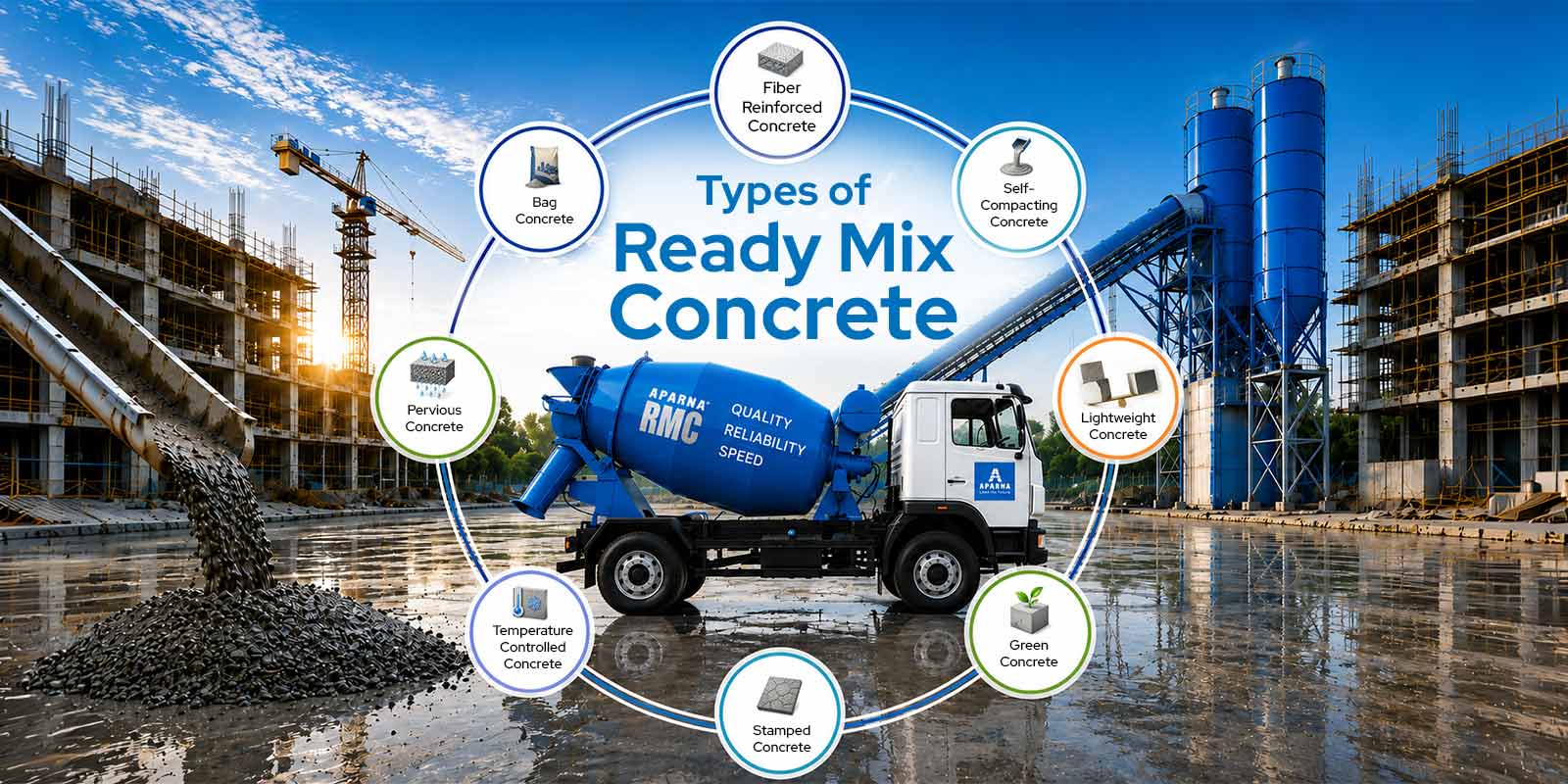
Ready mix concrete (RMC) is concrete that is batched and mixed at a central plant to a specified mix design, then delivered to the site ready to pour. The different types of ready mix concrete fall into three broad groups: by mixing method (transit, central, and shrink mixed), by mix design (nominal mix and design mix), and by application — such as self-compacting, fiber-reinforced, lightweight, temperature-control, green, decorative, and porous concrete.
Choosing the right type is what determines whether a structure is strong, durable, and built on schedule. This guide explains every major type of RMC, how it is classified, and where each one is used, so you can match the mix to your project with confidence.
Types of Ready Mix Concrete at a Glance
Classification basis |
Types |
| Mixing method | Transit-mixed, Central-mixed, Shrink-mixed |
| Mix design | Nominal mix, Design mix |
| Application | High-strength, Self-compacting, Smart dynamic, Fiber-reinforced (PP, steel, glass), Lightweight, Temperature-control, Green, Coloured, Stamped, Porous |
What Is Ready Mix Concrete?
Ready mix concrete is concrete manufactured in a batching plant according to a set recipe, then transported to the construction site in a transit mixer. Unlike concrete mixed by hand on site, RMC is produced under controlled, laboratory-tested conditions, which gives it consistent strength, lower material wastage, and faster placement.
Because the proportions of cement, aggregates, water, and admixtures are measured precisely, RMC removes much of the guesswork and quality variation that comes with site mixing. In India, this controlled, specification-driven production is exactly what established suppliers such as Aparna Enterprises, are built around.
Types of Ready Mix Concrete by Mixing Method
The most fundamental way to classify RMC is by where the mixing actually happens. There are three types.
-
Transit-Mixed (Truck-Mixed) Concrete
In transit-mixed concrete, the dry or partially combined materials are loaded into the truck’s drum at the plant, and full mixing takes place inside the rotating drum on the way to the site. This delays the mixing action, which makes it well suited to longer delivery distances. The drum can be set to mix during transit or only on arrival, giving the supplier control over when the concrete reaches its workable state.
-
Central-Mixed (Plant-Mixed) Concrete
Central-mixed concrete is completely mixed in a stationary mixer at the plant before being loaded into the truck, which then acts mainly as an agitator to keep the mix uniform during transport. Because mixing is finished before the concrete leaves the plant, this method delivers the most consistent quality and allows faster discharge at the site. It is the preferred choice for high-volume pours and projects with demanding strength requirements.
-
Shrink-Mixed Concrete
Shrink-mixed concrete is partially mixed at the plant and then finished inside the truck drum during transit. The name comes from the way the concrete “shrinks,” or reduces in volume, once mixing is complete. This hybrid approach balances plant control with transport flexibility and is often used for medium delivery distances.
| Type | Where mixing happens | Best suited for | Consistency |
| Transit-mixed | In the drum, in transit | Longer hauls | Good |
| Central-mixed | Fully at the plant | High-volume, high-strength pours | Highest |
| Shrink-mixed | Partly at plant, finished in transit | Medium distances | Good |
Types Based on Mix Design
RMC is also classified by how its proportions are decided.
-
Nominal Mix
A nominal mix uses fixed, standard proportions of cement, sand, and aggregate (for example, the familiar 1:2:4 ratio). It is simple to specify and is generally used for small-scale or non-critical work where high precision is not essential.
-
Design Mix
A design mix is engineered in a laboratory to achieve a specified target strength using calculated proportions and a controlled water-cement ratio. Because it is tailored to performance rather than a fixed recipe, the design mix is the standard for structural and large-scale construction, and it is the basis of almost all professionally supplied ready mix concrete.
Different Types of Ready Mix Concrete by Application
Beyond mixing and design, the most practical way to understand the different types of ready mix concrete is by what each one is engineered to do. The following are the application-based types you will encounter most often.
-
High-Strength Concrete
High-strength (or high-grade) concrete is engineered for exceptional compressive strength, typically at the upper grades. It is used for columns, transfer slabs, and load-bearing elements in high-rise towers, bridges, and heavy commercial structures where ordinary concrete would not carry the loads.
-
Self-Compacting Concrete (SCC)
Self-compacting concrete is a highly flowable mix that spreads and consolidates under its own weight, with no need for mechanical vibration. This makes it ideal for densely reinforced sections and complex formwork where vibrating a stiff mix would be difficult or impossible.
-
Smart Dynamic Concrete
Smart dynamic concrete is a high-flow mix designed to move easily into intricate shapes and detailed formwork. It shares much of the self-levelling behaviour of SCC and is chosen where complex geometry demands a mix that fills every corner cleanly.
-
Polypropylene Fiber-Reinforced Concrete
Polypropylene fiber-reinforced concrete uses synthetic polypropylene fibers distributed through the mix to resist shrinkage cracking and add flexibility. It performs well in slabs, pavements, and other high-stress flatwork.
-
Steel Fiber-Reinforced Concrete
Steel fiber-reinforced concrete incorporates steel fibers for high toughness and impact resistance. It is favoured for heavy-duty industrial floors, pavements, and areas subject to repeated loading.
-
Glass Fiber-Reinforced Concrete (GFRC)
Glass fiber-reinforced concrete combines strength with design flexibility, making it a popular choice for thin architectural elements, cladding, and facades.
-
Lightweight Concrete
Lightweight concrete uses lower-density aggregates to reduce the overall dead load of a structure while improving thermal insulation. It is valuable in high-rise construction and any application where reducing structural weight matters.
-
Temperature-Control (Mass) Concrete
Temperature-control concrete, also called mass concrete, is formulated with additives that limit the heat generated as concrete cures, reducing the risk of thermal cracking. It is essential for large pours such as raft foundations, thick slabs, and dam-type structures.
-
Green Concrete
Green concrete replaces a portion of cement with supplementary materials such as fly ash, GGBS, or recycled content. This lowers the carbon footprint of the mix and can improve long-term durability, making it the go-to option for projects with sustainability targets.
-
Coloured Concrete
Coloured concrete uses integral pigments to produce concrete in a range of shades, adding aesthetic value to architectural and landscaping work without the need for a separate finish.
-
Stamped Concrete
Stamped concrete is textured while still workable to mimic materials like natural stone, brick, or tile. It is widely used for patios, driveways, and walkways where appearance matters as much as durability.
-
Porous (Pervious) Concrete
Porous concrete, also known as pervious concrete, is engineered with interconnected voids that allow water to drain straight through it. This makes it useful for stormwater management, reducing surface runoff in pavements, parking areas, and green infrastructure.
-
Specialised Formats: Slab and Bag Concrete
A few RMC types are defined more by their delivery format than their composition. Slab concrete tailored for individual house builders packages a dependable structural mix for residential roofs and floors, while bagged concrete offers a convenient option for small jobs such as column starters and minor repairs.
Between them, these application types cover virtually every construction need — and most are supplied as engineered, project-specific mixes by RMC producers such as Aparna Enterprises.
Types vs. Grades: What’s the Difference?
These two terms are often confused, but they describe different things. A type of ready mix concrete tells you what kind of concrete it is and how it behaves — for example, self-compacting, lightweight, or fiber-reinforced. A grade tells you its compressive strength, expressed as M-numbers such as M20 or M30, where the number is the characteristic strength in megapascals at 28 days.
In practice you select both: the type that suits the application and the grade that meets the structural load.
Grade |
Typical use |
| M10 | Levelling course, plain cement concrete (PCC) |
| M15 | Flooring, pathways, non-structural work |
| M20 | Residential slabs, footings, beams |
| M25 | Reinforced columns, slabs, general structural work |
| M30–M40+ | High-rise, bridges, and heavy industrial structures |
For a complete breakdown of strengths, mix ratios, and where each grade is used, see our dedicated guide on ready mix concrete grades.
How to Choose the Right Type of Ready Mix Concrete
The right type of RMC depends on a few key factors working together:
- Structural requirement — the load the element must carry decides both the grade and whether you need a high-strength or fiber-reinforced mix.
- Placement conditions — congested reinforcement or complex formwork point towards self-compacting or smart dynamic concrete.
- Distance and timing — longer hauls favour transit-mixed delivery, while large pours benefit from temperature-control mixes.
- Finish and aesthetics — exposed surfaces may call for coloured or stamped concrete.
- Sustainability goals — projects targeting a lower carbon footprint should consider green concrete.
If you are unsure which combination of type and grade your project needs, Aparna Enterprises technical team can help you specify the right mix for the job — request a consultation.
Key Takeaways
- Ready mix concrete is classified three ways: by mixing method, by mix design, and by application.
- Transit, central, and shrink mixing differ mainly in where the concrete is mixed.
- Design mix is the standard for structural work; nominal mix suits minor, non-critical jobs.
- Application types — SCC, fiber-reinforced, lightweight, temperature-control, green, decorative, and porous concrete — are chosen by performance need.
- Type and grade are separate choices: match the type to the application and the grade to the structural load.
From high-strength and fiber-reinforced mixes to green and decorative concrete, Aparna Enterprises delivers consistent, lab-tested ready mix concrete on schedule across India. Talk to our team to find the right mix for your next project.
Frequently Asked Questions
The main types are classified three ways: by mixing method (transit, central, and shrink mixed), by mix design (nominal and design mix), and by application (such as self-compacting, fiber-reinforced, lightweight, green, and porous concrete).
RMC is produced at a batching plant under controlled, laboratory-tested conditions and delivered ready to pour, giving consistent quality and less wastage. Site-mixed concrete is mixed manually at the construction site, which makes its strength and consistency harder to control.
A design-mix concrete of an appropriate grade — commonly M20 to M25 for residential slabs and footings — is typically used, with the exact grade determined by the structural design.
A nominal mix uses fixed standard proportions and suits small or non-critical work, while a design mix is engineered in a lab to a target strength and is used for structural projects.
Ready mix concrete should generally be placed within about 90 to 120 minutes of batching, though admixtures and weather conditions can extend or shorten this window.
RMC is usually more reliable because its proportions are measured precisely and tested, so it delivers the specified strength far more consistently than hand-mixed concrete.
Start Your Project with the Right Materials
We provide everything you need for modern construction. Connect with our experts to discuss your requirements and get the best solution for your project. Submit your details and our team will contact you soon.
CORPORATE OFFICE
8-2-293/82/A, Plot No-1214, Road No-60,
Jubilee Hills, Hyderabad-500 033.