
Coloured & Laminated uPVC Windows and Doors: Complete Colour Chart and Wood Finish Guide
In This Article
White uPVC is no longer the default. Walk through any new residential project in Hyderabad, Bengaluru or Pune and you will see walnut-finish frames on villa elevations, anthracite grey on contemporary façades, and dual-tone profiles that read dark from the street and clean white from inside the room.
Two terms get used for this, often interchangeably, and the overlap confuses buyers: coloured uPVC and laminated uPVC. This guide explains what each actually means, sets out the full finish range, and helps you pick a colour that still looks right in fifteen years — including the mistakes that are expensive to undo.
What Are Coloured And Laminated uPVC Windows And Doors?
Coloured uPVC is any window or door profile finished in a shade other than standard white. Laminated uPVC is the most common method of applying that colour — a decorative foil is bonded to the profile surface under heat and pressure, producing either a solid shade or a realistic wood grain.
Most coloured uPVC sold in India is laminated uPVC. The two terms describe the same product from different angles: “coloured” is what you see, “laminated” is how it was made.
The distinction matters in one situation. A small number of profiles are coloured by co-extrusion, where the pigment sits within the outer layer of the material rather than on top of it. Co-extrusion cannot reproduce a wood grain, so every woodgrain frame you have seen is laminated. Both methods are explained in detail further down.
What coloured uPVC is not is painted. Paint applied to a uPVC surface has no mechanical key into the material and will lift at the corners within a few monsoons. Any supplier offering to paint new profiles is not selling you a finished product.
uPVC Colour Chart: The Complete Finish Range
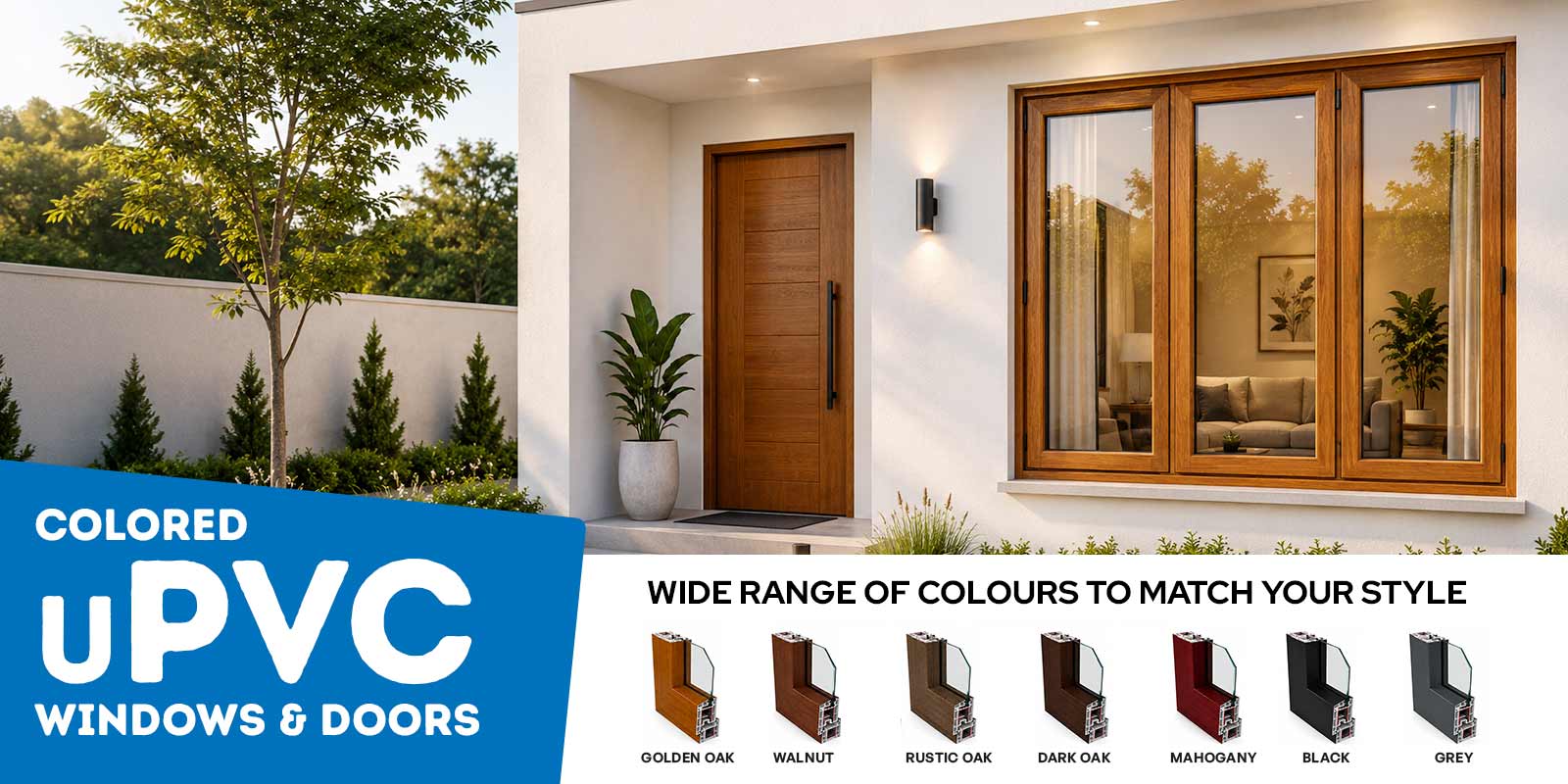
The range divides into two families — wood-finish laminates and solid colours. Both are available on windows and doors, and both can be specified on one face or on both.
Wood finish laminates
These are the finishes people mean when they search for brown or wooden uPVC windows. Each is a foil with a printed grain and an embossed surface texture, so the frame has the depth of timber under the hand as well as the eye.
| Finish | Character | Suits |
| Golden Oak | Warm honey-toned grain, light to mid tone. The most widely specified wood finish in India. | Traditional and transitional elevations, villas, homes with teak or sagwan interiors |
| Walnut | Mid-brown with a tighter, more defined grain than oak | Contemporary homes wanting timber warmth without visual heaviness |
| Dark Oak | Deep brown, strong grain definition, reads almost black at distance | Modern façades and high-contrast schemes against white or light walls |
| Rustic Oak | Textured and weathered, more character variation across the grain | Farmhouse, heritage and villa architecture |
| Mahogany | Rich reddish-brown with a classical depth | Colonial and formal styles, main entrance doors |
Solid colours
| Finish | Character | Suits |
| Pristine White | The standard profile finish | Any elevation; maximises apparent glass area |
| Ivory | Softer and warmer than white, less clinical | Warm-toned exteriors, cream and sandstone façades |
| Grey | From deep anthracite through to lighter mid-greys | Contemporary architecture; currently the fastest-growing choice in Indian metros |
| Black | Uniform contemporary black | Minimalist elevations, steel-look glazing schemes |
| Blue | Deeper blue tones | Coastal properties and accent applications |
Finding your colour by everyday name
Most people do not search by foil trade name. They search for a brown window or a grey door. This is how the common descriptions map onto the range:
| If you are looking for | Specify |
| Brown uPVC windows or doors | Walnut for a mid-brown, Dark Oak for a deep brown, Mahogany for a reddish-brown. Golden Oak if you want brown on the lighter, warmer side. |
| Wooden or teak-look frames | Golden Oak is the closest match to seasoned teak. Rustic Oak if you want visible weathering. |
| Grey or anthracite windows | Grey, in the depth of your choosing. Pair with white internally if the room is small. |
| Black windows | Black solid finish, or Dark Oak if you want depth and grain rather than flat colour. |
| Cream or off-white | Ivory. |
Dual-tone: different colours inside and out
Laminated profiles can carry a different foil on each face. The most common specification in Indian homes is a dark or wood finish externally with white internally — the elevation gets the contrast, the rooms stay bright, and interior furnishing is not constrained by the frame colour.
This is worth deciding early. Dual-tone is a manufacturing specification, not a finishing option, so it is set when the profile is laminated and cannot be added later.
How uPVC Gets Its Colour: Lamination Vs Co-extrusion
There are two industrial methods, and they behave differently over time.
Foil lamination
The white profile is extruded first. A decorative foil is then bonded to its surface using heat and an adhesive, with rollers pressing the foil into the profile contours so it wraps the shape without lifting at the edges.
Aparna profiles use German foil with a hot-melt polyurethane (PU) adhesive
Lamination is the only method that reproduces a wood grain, because the grain is printed and embossed into the foil. It also allows a different finish on each face of the same profile, which is what makes dual-tone possible.
Co-extrusion
Here the coloured layer is extruded simultaneously with the profile body, so the pigment is part of the material rather than a layer on it. Co-extrusion produces solid colours only. Its advantage is that a surface scratch does not reveal a different colour underneath; its limitation is the narrow palette and the absence of any grain.
| Foil lamination | Co-extrusion | |
| Wood grain | Yes — the only method that achieves it | No |
| Colour range | Wide; woodgrains and solids | Narrow; solids only |
| Dual-tone | Yes, different foil per face | Not practical |
| Deep scratch | Can expose the white substrate | Colour continues into the layer |
| Availability in India | Standard across the market | Limited |
For almost every Indian residential specification, lamination is the correct answer — it is what makes the finish range possible in the first place.
Laminated uPVC Windows And Doors: What The Finish Actually Does
A laminate is not decoration applied to a finished product. On an external window it is the layer taking the ultraviolet load, the monsoon and the dust, and its quality determines whether the frame still looks specified or looks tired after a decade.
Three things separate a laminate that lasts from one that does not:
- Adhesive system. Hot-melt PU adhesives cure into a bond that tolerates the expansion and contraction of a frame sitting in 45°C afternoon sun and cooling overnight. Cheaper adhesives become brittle and release at the corners first — which is where you will always see delamination begin.
- Foil quality. The pigments and UV stabilisers in the foil itself decide fade resistance. This is why two frames in the same Golden Oak can look completely different after five Indian summers.
- Wrap quality. The foil has to follow every contour of the profile, including the return edges. Gaps and air pockets at the corners are the entry point for moisture.
None of this is visible in a showroom sample. It is worth asking a supplier directly which foil they use, what adhesive system, and what the warranty covers.
Coloured uPVC Doors: Choosing A Front Door Colour
A front door carries more visual weight than any window on the elevation, and the colour decision is different in kind — it is the one element people are happy to make a statement with.
A few things that hold true in Indian conditions:
- Dark finishes on a west or south-facing entrance take the most thermal load. They are entirely suitable, but the profile quality matters more than it does on a shaded elevation.
- Wood finishes are the safest choice against brick, stone and earth-toned exteriors. Mahogany and Dark Oak both hold their own beside exposed brick without competing with it.
- Matching the door to the windows is not compulsory. A common and successful specification is Golden Oak or Walnut windows with a deeper Mahogany or Dark Oak entrance door — related, not identical.
- If your windows are already brown, a door in a deeper shade of the same family reads as deliberate. A door in an unrelated colour reads as an accident.
Will Coloured And Laminated uPVC Fade?
A quality laminated profile does not fade appreciably. AEL uPVC profiles carry a 20-year warranty against discolouration and structural degradation, with hardware warranted separately for one year.
Poorly made laminates do fade, and they do it unevenly — the south and west elevations first. The variable is not the colour, it is the foil.
Two design points sit alongside the warranty. Dark finishes absorb more heat than white, which is a consideration for frame temperature on unshaded elevations rather than a durability problem. And a deep scratch on a laminated profile can expose the white substrate beneath, which is more visible on Dark Oak or Black than on Golden Oak — uPVC touch-up pens matched to the foil handle this.
Aparna uPVC profiles are lead-free, use calcium-zinc stabilisers, and are manufactured to European standards with NABL-accredited testing.
Coloured uPVC vs White uPVC
Both are the same profile underneath. The differences are worth knowing honestly before you specify:
| White uPVC | Coloured / laminated uPVC | |
| Appearance | Clean and classic; maximises apparent glass area | Premium and contemporary; woodgrains read as timber at conversational distance |
| Design flexibility | Single standard shade | Wide range, dual-tone available, multiple textures |
| Durability | No foil layer, so no delamination risk | High, but a poorly bonded foil can lift at corners |
| Showing dirt | Highlights dust and stains | Mid and dark tones hide everyday dust better |
| Fade resistance | Excellent; can yellow slightly under severe UV | Good with quality foils; poor foils fade unevenly |
| Heat absorption | Lowest; stays coolest | Dark shades absorb noticeably more |
| Scratch visibility | Minimal — same colour throughout | Higher; a deep scratch can show the substrate |
Mistakes To Avoid When Choosing A Colour
- Choosing from a screen: Foil colours photograph badly and monitors vary. Ask for physical samples and look at them against your actual wall, in daylight, at the elevation they will sit on.
- Judging a sample indoors: A Dark Oak chip under showroom lighting looks nothing like the same frame on a sunlit façade. Take samples outside.
- Forgetting the inside of the room: A dark frame reduces the apparent size of a small room and frames every view in a heavy border. This is exactly what dual-tone exists to solve, and it costs nothing to decide it at specification stage.
- Specifying colour without asking about the laminate: Two suppliers quoting the same Golden Oak may be using very different foils and adhesives. Ask what is bonded to the profile and what is warranted.
- Leaving dual-tone until later: It is set during manufacture. There is no retrofit.
- Matching the frame to a trend rather than the building: Anthracite grey suits a contemporary elevation and fights a traditional one. The architecture should decide, not the year.
Can You Change The Colour Of Existing uPVC Windows?
Partly. Existing uPVC frames can be resprayed with a specialist uPVC coating or covered with an applied wrap film, but neither matches the durability of a factory-applied laminate, and neither carries the profile warranty.
Specialist uPVC sprays are formulated to key into the plastic and can look good initially. In Indian UV and monsoon conditions they typically need attention within a few years, and the finish is uniform — a spray cannot reproduce a wood grain. Wrap films are reversible and useful for a rental or interim fix, but edges and corners lift over time.
Ordinary house paint should not be used on uPVC under any circumstances. It will not bond, and removing it later is worse than the original problem.
If the frames themselves are sound and only the colour is wrong, a respray is a legitimate interim option. If the frames are aged or the hardware is failing, replacing with laminated profiles gives a factory-bonded finish and a fresh warranty.
Caring For Coloured And Laminated uPVC
- Wash every three to six months with mild soapy water and a soft cloth or non-scratch sponge.
- Avoid abrasive creams, solvents and pressure washers. Abrasives dull the foil surface; solvents can attack it; pressure washers force water into the foil edges.
- Apply a UV-resistant wax or car polish twice a year on exposed elevations. It adds a sacrificial layer over the foil.
- Lubricate hinges and locks annually with a silicone spray.
- Use a matched uPVC touch-up pen for minor scratches rather than any general-purpose paint.
Coloured And Laminated uPVC From Aparna Enterprises
Aparna Enterprises manufactures uPVC window and door profiles at its facility in Hyderabad, with over three million installations completed across India. Profiles are lead-free, tested in an NABL-accredited laboratory and manufactured to European standards.
The finish range covers five wood laminates — Golden Oak, Walnut, Dark Oak, Rustic Oak and Mahogany — alongside solid shades, with dual-tone specification available on any profile.
To see the finishes in person, request physical samples or arrange a site consultation.
Frequently Asked Questions
They usually describe the same product. Coloured uPVC means any non-white profile; laminated uPVC describes the method — a decorative foil bonded to the profile under heat and pressure. Almost all coloured uPVC in India is laminated, and every woodgrain finish is.
AEL uPVC profiles are warranted for 20 years against discolouration and structural degradation, with hardware covered for one year. Actual service life depends on installation quality and exposure
Quality laminates hold their colour. The variable is the foil, not the shade — cheaper foils fade unevenly, starting on south and west elevations. Ask what foil and adhesive a supplier uses before comparing quotes.
Yes. Dual-tone lamination applies a different foil to each face. It is the most common specification for dark and wood finishes in Indian homes. It must be decided at manufacturing stage — it cannot be retrofitted.
Coloured and laminated profiles carry a premium over standard white, because of the foil and the additional lamination stage. The difference varies with finish, profile system and window size, so it is best established through a quotation for your actual specification.
Walnut for mid-brown, Dark Oak for deep brown, Mahogany for reddish-brown, Golden Oak for a lighter warm brown. All four are wood-grain laminates rather than flat colours.
A deeper shade from the same family reads as intentional — Mahogany or Dark Oak against Golden Oak or Walnut windows. Avoid an unrelated colour, which reads as unplanned.
Not with ordinary paint, which will not bond and will lift within a season. Specialist uPVC sprays exist and can work as an interim measure on sound frames, but they do not match a factory laminate and carry no profile warranty.
Dark finishes absorb more heat than white. On unshaded west and south elevations this makes profile quality and reinforcement more important, but it is a specification consideration rather than a reason to avoid dark colours.
Start Your Project with the Right Materials
We provide everything you need for modern construction. Connect with our experts to discuss your requirements and get the best solution for your project. Submit your details and our team will contact you soon.
CORPORATE OFFICE
8-2-293/82/A, Plot No-1214, Road No-60,
Jubilee Hills, Hyderabad-500 033.