
Kitchen Cabinet Materials: Types, Comparison and How to Choose the Right One for an Indian Kitchen
In This Article
A kitchen cabinet is not made of one material. It is a box (the carcass), a door (the shutter), a surface on that door (the finish) and the hinges, channels and handles that hold it all together. Most disappointments with modular kitchens — swollen sink units, peeling shutter edges, sagging shelves — come from choosing the right material for the wrong part of the kitchen, or from a good material in the wrong grade.
This guide explains the main kitchen cabinet materials — often called modular kitchen materials — used in Indian homes, what each one does well, where it struggles, which Indian Standard grade to look for, and how to match materials to each zone of your kitchen.
Quick answer: which material is best for kitchen cabinets?
There is no single best kitchen cabinet material. Most well-built Indian kitchens combine materials by zone: BWP-grade plywood or HMR-grade board for the sink and base units, plywood or HMR board for wall cabinets, and MDF or HDHMR shutters finished in laminate, acrylic or PU. Grade, edge sealing and installation matter as much as the material.
What Are Kitchen Cabinets Made Of? Carcass, Shutters, Finishes and Hardware
Before comparing materials, separate the four layers of a cabinet. A quotation that says only “plywood kitchen” or “acrylic kitchen” tells you about one layer and nothing about the others.
Table: The four parts of a kitchen cabinet
| Part | What it does | Common materials | What to confirm |
| Carcass (cabinet box) | Carries the load of the countertop, sink, appliances and stored items; takes most of the moisture exposure | Plywood, HDHMR/HMR-grade board, MDF, particle board, PVC or WPC board, stainless steel | Board type, IS grade, thickness, back-panel material, edge banding on all sides |
| Shutters (doors and drawer fronts) | The face of the kitchen; opened many times a day | MDF, HDHMR, plywood, solid wood, aluminium profile frames with glass or panel inserts | Core material behind the finish, thickness, hinge type |
| Surface finish | Gives colour and texture; protects the core from stains and splashes | Laminate, acrylic, PU paint, veneer, membrane (PVC foil), glass | Finish on both faces and all four edges |
| Hardware | Hinges, drawer channels, lift-up mechanisms, baskets and handles | Steel, stainless steel, aluminium and zinc alloys | Brand, load rating, soft-close, corrosion protection |
Two practical points follow from this. First, a premium finish does not tell you anything about the board underneath — a glossy acrylic shutter can sit on an MDF core or an HDHMR core, and the two behave differently in steam. Second, hardware is a separate decision. A good carcass with weak hinges will still fail at the doors, so ask for hardware brand and model in writing.
Types of Kitchen Cabinet Materials
These are the main core materials used for the carcass and shutters of modular kitchens in India. Laminate, acrylic and PU are finishes, not core materials, and are covered in the next section.
Table 1: Types of kitchen cabinet materials
| Material | Main characteristics | Advantages | Limitations | Typical applications |
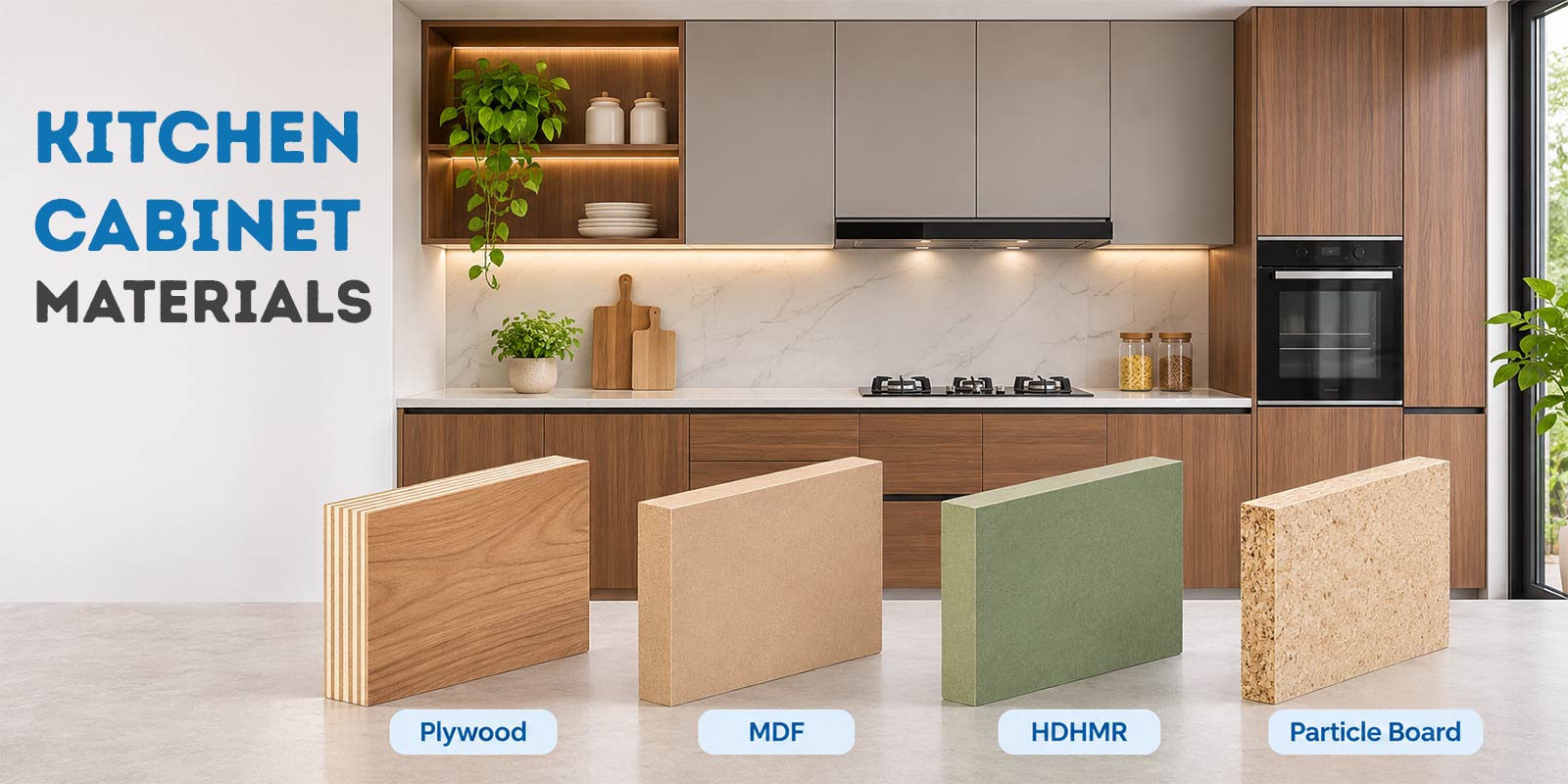
| Plywood (MR, BWR, BWP grades) | Thin wood veneers bonded in cross layers; grade depends on the adhesive and water-resistance test | High strength and screw holding; tolerates load; BWP grade handles wet zones well | Exposed edges absorb water unless banded; quality varies widely between makers | Carcass, especially sink base and base units; heavy-duty shelves |
| HDHMR / HMR-grade fibreboard | Dense fibreboard made with moisture-resistant resin; “HDHMR” is a trade name, the IS grade is HMR | Smooth, uniform surface for laminate, acrylic and PU; good dimensional stability; CNC-routable | Heavier than plywood; swells if water stands on cut edges; screw-holding needs correct fittings | Shutters, wall and base carcasses in many factory-made kitchens |
| MDF | Wood-fibre board bonded with resin; available in REG, MR and HMR grades | Smooth and economical; ideal for paint, PU, membrane and routed designs | Regular grade is not suited to wet zones; edges swell when exposed to water | Shutters, dry-zone wall cabinets, decorative panels |
| Particle board (pre-laminated) | Wood particles bonded with resin, usually supplied with a factory melamine finish | Lowest cost; flat and ready-finished | Lower moisture tolerance and edge strength; difficult to repair once swollen | Budget wall cabinets and dry storage |
| PVC board | Rigid PVC foam or hollow PVC sheet | Does not absorb water; resists rot and termites; light | Low stiffness, so long shelves can sag; softens with heat; lower screw holding | Under-sink units, utility and rental kitchens |
| WPC board | Wood fibre or flour bonded with plastic (commonly PVC) | Better water tolerance than wood-based boards; denser and more rigid than PVC foam | Heavier; cost and quality vary by density and maker; heat limits near the hob | Sink base, wet-zone carcasses |
| Stainless steel | Sheet steel cabinets, usually 304 or 200-series grades | Does not absorb water; hygienic, heat-tolerant surface | Shows fingerprints and dents; higher cost; corrosion resistance depends on grade | Full kitchens, sink units, high-hygiene or heavy-use kitchens |
| Solid wood | Natural timber such as teak, sheesham or rubberwood | Warm appearance; can be sanded and refinished | Moves with humidity; termite and moisture risk depends on species and treatment; expensive | Shutters and frames in premium or traditional kitchens |
Performance in every row depends on the specific product grade, the manufacturer, edge sealing, installation and maintenance.
Plywood: Which Grade Is Best for a Kitchen?
Plywood remains the most trusted carcass material in Indian kitchens because of its strength and screw holding. The grade is what decides its kitchen performance. Under IS 303:2024, plywood for general purposes is made in three grades — MR (moisture resistant), BWR (boiling water resistant) and BWP (boiling water proof) — and in two formaldehyde classes, E1 and E2.
This is a recent change worth knowing. Until the 2024 revision, IS 303 covered only MR and BWR grades, and buyers who wanted BWP-performance plywood were usually sold boards marked to IS 710.
IS 710:2010 is the standard for marine plywood, written for boats, pontoons and similar uses. It requires a BWP-type adhesive, a 72-hour boiling water test and pressure preservative treatment (IS 710:2010, Clauses 4.2.1, 5.3 and 9.1.3). For a kitchen, BWP-grade plywood to IS 303 is the relevant grade; marine plywood to IS 710 is a higher specification that a kitchen does not strictly need.
- For the sink base unit and base cabinets: BWP grade is the safer choice. Water from sink splashes, RO purifier leaks and floor mopping reaches the lower carcass first.
- For wall cabinets and dry storage: BWR grade is commonly used. MR grade is best kept to dry areas away from the sink and hob.
- For any grade: check that the board carries the IS number, the grade and the formaldehyde class, and that every cut edge is sealed with edge banding.
A higher grade does not make plywood waterproof. The adhesive may survive boiling, but the wood veneers still absorb water at exposed edges, screw holes and cut-outs, which is why edge sealing matters.
HDHMR and HDF Boards
HDHMR (high-density high-moisture-resistance) board is a trade name for a dense fibreboard made with moisture-resistant resins. It has become popular for shutters and for carcasses in factory-made kitchens because its smooth, uniform face takes laminate, acrylic and PU paint cleanly and it can be CNC-routed for handle-less profiles.
There is no separate Indian Standard called “HDHMR”. The current MDF standard, IS 12406:2025, classifies fibreboard into REG (regular), MR (moisture resistance) and HMR (high moisture resistance) grades, with HMR split into a general-purpose and a furniture grade. When a supplier offers HDHMR, ask which IS grade the board is certified to and ask to see the marking.
HMR-grade board is more moisture-tolerant than regular MDF, but it is not waterproof. For 12–19 mm boards, IS 12406:2025 still allows up to 7% thickness swelling after 24 hours in water for the general-purpose HMR grade, and up to 5% for the furniture grade. Standing water on an unsealed edge will swell any fibreboard.
MDF (Medium Density Fibreboard)
MDF is made from fine wood fibres bonded with resin into a dense, uniform board. Its smooth surface makes it a natural base for PU paint, membrane and routed shutter designs, and it is generally more economical than plywood or HDHMR. The IS 12406:2025 foreword recommends MDF for interior locations.
Grade matters here more than anywhere else. For 12–19 mm boards, IS 12406:2025 permits up to 12% thickness swelling after 24-hour water immersion for the REG grade, compared with 8% for MR and 7% for HMR (general purpose). Regular MDF therefore belongs on shutters and in dry wall cabinets, not in the sink unit.
Particle Board (Pre-laminated Board)
Particle board is made from wood chips or particles bonded with resin and is usually sold pre-laminated with a melamine-impregnated paper finish on both faces. It is the most economical cabinet board and is common in ready-made and flat-pack furniture.
The revised IS 3087:2025 defines REG, MR and HMR grades of particle board and recommends particle boards for interior locations. Its moisture limits are looser than fibreboard: for 13–20 mm boards, the MR grade allows up to 14% swelling after 24 hours in water and the HMR grade up to 12%.
Pre-laminated particle board is covered by IS 12823:2025, which also tests the surface for abrasion, steam, stains and cigarette burns. Use it for dry wall cabinets and storage on a tight budget, and keep it away from the sink.
PVC Boards
PVC kitchen cabinets use rigid PVC foam board or hollow PVC sheet instead of wood-based board. Because PVC does not absorb water, it does not swell or rot, and termites do not feed on it. That makes it a practical option for under-sink units and for rental or utility kitchens where water exposure is frequent.
The trade-offs are structural and thermal. PVC board is less stiff than plywood, so long shelves can sag under heavy steel vessels, and screws hold less firmly, which affects hinge alignment over time. PVC is a thermoplastic and softens with heat, so it should not sit directly beside a hob or tall oven without protection. If you are comparing PVC with uPVC for cupboards, see our explainer on the difference between PVC and uPVC.
WPC Boards
WPC (wood-plastic composite) board combines wood fibre or wood flour with a plastic binder, commonly PVC. It is denser and more rigid than PVC foam board while keeping much better water tolerance than wood-based boards, which is why it is used for sink bases and wet-zone carcasses.
WPC performance varies widely with density and formulation between manufacturers, and it is heavier than plywood. Like PVC, it is a plastic-based material with heat limits, so keep it away from direct hob heat. Ask the supplier for density, screw-holding and test data, and for the standard, if any, the board is certified against.
Stainless Steel
Stainless steel cabinets are made from steel sheet rather than board, so the carcass cannot absorb water or swell. They are easy to sanitise and tolerate heat, which is why they are common in commercial kitchens and are increasingly offered for homes.
The grade decides corrosion resistance. Grade 304 contains roughly 18% chromium and 8% nickel; the 200-series grades sold as lower-cost alternatives replace part of the nickel with manganese and are generally less corrosion-resistant, which matters near the sink and in coastal air. Steel cabinets also show fingerprints, can dent, and cost more than most board-based kitchens. Joints, welds and the floor-level plinth still need attention to keep water out.
Solid Wood
Solid wood offers warmth and character, and it can be sanded and refinished years later. It is mostly used for shutters, frames and premium or traditional kitchens rather than for full carcasses.
Solid timber expands and contracts as humidity changes, which can open joints or bind doors through Indian monsoon cycles. Termite and moisture resistance depend on the species, seasoning and treatment, so ask what timber is used, how it was seasoned and whether it was treated. Expect a higher price and more maintenance than engineered boards.
Kitchen Cabinet Finishes: Laminate, Acrylic, PU, Veneer, Membrane and Glass
A finish is the surface on top of the core material. It decides how the kitchen looks, how easily it cleans and how well it resists stains, heat and scratches — but it does not turn a weak core into a strong one. Laminate and acrylic are surface finishes, not structural cabinet materials. Indian cooking adds turmeric, oil and tadka splatter to the mix, so a finish that wipes clean without abrasive scrubbers makes daily upkeep easier.
Table 3: Cabinet core materials vs surface finishes
| Material or finish | Category | Function | Typical application | Important considerations |
| Plywood, HDHMR/HMR board, MDF, particle board | Core board | Provides structure, strength and screw holding | Carcass and shutters | Grade and edge sealing decide moisture performance |
| PVC, WPC, stainless steel | Core material (non-wood) | Structure with low water absorption | Sink base, wet zones, full kitchens | Check stiffness, heat limits and grade (for steel) |
| Solid wood | Core material | Structure and visible surface | Shutters, frames | Seasoning, treatment and humidity movement |
| Laminate (HPL or pre-laminate) | Surface finish | Decorative, wipeable face | Shutters, carcass faces | Edges and joints are the vulnerable points |
| Acrylic | Surface finish | High-gloss or matte decorative face | Shutters | Shows scratches and fingerprints; core behind it still matters |
| PU paint | Surface finish (coating) | Seamless painted surface | Shutters, usually on MDF or HDHMR | Can chip on impact; repair needs refinishing |
| Veneer | Surface finish (real wood) | Natural wood appearance | Shutters, panels | Needs sealing; colour varies naturally |
| Membrane (PVC foil) | Surface finish | Seamless wrap over routed MDF shutters | Shutters with profiles | Sensitive to sustained heat; edges can lift |
| Glass | Shutter insert or finish | Glossy, reflective or see-through face | Wall cabinets, display shutters | Weight and hinge rating; usually in an aluminium frame |
Laminate
Laminate is the most widely used kitchen finish in India. Decorative high-pressure laminate (HPL) is made by pressing resin-impregnated paper layers under heat and pressure and is bonded to the board at the factory or on site. Pre-laminated boards carry a lower-pressure melamine surface applied during manufacture. Laminates are wipeable, affordable and available in matte, gloss and textured finishes, including anti-fingerprint varieties. Their weak points are edges and joints: if edge banding fails, water reaches the core.
Acrylic
Acrylic shutters use a sheet of acrylic (PMMA) bonded to an MDF or HDHMR core to give a deep, high-gloss or smooth matte look. Acrylic is easy to wipe and suits modern, handle-less kitchens, but gloss acrylic shows fine scratches and fingerprints, so use a soft microfibre cloth and avoid abrasive scrubbers. It generally costs more than laminate.
PU Paint, Veneer, Membrane and Glass
- PU paint: a sprayed polyurethane coating, usually on MDF or HDHMR, giving a seamless colour finish in matte or gloss. Impact chips are repairable but need professional refinishing.
- Veneer: a thin slice of real wood on plywood or MDF, sealed with lacquer or PU. It gives a natural look at lower cost than solid wood, but each sheet varies and the surface needs sealing to handle kitchen moisture.
- Membrane: a thin PVC foil vacuum-pressed onto routed MDF shutters. It allows seamless profiled designs, but it can warp or discolour with sustained high heat and its edges can lift in high moisture, so keep it away from the oven and hob.
- Glass: lacquered or back-painted toughened glass, usually set in an aluminium profile frame. It is easy to clean and reflects light in small kitchens, but it is heavy, so the hinges must be rated for the shutter weight.
Latest Materials and Finishes for Kitchen Cabinets
Recent kitchens in India show a few clear directions: HDHMR or HMR-grade board for shutters, super-matte and anti-fingerprint laminates, handle-less profile shutters, aluminium-framed glass shutters for wall units, and mixed finishes within one kitchen — a durable laminate on base units and acrylic or PU on wall units. Newer is not automatically better. A trend finish still depends on the core behind it, the edge banding and the hardware.
Moisture Resistance: Which Kitchen Cabinet Material Is Waterproof?
Water damage is the most common reason kitchen cabinets fail in India, so it helps to use two terms precisely:
- Water-resistant means a material tolerates splashes, steam and humidity for a period without damage. BWP and BWR plywood, MR and HMR-grade boards are water-resistant to different degrees.
- Waterproof means the material itself does not absorb water. PVC board and stainless steel come closest. Even so, a cabinet built from them has joints, hinge holes and floor contact where water can collect.
No wood-based board is waterproof. The Indian Standards make this visible: they set a maximum swelling after 24 hours of soaking, rather than requiring zero swelling.
Table: Maximum 24-hour thickness swelling allowed by Indian Standards (board about 18 mm thick)
| Board and grade | Standard | Maximum swelling after 24 h in water |
| MDF — REG (regular) grade | IS 12406:2025, Table 4 (12–19 mm) | 12% |
| MDF — MR grade | IS 12406:2025, Table 5 (12–19 mm) | 8% |
| MDF — HMR grade (general purpose) | IS 12406:2025, Table 6 (12–19 mm) | 7% |
| MDF — HMR grade (furniture) | IS 12406:2025, Table 7 (12–19 mm) | 5% |
| Particle board — MR grade | IS 3087:2025, Table 6 (13–20 mm) | 14% |
| Particle board — HMR grade | IS 3087:2025, Table 7 (13–20 mm) | 12% |
These are the limits a certified board must meet, not typical performance. Actual swelling depends on the product, and edge banding reduces exposure in use.
Where Water Actually Gets In
- Unsealed edges and cut-outs: the sink cut-out, pipe holes and hinge holes expose the core. Ask for every cut to be sealed.
- The plinth (skirting): daily wet mopping soaks the bottom edge of base cabinets. A PVC or aluminium plinth with legs is safer than a board plinth touching the floor. If you are also choosing the floor, see our guide to kitchen floor tiles.
- The sink base: leaks from the sink coupling, the waste pipe and RO purifiers often go unnoticed for weeks.
- Steam zones: the underside of wall cabinets above the cooktop, and boards above dishwashers or beside ovens. Board makers such as EGGER advise protecting panel undersides near dishwashers and ovens with aluminium vapour-barrier foil (EGGER guidance).
Sink-Base Unit Checklist
- Use BWP-grade plywood, PVC, WPC or stainless steel for the sink carcass, and confirm the grade in writing.
- Ask for edge banding on every edge, including the hidden back and bottom edges.
- Fit an aluminium or PVC tray or mat on the base panel to catch drips.
- Seal the sink cut-out and every pipe hole.
- Keep plumbing accessible so leaks can be found and fixed early.
Humidity and Climate in Indian Kitchens
Climate changes how much grade you need. The Indian board standards themselves link grade to climate: IS 3087:2025 describes regular-grade particle board for arid, semi-arid or temperate conditions, MR grade for humid subtropical and tropical dry conditions, and HMR grade for high-humidity tropical wet conditions.
In practice, coastal and heavy-monsoon homes — Kerala, coastal Karnataka, Mumbai, Chennai — benefit from BWP plywood or HMR-grade board throughout the base units. Drier inland cities can use BWR plywood or MR-grade board more widely, while still keeping the sink unit to the highest grade.
Cooking habits matter too: frequent pressure-cooker steam, boiling and deep-frying raise humidity and grease around the hob more than occasional cooking.
Kitchen Cabinet Material Comparison
Table 2: Kitchen cabinet material comparison
| Material | Moisture resistance | Maintenance considerations | Relative cost* | Suitable applications |
| BWP plywood | High for a wood-based board; edges must be sealed | Inspect edge banding and sink-area panels | Medium to high | Sink base, base units, all carcasses |
| BWR plywood | Moderate to high | Keep away from standing water | Medium | Wall cabinets, dry base units |
| MR plywood | Limited | Dry areas only | Low to medium | Dry storage, lofts |
| HDHMR / HMR-grade board | Moderate to high for a fibreboard; cut edges are vulnerable | Seal edges; use correct fixings | Medium | Shutters, wall and base carcasses |
| MDF (REG grade) | Low | Avoid wet zones | Low to medium | Shutters, dry wall cabinets |
| Particle board | Low (REG) to moderate (HMR) | Hard to repair once swollen | Low | Budget dry storage |
| PVC board | Very high — does not absorb water | Watch for shelf sag and heat near the hob | Low to medium | Under-sink units, rental kitchens |
| WPC board | High | Check density; keep away from hob heat | Medium | Sink base, wet zones |
| Stainless steel | Very high — sheet does not absorb water | Fingerprints; check grade near the sink | High | Full kitchens, sink units |
| Solid wood | Variable — depends on species and treatment | Periodic sealing; humidity movement | High | Shutters, frames |
*Relative cost compares materials of similar thickness and finish; actual prices vary by brand, grade, city and finish. This is not a price quote.
Plywood vs MDF
Choose plywood for strength, screw holding and the sink and base zones. Choose MDF for a smooth painted, PU or routed shutter at a lower cost. Many good kitchens use both: a plywood carcass with MDF or HDHMR shutters. Avoid regular-grade MDF in any wet zone.
HDHMR vs Plywood
Neither is better everywhere. HDHMR or HMR-grade board gives a flatter, more stable shutter and a better surface for acrylic and PU. BWP plywood is the more forgiving choice under the sink and for heavy base units because it holds screws well under repeated load. A common combination is a BWP plywood carcass with HDHMR shutters. Whichever you choose, ask for the IS grade and seal every edge.
PVC vs WPC vs Plywood
PVC and WPC win on water: they do not swell or rot, which is valuable under the sink. Plywood wins on stiffness, screw holding and heat tolerance near the hob. A practical split is PVC or WPC for the sink unit and plywood or HMR board for the rest of the kitchen.
Solid Wood vs Engineered Boards
Solid wood offers character and can be refinished, but it moves with humidity and costs more. Engineered boards such as plywood, HDHMR and MDF are more dimensionally stable and consistent, which is why modular kitchens rely on them for carcasses and use solid wood mainly for frames and feature shutters.
Which Material Is Best for Kitchen Cabinets? Choosing by Kitchen Zone
The best material for kitchen cabinets is the one that matches each zone’s exposure. Use the table below as a starting point, then confirm grades and finishes with your kitchen designer.
Table 4: Choosing cabinet materials for different kitchen needs
| Kitchen requirement | Material options to consider | Selection factors | Important notes |
| Sink base unit | BWP plywood, PVC, WPC, stainless steel | Direct water and leak exposure | Seal all cut-outs; add a drip tray |
| Hob and oven zone | BWP or BWR plywood, HMR-grade board, stainless steel | Heat, grease and steam | Avoid membrane, PVC and WPC next to direct heat; use heat-rated finishes |
| Wall cabinets | BWR plywood, HMR-grade board, MR-grade board in dry kitchens | Weight on wall fixings; steam from below | Seal the underside above the cooktop |
| Tall units and fridge housing | Plywood or HMR-grade board | Appliance heat and ventilation | Leave the ventilation gaps the appliance maker specifies |
| Plinth (skirting) | PVC or aluminium plinth on legs | Daily wet mopping | Avoid board plinths touching the floor |
| Shutters | HDHMR, MDF or plywood core with laminate, acrylic or PU | Look, flatness, cleaning | Check the core, not only the finish |
| Humid coastal home | BWP plywood or HMR-grade board throughout base units | Year-round humidity | Ask for E1 boards and full edge banding |
| Budget or rental kitchen | PVC sink unit, pre-laminated MR/HMR board elsewhere | Cost and ease of replacement | Keep regular-grade boards out of wet zones |
| Premium kitchen | BWP plywood carcass with HDHMR shutters in acrylic, PU or veneer; or stainless steel | Finish quality and long-term upkeep | Pair with good hardware; premium finish ≠ premium core |
Budget and Premium Kitchens
For a small apartment on a budget, spend where water is: a PVC, WPC or BWP sink unit, then pre-laminated MR or HMR-grade board for dry wall units, with laminate shutters. For a premium kitchen, the extra budget is better spent on BWP carcasses, good edge banding and hardware than on the glossiest shutter alone.
Modular vs Carpenter-Made Cabinets
Factory-made modular cabinets are cut, edge-banded and drilled on machines, which gives consistent edge sealing and fit, and they are easier to remove and reinstall. Carpenter-made cabinets offer more on-site flexibility but depend heavily on the carpenter’s edge sealing and joinery. Either way, the materials and grades should be written into the quotation. For planning the layout itself, see our guide to types of kitchen layouts.
How to Check Kitchen Cabinet Material Quality Before You Sign?
Most quality problems are visible on paper before they appear in the kitchen. Ask for these in the quotation:
- Board type and IS grade for each zone: for example, “carcass: BWP plywood to IS 303:2024, E1”.
- Certification marking: the ISI mark with licence number, the IS number and the grade printed on the board. You can verify a BIS licence using the BIS Care app.
- Thickness: for the carcass, shutters and back panel, stated separately.
- Edge banding: material and whether all four edges of every panel are banded.
- Finish: on which faces, and whether the inside of the carcass is also finished.
- Hardware: brand and model of hinges, channels and lift-up systems.
- Warranty: what is covered (board, finish, hardware) and for how long, in writing.
For a broader view of standards, test reports and certifications across building materials, see our guide on how to check building material quality.
Formaldehyde Emissions: E1 vs E2
Wood-based boards use resins that can release formaldehyde. Indian Standards now classify boards by formaldehyde class. Under IS 12406:2025 and IS 3087:2025, E1 boards have a formaldehyde content of no more than 8 mg per 100 g of oven-dry board, while E2 boards allow 8–30 mg; IS 303:2024 also lists E1 and E2 classes for plywood. If you want a lower-emission kitchen, ask for E1 boards and the test report that supports the claim.
Common Mistakes When Choosing Kitchen Cabinet Materials
- Choosing by finish alone. An acrylic or PU shutter says nothing about the board under it.
- One material for the whole kitchen. The sink unit and the loft cabinet face very different conditions.
- Regular-grade MDF or particle board under the sink. These are the first boards to swell.
- Ignoring hidden edges. The back and bottom edges of a carcass are where water often enters.
- Treating “waterproof” or “termite-proof” as guarantees. These depend on grade, treatment, installation and upkeep.
- Assuming marine plywood is required. BWP-grade plywood to IS 303:2024 is the relevant kitchen grade; IS 710 is a marine specification.
- Leaving grades out of the quotation. If it is not written, it cannot be checked.
Planning Your Modular Kitchen with Aparna Enterprises
Aparna Enterprises offers end-to-end modular kitchen and wardrobe solutions, from design and material selection to installation. If you are planning a new kitchen, our team can help you match carcass, shutter and finish choices to your kitchen’s layout, climate and cooking habits, and set out the grades in writing. If you are planning storage beyond the kitchen, our guide to modular wardrobe design covers wardrobes too. Contact our team to discuss your project.
Disclaimer: This article is for general information only. Indian Standards are revised from time to time; check the current version and the product’s certification before buying. Actual performance of any cabinet material depends on the specific product, grade, manufacturer, installation and maintenance. Swelling limits quoted are the maximum values allowed by the cited standards, not measured results for any product. For project-specific advice, consult a qualified kitchen designer.
Frequently Asked Questions On Kitchen Cabinet Materials
PVC is better under the sink because it does not absorb water. Plywood is better for the rest of the kitchen because it is stiffer, holds screws more firmly and tolerates heat near the hob. Many kitchens use PVC or BWP plywood for the sink unit and plywood or HMR-grade board elsewhere.
For most kitchens, BWP-grade plywood to IS 303:2024 is the relevant choice. IS 710:2010 covers marine plywood for boats, pontoons and similar uses, with a 72-hour boiling test and preservative treatment. It is a higher specification than a kitchen strictly needs.
Yes, for shutters and for many carcasses, if it is a certified high-moisture-resistance grade and every edge is sealed. HDHMR is a trade name; ask which IS 12406:2025 grade the board meets. It is heavier than plywood and, like all fibreboard, swells if water stands on a cut edge.
WPC works well in wet zones such as the sink base because it tolerates water better than wood-based boards and is more rigid than PVC foam. It is heavier, quality varies with density, and it should be kept away from direct hob heat. Ask for density and test data before buying.
MDF is good for shutters and dry wall cabinets, especially with PU, membrane or routed designs. Regular-grade MDF should not be used in the sink unit. For damp areas, choose MR or HMR grade and seal every edge.
No material is termite-proof in every situation. PVC and stainless steel are not a food source for termites, and treated boards resist attack better, but termites can still enter through walls and damage nearby wood. Treatment, installation and site conditions matter.
Laminate is more affordable and hides daily wear well, especially in matte and textured finishes. Acrylic gives a deeper gloss or smooth matte look but shows scratches and fingerprints more readily and costs more. Both need a moisture-resistant core and sealed edges.
Start Your Project with the Right Materials
We provide everything you need for modern construction. Connect with our experts to discuss your requirements and get the best solution for your project. Submit your details and our team will contact you soon.
CORPORATE OFFICE
8-2-293/82/A, Plot No-1214, Road No-60,
Jubilee Hills, Hyderabad-500 033.