
uPVC Profile Manufacturer in India | Lead-Free & Weather Resistant Profiles
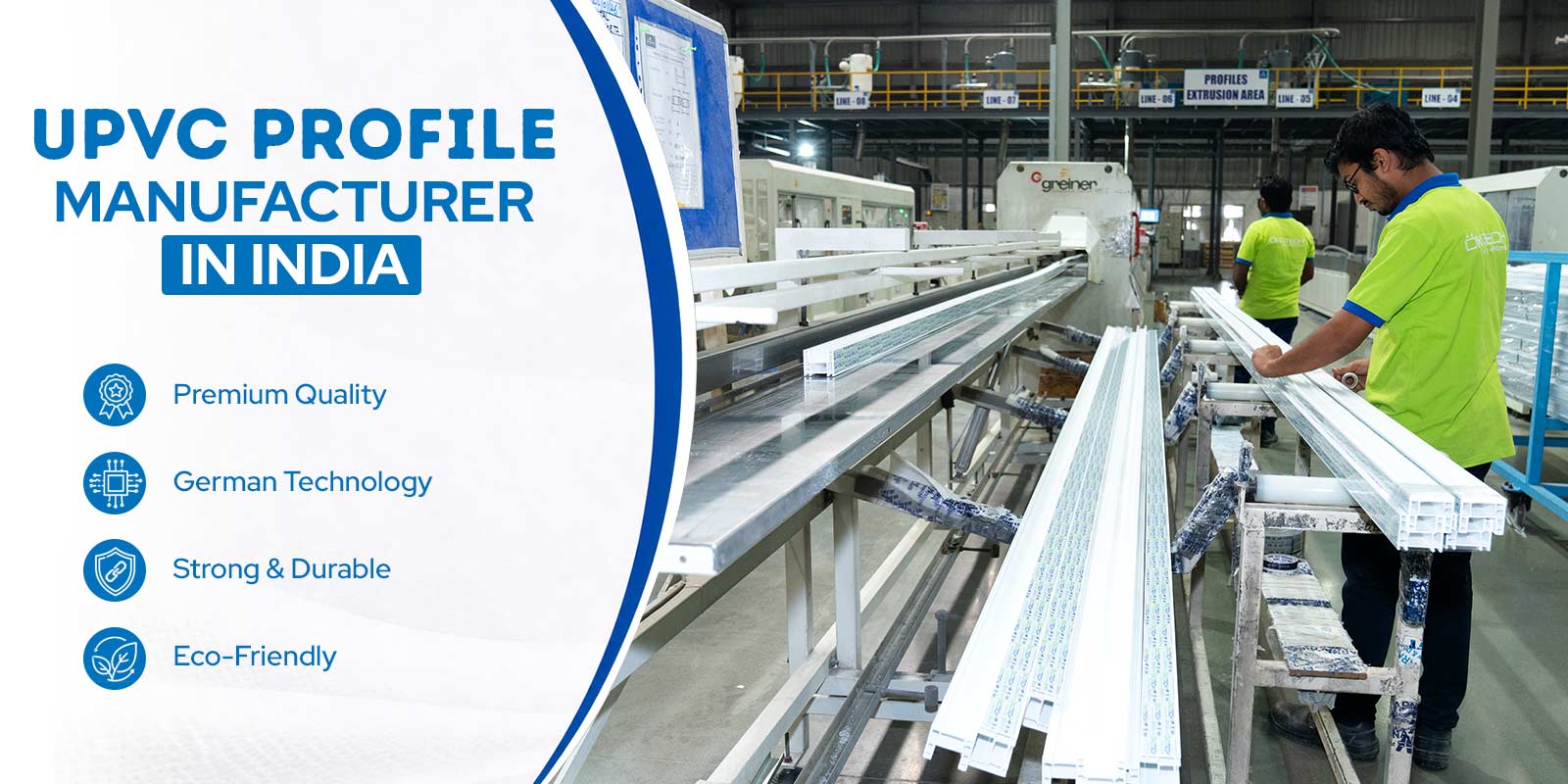
uPVC profiles are the extruded structural frames that form the backbone of every uPVC window and door. The quality of the profile decides how long your doors and window systems last. This guide covers what a uPVC profile is, how to identify a quality profile, types of uPVC profiles, and how to choose the right uPVC profile manufacturers in India.
What Is a uPVC Profile?
A uPVC profile is an extruded section made from Unplasticized Polyvinyl Chloride. It is a rigid polymer used as a structural frame in windows and doors.
uPVC Profile Structure
The uPVC profile structure consists of several components, such as frame, internal chambers, reinforced steel, rubber gaskets, beads, and hardware.
Component |
Function |
| Outer wall | First line of defence against weather, UV, and impact. |
| Internal chambers | Air pockets that provide thermal insulation. |
| Steel reinforcement cavity | Hollow channel to insert galvanised steel. |
| Gasket | Rubber seal that stops air and water leaks. |
| Glazing bead channel | Slot that holds the glass. |
What Makes a Quality uPVC Profile?
A quality uPVC profile is based on its engineering standards and material composition.
-
Wall Thickness / Structural Class
Use third-party test results to confirm that uPVC window and door profiles meet the standard 2.2 ± 0.2 mm or heavy-duty 2.8 ± 0.2 mm wall thickness x`x1.
-
Multi-Chamber Design
Heat transfer (U-value) and sound transmission can be reduced with more air chambers. Therefore, a multi-chamber profile can lessen the transmission of noise.
-
Virgin, Lead-Free Compound
To produce quality window and door profiles, the manufacturer must procure raw virgin PVC resin. This guarantees uPVC windows and doors will be as strong, structurally sound, and long-lasting.
-
Steel Reinforcement Cavity
A properly sized profile allows galvanised steel inserts inside a hollow chamber before fabrication begins. Without reinforcement, profiles droop or bow, resulting in hardware misalignment and seal failure in two to three monsoon seasons.
-
UV & Heat Stabilisation
India’s climate features temperatures that can exceed 45 °C at the surface, along with significant UV radiation, particularly in Rajasthan, Gujarat, and coastal regions. A quality profile incorporates titanium dioxide (TiO₂) and heat stabilisers to preserve colour and mechanical properties for at least 10 years.
Simplified Quality Checklist
This checklist helps you choose the best uPVC profiles by comparing quality, options, and costs:
Metrics |
Good Profile |
Basic Profile |
| Wall Thickness | 2.2 ± 0.2 mm to 2.8 ± 0.2 mm | Below standard |
| Air Chambers | 3–5 chambers | 1–2 chambers |
| Reinforcement | Galvanised steel | No steel / thin metal |
| Material Quality | Virgin, lead-free PVC | Recycled PVC |
| UV Resistance | Won’t fade or yellow | May crack or fade |
| Certifications | Tested & certified | No certification |
| Warranty | 10+ years | 1–2 years or none |
How to Choose a uPVC Profile Manufacturer in India?
To evaluate a uPVC profile manufacturer in India, you must prioritise the following criteria over brand. Let’s see them in detail here:
-
Does the manufacturer extrude in-house?
The best indicator of quality control is in-house extrusion, which involves owning the dies, extruders, and compound. Consistency between batches cannot be guaranteed by a company that trades or rebadges profiles from third parties. Find out if the tooling is proprietary and what the plant’s capacity is.
-
What raw material does the manufacturer use?
Ask for the name of the compound supplier and a lead-free declaration. Reputable producers can give batch traceability, which connects every provided profile to a particular compound batch and production date. They also source stabilised PVC compound from recognised chemical groups.
-
What certifications and test reports are available?
Check for RoHS compliance, ISO 9001 (quality management), and test reports to IS 12866 (the BIS standard for uPVC profiles). Internal datasheets are not as reliable as independent third-party lab results. Request reports that are current rather than those more than three years old.
-
What do the warranty terms actually cover?
The warranty must cover defects in the profile, including warping, discolouration, cracking, and delamination. Verify the time frame (10 years is the standard), what proof is required to file a claim, and whether the manufacturer will replace the product or just fix it.
-
How strong is the fabricator and dealer network near your project?
Installation risk can be eliminated by a manufacturer with a large, skilled network of fabricators. Find out how many qualified fabricators the manufacturer supports in your state and if they offer tooling guidelines and fabrication training.
-
What after-sales and technical support does the manufacturer provide?
On-site troubleshooting, replacement part availability, and fabrication assistance are examples of technical support. If a profile defect is verified, how soon will a new piece be shipped? Manufacturers are at risk if they are unable to provide a clear response to this issue.
Types Of uPVC Profiles & Systems
A ‘system’ or ‘series’ refers to the family of coordinated profiles such as frame, sash, mullion, transom, and bead, designed to work together. The fabricator’s options for window and door configurations are determined by selecting the appropriate system.
System |
Best Use |
Key Benefit |
| Sliding | Living rooms, bedrooms, balconies | Easy operation and space-saving |
| Casement | All room types | Excellent weather sealing and security |
| Tilt & Turn | Apartments, hospitals, high-rises | Ventilation and easy cleaning |
| Fixed + Opening | Stairwells, facades | Design flexibility |
| Ventilator / Top Hung | Bathrooms, kitchens | Compact ventilation |
| Slide & Fold / Bi-fold | Balconies, terraces | Wide unobstructed opening |
uPVC Profile Price in India: What Affects Cost?
The cost of uPVC profiles varies depending on the profile specification, raw material quality, reinforcement requirements, finish options, and order quantity. Rather than focusing on a fixed price, it is more important to understand the factors that influence the overall cost and long-term value of a uPVC profile system.
Key Price Drivers: Most simplified version:
| Price Factor | Impact on Cost |
| Thickness | Thicker profiles cost more |
| Chambers | More chambers cost more |
| Reinforcement | Reinforcement adds cost |
| Finish | Colour and lamination cost more |
| Material | Virgin PVC costs more |
| Quantity | Bulk orders may cost less |
| Custom Design | Custom profiles cost more |
Certifications & Standards To Look For
When evaluating a uPVC profile manufacturer, the following certifications and standards provide objective evidence of quality, safety, and process control:
- IS 12866 (BIS Standard): The Bureau of Indian Standards specification that addresses weathering performance, mechanical characteristics, and dimensional tolerances. Test reports from labs accredited by the NABL are required.
- RoHS Compliance: Check for directives on Restriction of Hazardous Substances (RoHS) to confirm that lead, cadmium, and other restricted substances are below permitted thresholds. Relevant for residential and healthcare projects.
- Lead-Free Declaration: A specific manufacturer declaration, supported by an independent third-party test, confirming the absence of lead stabilisers.
- Batch Traceability: The ability to trace any delivered profile back to a specific raw material batch, production date, and machine. This is crucial for resolving warranty claims.
Why uPVC Profiles Suit Indian Conditions?
Buildings in India deal with a variety of environmental issues. High-quality uPVC profiles are designed to handle the below-mentioned harsh factors:
- UV & heat resistance: Window and door frames in many parts of India are subjected to strong sunlight, which leads to discolouration or deformation. So, high-quality uPVC profiles contain UV stabilisers like titanium dioxide to prevent profiles from turning yellow.
- Monsoon and coastal corrosion resistance: Unlike wood, uPVC is non-porous, making it resistant to water and humidity. So they do not rust, rot, or decay when exposed to moisture, making it a practical option for coastal areas.
- Acoustic insulation: Noise from traffic, ongoing construction, railway lines, and growing urban density is a major concern in cities. To address these issues, a multi-chambered uPVC profile, combined with sealing and glazing, helps minimise external noise.
- Thermal Efficiency: uPVC is a poor conductor of heat, so they do not transfer heat through windows and doors. When they are combined with double or triple-glazing, they can improve indoor comfort.
- Low maintenance: uPVC profiles require only occasional cleaning with mild soap and water, eliminating the effort required to maintain them.
- Recyclability: uPVC profiles can be recycled after the end of their life. This aligns with sustainability goals associated with green building practices.
uPVC vs Wood
The best material choice depends entirely on your requirement. This section provides a clear side-by-side comparison of uPVC vs wood:
Parameter |
uPVC |
Wood |
| Thermal Insulation | Excellent | Good |
| Sound Insulation | Excellent | Moderate |
| Maintenance | Low | High |
| Moisture Resistance | Excellent | Requires treatment |
| Coastal Suitability | Excellent | Limited |
| Lifespan | 10–25 years | 10–15 years |
| Sustainability | Recyclable | Biodegradable |
| Cost | Moderate | High |
Warranty & After-Sales Support: What to Expect
A premium manufacturer offers uPVC profiles with a warranty and after-sales support assistance. A warranty must cover warping, cracking, and discolouration under normal usage conditions.
Buyers should also check if the manufacturer provides replacement support, fabrication advice, technical assistance, and timely servicing.
uPVC profiles are backed by a 10-year warranty, offering long-term assurance for residential, commercial, and institutional projects.
Aparna Enterprises Limited: Engineered uPVC Profile Systems For Indian Conditions
Aparna Enterprises Limited (AEL) produces uPVC profiles, which are the foundation of high-performing window and door systems. AEL provides comprehensive solutions for contemporary building needs.
Why Architects, Fabricators & Developers Choose AEL?
- In-House Manufacturing: uPVC profiles are manufactured in-house using advanced extrusion technology, imported from Germany, to ensure quality and precision.
- Quality Raw Materials: Profiles are produced using virgin and 100 per cent lead-free uPVC compounds. Best-in-class raw materials are sourced and tested to produce profiles that last for several years.
- Certified Quality Standards: Aparna Enterprises’ manufacturing processes are backed by recognised quality systems and independent product testing to ensure consistent performance.
- 10-Year Warranty: uPVC profiles come with a 10-year warranty, covering key profile-related defects.
- Strong Fabricator Network: A wide network of over 120 fabricators and presence in 90-plus cities, AEL ensures professional fabrication and installation support.
- Advanced Manufacturing Facility: The manufacturing unit utilises German technology and has a capacity of 15,000 TPA (Tonnes Per Annum).
Ask for a Quote
Be it a residential or commercial project, the success of your project depends on selecting the right manufacturer with established quality processes, technical knowledge, and long-term support.
So, if you are looking out for a reputed uPVC profile manufacturer, contact Aparna Enterprises Limited for product details, project advice, and any other information.
Become a Dealer or Distributor
Interested in partnering with AEL? Connect with our team today to explore dealership and distribution opportunities in your region.
Frequently Asked Questions
Unplasticized Polyvinyl Chloride (uPVC) is made of PVC resin, impact modifiers, stabilisers, and titanium dioxide (TiO₂). It is a strong, long-lasting polymer that is used to create door and window frames. It lacks plasticisers, making it durable and resistant to weather.
A uPVC profile is an extruded section that is used to make a window or door frame. A window made of these uPVC profiles, along with glass, hardware, gaskets, and reinforcement, is called a uPVC window.
Yes, uPVC profiles from top uPVC profile manufacturers in India are engineered to handle the Indian climate. The profiles can tolerate intense sunlight, monsoons, humidity, and coastal exposure. They also do not rust, rot, or require regular maintenance.
Start Your Project with the Right Materials
We provide everything you need for modern construction. Connect with our experts to discuss your requirements and get the best solution for your project. Submit your details and our team will contact you soon.
CORPORATE OFFICE
8-2-293/82/A, Plot No-1214, Road No-60,
Jubilee Hills, Hyderabad-500 033.