
Casement vs Sliding Windows: Which Is Better for Your Home?
In This Article
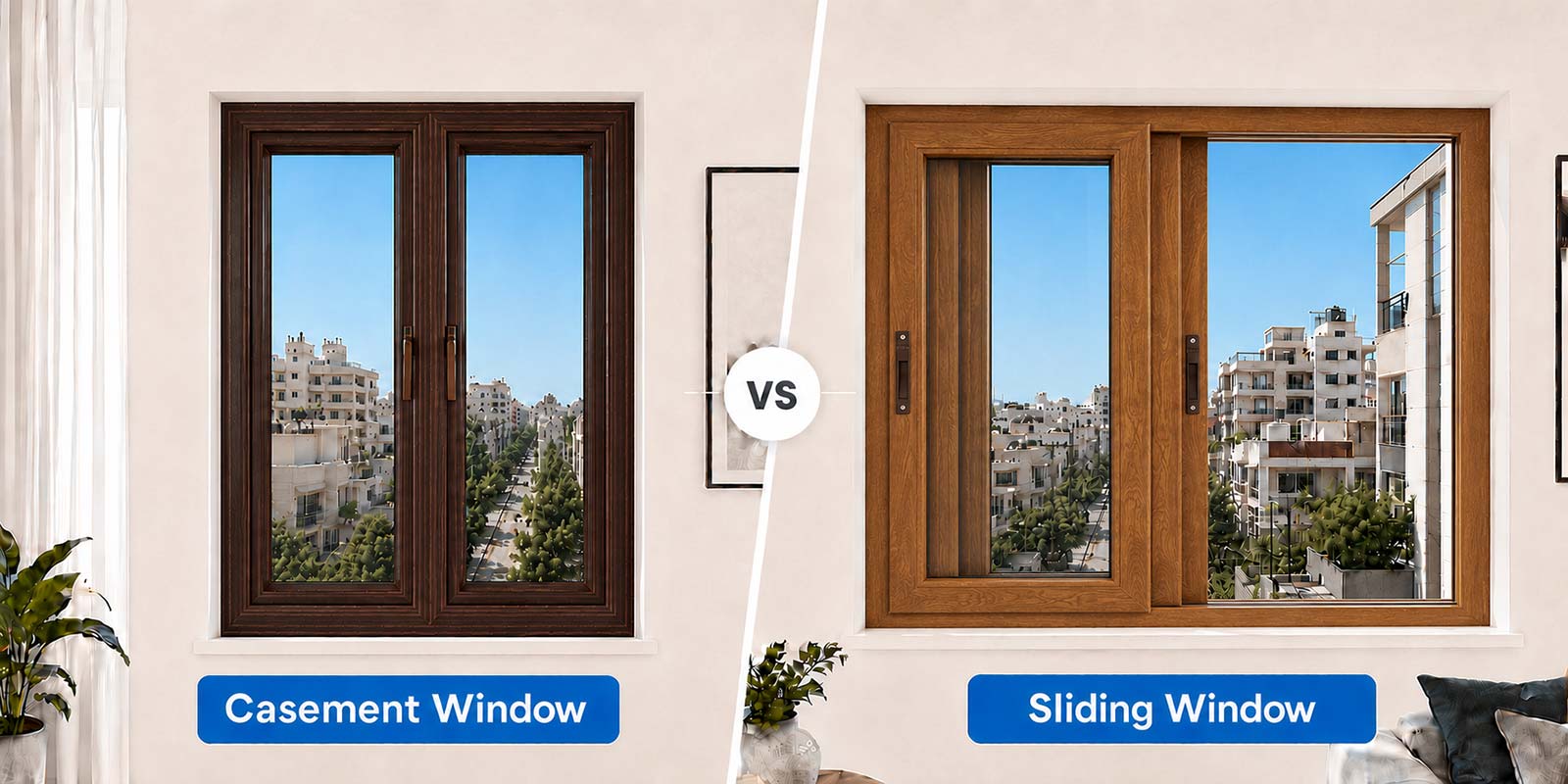
Choosing between a casement window vs sliding window is one of the first decisions you make when specifying uPVC windows for a home. Both are excellent choices: both are energy efficient, both are secure, and both last for decades in Indian conditions. They simply open in different ways — and that difference is what makes each one the natural fit for a particular room, opening shape and lifestyle.
This guide compares sliding and casement windows across the factors that shape the decision — space, airflow, sealing, energy efficiency, weather resistance, security, maintenance, cost and hardware — so you can match the right window to each opening in your home.
Quick Answer: Casement Or Sliding Window?
Casement windows are hinged at the side and swing open like a door, so the full opening clears for airflow and the sash closes tight into the frame — a natural fit for bedrooms, kitchens, study rooms and tall, narrow openings where maximum ventilation and a snug seal matter. Sliding windows glide horizontally on a track and stay within the plane of the wall, so nothing projects into the room — a natural fit for balconies, passages, wide walls and high-rise apartments where space and large, uninterrupted views matter. Both deliver strong thermal insulation and security when properly specified, so the right choice comes down to the room, the shape of the opening and how you like a window to work.
Casement Vs Sliding Windows: At-a-glance Comparison
Factor |
Casement uPVC Window |
Sliding uPVC Window |
| Opening mechanism | Side-hinged sash swings in or out | Sash glides horizontally on a track |
| Airflow pattern | Full opening ventilates; catches side breezes | About half the width opens at a time; steady, easy airflow |
| Sealing method | Sash compresses into the frame | Brush and weather seals along the track |
| Energy efficiency | Energy efficient; compression seal limits air leakage | Energy efficient; multi-chamber profile and seals limit air leakage |
| Space / clearance | Needs swing clearance in or out | Stays within the wall; nothing projects out |
| Best opening shape | Tall, narrow openings | Wide openings (wider than they are tall) |
| Span suitability | Ideal for standard room openings | Suited to very large spans and feature walls |
| High-rise suitability | Well suited, with swing clearance planned | Well suited; flush, with no external swing |
| Weather performance | Compression seal closes tight against rain | Multi-chamber tracks with weep-hole drainage |
| Security | Multi-point locking pulls the sash to the frame | Multi-point locking with anti-lift interlocks |
| Cleaning | Both faces reachable from inside | Easy at low level; outer pane via mesh removal upstairs |
| Maintenance focus | Hinges, stays and handles | Tracks and rollers |
| Commonly chosen for | Bedroom, kitchen, study, pooja room | Balcony, living room, passage, utility |
What Are Casement Windows?
A casement window is hinged on one side and opens outward (or, less commonly in India, inward) like a door, operated by a handle and held in position by a friction stay. Because the sash swings clear of the frame, the entire opening is available for airflow, and when you close and lock it, the sash is drawn tight against the frame — forming a compression seal that keeps out air, dust, rain and noise. Casement windows suit tall, narrow openings and rooms where you want to throw the window wide open.
What Are Sliding Windows?
A sliding window has two or more sashes that glide horizontally along a track; typically one sash stays fixed while the other slides across it. Nothing swings into the room or out over a balcony, which is why sliding windows are a favourite in Indian apartments and in any busy or compact space. A sliding casement window — a term some buyers use for a horizontally-sliding uPVC unit — offers effortless one-hand operation, slim frame lines and wide, uninterrupted views, with roughly half the opening ventilating at a time.
The Detailed Comparison
-
Space and clearance
In compact urban homes, every inch counts. Sliding windows open within the plane of the wall, so they never intrude on a room, a balcony walkway, a planter or a piece of furniture — which makes them a natural fit above the kitchen sink, along corridors, on balconies and in high-rise apartments. Casement windows use a swing arc, indoors or outdoors, so they work best where that arc is clear — which is most bedrooms, studies and standard wall openings. If clearance is your main constraint, sliding fits neatly; if the opening is unobstructed, a casement’s swing is a non-issue.
-
Airflow and ventilation
The two windows ventilate in different ways. A casement opens fully, so the whole aperture is available to the breeze, and the open sash can even funnel side winds into the room — useful for cross-ventilation. A sliding window ventilates roughly half its width at a time, giving steady, easily-adjusted airflow that’s simple to fine-tune with one hand. Both keep a room fresh; a casement is the one to choose when you want to open a room up completely, while a slider suits day-to-day, effortless ventilation.
-
Sealing and energy efficiency
Both casement and sliding uPVC windows are energy efficient, and both help reduce cooling loads and electricity bills compared with conventional frames — uPVC’s multi-chamber profile is an excellent insulator in either style. The difference is in how each achieves its seal. A casement’s sash compresses into the frame when locked, giving a snug compression seal. A sliding window seals with brush and weather strips along the track, engineered to keep out dust, draught and noise while allowing the sash to glide. Specifying double glazing and quality gaskets raises thermal and acoustic performance further in both styles, so energy efficiency is a question of specification, not of choosing one type over the other.
-
Weather and rain resistance
Both styles handle the Indian monsoon well when they’re properly engineered. A locked casement’s compression seal closes tight against driving rain. A quality sliding window manages water through design instead — multi-chamber tracks and weep holes channel rainwater out and away. The key in both cases is the quality of the profile, gaskets and installation, which is where a branded, engineered system makes the difference.
-
Security
Both window types are secure when specified well. Casement windows typically use multi-point locking that engages the sash to the frame at several points. Sliding windows pair multi-point locks with anti-lift interlocks that prevent a locked sash being lifted off its track. In both styles, laminated or toughened glass and quality branded hardware add further protection. Security is determined by the hardware and glass you specify, not by the opening mechanism.
-
Maintenance and cleaning
Both are low-maintenance uPVC — no painting, no rust, no rot — with slightly different care routines. A sliding window’s tracks and rollers benefit from a regular vacuum and wipe, which keeps the sash gliding smoothly for years. A casement’s hinges, handles and stays appreciate occasional lubrication. For cleaning glass, a casement lets you reach both faces from inside, while a sliding window is easy to clean at low level and, on upper floors, through a removable mesh panel.
-
Cost
This answers the common casement vs sliding windows cost question. Both casement and sliding uPVC windows are available across a wide range of budgets, and the final price of either is shaped far more by what you specify than by the opening style: profile system, glazing (single, double or laminated), hardware grade, mesh, size and finish all move the number. A casement uses hinges and friction stays; a slider uses tracks and rollers. Because rates vary widely by city, size and specification, compare quotes on a per-square-foot installed basis.
-
Aesthetics and views
Sliding windows have slim frame lines and wide glass panes that create clean, horizontal, panoramic views — a natural fit for modern, minimalist interiors and open-plan spaces flowing onto a balcony. Casement windows frame views with a little more depth and character and can be divided into panes for a classic look, suiting villas and heritage-style homes. This one comes down to the architecture and your taste.
Window Hardware Explained: Stays, Hinges, Rollers And Locks
Hardware is where a window quietly succeeds or fails, and it’s the part most guides skip — including the question behind searches for sliding casement window stays.
- Friction stays: the hinged, sliding arm on a casement window that lets the sash open, hold at any angle and stay put against a breeze without a separate prop. Quality stainless-steel friction stays are what keep a casement opening smoothly and holding securely for years.
- Multi-point / espagnolette locking: on a casement window, a single handle throws multiple locking points around the frame, drawing the sash tight for both security and sealing.
- Rollers and tracks: on a sliding window, rollers carry the sash along the track. Good-quality rollers and clean tracks are what keep a slider gliding effortlessly; if one starts to drag, the rollers usually need cleaning, lubricating or replacing — not the whole sash.
- Anti-lift interlocks: interlocking sash profiles and anti-lift blocks stop a locked sliding sash being lifted off its track — a key security detail on sliding windows.
- Brush and weather seals: the strips that seal a sliding sash along the meeting rail; replace them when they harden to keep out dust and noise.
Whichever style you choose, hardware quality is what determines how well it performs over the years — which is where a branded, engineered system pulls clearly ahead of low-cost local fabrication.
Which Should You Choose? A Room-by-room Guide
Neither style is better overall — each simply fits certain rooms more naturally. Use this as a starting point, then specify to your own priorities:
Room / situation |
Commonly suits |
Why |
| Bedroom | Casement | Full airflow and a snug seal for quiet, restful, well-insulated rooms |
| Living room (wide wall) | Sliding | Wide spans and slim sightlines with no swing into the room |
| Kitchen (over the sink) | Sliding | Easy one-hand operation across a reach; nothing swings over the counter |
| Kitchen (ventilation-led) | Casement | Full opening clears smoke, steam and cooking odours quickly |
| Balcony / sit-out | Sliding | Stays flush with the wall; nothing swings over the walkway |
| Study / pooja / quiet room | Casement | Compression seal supports excellent sound insulation |
| High-rise apartment | Sliding | Flush profile with no external swing; space-efficient |
| Coastal / heavy-monsoon home | Either, well specified | Both perform well with quality seals, drainage and corrosion-proof hardware |
| Narrow, tall opening | Casement | Suits the proportion of the opening |
| Wide, feature opening | Sliding | Designed for large spans and panoramic glass |
Can You Use Both Casement And Sliding Windows In One Home?
Yes — and most well-designed homes do. There’s no rule that a house must pick one style. Architects routinely mix sliding and casement windows to suit each room: casements where you want to open a room right up (bedrooms, study), sliders where space and wide views matter (living room, balcony, kitchen sink wall). Using the same uPVC profile family across both keeps the exterior visually consistent while letting each window do the job it’s best suited to.
Why uPVC For Both Styles?
Whichever style you choose, uPVC is an excellent frame material for Indian homes: strong thermal and acoustic insulation, termite-proof and rust-proof, no repainting, and a long service life in Indian weather. Multi-chamber profiles with galvanised steel reinforcement handle large spans and wind loads, and uPVC is fully recyclable. These advantages apply equally to sliding and casement windows — the choice between them is about mechanism and fit, not durability or efficiency.
Aparna Enterprises: Engineered uPVC Windows, Built For Indian Conditions
Aparna Enterprises manufactures both sliding and casement uPVC windows engineered for Indian climate, dust and monsoon conditions — with precision-fit tracks and seals that limit air leakage, corrosion-proof hardware, and double-glazing and mesh options for sound, security and energy performance. Frames, glazing thickness, colour finishes and hardware can all be specified to the room, so each opening in your home gets the window style that suits it best — backed by the quality control and after-sales support of a branded system.
Planning windows for a new home or a replacement project? Talk to the Aparna Enterprises team for a specification tailored to your rooms.
Frequently Asked Questions
Yes. In India, outward-opening casement windows are far more common because they don’t intrude on the room, but inward-opening versions are available and are chosen where external clearance is limited or where cleaning access from inside matters.
Yes. Sliding windows use a separate sliding mesh panel on an added track, while casement windows use a fixed or hinged mesh on the inside. Both keep insects out while still allowing airflow.
Sliding windows are designed to span wider openings, because the sash weight is carried on a track. A casement sash is sized to swing on hinges and seal cleanly, which suits standard room openings. For a very wide feature wall, a sliding unit or a fixed-plus-casement combination is the usual approach.
Sliding windows are the simplest to use, needing only a light horizontal push. Casement windows use a handle turn and, for outward-opening units, a little reach to push the sash out — easy at most openings, though a slider may be preferable over a deep counter.
Usually yes, within the same opening, but the frame, hardware and sometimes the sill detail change, so it’s a full window replacement rather than a simple sash swap. Have the opening measured before deciding.
Start Your Project with the Right Materials
We provide everything you need for modern construction. Connect with our experts to discuss your requirements and get the best solution for your project. Submit your details and our team will contact you soon.
CORPORATE OFFICE
8-2-293/82/A, Plot No-1214, Road No-60,
Jubilee Hills, Hyderabad-500 033.