
Composite Doors Vs uPVC Doors: Which Is Better For Your Home?
In This Article
Composite doors and uPVC doors are both durable, low-maintenance and secure — but they suit different needs. A composite door is thicker, stronger and closest to real timber in look, which makes it a popular choice for a statement front entrance. A uPVC door is lighter, easier to maintain, highly resistant to heat and moisture, and far simpler to source and service — making it the practical choice for most doors across a home. The right pick depends on where the door goes, the climate it faces, and how much upkeep and availability matter to you.
The quick verdict
Choose a composite door if you want a premium, timber-look front entrance with maximum thickness and top-tier security — and reliable installation and service are available to you.
Choose a uPVC door if you want dependable performance in hot, humid or coastal conditions, effortless maintenance, easy customisation, and simple sourcing, servicing and replacement — the practical choice for most doors in a home.
What Is A uPVC Door?
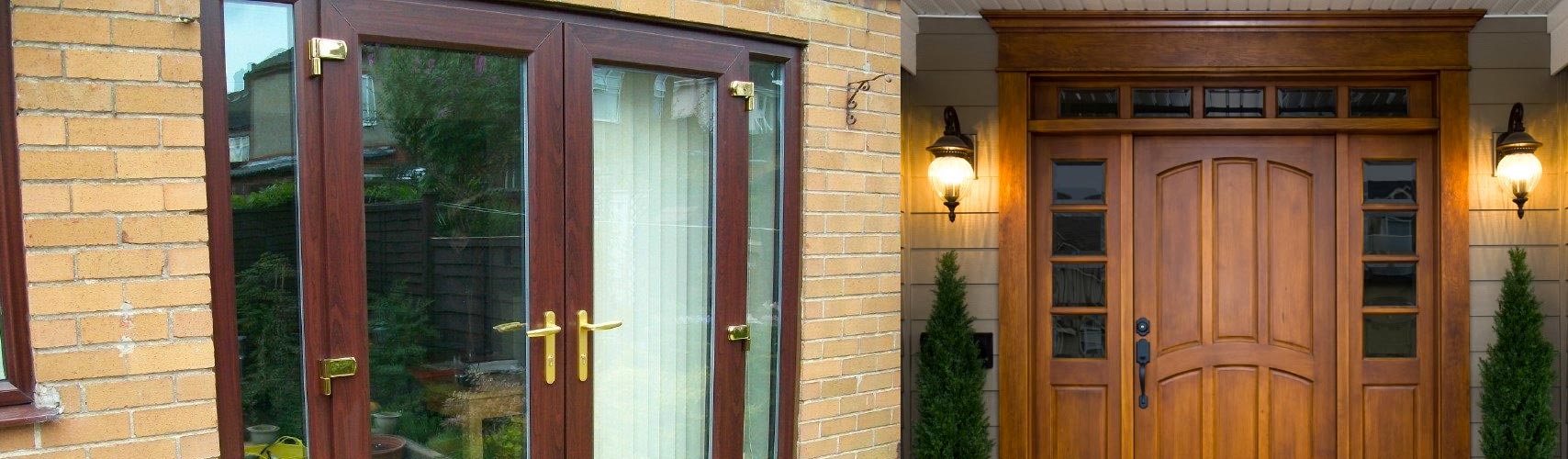
uPVC (unplasticised polyvinyl chloride) is a rigid, weather-resistant form of PVC used widely for windows and doors. A uPVC door is built around a reinforced, multi-chamber frame sealed in this tough plastic, usually fitted with double-glazed panels and a multi-point locking system. It is valued for being lightweight, low-maintenance, energy-efficient and highly resistant to moisture, warping and corrosion. Modern uPVC doors come in a wide range of colours and realistic wood-grain laminate finishes, so they no longer resemble the plain white doors of the past.
- Rigid and corrosion-proof — unaffected by moisture or humidity
- Very low maintenance; an occasional wipe keeps it looking new
- Good thermal and sound insulation from sealed, double-glazed units
- Multi-point locking for dependable everyday security
- Wide choice of colours and wood-grain laminations
- Widely manufactured — easy to source, customise, service and replace
What Is A Composite Door?
A composite door is made from several materials bonded together under high pressure — typically a solid timber or high-density foam core, an outer skin of glass-reinforced plastic (GRP), and often a supporting uPVC or timber sub-frame. This layered construction is what gives the door its defining qualities: it is thicker and heavier than a single-material door, closely mimics the look and feel of real wood, and offers excellent strength and security. Composite doors are most often chosen as front entrance doors, where appearance and robustness are the priority.
- Multi-material build (GRP skin over an insulating core) for high strength
- Thicker and more solid than a standard uPVC door
- Authentic timber-look finish with strong kerb appeal
- Excellent thermal insulation and security
- Long service life
- A more specialised product — narrower availability and fewer service options in some markets
Composite Doors Vs uPVC Doors: A Head-to-head Comparison
The table below sets both doors side by side across the factors that decide most purchases:
Factor |
uPVC door |
Composite door |
| Core construction | Reinforced multi-chamber uPVC frame with sealed glazed panels | Timber or high-density foam core with a GRP outer skin, bonded under high pressure |
| Strength & thickness | Sturdy, but lighter and slimmer | Thicker, heavier and more solid |
| Security | Multi-point locking; dependable everyday security | Multi-point locking on a denser, harder-to-breach slab; superior |
| Appearance | Wide colour range and realistic wood-grain laminates | Closest to real timber; premium kerb appeal |
| Thermal insulation | Very good | Excellent |
| Moisture & humidity resistance | Excellent — will not absorb water, rot or corrode | Very good; depends on core quality and edge sealing |
| Heat & sun resistance | High resistance to warping and discolouration | Good; premium builds resist warping well |
| Maintenance | Minimal — an occasional wipe | Low — occasional wipe and hinge/lock care |
| Lifespan | Long — roughly two to three decades | Long — often three decades or more |
| Sound insulation | Good | Very good |
| Availability & servicing | Widely made; easy to source, service and replace | More specialised; fewer suppliers and service options in some markets |
| Best suited to | Most doors across a home; hot, humid or coastal settings | Statement front doors where look and robustness lead |
Strength And Security: Which Door Is More Secure?
Both door types use multi-point locking as standard, so both offer solid everyday security. The difference lies in the door slab itself. A composite door is thicker and denser, with a GRP skin over a solid core, which makes it harder to force or damage — so for a front entrance where maximum resistance matters, composite has the edge. A uPVC door, while lighter, still provides dependable security for the vast majority of homes and is more than adequate for internal doors and most external openings.
Weather, Heat And Moisture Resistance
This is where uPVC quietly excels. uPVC does not absorb water, rot, rust or corrode, and it holds up extremely well against humidity, heavy rain and salt-laden coastal air — the conditions that punish timber and can, over time, test the edges and core of a lower-quality composite door. uPVC also resists warping and discolouration under strong heat and sunlight. A well-made composite door performs well in most conditions too. Still, its timber content means core quality and edge sealing matter more for long-term durability in harsh, humid environments.
Thermal Efficiency And Comfort
Both doors insulate far better than untreated timber. Composite doors, with their dense multi-layer core, typically hold a slight edge in raw thermal performance. uPVC doors with sealed, double-glazed units are close behind and keep interiors comfortable while reducing heat transfer — which, in warm conditions, means helping keep cool air in and heat out.
Appearance And Design Options
A composite door is the closest you will get to the look and feel of solid timber without the upkeep, which is why it is favoured for premium front entrances and strong kerb appeal. uPVC has closed much of the aesthetic gap: today’s uPVC doors come in a broad palette of colours and realistic wood-grain laminate finishes that let you coordinate a home’s windows and doors for a consistent look.
Maintenance And Upkeep
Both are low-maintenance compared with wood — no sanding, painting or sealing. uPVC is about as fuss-free as a door gets: an occasional wipe with mild soapy water keeps it looking new. Composite doors need only slightly more attention, such as periodic cleaning and occasional oiling of hinges and locks.
Lifespan And Durability
Both are long-term investments. A quality uPVC door commonly lasts two to three decades with minimal care and will not warp or discolour easily. A composite door can last three decades or more, helped by its robust construction. In demanding, humid or coastal conditions, uPVC’s complete immunity to moisture gives it a consistency advantage across the many doors of a typical home.
Availability, Servicing And Replacement
A practical point that is easy to overlook: uPVC doors are widely manufactured and easy to source, customise, service and replace, with established supply and support networks. Composite doors are a more specialised category, and in many markets suppliers, spare parts and after-sales service are harder to come by. For a homeowner who wants dependable long-term support — not just a good door on day one — availability and serviceability can matter as much as the door itself.
Which Door Should You Choose?
The best choice depends less on which door is “better” overall and more on the job you need it to do.
If your priority is… |
Better choice |
| A premium statement front door, where looks and robustness lead | Composite (where reliable supply and service exist) |
| Most external and internal doors across a home | uPVC |
| Hot, humid, high-rainfall or coastal conditions | uPVC |
| Lowest possible maintenance and easy servicing/replacement | uPVC |
| A consistent look across your windows and doors | uPVC |
| The absolute thickest, most timber-like door slab | Composite |
How To Decide: A Quick Checklist
Before you choose, ask yourself:
- Where is this door going — a showcase front entrance, or one of many doors in the home?
- What climate will it face — humid, coastal, high heat, heavy rain?
- How important is a real-timber look versus a wide choice of colours and finishes?
- How much maintenance are you realistically willing to do?
- Is reliable supply, servicing and replacement available for the option you are considering?
- Do you want visual consistency between your windows and doors?
If your answers lean toward showcase appearance and peak robustness, a composite door is worth considering. If they lean toward all-round durability, easy upkeep, moisture and heat resistance, and dependable availability, a uPVC door is the more practical choice for most homes.
Takeaway
Composite and uPVC doors are both strong, secure and low-maintenance choices that comfortably outperform untreated timber. A composite door stands out for a premium, timber-look front entrance with maximum thickness and security. A uPVC door stands out for all-round durability, effortless maintenance, excellent moisture and heat resistance, easy customisation and dependable availability — which makes it the practical, long-lasting choice for most doors in a home.
With decades of expertise in uPVC windows and doors, Aparna Enterprises engineers uPVC doors built for strength, energy efficiency and lasting performance in demanding conditions — with the finish options and reliable support to match. Explore the full range of uPVC windows and doors from Aparna Enterprises to find the right fit for every doorway in your home.
Frequently Asked Questions
It depends on your needs. A composite door is stronger and more timber-like, ideal for a statement front entrance. A uPVC door is lighter, lower-maintenance, more moisture- and heat-resistant, and easier to source and service — making it the more practical choice for most doors in a home.
Both use multi-point locking. A composite door’s thicker, denser slab makes it harder to force, so it has a slight security edge for front entrances. uPVC doors still offer dependable security for the vast majority of homes.
Both are long-lasting. A quality uPVC door typically lasts two to three decades, and a composite door often three decades or more. In humid or coastal conditions, uPVC’s complete resistance to moisture gives it a consistency advantage.
Not anymore. Modern uPVC doors come in a wide range of colours and realistic wood-grain laminate finishes and can be matched to a home’s windows for a coordinated look — though a composite door still offers the most authentic solid-timber appearance.
uPVC. It does not absorb moisture, rot or corrode, and it resists warping in strong heat and sunlight, making it especially well-suited to humid, high-heat and coastal environments.
If you want a premium, timber-look front door with maximum thickness and robustness — and reliable supply and service are available to you — a composite door can be worth it. For most other doors, a quality uPVC door delivers excellent durability and all-round performance.
Start Your Project with the Right Materials
We provide everything you need for modern construction. Connect with our experts to discuss your requirements and get the best solution for your project. Submit your details and our team will contact you soon.
CORPORATE OFFICE
8-2-293/82/A, Plot No-1214, Road No-60,
Jubilee Hills, Hyderabad-500 033.