
Double Charge Vitrified Tiles: Thickness, Designs & How to Identify Them
In This Article
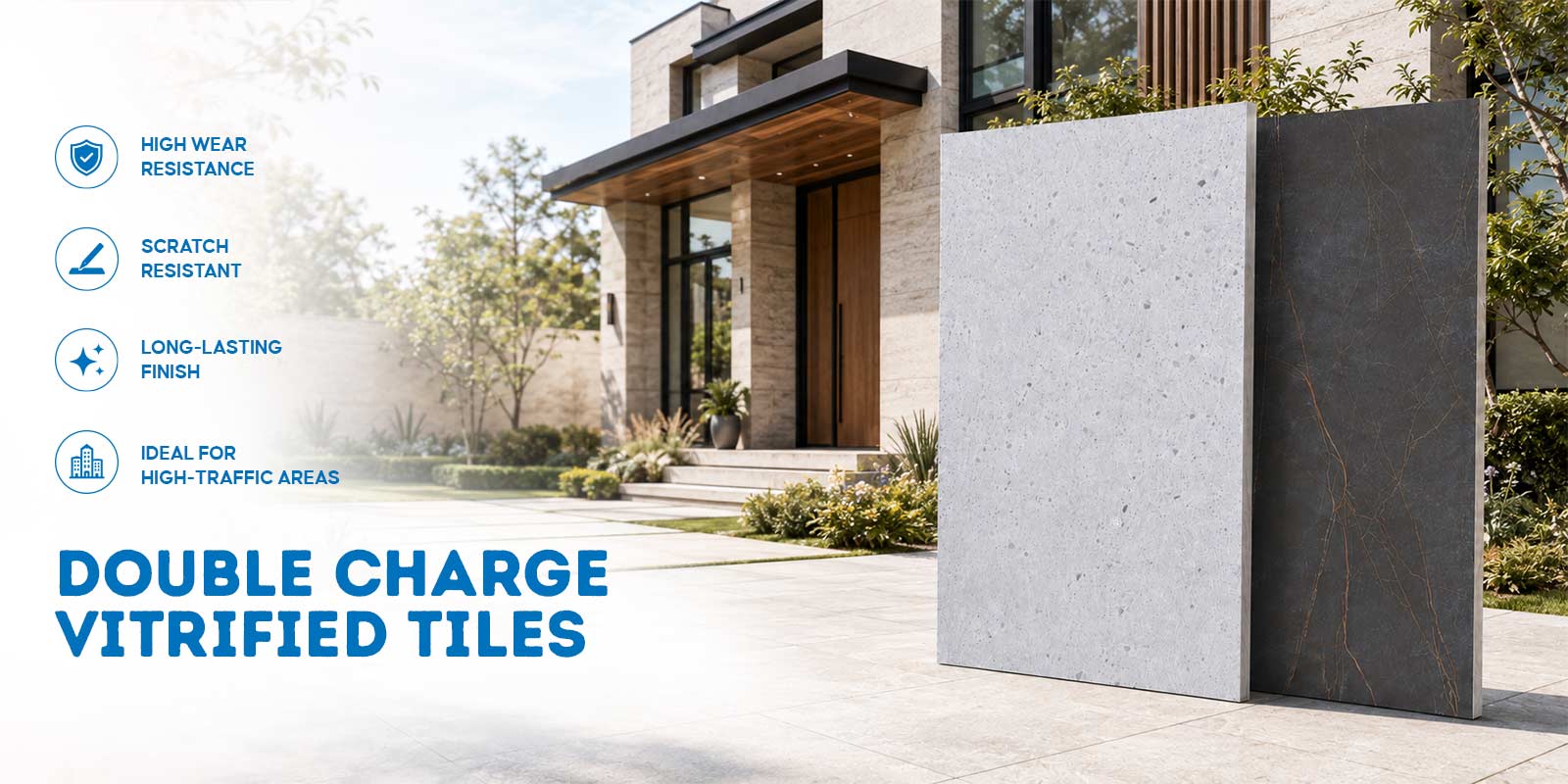
Double charge vitrified tiles are durable, heavy-duty floor tiles. They are made by pressing two layers of coloured clay together with high pressure. This creates about a 3–4 mm thick, hard top layer to resist wear. The tiles don’t absorb water (less than 0.5% water absorption) and can resist scratches, stains, and fading. They also offer a more cost-effective alternative to natural marble and granite over the long term due to their durability and low maintenance. They are also called twin tiles.
If you need flooring without losing its appeal, double charge vitrified tiles are a good choice. They have a thick, tough surface, so they work well in both homes and commercial buildings. They are also easy to maintain.
This write-up covers what double-charge vitrified tiles are, their benefits, specifications, how they’re made, where to use them, and their comparison with other tile types.
What Are Double Charge Vitrified Tiles?
Double charge vitrified tiles are strong floor tiles, which are built for heavy use. Because the surface doesn’t absorb water, it’s a good choice for busy areas like offices and homes. They last a long time, need low maintenance, and cost less than marble or granite.
Advantages of Double Charge Vitrified Tiles
DCVT is durable, resistant to scratches, easy to maintain, colour consistent, tolerates traffic, and hygienic.
- Durable: The top layer handles high traffic and impact for several years because they are manufactured using a dual-layer pigment press fused with raw materials (clay, quartz, and feldspar) at high temperatures. This creates an ultra-dense, non-porous structure with a 3–4 mm thick wear layer.
- Resists scratches and stains: They are highly resistant to scratches because their top 3–4mm layer is solid. Their stain resistance comes from the vitrification process, which leaves no pores, so liquids cannot penetrate the surface to leave a stain.
- Easy to maintain: They are easy to clean because they do not attract stains and dirt. These tiles can be easily mopped with warm water.
- Colour stays consistent: Since colour runs through the 3–4 mm upper layer of the tile body, they do not reveal a different shade underneath.
- Good for heavy traffic: They are compressed under hydraulic pressure, making them suitable for offices, malls, and other public spaces.
- Non-porous and hygienic: The water absorption ratio is under 0.5%, limiting bacteria and stains. So they are good for kitchens and clinics.
- Saves money long-term: Though they generally cost more than ceramic tiles initially, their durability and low maintenance make them cost-effective over the long term. They eliminate recurring sealing, polishing, and premature replacement costs.
- Eco-friendly and safe: It contains natural clay and minerals, which do not emit Volatile Organic Compounds (VOCs), toxins, or formaldehyde. This is because the tiles become inert after firing.
Double Charge Vitrified Tiles Specifications
Specification |
Typical Value |
| Composition | Two fused layers of clay and minerals |
| Top (Double Charge) Layer | 3–4 mm |
| Overall Thickness | 8–12 mm |
| Water Absorption | Below 0.5% |
| Common Sizes | 600×600 mm, 600×1200 mm, 800×800 mm |
| Available Finishes | Matte, Polished, Anti-skid, Textured |
How Are Double Charge Vitrified Tiles Made?
Double charge vitrified tiles are manufactured by pressing two layers of pigment into the tile body. It involves steps like preparation of material, dual-layer pressing, vitrification, and nano-polishing.
- Material Preparation: At first, a homogeneous powder is made by mixing raw materials – clay, quartz, feldspar, and silica.
- Dual-Layer Pressing: The raw mixture is then passed into a high-capacity press in two layers – the base layer (main tile body) and the top layer (pigments and patterns).
- Vitrification (Firing): The pressed tiles are heated at temperatures between 1200°C and 1250°C. When heated at such a high temperature, the raw materials melt together and fuse two layers into a dense mass.
- Nano-Polishing: Once they are cooled, the surface is nano-polished to achieve an ultra-smooth, glossy finish. This makes the tile resistant to stains, scratches, and high traffic.
Best Places to Use Double Charge Vitrified Tiles
DCVT tiles are used at malls, airport terminals, living and kitchen rooms, entryways, hospitals, and office spaces.
- Mall Corridors & Airport Terminals: They are used widely in showrooms and lobbies to maintain a glossy, premium aesthetic under high traffic.
- Residential Flooring: Double charge tiles are used in living rooms, kitchens, entryways, and staircases because they resist scratches from dragged furniture and handle high-velocity foot traffic.
- Healthcare Environments: There is very little scope for bacteria to hide because it reduces microscopic hiding places for bacteria due to the <0.5% water absorption rate. This makes it resists common cleaning and disinfecting agents.
- Waiting Rooms: Support heavy medical machinery, wheelchairs, and stretchers without cracking under high point loads, but it requires a perfectly flat and void-free subfloor.
- Professional Offices: Used in office layouts and workspaces, utility, and server rooms because they shrug off friction and scraping and resist stress.
Trending Designs
Marble and stone looks: Copies the look of natural marble or granite, at a lower cost and with better durability.
- Neutral colours: Greys, beiges, ivory, and whites suit most modern interiors and decors, making them a popular choice.
- Large tiles: Large-sized tiles like 800 × 800 mm or 600 × 1200 mm are the latest trend. Also, fewer grout lines make rooms look much larger.
- Glossy finish: Polished double charge vitrified tiles are a living popular choice for offices, showrooms, and other dry indoor spaces. They reflect light and create a premium appearance. They are best suited to areas where slip risk is low.
- Textures and patterns: DCVT features gentle, flowing veins that mimic marble, and it also offers a speckled salt-and-pepper texture.
- Matte or high-grip finishes: Matte and textured finishes are preferred for kitchens, bathrooms, entryways, hospitals, and other wet or high-traffic areas because they offer better slip resistance while maintaining durability.
A comparison of Double Charge, Glazed Vitrified (GVT), and Full Body tiles helps you in selecting the right tiles.
Double Charge vs. GVT (Glazed Vitrified Tiles)
Feature |
Double Charge |
GVT |
| Top layer | 3–4 mm coloured body | Thin printed glaze (under 1 mm) |
| Design range | Limited colours and patterns | Nearly unlimited (digital printing) |
| Durability | Very high — pattern survives wear | Surface design can wear over time |
| Best for | Heavy-traffic floors | Walls and design-focused spaces |
| Cost | Mid-range | Mid to high, depending on design |
Double Charge vs. Full Body Vitrified Tiles
Feature |
Double Charge |
Full Body |
| Colour depth | Top 3–4 mm layer only | Same colour all the way through |
| Wear behaviour | Excellent | Best — chips barely show |
| Cost | Lower than full body | Higher |
| Best for | Most homes and businesses | Extreme-wear industrial spaces |
Why Choose Aparna Enterprises Double Charge Vitrified Tiles?
Buying from a trusted manufacturer means you get consistent quality and reliable performance. Aparna Enterprises’ double charge vitrified tiles are built to last long and are tested for accurate sizing, surface hardness, and low water absorption.
Aparna Enterprises’ tiles are IS 15622 and GreenPro certified [1], which means they are durable, safe, and made using eco-friendly, sustainable methods.
Takeaway
Double charge vitrified tiles are a practical, durable, and long-lasting flooring choice for homes and businesses. They combine a strong surface and low upkeep, making them a popular pick for busy areas. Their long life makes them a smart, cost-effective investment.
Choose reliable quality with Aparna Enterprises and create flooring that lasts for years — reach out today for guidance and the best tile options.
Frequently Asked Questions On Double Charge Vitrified Tiles
Have a look at the edges of the tile; they feature two layers. The top layer contains colours and pigment (3-4 mm). The tiles are also thicker than standard tiles, i.e, 8 mm to 12 mm. They feel heavy, the colour stays consistent through the top layer, and the design won’t peel or scratch off easily.
Yes, but they’re suitable for floors. On walls, they need a high-strength (C2) adhesive and, above a certain height, mechanical support. For feature walls, lighter glazed tiles are usually the better choice.
Double charge tiles have a thick 3–4 mm coloured top layer. Digital tiles use inkjet-printed designs on a thin glaze. So choose double charge for heavy-traffic floors, and digital for more design variety.
600×600 mm size is the most common double charge tile. It suits homes, offices, and showrooms. They are also easy to lay and come with fewer grout lines.
Double charge tiles carry their design in a thick coloured body, while GVT carries it in a thin surface glaze. Double charge wins on floor durability, while GVT wins on design range and wall use.
Full body tiles have the same colour all the way through, so chips barely show — great for extreme-wear areas. Double charge tiles have a 3–4 mm coloured top layer, offering strong durability at a lower cost for most spaces.
They have a smaller range of designs and colour options compared to digital GVT. They cost more than ceramic tiles and need professional installation because of their weight and size.
Start Your Project with the Right Materials
We provide everything you need for modern construction. Connect with our experts to discuss your requirements and get the best solution for your project. Submit your details and our team will contact you soon.
CORPORATE OFFICE
8-2-293/82/A, Plot No-1214, Road No-60,
Jubilee Hills, Hyderabad-500 033.