
Tiles Manufacturer in Morbi | A Buyer’s Guide to Choosing the Right Supplier
In This Article
Morbi, Gujarat is India’s largest tile manufacturing hub — a cluster of more than 800 ceramic and vitrified tile units (several industry estimates place the figure above 1,000) that produces the overwhelming majority of the country’s tile output and roughly 13% of the world’s ceramic production. For builders, dealers, architects, and international importers, sourcing from Morbi means factory-direct pricing, enormous design variety, and export-grade manufacturing infrastructure. But with hundreds of factories making broadly similar claims, choosing the right partner is the hard part. This guide explains how the Morbi cluster works, which tiles it produces, how to evaluate a manufacturer step by step, what buying directly involves, and the mistakes that cost buyers the most.
Why Is Morbi Called The Ceramic Capital Of India?
Morbi is called the Ceramic Capital of India because this one district in Gujarat’s Saurashtra region produces most of the nation’s ceramic and vitrified tiles, hosts the world’s second-largest ceramic cluster after China’s Guangdong province, and carries the Government of India’s official “Town of Export Excellence” designation for ceramics.
A Brief History Of Morbi’s Tile Industry
Morbi’s tile story began with Naliya — traditional clay roofing tiles — manufactured here for generations using local clay deposits. The real transformation came after economic liberalisation in the 1990s, when family-run units began importing modern presses and kilns and shifted to ceramic wall and floor tiles. The arrival of an industrial gas pipeline in 2008, digital printing technology in the 2010s, and a wave of investment in vitrified tile plants turned a regional pottery town into a global manufacturing powerhouse. Factories now line the 8-A National Highway between Wankaner and Morbi, extending along the Halvad and Jetpar roads.
What Types Of Tiles Are Manufactured In Morbi?
Morbi manufactures the full spectrum of tiles: ceramic wall and floor tiles, vitrified tiles (including GVT, PGVT, double charge, and full body), porcelain and large-format slabs, parking and elevation tiles, and allied products such as sanitaryware. It is the only cluster of its kind where every major tile category is produced within a single district.
Ceramic Wall & Floor Tiles
Ceramic tiles are the cluster’s original product line – clay-based, kiln-fired, and glazed. They remain the most economical choice for residential walls and light-traffic floors, typically produced in sizes such as 30×45 cm and 30×60 cm for walls and 40×40 cm for floors, in thousands of digitally printed designs.
Vitrified Tiles (GVT, PGVT, Double Charge, Full Body)
Vitrified tiles are the fastest-growing segment of Morbi’s output, and the one driving most new plant investment. Manufactured by vitrifying a blend of clay, silica, quartz, and feldspar at high temperature, they achieve water absorption below 0.5%, which makes them denser, stronger, and more stain-resistant than standard ceramic tiles. The main families are:
- Glazed Vitrified Tiles (GVT): A digitally printed glaze layer allows almost unlimited designs, wood, marble, stone, and concrete looks, in matt, satin, and carving finishes.
- Polished Glazed Vitrified Tiles (PGVT): The same construction with a high-gloss polished surface; the most exported product type from Morbi.
- Double Charge: Two layers of pigment pressed together create a thick design layer suited to heavy-traffic commercial floors.
- Full Body: Colour runs through the entire tile thickness, so wear and edge chips stay invisible — preferred for malls, airports, and industrial floors.
Common formats run from 60×60 cm and 60×120 cm up to 80×160 cm, with demand steadily shifting toward larger sizes for seamless floors.
Porcelain & Large-Format Slabs
Morbi’s newest plants produce porcelain slabs in formats as large as 120×240 cm and 160×320 cm – used for countertops, facades, and bookmatched feature walls. These lines compete directly with Italian and Spanish slab producers at significantly lower price points.
Parking, Elevation & Outdoor Tiles
Heavy-duty parking tiles (typically 30×30 cm in 8–12 mm thickness), anti-skid outdoor tiles, and front-elevation tiles round out the exterior range. These are engineered for load-bearing strength and weather resistance rather than fine surface finish.
Sanitaryware & Allied Products
Beyond tiles, the cluster manufactures sanitaryware, industrial ceramics, and technical ceramic products, useful for buyers who want to consolidate a full bathroom or project package from one sourcing trip.
How Do You Choose The Right Tiles Manufacturer In Morbi?
Choose a Morbi tile manufacturer by verifying certifications, inspecting manufacturing technology, testing quality parameters against IS/ISO standards, confirming production capacity for your order size, checking export and packaging experience, visiting the plant, and only then comparing prices. Price should be the last filter, not the first – the cheapest quote in a cluster this large almost always hides a compromise.
-
Check Certifications & Compliance
A serious manufacturer will hold ISO 9001 (quality management) and usually ISO 14001 (environmental management), with product compliance to BIS standards, and CE marking if they ship to Europe. For government or institutional projects in India, BIS/ISI compliance is frequently mandatory, so ask for certificates up front rather than after sampling.
-
Evaluate Manufacturing Technology
The cluster’s best plants run imported high-tonnage presses, modern roller kilns, and digital inkjet printing lines, with in-house R&D and quality labs. Technology matters because it controls the defects you cannot see in a showroom sample: size calibration, flatness, and shade consistency across thousands of boxes. Ask which press tonnage, kiln length, and printing systems a factory runs, manufacturers proud of their line will tell you precisely.
-
Verify Quality Parameters
Five checks separate export-grade tiles from seconds: water absorption (under 0.5% for vitrified), breaking strength, surface hardness (MOHS scratch scale), shade and calibre consistency between batches, and edge rectification accuracy. Request the factory’s lab test reports for the specific SKU you are ordering, not a generic brochure, and, for large orders, consider third-party pre-shipment inspection.
-
Assess Production Capacity & Consistency
For project or repeat orders, a manufacturer’s daily capacity and inventory discipline matter as much as quality. A plant running near full capacity may quote attractive prices but slip delivery dates; a plant with healthy capacity headroom can hold your shade lot for repeat orders. Ask for current lead times in writing and how long the factory archives shade references.
-
Review Export Experience & Packaging Standards
If you are importing, prioritise factories already shipping to your region. They will understand your market’s certification, labelling, and pallet/packaging norms, and their proximity to Mundra and Kandla ports keeps freight competitive. Ask for references in your country and check how breakage claims have been handled.
-
Visit the Plant or Ask for a Virtual Tour
Nothing replaces seeing a production line, the QC lab, and the finished-goods warehouse. Most reputable manufacturers in the Morbi belt welcome scheduled visits, and many now offer live video factory tours for international buyers. A factory that resists showing its line is telling you something.
-
Compare Pricing, MOQ & Payment Terms
Only after the checks above should quotes be compared — like-for-like on grade (premium vs. standard vs. commercial), thickness, and packing. Confirm minimum order quantities, advance/balance payment structure, and whether transport and loading are included. In a cluster with hundreds of suppliers, the goal is not the lowest price; it is the lowest price from a factory that passed every other filter.
The Manufacturing Landscape In And Around Morbi
The cluster is not confined to Morbi city. Factories spread across a belt of several hundred square kilometres — along the 8-A National Highway toward Wankaner, and outward along the Halvad and Jetpar roads — forming what industry observers describe as the world’s second-largest tile production zone. The region hosts every kind of producer: large national brands with multiple plants, export-focused units shipping to 160+ countries, OEM manufacturers producing private-label tiles for global retailers, and specialised single-category factories.
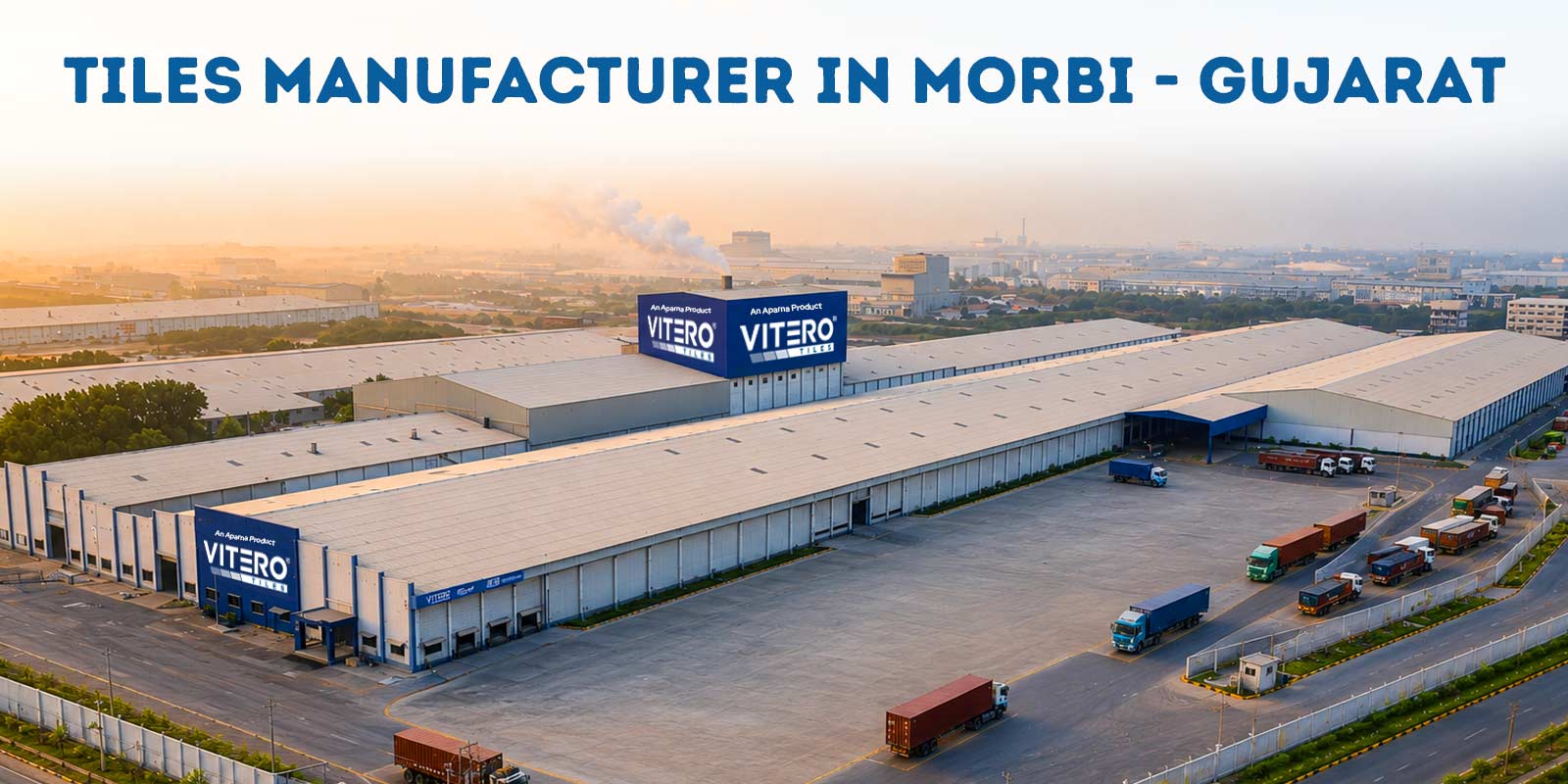
For example, Aparna Enterprises operates a modern tile manufacturing facility near Morbi, Gujarat, equipped with digital printing lines and automated quality-control systems, supplying residential and commercial projects across India. Facilities of this kind illustrate what buyers should look for in the belt: current-generation technology, documented quality processes, and a location with direct highway and port connectivity.
Locate Aparna Enterprises Manufacturing Facility below to check our address and find our exact location in Morbi, Gujarat:
Buying Tiles Directly From Morbi Manufacturers: Process, Pricing & Logistics
Buying directly from a Morbi manufacturer follows a standard sequence: enquiry and product selection, physical samples, a proforma invoice confirming specifications and price, advance payment, production and quality check, then dispatch by road for domestic orders or container shipment via Mundra/Kandla for exports. Done correctly, factory-direct buying removes one to two layers of trade margin.
How the B2B Buying Process Works
- Enquiry: share your requirement — tile type, size, grade, quantity, and destination — with shortlisted factories.
- Sampling: evaluate physical samples for design, finish, and calibre; approve a master sample in writing.
- Proforma invoice: confirms SKU, grade, packing, price, delivery timeline, and payment terms — read the grade definition carefully.
- Production & QC: for large orders, schedule an inspection (your own or third-party) before dispatch.
- Dispatch: domestic orders move by truck; export orders are containerised, with most factories experienced in mixed-design container loading.
How Pricing Works?
Ex-factory prices in Morbi are driven by tile type and size, surface finish, grade (premium/standard/commercial), order volume, and natural gas prices, which form a large share of production cost and cause genuine quote-to-quote movement. This is why credible manufacturers quote validity periods on their offers, and why published price lists go stale quickly.
MOQ, Lead Times & Dispatch
Minimum order quantities for export buyers typically start around 500–1,000 square metres, with meaningful discounts at container-load and multi-container volumes; domestic MOQs are often more flexible. Standard production lead times run from days for in-stock designs to a few weeks for made-to-order SKUs — always confirm in writing. Morbi’s proximity to Mundra and Kandla ports keeps export logistics fast and cost-competitive.
Dealer vs. Direct-from-Manufacturer: Which Is Better?
Buy direct when your volume is large enough to meet factory MOQs and you can manage inspection and logistics – the per-unit savings are real. Buy through a dealer when you need small quantities, immediate availability, on-site support, or easy returns. Many project buyers use a hybrid: direct factory supply for the main order, a local dealer for top-ups and breakage replacement.
Common Mistakes Buyers Make When Sourcing From Morbi
Most sourcing failures in Morbi trace back to six avoidable errors:
- Choosing on price alone: In a cluster with hundreds of factories, an outlier-low quote usually means commercial-grade material, thinner bodies, or loose calibration – the savings disappear in wastage and complaints.
- Ignoring shade and batch variation: Tiles are fired products; shade varies between production lots. Order the full quantity (plus 5–10% wastage margin) from one batch and verify the shade code on every box at delivery.
- Skipping packaging specs on export orders: Corner protection, pallet strapping, and container loading patterns determine whether your tiles arrive intact. Agree packaging standards in the proforma invoice, not after a breakage claim.
- Not defining grade in writing: “Premium” is not a standardised term. Ask each factory how it defines its grades and what defect tolerance each grade carries.
- Overlooking after-sales support: Confirm before ordering how shortages, breakage, and shade complaints are settled — credit note, replacement, or deduction — and the claim window.
Conclusion: Finding a Manufacturer You Can Rely On
Morbi gives buyers something no other tile market in India can: the entire spectrum of products, factory-direct economics, and export-grade manufacturing depth inside a single district. The differences between a good outcome and a costly one rarely come down to design or headline price, they come down to certifications, technology, documented quality parameters, and the supplier’s discipline on grading, packing, and after-sales. Apply the seven-step evaluation in this guide and the shortlist narrows itself quickly.
If you’re evaluating manufacturers in the region, get in touch with Aparna Enterprises for more information.
Frequently Asked Questions
Industry estimates place the Morbi cluster at more than 800 ceramic and vitrified tile manufacturing units, with several sources — including regional industry bodies — putting the figure above 1,000. The factories spread across a belt covering Morbi, Wankaner, and the Halvad and Jetpar roads, forming the world’s second-largest tile production zone.
Yes. A significant share of Morbi’s output is produced as OEM or private-label manufacturing for dealers, importers, and retail brands worldwide — with the buyer’s branding on boxes, custom packaging, and exclusive designs. Several facilities near Morbi handle custom branding and packaging as a standard service; confirm minimum volumes for private labelling before sampling.
Export MOQs typically start around 500–1,000 square metres — roughly a partial to full container — while domestic MOQs are often lower and negotiable. Lead times range from a few days for in-stock designs to several weeks for made-to-order production. Always get the committed dispatch date in your proforma invoice.
Cross-check the company’s GST registration and export code, ask for ISO/BIS certificates and recent lab test reports, request references from buyers in your market, and insist on a plant visit or live video tour. Genuine manufacturers provide all of this readily; hesitation on any item is a meaningful warning sign.
Usually yes — buying factory-direct removes one or two layers of trade margin, and savings grow with volume. The trade-off is that you take on logistics, inspection, and wastage planning yourself. For small quantities or urgent requirements, a local dealer’s availability and support often outweigh the price difference.
Yes — the belt around Morbi, Gujarat hosts hundreds of manufacturing facilities ranging from national brands to export-focused units. When shortlisting any plant, verify certifications, technology, and quality documentation as outlined in this guide.
Start Your Project with the Right Materials
We provide everything you need for modern construction. Connect with our experts to discuss your requirements and get the best solution for your project. Submit your details and our team will contact you soon.
CORPORATE OFFICE
8-2-293/82/A, Plot No-1214, Road No-60,
Jubilee Hills, Hyderabad-500 033.