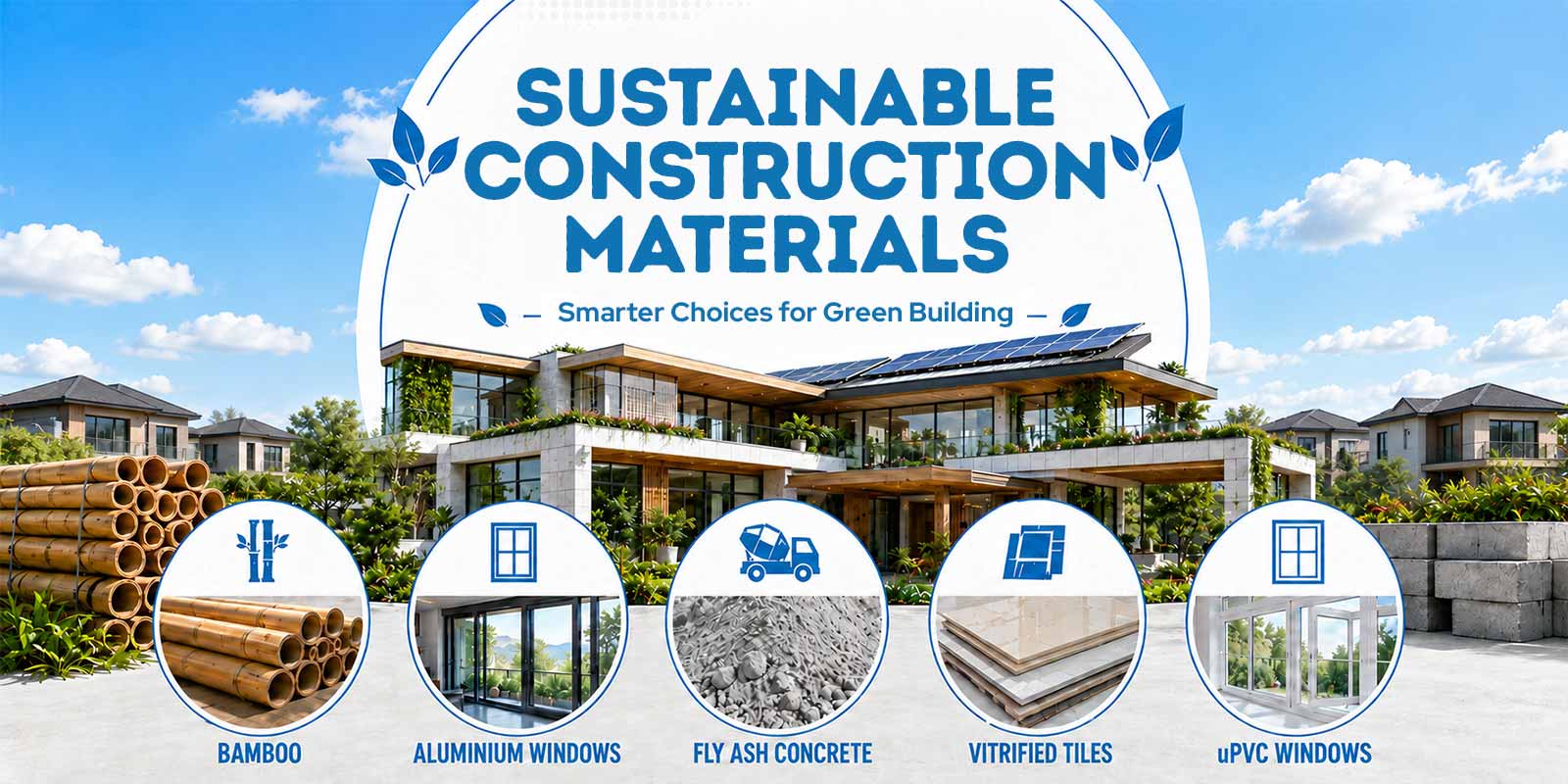
Green & Eco-Friendly Building Materials: Types, Uses & Benefits
In This Article
- What Makes a Material Sustainable?
- Sustainable Materials & Best-Use
- Recycled Construction Materials
- Reclaimed Construction Materials
- Recycled vs Reclaimed
- Cost & Performance: What Changes
- How to Select Sustainable Materials?
- Standards, Ratings & Rules in India
- Sustainability Across the Lifecycle
- Where Aparna Enterprises Fits?
Sustainable construction materials are materials whose overall environmental impact — across sourcing, manufacture, transport, service life and disposal — is lower than the conventional option they replace, without giving up the performance the building needs.
That definition does a lot of work, because it rules out the way the term is usually used. No material is sustainable on its own. A material is sustainable relative to an alternative, in a specific application, in a specific location. Bamboo shipped 2,000 km is not automatically better than a locally quarried stone. Recycled aggregate is not automatically better than natural aggregate if it fails the grade requirement and the slab has to be redone.
This guide covers what actually qualifies a material, twenty materials and where each one genuinely works, how recycled and reclaimed materials differ, what drives cost, and — the part almost nobody publishes — how to check whether a sustainability claim is real.
What Are Sustainable Construction Materials?
Sustainable construction materials are building materials selected to reduce environmental impact across their full lifecycle — raw material sourcing, manufacturing, transport, use and end of life — while meeting the structural, durability and safety requirements of the project. They are evaluated against alternatives, not certified in isolation.
The confusion in this subject is mostly vocabulary. Sustainable, green, eco-friendly, recycled, reclaimed, renewable and recyclable are used as if they mean the same thing. They do not, and specifying the wrong one is how projects end up with materials that tick a marketing box and fail a performance requirement.
The seven terms, and what each one actually means
| Term | What it actually means | Common misuse | Worked example |
| Sustainable | Lower total lifecycle impact than the alternative it replaces, while still performing. A comparative, multi-factor judgement. | Used as a standalone badge — “this is a sustainable material” — with no comparison stated. | Fly-ash-blended cement is sustainable relative to OPC in the same application, because part of the clinker is replaced. |
| Green | Informal umbrella term, usually meaning “associated with green building practice.” Has no technical definition in Indian standards. | Treated as equivalent to “certified.” It is not a certification. | “Green concrete” is a descriptive category, not a specification. Ask which SCM, at what replacement level. |
| Eco-friendly | Marketing term indicating reduced harm in one or more respects. Not defined, not measured, not regulated. | Used to imply zero impact. Every construction material has impact. | A low-VOC paint is eco-friendly on indoor air quality — that says nothing about its embodied carbon. |
| Recycled | Contains material recovered from a waste stream and reprocessed into a new product. | Confused with reclaimed. The reprocessing is the distinction. | Steel melted from scrap; concrete crushed into recycled aggregate; fly ash used in cement. |
| Reclaimed | Recovered from an existing structure and reused largely as-is, without reprocessing. | Assumed to be structurally equivalent to new. It rarely is, without testing. | Old teak beams re-milled into flooring; salvaged clay roof tiles; reused steel sections. |
| Renewable | Derived from a biological source that regenerates within a useful timeframe. | Assumed to mean low-impact. Renewable says nothing about transport, treatment chemicals or durability. | Bamboo (3–5 year cycle), cork, timber from managed forests. |
| Recyclable | Capable of being recycled at end of life. A property, not an outcome. | Presented as if the recycling has already happened. Recyclability only counts if collection and reprocessing infrastructure actually exists locally. | Aluminium is highly recyclable — but only delivers that benefit if it is actually collected and remelted. |
What Makes a Construction Material Sustainable?
There is no single test. Sustainability is a balance across ten factors, and a material can score well on some and badly on others. What matters is the net position in your specific application.
| Factor | What it measures | Ask the supplier |
| Raw material sourcing | Whether the input is renewable, abundant, a waste stream, or extracted from a finite or ecologically sensitive source | Where does the raw material come from, and is any part of it recovered? |
| Manufacturing impact | Energy, water, emissions and waste generated in production | What is the process, and what fuel does the plant run on? |
| Embodied carbon and energy | Total energy/CO2 locked into the material before it reaches site | Is there an Environmental Product Declaration (EPD) or published embodied-carbon figure? |
| Durability and service life | How long it lasts before replacement. The most underrated factor — a material lasting twice as long halves its lifetime impact | What is the expected service life in this exposure condition? |
| Transportation distance | Emissions from moving heavy material. Significant for high-mass materials like aggregate, blocks and concrete | Where is the nearest supplying plant to my site? |
| Maintenance requirement | Coatings, sealants, treatments and repairs consumed over the building’s life | What maintenance does this need, at what interval? |
| Operational implications | Effect on the building’s running energy — insulation value, solar reflectance, daylight, air-tightness | What is the thermal performance figure, tested to which standard? |
| Recycled content | Proportion of the product made from recovered material | What percentage is recycled content, and is it declared in writing? |
| Reuse potential | Whether it can be dismantled and reused rather than demolished | Is it mechanically fixed or permanently bonded? |
| End-of-life recyclability | Whether recycling infrastructure genuinely exists for it in India | Where does this go at end of life, realistically? |
Sustainable Construction Materials and Their Best-Use Applications
The table below covers twenty materials used in Indian construction. Each entry states what makes it defensible as a sustainable choice and where that defence breaks down — because a materials list without limitations is a sales sheet, not a guide.
| Material | Key sustainability attribute | Typical application | Main advantage | Limitation / consideration |
| Fly ash & GGBS blended cement | Industrial by-product replaces part of the clinker, the highest-emission ingredient | All structural and non-structural concrete | Reduces clinker demand at scale; improves long-term strength and durability | Slower early strength gain; supply of quality fly ash varies regionally |
| Recycled concrete aggregate (RCA) | Diverts demolition waste; reduces virgin quarrying | Lean concrete, sub-base, PCC; limited structural use | Highest-volume waste diversion available in construction | Percentage strictly capped by IS 383:2016 — see Section 4 |
| Manufactured sand (M-sand) | Crushed from quarry rock; removes river-bed extraction | Concrete, plaster, masonry mortar | Consistent gradation; ends dependence on river sand dredging | Higher fines can raise water demand; requires gradation control |
| Recycled steel | Steel is remelted indefinitely without loss of properties | Reinforcement, structural sections, framing | The most established material-recovery loop in construction | Recycled content is a mill-level property — needs a mill test certificate, not a claim |
| AAC blocks | Low density; often incorporates fly ash; less material per m3 of wall | Internal and external non-load-bearing walls | Light weight reduces structural steel and foundation loads; good thermal insulation | Lower compressive strength than concrete block; needs specific adhesives and fixings |
| Fly ash bricks | Utilises coal combustion residue instead of topsoil | Masonry walls | Avoids the topsoil loss and kiln firing of clay bricks | Quality varies widely by producer; verify to IS 12894 |
| Bamboo | Renewable in 3–5 years; high strength-to-weight | Scaffolding, screens, flooring, light structural framing | Fastest-regenerating structural biomaterial | Requires borate/thermal treatment against borers and fungus; performance is treatment-dependent, not species-dependent alone |
| Certified / sustainably harvested timber | Renewable if sourced from managed forests | Framing, joinery, doors, flooring | Sequesters carbon; low processing energy | Only defensible with chain-of-custody documentation; untreated timber is vulnerable to termites and humidity |
| Engineered wood (CLT, glulam, LVL) | Uses smaller/faster-growing stock efficiently | Structural framing, floors, roofs | High strength-to-weight; fast dry construction | Very limited Indian manufacturing and code coverage; adhesive systems vary |
| Reclaimed timber | Reuse — no new processing | Flooring, joinery, feature elements, doors | Retains existing embodied energy entirely | Needs grading, moisture testing and pest inspection before structural use |
| Rammed earth | Locally sourced soil; low processing energy compared with fired or cement-bound walling | Load-bearing walls in low-rise buildings | Excellent thermal mass; minimal transport | Not zero-impact — most mixes are stabilised with cement or lime, and that addition carries its own footprint. Labour-intensive; needs weather protection; unsuited to high-rainfall exposure without careful detailing |
| Compressed stabilised earth blocks (CSEB) | Soil-based, cured not fired | Low-rise walling | Removes kiln firing from masonry | Requires soil testing; low tolerance to prolonged saturation |
| Natural stone | Minimal processing; extremely long service life | Cladding, flooring, paving, walls | Service life measured in centuries; near-zero maintenance | Quarrying has real ecological impact; heavy, so transport distance dominates its footprint |
| Vitrified tiles | Very long service life; low maintenance; inert surface | Floors and walls, internal and external | Durability reduces replacement cycles; no coating or sealing needed | Kiln-fired and energy-intensive to produce — the sustainability case rests on service life, not manufacture |
| Low-E and high-performance glass | Can reduce solar heat gain and cooling load | Windows, façades, curtain walls | Where correctly specified, reduces operational energy over the building’s life | Higher embodied energy. The benefit is not automatic — it depends on climate zone, façade orientation, the specified U-value and SHGC, shading, glazed area and how the building is operated. Wrongly specified glass can increase energy use |
| uPVC windows and doors | Low thermal conductivity; long service life; the material is technically recyclable | Windows, external doors | Good thermal and acoustic sealing; no repainting | Technical recyclability is not the same as recycling actually happening — it depends on take-back and collection infrastructure existing locally at end of life, which in India is limited. Larger sections require steel reinforcement |
| Aluminium (high recycled content) | Recycling uses a fraction of the energy of primary production | Windows, façades, cladding, louvres | Recyclable repeatedly without property loss; long service life | Primary aluminium is highly energy-intensive — the benefit is only in recycled content, so ask for the figure |
| Cork | Harvested bark; the tree is not felled | Insulation, flooring, acoustic panels | Renewable, biodegradable, good insulation | Almost entirely imported into India — transport distance offsets much of the benefit |
| Hempcrete | Bio-based; carbonates over time | Non-structural infill walls, insulation | Low embodied carbon; vapour-permeable | Non-structural. Very limited Indian supply chain and no BIS standard |
| Recycled plastic composites | Diverts plastic waste from landfill | Decking, pavers, boards, formwork | Diverts a difficult waste stream; moisture-immune | Not structural; UV stability and fire performance vary sharply by producer |
Notes on the materials that get misrepresented most
Bamboo is the category’s poster material, and its performance is almost entirely about treatment. Untreated bamboo in Indian humidity is a maintenance liability within a few years. Treated, detailed and kept off the ground, it performs. Specify the treatment, not the plant.
Recycled aggregate is where the gap between marketing and regulation is widest. It is genuinely valuable — and its use in structural concrete is capped by standard. Section 4 has the numbers.
Vitrified tiles and natural stone make an argument the category usually gets backwards. Both are energy-intensive to produce. Both are defensible anyway, because a surface that lasts 40 years without replacement, coating or sealing beats a lower-impact surface replaced three times in the same period. Durability is a sustainability strategy, not a compromise on one.
Aluminium varies more between products than almost anything else in the table, and the variables are the production route and the recycled content. Primary (smelted) aluminium is among the most energy-intensive materials in construction; secondary (remelted) aluminium requires a fraction of that energy. Service life and whether the material is actually recovered at end of life then decide the rest. “Aluminium is recyclable” is not the claim that matters. “This extrusion contains X% recycled content, and here is the declaration” is.
Hempcrete and mycelium appear on many international lists on sustainable construction materials. Both currently have limited mainstream supply-chain availability in India, and there are no applicable BIS standards for the specific construction applications discussed here. Hempcrete has begun to enter overseas codes, including a hempcrete appendix in the 2024 International Residential Code in the US, but there is no equivalent Indian code recognition for these applications. They are worth knowing about, but their limited availability and lack of applicable BIS standards currently make them niche options for Indian projects.
Materials suited to hot and humid Indian conditions
Most published lists on this subject are written for temperate climates. In hot-humid and coastal Indian conditions, the selection changes:
- Prioritise: high thermal mass or good insulation on the envelope; moisture-tolerant and non-corroding finishes; solar-reflective roofing; vapour-permeable wall build-ups.
- Treat with caution: untreated biomaterials, absorbent finishes in wet areas, and any ferrous fixing within a few kilometres of the coast without appropriate protection.
- Watch the detail, not just the material: in high-rainfall and monsoon-exposed conditions, earth-based and bio-based walling materials fail on detailing — overhangs, plinth height and rain-screening — far more often than on material choice.
Recycled Construction Materials
Recycled construction materials are materials recovered from a waste stream and reprocessed into a new product — crushing demolition concrete into aggregate, remelting steel scrap, or using fly ash from thermal power generation as a cement replacement. The reprocessing step is what separates recycled from reclaimed.
Where recycled inputs are actually used?
| Recycled input | What it replaces | Where it is used | Key constraint |
| Recycled concrete aggregate (RCA) | Natural coarse/fine aggregate | Lean concrete, sub-base, PCC, limited structural concrete | Capped by IS 383:2016 — see below |
| Recycled aggregate (RA, mixed C&D) | Natural aggregate | Lean concrete only | Not permitted in plain or reinforced concrete |
| Fly ash | Part of the cement clinker | Blended cement, RMC, fly ash bricks, blocks | Quality and supply vary by source plant |
| GGBS (slag) | Part of the cement clinker | Blended cement, RMC | Regional availability tied to steel plants |
| Steel scrap | Iron ore | Reinforcement, structural sections | Recycled content is set at the mill |
| Crushed glass | Aggregate, decorative fill | Terrazzo, non-structural fill | Not a structural aggregate |
| Recycled plastics | Timber, virgin polymer | Decking, boards, pavers, formwork | Non-structural; verify UV and fire performance |
The regulation nobody quotes: how much recycled aggregate is actually allowed
This is where most articles on this subject stop, and where the specification question actually starts. IS 383:2016 (Coarse and Fine Aggregate for Concrete), Table 1 sets maximum permitted use:
| Aggregate type | Lean concrete (below M15 grade) | Plain concrete | Reinforced concrete |
| Recycled concrete aggregate (RCA) — coarse and fine | Up to 100% | Up to 25% | Up to 20%, and only up to M25 grade |
| Recycled aggregate (RA) — mixed C&D derived | Up to 100% | Nil | Nil |
Two further provisions matter:
- IS 383:2016 groups these under manufactured aggregate (Clause 4.2) — a category that also covers iron slag, steel slag and copper slag aggregate and bottom ash from thermal power plants, not only C&D-derived material.
- Manufactured aggregate is not permitted in prestressed concrete (Clause 4.2.2).
- Only one type of manufactured coarse aggregate and one type of manufactured fine aggregate may be used in a given structure (Table 1, Note 2).
What this means in practice: recycled aggregate is a real and standardised option in India — with defined ceilings, and the two types are not interchangeable. A proposal to use RCA in reinforced concrete above M25, or at more than 20% replacement, falls outside IS 383:2016. A proposal to use RA in any reinforced or plain concrete falls outside it at any grade. Establish which of the two is actually being offered before a sustainable-sourcing claim reaches a specification.
The rules changed on 1 April 2026 — and they now set targets
Construction and demolition waste in India is governed by the Environment (Construction and Demolition) Waste Management Rules, 2025, notified by MoEFCC as G.S.R. 219(E) and in force from 1 April 2026. They supersede the Construction and Demolition Waste Management Rules, 2016 (G.S.R. 317(E)).
Two changes matter for anyone specifying materials.
First, Extended Producer Responsibility now applies to C&D waste. Projects at or above 20,000 sq m of built-up area are treated as producers, must register on the central portal, and must meet recycling targets against the waste they generate, evidenced through EPR certificates.
Second — and this is the part with direct consequences for material selection — the rules set a statutory minimum percentage of processed C&D material that qualifying projects must actually use.
| Financial year | EPR recycling target (of waste generated) | Minimum processed C&D material — buildings | Minimum processed C&D material — roads |
| 2025-26 | 25% | — | — |
| 2026-27 | 50% | 5% | 5% |
| 2027-28 | 75% | 10% | 5% |
| 2028-29 | 100% | 15% | 10% |
| 2029-30 | 100% | 20% | 10% |
| 2030-31 onwards | 100% | 25% | 15% |
What this changes: using recycled C&D material is moving from a voluntary sustainability gesture to a compliance requirement with a rising floor — while IS 383:2016 simultaneously caps how much of it can go into structural concrete. Those two constraints have to be reconciled at design stage, not at pour stage. In practice it pushes recycled aggregate toward lean concrete, sub-base, PCC, paving and non-structural applications, where the permitted percentages are far higher.
Separately, the Fly Ash Utilisation Notification, 2021 (as amended) places ash utilisation obligations on coal and lignite-based thermal power plants — the reason fly ash reaches the construction sector at scale in the first place.
Reclaimed Construction Materials
Reclaimed construction materials are recovered from existing buildings and reused largely in their original form, without being broken down and reprocessed. Salvaged teak doors, old Burma teak beams re-milled into flooring, hand-made clay roof tiles, cut stone, structural steel sections and period ironwork are the common categories in India.
Reclaimed material carries a real advantage that recycling cannot match: it retains much of the embodied energy already invested in the material, because nothing is remelted, refired or recrushed. It is not impact-free — careful deconstruction, transport, cleaning, de-nailing, re-milling and re-grading all carry their own footprint, and a piece salvaged 400 km away with heavy re-machining can lose much of the advantage.
Where reclaimed material realistically comes from?
- Demolition and deconstruction of older buildings, particularly pre-1970 stock with better-quality hardwood and stone
- Specialist salvage yards and architectural reclamation dealers
- Heritage and conservation projects releasing material during restoration
- Industrial decommissioning, for structural steel and plate
What it works for — and what it does not?
- Works well for: flooring, joinery, doors and frames, cladding, feature walls, stone paving, and interior elements where character is part of the value.
- Requires caution for: anything structural. Reclaimed timber and steel can be excellent structurally, but only after grading, moisture-content testing, section verification and pest inspection. Age is not a grade.
- Practical constraints: availability is opportunistic — you get what is available, in the quantity available, when it becomes available. Sizes are non-standard. Lead times cannot be committed the way a manufactured order can. This makes reclaimed material well suited to defined, bounded scopes and poorly suited to repetitive, schedule-driven ones.
Recycled vs Reclaimed Construction Materials
This is the comparison the category consistently blurs. The two are not interchangeable and they suit different parts of a project.
| Recycled | Reclaimed | |
| Meaning | Recovered from a waste stream and reprocessed into a new product | Recovered from an existing structure and reused close to its original form |
| Sourcing | Industrial by-products, demolition waste, post-consumer scrap | Deconstructed buildings, salvage yards, heritage projects |
| Processing | Substantial — crushing, screening, remelting, reforming | Lower, but not nil — deconstruction, transport, cleaning, de-nailing, re-milling, re-grading |
| Consistency | Manufactured to a specification; predictable and testable | Variable by batch and by source building |
| Performance basis | Governed by product standards (e.g. IS 383:2016 for aggregate) | Established by inspection and testing of the actual piece |
| Availability | Supplied at volume through normal channels | Opportunistic; limited quantities, non-standard sizes |
| Cost drivers | Processing, transport, and local supply of the waste stream. Can be at or below the virgin equivalent | Recovery labour, condition, rarity and demand. Often a premium, not a saving, for good hardwood and stone |
| Best suited to | Structural and volume applications — concrete, cement, steel, sub-base | Finishes, joinery, flooring, cladding, and character-led elements |
Cost and Performance: What Actually Changes
The claim that sustainable materials cost more, and the counter-claim that they pay for themselves, are both too broad to be useful. Price depends on the specific material, the location, the processing involved and local availability — and for several of the materials in this guide, the sustainable option is already the market-standard option at market-standard prices.
What actually drives the cost difference?
| Cost driver | Effect | Example |
| Local availability | The largest single variable. A material made near site is competitive; the same material trucked 800 km is not | Fly ash pricing tracks proximity to thermal power plants |
| Processing intensity | More reprocessing means more cost | Crushed and graded RCA costs more than unprocessed rubble and less than quarried aggregate |
| Scale of production | Established supply chains price competitively; niche materials do not | AAC blocks are mainstream and priced accordingly; hempcrete is not |
| Labour intensity | Some low-impact materials shift cost from material to labour | Rammed earth has near-zero material cost and high skilled-labour cost |
| Certification and documentation | EPDs, chain-of-custody and third-party testing add cost | Certified timber costs more than uncertified timber of the same species |
| Rarity and demand | Applies specifically to reclaimed material | Reclaimed Burma teak commands a premium over new hardwood |
| Service life | Changes cost-per-year, not cost-at-purchase | A 40-year surface at twice the price of a 15-year surface is cheaper per year |
Three honest scenarios
- Usually cost-neutral or cheaper: fly ash and GGBS blended cements, M-sand, AAC blocks, RCA in lean concrete and sub-base, fly ash bricks. These are established, high-volume products competing directly with conventional equivalents.
- Usually a higher upfront cost with a defensible return: high-performance glazing, uPVC and thermally-broken aluminium systems, insulation. The return comes from reduced operational energy — real, but dependent on climate, orientation and how the building is run.
- Usually more expensive, with no operational payback: reclaimed hardwood and stone, certified timber, cork, hempcrete. These are chosen for embodied impact, character or specific performance — not for cost.
What not to assume: a lower purchase price does not mean lower environmental impact, and a higher price does not mean higher sustainability. The two are not correlated. Cheap, poorly-made materials that need early replacement are usually the worst outcome on both counts.
How to Select Sustainable Materials for a Construction Project?
A six-step framework
- Define the performance requirement first: Structural grade, fire rating, exposure condition, expected service life, acoustic and thermal targets. A material that fails the requirement is not a sustainable choice at any impact level — it becomes a replacement.
- Identify which sustainability factors matter for this building: For an air-conditioned commercial building, operational energy usually dominates, so envelope and glazing decide most of the impact. For an unconditioned low-rise building, embodied impact matters relatively more. The priorities are not the same, and treating them as the same is the most common selection error.
- Shortlist by local availability: Filter to materials with a genuine supply chain within a reasonable radius of site. This single step removes most of the imported materials that dominate published lists, and usually improves the outcome.
- Compare like with like: Compare materials that can do the same job in the same location — not a biomaterial against a mineral one in the abstract.
- Verify the claim before it enters the specification: See the checklist below.
- Specify the documentation, not just the material: Write the required test certificates, declarations and standards into the specification. A sustainability requirement that is not documented is not enforceable at site.
Specification checklist: how to verify a sustainability claim
Use this on any supplier, including us:
- Which standard does it conform to? Ask for the IS number and the current year of the standard, not just “IS certified.”
- Where are the test certificates? Batch or consignment test reports from an accredited laboratory, not a generic brochure.
- What percentage is recycled content, in writing? “Contains recycled material” is not a specification. A percentage in a declaration is.
- Is there an Environmental Product Declaration (EPD)? If not, is there a published embodied-carbon figure and what is its basis?
- Where is the nearest supplying plant? For high-mass materials, transport distance can outweigh the material difference.
- What is the expected service life in this exposure condition, and what maintenance does it require?
- What happens at end of life? Is there actual recycling infrastructure for it in India, or only theoretical recyclability?
- If certified timber: where is the chain-of-custody documentation?
- If a certification is claimed: which scheme, which certificate number, and is it current?
- Does the claim compare against a stated alternative? A sustainability claim with no comparison is a marketing claim.
Rule of thumb: if a supplier cannot answer questions 1, 2 and 3 in writing, treat the claim as unverified — regardless of how the product is branded.
Standards, Ratings and Rules That Apply in India
Material selection in India sits inside a specific regulatory and rating framework. Most international guides on this subject omit it entirely.
Rating systems and codes
| Framework | Administered by | What it covers | Relevance to material selection |
| IGBC ratings | Indian Green Building Council (CII) | Green building rating across building types | Awards credits for regional materials, recycled content, and reused materials — materials contribute credits, they do not by themselves confer a rating |
| GRIHA | GRIHA Council / TERI, endorsed by MNRE | National rating system for habitats | Includes criteria on material sustainability and embodied energy |
| LEED | USGBC / GBCI, used in India | International rating system | Widely used on commercial projects in India; materials and resources credits apply |
| ECBC 2017 | Bureau of Energy Efficiency | Energy Conservation Building Code — commercial buildings | Sets envelope performance requirements that drive glazing, insulation and roofing choices |
| Eco Niwas Samhita 2021 | Bureau of Energy Efficiency | Energy code for residential buildings | Envelope performance requirements for housing |
| Environment (C&D) Waste Management Rules, 2025 | MoEFCC | Construction and demolition waste; in force 1 April 2026, superseding the 2016 rules | Introduces EPR for C&D waste and a statutory minimum percentage of processed C&D material that qualifying projects must use, rising to 2030-31. Directly affects material specification — see Section 4 |
| Fly Ash Utilisation Notification, 2021 | MoEFCC | Ash utilisation by thermal power plants | The reason fly ash is available to construction at scale |
The material standards worth naming in a specification
| Material | Standard |
| Coarse and fine aggregate, including recycled aggregate | IS 383:2016 |
| Plain and reinforced concrete — code of practice | IS 456:2000 |
| Concrete mix proportioning | IS 10262:2019 |
| Fly ash for use as pozzolana in cement and concrete | IS 3812 (Part 1) |
| Portland Pozzolana Cement, fly-ash based | IS 1489 (Part 1) |
| Portland Slag Cement | IS 455 |
| GGBS for use in cement, mortar and concrete | IS 16714 |
| Autoclaved cellular (aerated) concrete blocks | IS 2185 (Part 3) |
| Fly ash–lime bricks | IS 12894 |
| Pressed ceramic and vitrified tiles | IS 15622:2021 |
| uPVC window and door profiles | IS 17953:2023 |
A correction worth making: using certified or sustainable materials does not make a building green-certified. Ratings such as IGBC, GRIHA and LEED assess the whole building — design, energy, water, waste, indoor environment and site — and materials contribute a portion of the available credits. A material can support a rating. It cannot deliver one.
Sustainability Across the Material Lifecycle
Every judgement in this guide depends on where you draw the boundary. Two figures for the same material can both be correct and mean entirely different things.
| Lifecycle stage | What happens | What it contributes | How it is measured |
| Raw material extraction | Quarrying, harvesting, or waste-stream recovery | Resource depletion, land and habitat impact | Included in embodied carbon |
| Manufacturing | Processing, firing, forming, curing | Usually the largest share of embodied impact for processed materials | Embodied carbon / embodied energy |
| Transport to site | Movement from plant to project | Rises sharply with mass and distance | Embodied carbon, transport stage |
| Construction | Installation, wastage, temporary works | Site waste and installation energy | Site waste records |
| Use and maintenance | Operation, cleaning, repair, recoating, replacement | Operational energy plus recurring embodied impact | Operational energy; maintenance cycles |
| End of life | Demolition, recovery, recycling, disposal | Recovery credit or landfill burden | End-of-life scenario in an LCA |
Two terms worth getting right:
- Embodied carbon is the greenhouse-gas emissions associated with a building’s materials rather than its energy use — raw material supply, manufacture and transport, plus emissions from replacement, repair and refurbishment during the building’s life, and from demolition and disposal at the end of it. The product-stage share is effectively fixed once the material is made and installed; the later share is not, and is still influenced by how long components are kept, whether they are repaired rather than replaced, and what happens at end of life. Which of these stages a published figure includes depends entirely on the assessment boundary — always check it.
- Operational carbon is the emissions from running the building, principally its energy use for cooling, heating, ventilation, lighting and equipment. Water use carries emissions too, through treatment and pumping, but it is normally accounted separately rather than folded into operational carbon. Operational emissions can be reduced after completion, through retrofit, better controls or a cleaner electricity supply.
Which of the two dominates is not a fixed answer: For an air-conditioned commercial or residential building on a long design life, operational emissions have historically been the larger share — which is why envelope materials, glazing and insulation carry disproportionate weight there. But the balance shifts with building type, climate zone, how energy-efficient the building is, how the electricity running it is generated, and the design life assumed. As buildings become more efficient and the grid decarbonises, the embodied share grows and material choice matters more, not less. For a low-energy or unconditioned building, embodied impact can dominate from the outset.
Cradle-to-gate vs cradle-to-grave: a cradle-to-gate figure stops at the factory gate and excludes transport, use and disposal. A cradle-to-grave figure covers the full life. Comparing one against the other is the most common error in material sustainability comparisons. An Environmental Product Declaration (EPD) states which boundary was used — which is the main reason to ask for one.
Where Aparna Enterprises Fits?
Aparna Enterprises Limited manufactures and supplies building materials across concrete, tiles, uPVC and aluminium fenestration, facades, steel reinforcement and home improvement products. The sustainability-relevant characteristics of those categories are set out below — as attributes to verify, not as certifications.
| Category | Sustainability-relevant attribute | What to ask for |
| Ready mix concrete | Mixes can incorporate supplementary cementitious materials including fly ash and slag, and recycled aggregate within IS 383:2016 limits. Plant batching proportions materials by weight to a designed mix, which is generally associated with less material wastage than site mixing — a characteristic of the method, not a measured figure for any particular project. Pervious concrete supports groundwater recharge in paved areas. | Mix design, SCM replacement level, aggregate source, and the nearest supplying plant to your site |
| Manufactured sand | Crushed from quarry rock, removing dependence on river-bed sand extraction | Gradation test report against IS 383:2016 |
| Vitrified tiles | The sustainability case rests on service life and low maintenance — a durable, inert, uncoated surface that does not need sealing or periodic replacement | Conformance to IS 15622:2021 and batch test reports |
| uPVC windows and doors | Low thermal conductivity supports envelope performance; correctly installed sealed systems reduce air infiltration; the profile material is technically recyclable, though whether it is actually recycled depends on collection and reprocessing infrastructure existing at end of life | Conformance to IS 17953:2023, profile wall thickness class, and glazing specification |
| Aluminium windows, doors and facades | Aluminium is repeatedly recyclable without property loss, and recycled aluminium requires a fraction of the energy of primary production | The recycled content percentage — this is the figure that determines the benefit |
| Steel reinforcement | Steel carries established recycled content through scrap-based production and is fully recoverable at demolition | Mill test certificate and grade conformance |
| Integrated supply across categories | Sourcing several materials from one manufacturer has the potential to consolidate deliveries and reduce separate transport legs. Whether it does depends on plant locations relative to site, delivery scheduling and the categories involved — it is not automatic, and it is not currently supported by published project data | Plant locations relative to your project, and how deliveries would actually be consolidated |
Disclaimer:
This article is provided for general information only. It is not a specification, a design document, or engineering, environmental or legal advice, and it should not be relied on as the sole basis for any material selection, procurement or compliance decision. Users should obtain independent professional advice from a qualified structural engineer, architect, sustainability consultant or legal adviser as appropriate to their project.
Frequently Asked Questions Eco Friendly Building Materials
Sustainable construction materials are materials selected to reduce environmental impact across their full lifecycle — sourcing, manufacture, transport, use and disposal — while still meeting the project’s structural, durability and safety requirements. Sustainability is a comparison against an alternative, not a fixed property of a material.
No. Sustainable is a comparative, multi-factor judgement about total lifecycle impact. Green is an informal umbrella term with no technical definition in Indian standards. Eco-friendly is a marketing term indicating reduced harm in at least one respect, and is neither defined nor regulated. A product can be eco-friendly in one dimension and poor overall.
Recycled materials are recovered from a waste stream and reprocessed into a new product — such as crushed concrete becoming aggregate. Reclaimed materials are recovered from an existing building and reused close to their original form, such as old timber beams re-milled into flooring. Recycled is more consistent and more available; reclaimed retains more embodied energy but is variable in supply.
Yes, within limits, and the two types are treated differently. IS 383:2016 Table 1 permits recycled concrete aggregate (RCA) up to 20% in reinforced concrete and only up to M25 grade, up to 25% in plain concrete, and up to 100% in lean concrete (below M15). Mixed recycled aggregate (RA) is permitted only in lean concrete — nil in plain and nil in reinforced concrete. No manufactured aggregate of any type is permitted in prestressed concrete.
Not consistently. Fly ash and slag blended cements, M-sand, AAC blocks and fly ash bricks are mainstream products at market prices. High-performance glazing and insulation typically cost more upfront with an operational return. Reclaimed hardwood, certified timber and imported biomaterials usually cost more with no operational payback. Cost depends on the material, location, processing and local availability.
It depends on the brick. Fired clay bricks consume topsoil and kiln fuel, which counts against them. Fly ash bricks use an industrial by-product instead of topsoil and avoid firing. Compressed stabilised earth blocks avoid firing entirely. Brick as a category is neither sustainable nor unsustainable — the production route decides it.
Partly. Stone requires very little processing and lasts for generations with almost no maintenance, which is a strong sustainability position. Against that, quarrying has real ecological impact and stone is heavy, so transport distance dominates its footprint. Locally quarried stone is a defensible choice; the same stone transported across the country is much weaker.
Prioritise moisture-tolerant and non-corroding materials, solar-reflective roofing, vapour-permeable wall assemblies and either high thermal mass or good insulation on the envelope. Treat untreated biomaterials and absorbent finishes in wet areas with caution. In monsoon-exposed conditions, earth-based and bio-based walling more often fails on detailing — overhangs, plinth height, rain-screening — than on material choice.
No. Ratings such as IGBC, GRIHA and LEED assess the whole building — design, energy, water, waste, indoor environment and site. Materials contribute a portion of the available credits. A material can support a rating; it cannot deliver one.
Embodied carbon is the greenhouse-gas emissions associated with a building’s materials — raw material supply, manufacture and transport, plus replacement, repair and end-of-life. The product-stage share is effectively fixed once the material is made and installed; the later stages are not. Operational carbon is the emissions from running the building, principally its energy use, and can be reduced later through retrofit, better controls or a cleaner electricity supply. Any published figure depends on the assessment boundary used, so always check which stages it covers.
Ask four questions in writing: which IS standard and which year does it conform to; where are the accredited laboratory test certificates; what percentage of it is recycled content; and is there an Environmental Product Declaration. A claim with no stated comparison, no percentage and no documentation is a marketing claim.
Yes, for qualifying projects. The Environment (Construction and Demolition) Waste Management Rules, 2025 came into force on 1 April 2026 and apply Extended Producer Responsibility to projects at or above 20,000 sq m of built-up area. They also set a minimum percentage of processed C&D material that such projects must use — starting at 5% in FY 2026-27 for buildings and rising to 25% from FY 2030-31, with a separate lower schedule for road projects. Confirm the current schedule and applicability against the gazette text for your project.
Fly ash and GGBS blended cements, manufactured sand, AAC blocks, fly ash bricks, recycled aggregate within IS 383:2016 limits, recycled steel, high-performance glazing, uPVC and aluminium systems, vitrified tiles and locally quarried stone all have established Indian supply chains. Hempcrete, mycelium and cork are widely written about internationally but have limited or no Indian supply chain and, in several cases, no BIS standard.
Start Your Project with the Right Materials
We provide everything you need for modern construction. Connect with our experts to discuss your requirements and get the best solution for your project. Submit your details and our team will contact you soon.
CORPORATE OFFICE
8-2-293/82/A, Plot No-1214, Road No-60,
Jubilee Hills, Hyderabad-500 033.