
Kitchen Countertop Materials: Types, Comparison and How to Choose for Indian Kitchens
In This Article
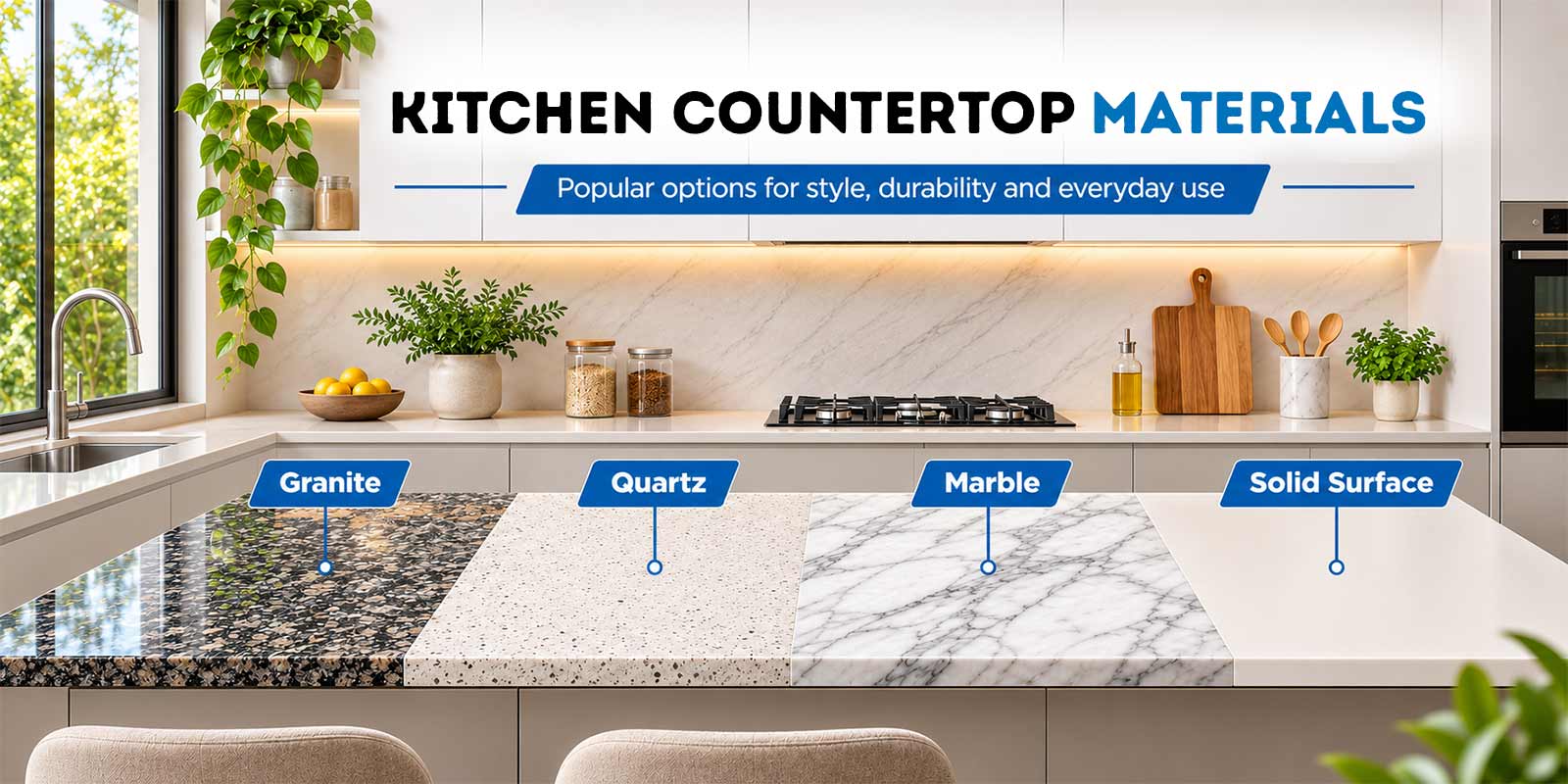
The main kitchen countertop materials used in Indian homes are granite, engineered quartz and marble. Other options include quartzite, porcelain and sintered stone slabs, solid surface, stainless steel, laminate and wood. No single material suits every kitchen. Granite and porcelain handle heat well, quartz and porcelain resist staining, and marble needs the most care.
A countertop, often called the kitchen platform in India, takes more punishment than any other surface in the home: hot kadais and pressure cookers, tadka oil, turmeric, lemon and tamarind, water around the sink, and daily wiping. The right material depends on how you cook, how much upkeep you will accept, your budget and the look you want. This guide explains what each material is, where it performs well and where it falls short, and how to match it to an Indian kitchen.
Key Takeaways
- Granite is a long-standing choice for heavy Indian cooking: it copes well with heat and wear, but its need for sealing depends on the individual stone.
- Engineered quartz resists stains and does not need sealing, but its resin binder can be damaged by direct high heat, so hot vessels need a trivet.
- Marble looks premium but scratches more easily and etches when acidic foods touch it; sealing reduces staining but does not prevent etching.
- Porcelain and sintered stone slabs combine low water absorption with good heat tolerance; edges and cut-outs need careful fabrication.
- Laminate, solid surface and wood are lighter-duty options that need more care around heat and water.
- Fabrication and installation quality affects performance as much as the material itself.
How Kitchen Countertop Materials Are Grouped?
Most countertop materials fall into six families. Knowing the family tells you a lot about how a surface will behave before you look at colour or price.
- Natural stone is quarried and cut into slabs: granite, marble, quartzite, Kota stone and soapstone. Performance varies from one stone to the next and sometimes from one slab to the next.
- Engineered stone is manufactured from crushed stone or minerals bound with resin. Engineered quartz is the main example; “artificial granite” and “artificial marble” are trade names often used for products in this family.
- Ceramic surfaces are fired at high temperature: porcelain slabs, sintered stone and tiles. They contain no resin binder.
- Solid surface is a resin-based material, typically acrylic or polyester resin with mineral filler, that can be joined almost invisibly.
- Metal, mainly stainless steel, is used in professional kitchens and some modern homes.
- Wood and wood-based surfaces include solid wood (butcher block) and laminate bonded to a board core.
Two terms are worth separating early. The material is what the slab is made of; the finish is how its surface is treated, such as polished, honed (matte) or leathered. The same granite can look and behave differently in a polished and a leathered finish. The edge profile and the way the slab is supported and joined are fabrication choices, and they matter too.
Types of Kitchen Countertop Materials at a Glance
| Material | Main characteristics | Advantages | Limitations | Suitable applications |
| Granite | Natural igneous stone; each slab is unique | Copes well with heat and daily wear; wide colour range | Porosity varies by stone, so some slabs need sealing; can chip at edges | Busy Indian kitchens, heavy cooking |
| Marble | Natural calcite or dolomite stone with veining | Distinctive premium look; stays cool to the touch | Etches with acids; scratches and stains more readily | Low-use or display kitchens, baking zones, islands |
| Quartzite | Natural metamorphic stone formed from quartz sandstone | Hard and heat-tolerant; marble-like veining in some stones | Higher cost; sealing need varies; some stones sold as quartzite are actually marble | Premium kitchens wanting a natural, marble-like look |
| Engineered quartz | Crushed quartz bound with polymer resin and pigments | Non-porous, no sealing needed, consistent colour | Resin can scorch or discolour under direct high heat; not for cutting directly on | Modern kitchens, light colours, low-maintenance households |
| Porcelain / sintered stone | Fired ceramic slabs with very low water absorption | Good heat and stain resistance; large formats with few joints | Edges and cut-outs can chip; printed designs may not run through the body | Heavy cooking with a modern or marble look |
| Solid surface | Acrylic or polyester resin with mineral filler | Seamless joints, integrated sinks, repairable scratches | Moderate heat resistance; scratches more easily than stone | Seamless designs, light-duty kitchens |
| Stainless steel | Non-porous metal sheet over a supporting core | Hygienic, heat-tolerant, easy to clean | Scratches, dents and shows marks; industrial look | Professional or high-use cooking zones |
| Laminate | Decorative plastic laminate bonded to a board core | Low cost, many designs, light | Can scorch; water at joints can swell the core | Budget kitchens, dry zones, rentals |
| Wood (butcher block) | Solid timber strips glued together | Warm look; can be sanded and refinished | Needs regular oiling; vulnerable to water and heat | Islands, breakfast counters, dry prep zones |
Natural Stone Countertops
Granite
Granite is a natural igneous rock made mostly of quartz and feldspar minerals. In the stone trade, “granite” is also used for other hard silicate stones with a similar look, so two slabs sold as granite can behave differently. It is widely used in Indian kitchens because it copes well with heat, heavy vessels and daily wear.
Strengths: Granite tolerates hot cookware better than resin-based surfaces and resists everyday scratching from steel utensils. It is widely quarried in India, so there is a large choice of colours and price points.
Limitations: Granite is porous to a degree that varies by stone and finish. Dense, dark granites may absorb very little, while some lighter or more open-grained stones absorb oil and turmeric more readily. Edges and corners can chip under a hard knock. Although granite handles heat well, very hot vessels placed repeatedly on one spot, or on a resin-filled repair, can still cause damage, so a trivet is sensible for the hottest pans.
Sealing: Not every granite needs the same sealing routine. A simple water test helps: place a few drops on the surface and watch for a few minutes. If the stone darkens, it is absorbing and may benefit from an impregnating sealer. Sealing reduces absorption; it does not make granite stain-proof.
Best for: Kitchens with frequent, high-heat cooking where durability matters more than a uniform pattern.
Marble
Marble is a metamorphic stone made of calcite or dolomite, which gives it its soft veining and luminous look. That same composition is its weakness in a kitchen. Calcite reacts with acids, so lemon juice, tamarind, tomato, vinegar and some cleaners can leave dull marks called etching.
Strengths: Marble offers a premium, classic look, stays cool for rolling dough, and is available in Indian and imported varieties.
Limitations: Etching is surface damage, not a stain, and sealing does not prevent it. Marble is also softer than granite, so it scratches more readily, and lighter marbles can absorb oil and turmeric if spills are left. A honed (matte) finish shows etch marks less than a polished one.
Best for: Homeowners who accept a lived-in patina, low-intensity cooking, baking areas, or islands used more for serving than cooking.
Quartzite and Other Natural Stones
Quartzite is a natural metamorphic rock formed when quartz-rich sandstone is subjected to heat and pressure. It is not the same as engineered quartz. True quartzite is hard enough to scratch glass, tolerates heat well, and can show marble-like veining, which is why it is popular in premium kitchens.
Be careful with names. Some stones sold as “quartzite”, especially “soft quartzite”, are actually marble or dolomite and will etch. A supplier can show you two quick checks: whether a sample scratches glass, and whether a drop of lemon juice dulls the surface after a few minutes. Sealing needs vary from stone to stone.
Kota stone is a fine-grained limestone quarried in the Kota district of Rajasthan and widely used across India for flooring and paving. As a limestone, it is not resistant to acids or alkalis, so it marks more easily than granite on a cooking platform. Soapstone, sandstone and travertine are occasionally used but are softer or more porous and are uncommon for Indian cooking platforms.
Engineered Countertop Materials
Engineered Quartz
Engineered quartz is made mostly from crushed natural quartz bound with polymer resin and pigments, then pressed into slabs. Because it is manufactured, colour and pattern are consistent from slab to slab, including marble-look designs.
Strengths: Quartz is non-porous and does not need sealing, so oil and spice spills sit on the surface rather than soaking in. It needs less routine care than natural stone and comes in light colours that are hard to find in granite.
Limitations: The resin binder is the weak point under heat. One leading manufacturer recommends using a trivet to prevent burning, so pressure cookers, tawas and kadais should not go straight from the flame onto quartz. The same manufacturer advises against cutting directly on quartz and lists harsh chemicals to avoid, such as oven cleaners, drain cleaners and toilet-bowl cleaners. Strong pigments such as turmeric can still mark the surface if left to sit, so wipe spills promptly. Check the manufacturer’s guidance before using quartz outdoors or in strong direct sunlight.
Fabrication note: Cutting and grinding engineered stone releases respirable crystalline silica dust, which can cause silicosis in workers. Australia banned the manufacture, supply, processing and installation of engineered stone from 1 July 2024 for this reason. Authorities there note that installed engineered stone does not pose a safety risk while it is undisturbed. If you choose quartz, ask your fabricator to cut it off-site with water suppression and dust control rather than dry-cutting in your home.
“Artificial granite”, “artificial marble” and “nano white”: These are trade names, not material categories. Depending on the seller, “artificial granite” may mean engineered quartz, another resin-bound stone, or even decorative sheets. “Nano white” usually refers to a bright white engineered or glass-ceramic surface. Before buying anything sold under these names, ask what it is made of, whether it contains resin, and for the manufacturer’s heat, stain and care data.
Best for: Modern kitchens and households that want a uniform look and low routine maintenance, and are disciplined about using trivets.
What to check when buying quartz: Because quartz is a manufactured product, quality depends on both the manufacturer and the fabricator. Before you order, ask for:
- The manufacturer’s name and the product’s declared test data, such as water absorption, flexural strength, and stain and chemical resistance
- Slab thickness and slab size, since thickness is supplier-specific and larger slabs mean fewer joints
- A sample of the exact colour and finish (polished, matt or textured), as pattern and tone can vary between batches
- The manufacturer’s care guide and warranty terms, including the conditions attached to the warranty
- Where and how the slab will be cut, with water suppression and dust control
Porcelain and Sintered Stone Slabs
Porcelain and sintered stone are ceramic surfaces made by compacting minerals and firing them at very high temperature. Under ISO 13006, porcelain tiles are classified in Group BIa, with water absorption of 0.5% or less. In India, many such products are sold as vitrified or full-body slabs; you can read more about how porcelain and vitrified tiles compare.
The two terms are related but not identical. Porcelain slabs are usually made from dense clays, and their pattern is often printed on the surface only. “Sintered stone” or compact sintered surfaces are made by proprietary processes, and some are coloured through their full thickness. Ask for the declared water absorption, thickness and whether the design runs through the body.
Strengths: With no resin binder, these surfaces generally tolerate hot cookware better than quartz or solid surface. Their very low water absorption makes them highly resistant to oil and turmeric stains, and they need no sealing.
Limitations: Thin, large slabs can be brittle during handling, and sharp edges can chip under hard knocks. Where the design is printed on the surface, edge profiles and sink cut-outs can expose a different-coloured body. Fabrication needs specialist tools and experience. Full-body vitrified slabs carry the same colour through the body but cannot reproduce fine marble veining.
Best for: Heavy cooking kitchens that want a marble or concrete look with low maintenance, provided an experienced fabricator handles the installation.
Solid Surface
Solid surface is a resin-based material, usually combining aluminium trihydrate (a mineral filler) with acrylic or polyester resin and pigments. Its defining feature is that pieces can be joined with almost invisible seams, and sinks and upstands can be integrated into one continuous surface.
Strengths: It is non-porous, warm to the touch, and repairable: light scratches and some damage can be sanded and refinished by a professional.
Limitations: Solid surface is only moderately heat-resistant and scratches more readily than stone or porcelain, so it needs trivets and chopping boards in an Indian kitchen.
Best for: Seamless designs, integrated sinks and lighter-duty kitchens.
Metal, Laminate and Wood Countertops
Stainless Steel
Stainless steel is widely used in commercial kitchens because it is non-porous, tolerates heat and is easy to sanitise. In homes it suits a professional or industrial look. It does scratch and can dent, shows fingerprints and water spots, and can be noisy. Ask for the steel grade and sheet thickness, and make sure the sheet is fully supported on a rigid core.
Laminate
Laminate countertops use a decorative plastic laminate sheet bonded to a board core. In India, the terms “mica” and “sunmica” are commonly used for decorative laminates. Laminate is one of the most budget-friendly options and comes in many stone and wood designs.
Its limits are heat and water. Hot vessels can scorch or blister the surface, and water seeping through joints, edges or the sink cut-out can swell the board core. Decorative cabinet sheets such as PVC, acrylic or PU-finished panels are cabinet finishes, not worktop-grade surfaces. Laminate works best in dry zones, budget renovations and rentals.
Wood (Butcher Block)
Solid wood countertops are made from strips of timber glued together. They bring warmth and can be sanded and refinished. They need regular oiling, are vulnerable to water around the sink and to hot vessels, and suit islands, breakfast counters and dry prep areas more than the main cooking platform.
Concrete, Tile and Other Surfaces
Concrete countertops are cast to size and offer an industrial look, but concrete is porous, needs sealing and can develop hairline cracks. Tile countertops are economical, but grout joints collect oil and turmeric and are harder to keep clean than a slab; large-format slabs with few joints are the modern alternative. Explore the wider range of tile types for walls and floors. Epoxy “countertops” are resin coatings poured over an existing surface rather than a solid countertop material, and their durability depends heavily on how they are applied.
Natural Stone vs Engineered Countertop Materials
| Comparison factor | Natural stone (granite, marble, quartzite) | Engineered materials (quartz, solid surface) | Key considerations |
| Origin | Quarried and cut from natural rock | Manufactured from minerals and resin | Porcelain and sintered stone are manufactured but contain no resin |
| Pattern | Unique; varies between slabs | Consistent from slab to slab | Select natural stone slabs in person |
| Porosity and sealing | Varies by stone; some need periodic sealing | Non-porous; no sealing needed | Sealing reduces absorption but does not make stone stain-proof |
| Heat | Granite and quartzite generally tolerate heat well | Resin can scorch or discolour under direct high heat | Use trivets for the hottest vessels on any surface |
| Acids | Marble and limestone etch; granite and quartzite resist | Generally resistant; avoid harsh chemicals | Etching is surface damage, not a stain |
| Repairs | Chips can be filled; etches can be re-polished | Solid surface is repairable; quartz chips are harder to hide | Ask the fabricator about repair options before buying |
| Fabrication | Standard stone-cutting | Engineered stone releases silica dust when cut | Ask for wet cutting and dust control |
Kitchen Countertop Material Comparison
Two distinctions make comparisons more useful. Heat resistance describes how a material copes with high temperature; thermal shock is damage from a sudden temperature change, such as a very hot vessel placed on a cold surface. A material can tolerate heat in general and still be damaged by thermal shock or by repeated heat in one spot. Similarly, stain-resistant is not the same as stain-proof: low-porosity surfaces resist staining, but strong pigments such as turmeric can still mark many surfaces if left to sit.
| Material | Heat considerations | Stain considerations | Maintenance | Relative cost |
| Granite | Generally tolerates hot cookware; trivet advised for the hottest vessels | Depends on the stone; denser stones absorb less | Periodic sealing if the water test shows absorption | Low to high, by variety |
| Marble | Tolerates moderate heat; trivet advised to avoid marks and thermal shock | Etches with acids; lighter stones absorb oil | Highest; prompt cleaning, sealing, occasional re-polishing | Mid to high |
| Quartzite | Generally tolerates heat well | True quartzite resists acids; sealing need varies | Periodic sealing for some stones | High |
| Engineered quartz | Resin can scorch; always use a trivet | Non-porous; wipe pigments promptly | Low; no sealing; avoid harsh chemicals | Mid to high |
| Porcelain / sintered stone | Generally tolerates hot cookware; check maker’s guidance | Very low absorption; highly stain-resistant | Low; no sealing; protect edges | Mid to high |
| Solid surface | Moderate; trivet needed | Non-porous; light colours can mark | Low to moderate; repairable | Mid |
| Stainless steel | Tolerates heat | Non-porous; shows water spots | Low; wipe to avoid marks | Mid to high |
| Laminate | Can scorch or blister | Surface resists stains; joints vulnerable to water | Moderate; keep joints dry | Low |
| Wood | Can scorch | Absorbs liquids if not oiled | High; regular oiling | Mid |
Relative cost is indicative only. Actual prices depend on the variety or brand, thickness, finish, slab size, edge profile, cut-outs, fabrication, transport, installation and your location.
Granite vs Quartz
Choose granite if you cook at high heat every day and want a natural surface that copes with hot vessels; accept that its sealing needs depend on the stone. Choose engineered quartz if you want a uniform look, light colours and no sealing, and you are willing to use trivets every time. Cost overlaps: common Indian granites are often cheaper than branded quartz, while premium imported granites can cost more.
Granite vs Marble
Granite is the more practical cooking surface: it is harder, more heat-tolerant and does not etch with acids. Marble offers a more refined look but etches, scratches and stains more readily. In many Indian kitchens, marble is used for islands or serving counters while granite or quartz is used near the hob.
Porcelain vs Granite and Quartz
Porcelain and sintered stone combine much of granite’s heat tolerance with quartz’s stain resistance, and need no sealing. The trade-off is fabrication: edges and cut-outs need specialist handling, and a chipped edge is harder to repair. Ask for the declared water absorption and thickness of the specific product.
Which Countertop Material Is Best for Indian Kitchens?
Indian cooking puts a specific set of demands on a kitchen platform: high-heat tempering and frying, pressure cookers and heavy steel and cast-iron vessels, turmeric, oil and acidic ingredients, water splashes around the sink, and frequent wiping. No single material is best for every home, but some handle these conditions better than others.
| Kitchen requirement | Materials to consider | Selection factors | Important notes |
| Daily high-heat cooking | Granite, porcelain / sintered stone, stainless steel | Heat tolerance, edge strength | Use trivets for the hottest vessels on any surface; always on quartz, solid surface and laminate |
| Frequent turmeric, oil and masala spills | Engineered quartz, porcelain / sintered stone, dense sealed granite | Low porosity, finish, colour | Wipe pigments promptly; darker or patterned surfaces hide marks better |
| Lowest routine maintenance | Engineered quartz, porcelain / sintered stone, stainless steel | No sealing, easy cleaning | Low maintenance is not maintenance-free |
| Tight budget | Laminate (dry zones), common Indian granites, Kota stone, tile | Upfront cost vs lifespan of the surface | Keep laminate away from the sink and hob |
| Marble look | Marble-look quartz or porcelain, or honed marble | Veining, maintenance tolerance | Real marble will etch; marble-look surfaces avoid this |
| Wet sink zone | Granite, quartz, porcelain, stainless steel | Water resistance, sealed cut-out edges | Avoid laminate and unsealed wood at the sink |
| Seamless or integrated sink | Solid surface, stainless steel | Joint visibility, repairability | Both need care around heat and scratches |
Colour matters as much as material in a busy Indian kitchen. Darker and patterned surfaces hide turmeric and oil marks better, while plain light surfaces show every spill until it is wiped. Polished dark surfaces can show dust, water spots and fingerprints, which a honed or leathered finish hides better.
Material vs Finish: Polished, Honed and Leathered Surfaces
The finish is a surface treatment applied to the material, and it changes both looks and upkeep.
- Polished: a glossy, reflective surface that brings out colour and pattern. It reflects light well but shows etch marks on marble and water spots on dark stone.
- Honed: a smooth matte surface. It hides etching and minor scratches better, but on some stones it can be slightly more absorbent than a polished finish.
- Leathered: a soft, textured matte finish used mainly on granite. It hides fingerprints and water spots well; spills need wiping from the texture.
Ask to see a sample of the exact stone in the exact finish you are buying, because the same material can look very different.
How Much Do Kitchen Countertop Materials Cost?
Countertop prices in India vary so widely, by variety, brand and city, that a single price list can be misleading. As a broad guide, laminate and tile are usually the most economical options; common Indian granites sit at the lower to middle end; engineered quartz, solid surface and stainless steel usually sit in the middle to upper range; and imported marble, quartzite and premium sintered stone are usually the most expensive. These bands overlap.
When comparing quotes, check that each one includes the same items:
- Material, variety or brand, and slab thickness
- Finish (polished, honed or leathered) and edge profile
- Running length and depth, including backsplash upstands
- Sink and hob cut-outs, and edge polishing at the cut-outs
- Fabrication, transport, lifting and installation
- Sealing (for natural stone) and any warranty terms
How Fabrication and Installation Affect Performance?
A good material can perform poorly if it is badly fabricated or installed. Before you finalise a fabricator, ask how they will handle the following:
- Support: slabs need a level, continuous base on the cabinets, especially around sink and hob cut-outs and overhangs.
- Seams: where joints will fall, how they will be filled and colour-matched, and whether they will sit away from the sink.
- Edges and cut-outs: the edge profile, how cut-out corners will be shaped to reduce cracking, and how exposed edges will be finished.
- Sealing at installation: whether natural stone will be sealed after fitting, and with what.
- Dust control: whether engineered stone will be cut off-site with water suppression.
Plan the countertop together with the kitchen layout, because the layout decides where seams, cut-outs and overhangs fall, and agree the platform height, depth and slab thickness before the slab is ordered.
How to Choose a Kitchen Countertop Material?
- List how you cook. Count how often you cook at high heat, use pressure cookers and heavy vessels, and handle turmeric, oil and acidic ingredients.
- Decide how much upkeep you will accept. If you will not seal stone or use trivets consistently, narrow the list accordingly.
- Set a realistic budget that includes fabrication, cut-outs and installation, not just the slab.
- Shortlist two or three materials using the comparison tables above.
- Test samples at home. Leave turmeric, oil and lemon on a sample for a few minutes and see how it cleans; check how the finish shows marks.
- Check what you are buying. Ask for the material, its composition (especially for trade names), thickness and the manufacturer’s care guidance.
- Choose the fabricator carefully, using the installation questions above.
How to Clean and Maintain Kitchen Countertops?
Most countertops share a simple daily routine: wipe spills promptly, clean with warm water and a mild pH-neutral detergent, and dry the surface. The differences lie in what to avoid.
- Natural stone: avoid acidic and abrasive cleaners on marble and limestone; reseal granite and quartzite when the water test shows absorption.
- Engineered quartz and solid surface: use trivets and chopping boards; avoid harsh chemicals such as oven cleaners and drain cleaners.
- Porcelain and sintered stone: use a chopping board for daily cutting, and avoid hard knocks on edges.
- Stainless steel: wipe in the direction of the grain and dry to avoid water spots.
- Laminate and wood: keep joints and edges dry; oil wood regularly.
Abrasive powders and scouring pads can dull polished stone and scratch softer surfaces, so check the manufacturer’s care guide before using them.
Choosing the Right Countertop for Your Kitchen
The best kitchen countertop material is the one that matches your cooking, your tolerance for upkeep and your budget. Granite remains a dependable choice for heavy Indian cooking, quartz and porcelain suit households that want low maintenance, and marble rewards those who accept its patina. Whatever you choose, fabrication quality and everyday care decide how well it lasts.
Aparna Enterprises manufactures engineered quartz for kitchen countertops, offers modular kitchen solutions, and manufactures vitrified tiles for kitchen floors and walls. See our guide to the best floor tiles for kitchens to plan the surfaces around your countertop.
References
- Caesarstone, Care and Maintenance Manual (quartz and porcelain care guidance): https://www.caesarstone.ca/wp-content/uploads/sites/5/2025/06/digital_CA-EN_care_maintenance_manual.pdf
- Queensland Government, Engineered stone ban: https://www.worksafe.qld.gov.au/safety-and-prevention/hazards/workplace-hazards/ban-on-engineered-stone-protecting-workers-health
- Natural Stone Institute (Use Natural Stone), How to Be Your Own Stone Sleuth: https://usenaturalstone.org/how-to-be-your-own-stone-sleuth/
- Wikipedia, Solid surface material: https://en.wikipedia.org/wiki/Solid_surface_material
- Wikipedia, Kota Stone: https://en.wikipedia.org/wiki/Kota_Stone
Frequently Asked Questions On Kitchen Countertop Materials
There is no single best material. Granite is a widely used choice for heavy daily cooking because it copes well with heat and wear. Engineered quartz and porcelain suit households that want low maintenance and strong stain resistance, while marble suits those who accept more care for its look.
Often, but not always. Common Indian granites are usually cheaper than branded engineered quartz, while premium imported granites can cost more than quartz. Compare quotes that include the same thickness, finish, edge profile, cut-outs and installation.
“Artificial granite” is a trade name rather than a specific material. It often refers to engineered stone such as engineered quartz, but some sellers use it for other resin-bound products or decorative sheets. Ask what the product is made of and for the manufacturer’s heat and stain data.
It depends on the stone. Place a few drops of water on the surface; if the stone darkens within a few minutes, it is absorbing and may benefit from an impregnating sealer. Sealing reduces absorption but does not make granite stain-proof.
It is not recommended. Engineered quartz contains a resin binder that can scorch or discolour under direct high heat, and manufacturers advise using a trivet. This applies especially to pressure cookers, tawas and kadais taken straight from the flame.
They are different materials. Granite is a natural stone, while “nano white” is a trade name usually used for a bright white engineered or glass-ceramic surface. Granite is the more proven choice for heavy cooking; for nano white, ask the seller for its composition and heat and stain data.
Turmeric can mark many surfaces if it is left to sit. Low-porosity surfaces such as engineered quartz, porcelain and dense, sealed granite resist staining best, but no countertop is completely stain-proof. Wipe turmeric and oil spills promptly with warm water and a mild detergent.
No. Engineered quartz is a manufactured slab of crushed quartz bound with resin. Quartzite is a natural stone formed from quartz-rich sandstone. Some stones sold as quartzite are actually marble, so check that a sample scratches glass and does not etch with lemon juice.
Engineered quartz, porcelain or sintered stone and stainless steel need the least routine care because they are non-porous and do not need sealing. Low maintenance is not maintenance-free: they still need prompt cleaning, trivets where advised and protection from hard knocks.
Start Your Project with the Right Materials
We provide everything you need for modern construction. Connect with our experts to discuss your requirements and get the best solution for your project. Submit your details and our team will contact you soon.
CORPORATE OFFICE
8-2-293/82/A, Plot No-1214, Road No-60,
Jubilee Hills, Hyderabad-500 033.