
Bed Position According to Vastu: Direction, Placement and Layout Guide
In This Article
- Vastu for Bed Position in Bedroom
- Bed Head Position: All Eight Directions
- Head in North While Sleeping
- Where the Rule Comes From
- Master Bedroom Bed Position
- Bed Position by Age & Life Stage
- Mistakes to Avoid — and Fixes
- Sleeping Direction as per Science
- Bed Position Vastu Checklist
- Getting It Right at Design Stage
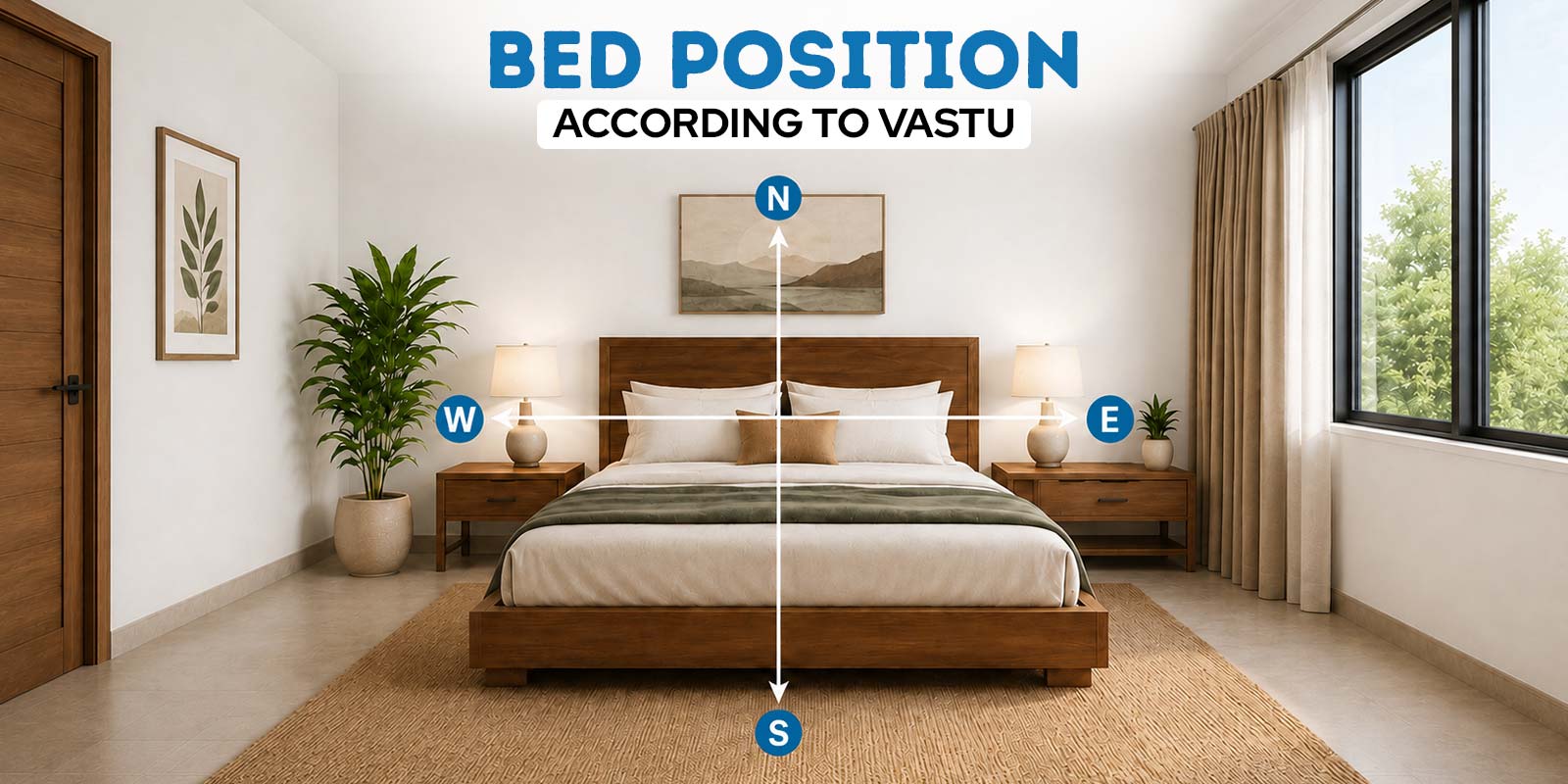
According to Vastu Shastra, the bed should sit in the south-west zone of the bedroom with the headboard against a solid south or west wall, so your head points south while you sleep. East is the next best head direction. Avoid a head-north position, a bed directly in line with the door, and a bed placed under an exposed beam.
Bed position according to Vastu is easier to get right once you realise it is not one decision but three: which room you sleep in, where the bed sits within that room, and which way your head points. Kept separate, the rules line up cleanly. This guide takes each in turn, gives the full eight-direction picture rather than the usual four, and covers what to do when your room simply will not allow the ideal arrangement.
Key Takeaways
- Bed position in Vastu is three decisions: which room, where the bed sits in that room, and which way your head points.
- The south-west zone of the room is the recommended place for the bed; the south wall is the recommended headboard wall.
- Head south is the first preference, head east the second. Head north is the position Vastu consistently advises against.
- A solid headboard against a solid wall, clear floor on both sides, no beam overhead and no mirror facing the bed matter as much as the compass direction.
- If you cannot achieve the ideal, give up the room zone first, the wall second, and the head direction last.
Bed Position in Vastu Is Three Separate Decisions
The answer to “what is the best bed position as per Vastu” changes depending on which of these three you are asking about.
Decision |
The question it answers |
The Vastu recommendation |
How fixable is it? |
| 1. Room | Which room should be the bedroom? | South-west quadrant of the home for the master bedroom | Hard — fixed at design stage |
| 2. Zone | Where should the bed sit within that room? | South-west zone, headboard on the south or west wall | Moderate — depends on doors, windows and wardrobes |
| 3. Head direction | Which way should your head point? | South first, east second; never north | Easy — usually just turning the bed |
These can conflict. A south-west room with the bed in the south-west zone naturally puts the headboard on a south or west wall, which gives a head-south position — the outcome Vastu is aiming at. In an awkwardly shaped room, satisfying all three at once becomes impossible, and the order of priority for what to sacrifice is set out later in this guide.
Best Bed Position and Bed Orientation as per Vastu: At a Glance
This table settles the best position for bed as per Vastu across every element that matters:
| Element | Recommended | Avoid |
| Zone within the room | South-west zone | Centre of the room; floating away from any wall |
| Headboard wall | Solid south or west wall | Wall shared with a bathroom; wall under a window |
| Head direction while sleeping | South (first choice), east (second choice) | North; north-east |
| Relationship to the door | Diagonal to the door, door visible from the bed | Directly in line with the door, feet pointing at it |
| Above the bed | Clear, flat ceiling | Exposed beam, sloped ceiling, overhead loft or storage |
| Headboard type | Solid, one-piece, preferably wooden | Broken, hollow, mirrored or no headboard |
| Clearance | Free floor space on both long sides | Bed pushed into a corner on two sides |
| Mirrors | Positioned so they do not reflect the bed | Mirror or mirrored wardrobe facing the bed |
| Under the bed | Empty, or soft storage only | Metal, tools, electronics, clutter |
Vastu for Bed Position in Bedroom: Where the Bed Should Sit
The bed position in bedroom as per Vastu is the south-west zone of the room. In the Vastu Purusha Mandala, the south-west is the zone of the earth element, associated with weight and stability — and in a bedroom the bed is almost always the heaviest object. Light and movement belong in the north-east, mass and rest in the south-west.
- Push the bed towards the south-west, not into it. Occupy the south-west portion, but keep walking space along at least one long side.
- Put the headboard against a solid wall. Not a window, not a half-wall, and preferably not the wall shared with a bathroom.
- Keep clearance on both long sides. Two people should be able to get in and out without climbing over each other.
- Do not float the bed in the centre. The centre of any space — the brahmasthan — is meant to stay open.
PRACTICAL NOTEIn most Indian apartment bedrooms the south-west zone is already partly taken by the wardrobe, which Vastu also assigns to the south-west or west. If you have to choose, give the bed the south-west and move the wardrobe to the west or north-west wall.
Bed Head Position as per Vastu: All Eight Directions
Real bedrooms — especially in plots not aligned to the cardinal axes — routinely produce a head position somewhere in between. This table covers all eight Vastu bed head position options, with the directional guardian (dikpala) each is traditionally assigned to.
Head direction |
Dikpala |
Traditional interpretation |
Rating |
| South | Yama | The most recommended position. Associated with deep rest, stability and grounding; the classical texts single it out for householders. | Best |
| East | Indra | Second preference. Associated with alertness, clarity and focus. Traditionally advised for students and for those in study or spiritual practice. | Very good |
| West | Varuna | Acceptable rather than ideal. Associated with ambition and worldly gain. A reasonable fallback when south and east are impossible. | Acceptable |
| North | Kubera | The position Vastu consistently advises against for sleeping, on the reasoning that the head should not point the same way as the earth’s northern pole. | Avoid |
| South-east | Agni | The fire zone. Associated with heat and agitation, and traditionally linked to unsettled sleep, particularly for couples. | Avoid |
| South-west | Nirriti | Acceptable as a compromise if the head leans south rather than west. Treated as neutral rather than beneficial. | Neutral |
| North-west | Vayu | The air zone, associated with movement and change rather than rest. Considered unsettled for long-term sleeping, though tolerable in a guest room. | Weak |
| North-east | Ishana | The most sacred zone in Vastu and the one meant to stay open and light. Discouraged more firmly than plain north. | Avoid |
IF YOUR ROOM IS NOT SQUARE TO THE COMPASSRound to the nearest of the eight directions using a compass, standing at the head of the bed and facing the way your head points. Vastu practitioners work to the nearest recognised sector rather than to exact degrees, so a bed pointing 20° off south is still treated as a south-facing head position.
Please note: Interpretations of the eight directions vary between Vastu schools and practitioners. The ratings above reflect the most widely followed guidance, not a single authoritative standard.
Head in North While Sleeping: Why Vastu Advises Against It
Keeping the head in north while sleeping is the one arrangement every Vastu source agrees on, which is why the north direction sleep question comes up more than any other. The traditional reasoning is that Vastu treats the human head as the body’s north pole, so pointing it at the earth’s magnetic north sets two like poles against each other — resistance rather than rest. The north is also Kubera’s direction, meant to stay open and active rather than slept against.
The magnetic explanation is a modern gloss rather than something the classical texts state, and it is not an established physical effect. If your bed points north, the usual fix is simply to swap which end is the headboard — in a room with a single north–south axis that converts a head-north position into a head-south one at no cost. Where the room cannot change, keep the rest of the checklist tight: solid headboard, no beam overhead, no mirror facing the bed, clear floor on both sides. Vastu is applied as a set of priorities, not as a pass-fail test.
Vastu Shastra Bed Position: Where the Rule Comes From
The head-south and head-east preference is not a modern invention. It appears in classical Indian literature well before it became a property talking point.
- Ashtanga Hridaya. The Ayurvedic compendium attributed to Vagbhata records head-east and head-south as the beneficial positions, with the choice between them tied to the sleeper’s stage of life — east for those in study and celibate practice, south for householders.
- Vishnu Purana and the Mahabharata. Both contain the instruction to lie with the head placed southward or eastward.
- The dikpala system. Vastu assigns a guardian to each of the eight directions: Yama governs the south, Indra the east, Varuna the west and Kubera the north.
Master Bedroom Bed Position Vastu
For the master bedroom, the ideal bed position as per Vastu stacks all three decisions in the same direction: a bedroom in the south-west quadrant of the house, the bed in the south-west zone of that room, and the head pointing south. The south-west is associated with the stability of the household, which is why it is assigned to whoever heads it.
For couples
- Keep the bed as a single unbroken unit rather than two mattresses pushed together on separate frames.
- Leave equal clearance on both sides, with matching bedside tables and lamps to reinforce the symmetry Vastu associates with balance.
- Avoid the south-east zone of the house for a couple’s bedroom — the fire zone is the placement most often linked in traditional guidance to friction between partners.
- Keep televisions, laptops and chargers out of the immediate sleeping area. Vastu places electricals in the south-east corner of the room.
Bed Sleeping Position Vastu by Age and Life Stage
The sleeping bed position according to Vastu is not identical for everyone in the house:
Who |
Recommended room |
Head direction |
Reasoning |
| Married couple / head of household | South-west | South | Stability and long-term grounding |
| Students and children in study | East or north-east room, bed in the room’s south-west | East | Alertness and concentration |
| Young children | East or north | East | Associated with growth and settled sleep |
| Teenagers and working adults | West or north-west | South or east | Independence and career focus without displacing the household head |
| Guests | North-west | South, east or west | The north-west is the zone of movement, traditionally read as suiting short stays |
| Elderly family members | West or south-west, ground floor if possible | South | Stability, and the practical benefit of avoiding stairs at night |
Please note: These are traditional associations by life stage, not recommendations based on age, health or individual circumstances. Adapt them to what actually suits the people using the room.
Bed Position Mistakes to Avoid — and How to Fix Each
Direction is only half of bed position according to Vastu. These placement errors are treated as seriously as a wrong compass reading, and most have a fix that costs nothing.
Mistake |
Why Vastu objects |
Fix |
| Head pointing north | The most firmly discouraged sleeping position in Vastu. | Rotate the bed so the head points south or east. If the room only allows a north–south axis, reverse which end is the headboard. |
| Bed directly in line with the door | Described as leaving the sleeper exposed and disrupting the flow of the room. | Shift the bed sideways so it is diagonal to the door — visible from the pillow, but not in its path. |
| Bed under an exposed beam | A beam overhead is read as downward pressure on the sleeper. | Move the bed clear of the beam, or conceal it with a false ceiling. |
| Mirror or mirrored wardrobe facing the bed | The reflection is said to bounce energy back at the sleeper. | Reposition the mirror, or fit a curtain or sliding panel and close it at night. |
| No headboard, or a hollow or broken one | The headboard represents support; a weak one is read as unstable backing. | Fit a solid one-piece headboard. Wood is traditionally preferred over metal. |
| Headboard against a window | An opening behind the head is the opposite of a solid wall. | Move the headboard to a solid wall. If unavoidable, use heavy curtains and a tall solid headboard. |
| Bed under a sloped ceiling or a loft | Same objection as the beam — compressed space above. | Position the bed under the highest part of the ceiling, or move the loft to the foot end. |
| Metal, tools or electronics stored under the bed | The space under the bed is meant to stay clear. | Clear it, or keep under-bed storage to soft goods only. |
| Bed floating in the centre of the room | Blocks the brahmasthan, the open centre of the space. | Move the bed towards the south-west with the headboard on a wall. |
| Feet pointing directly at the door | Traditionally the strongest version of the door-alignment objection. | Rotate or shift the bed so the foot end is not aimed at the doorway. |
What If Your Room Will Not Allow the Ideal Bed Position?
A finished apartment has fixed doors, fixed windows and a fixed wardrobe recess, so something usually has to give. Vastu practitioners work to a rough order of priority — give up the least important element first.
Give up |
Order |
Reasoning |
| The room’s position in the house | First | You rarely control this in an apartment, and it is the most abstract of the three. |
| The south-west zone within the room | Second | Meaningful, but less directly tied to the sleeper than the head direction. |
| The specific headboard wall | Third | A solid wall matters more than which solid wall it is. |
| The head direction | Last | This is the element the classical texts actually specify, and the one that costs nothing to fix. |
Compromises considered acceptable
- Head east instead of south when the room’s only solid wall runs east–west. East is a strong second, not a poor substitute.
- Head west when neither south nor east is available — far better than settling for north.
- Bed in the west or south zone rather than strictly south-west, when the wardrobe recess owns the corner.
- A tall, solid headboard in place of a solid wall, where the bed has to sit against a window.
- A false ceiling where a beam cannot be avoided — a standard accepted remedy rather than a workaround.
Sleeping Direction as per Science
Vastu is a traditional architectural system with cultural and religious weight. It is worth being clear about which of its guidance is traditional and which is supported by evidence.
Guidance |
Status |
| Sleeping with the head south aligns the body with the earth’s magnetic field | A traditional belief with a modern explanation attached. It is not an established physical effect, and no reliable research demonstrates that compass direction changes how well people sleep. |
| A solid headboard against a solid wall helps you settle | Traditional, with a plausible practical basis — a protected head position with an open view of the room is a widely reported comfort preference. |
| Screens and electronics near the bed disturb sleep | Evidenced. Evening screen exposure and light at night are well documented as sleep disruptors. Vastu’s placement rule and the research point the same way. |
| Room temperature, noise and morning light affect sleep | Strongly evidenced — and far more influential than compass direction. |
None of this is an argument against following Vastu. A layout that respects it will typically also give you a bed on a solid wall, away from the door, clear of clutter and out of the direct path of morning light — a good bedroom by any standard. It is an argument for treating the compass as one input among several, and for putting at least as much attention into how well the room holds temperature, how much street noise reaches the bed, and how much light gets in at 6 a.m.
Please note: This section describes the general state of published research and is not health advice. If poor sleep is affecting you, a qualified professional is the right person to speak to — not a furniture guide.
Bed Position Vastu Checklist
These are the Vastu tips for sleeping that carry the most weight, in the order they matter. If you can tick the first six, the bed position is sound.
- The head points south, or east if south is not possible.
- The head does not point north or north-east.
- The bed sits in the south-west zone of the room, not the centre.
- The headboard is solid, one-piece, and against a solid wall.
- The bed is diagonal to the door, and the feet do not point at the doorway.
- There is no exposed beam, sloped ceiling or overhead loft directly above the bed.
- No mirror or mirrored wardrobe reflects the bed while you sleep.
- There is clear floor space on both long sides of the bed.
- The space under the bed is empty, or holds soft items only.
- Screens, chargers and heavy electronics are away from the sleeping area.
- Wall colours are soft and light — pale rose, cream, light blue or soft green rather than strong reds and blacks.
Getting Bed Position Right at the Design Stage
Bed position according to Vastu is cheap to fix before the walls exist and expensive afterwards. If you are building or renovating, these decisions determine whether a Vastu-compliant bed placement is even possible later.
- Door position. A door placed centrally on a wall forces the bed off-axis in a small room. Placing it towards a corner leaves a clean run of wall for the headboard.
- Window position. A window on the south wall of a south-west bedroom removes your best headboard wall. Moving it to the east or north wall preserves the wall and improves morning light.
- Window performance. Once the bed is fixed against a wall, the window is the main variable left. Sealed, multi-chambered uPVC windows and doors cut street noise and heat gain. See also soundproof uPVC windows for the home.
- Beam planning. Ask for the beam layout at slab stage so the bed can be positioned clear of them without a false ceiling later.
- Wardrobe zone. Decide early whether the wardrobe or the bed gets the south-west corner.
- Flooring and storage. Cool, low-glare flooring keeps a bedroom comfortable through Indian summers. Planned storage elsewhere keeps the area around the bed clear.
Conclusion
Bed position according to Vastu comes down to three decisions taken in order: put the bedroom in the south-west of the house if you can, put the bed in the south-west of that room, and point your head south — or east if south is not available. Back that up with a solid headboard on a solid wall, keep the bed out of the door’s path and clear of beams and mirrors, and leave room to walk on both sides. Where the room fights you, give up the room zone before the wall and the wall before the head direction.
References
https://www.wisdomlib.org/hinduism/book/ashtanga-hridaya-samhita-sanskrit/d/doc411533.html
https://www.wisdomlib.org/definition/dikpala
Frequently Asked Questions
The bed should be placed in the south-west zone of the bedroom with the headboard against a solid south or west wall, so that your head points south while sleeping. East is the second-best head direction. Avoid placing the bed in line with the door or under a beam.
South is the first preference and east the second. West is acceptable as a fallback. Keeping the head in north while sleeping is the position Vastu advises against.
Traditional Vastu holds that the head should not point the same way as the earth’s northern pole. This is a traditional belief rather than an established physical effect, and the simplest correction is to reverse which end of the bed is the headboard.
Yes, as a fallback. West is treated as acceptable rather than ideal, and is associated with ambition and worldly gain. It is a far better compromise than a head-north position.
In the south-west zone of a south-west bedroom, with the headboard on the south wall. This is the arrangement in which all three Vastu decisions — room, zone and head direction — align.
No. A bed directly in line with the door is discouraged, and feet pointing at the doorway is the version treated most seriously. Position the bed diagonally so the door is visible from the pillow but not in the bed’s direct path.
Head towards the east, in an east or north-east bedroom, with the bed still in the south-west zone of that room. The east head position is traditionally associated with concentration and clarity.
Move the bed clear of the beam if the layout allows. Where it does not, a false ceiling that conceals the beam is the standard accepted remedy.
Vastu holds that a mirror reflecting the bed bounces energy back at the sleeper. Where a mirrored wardrobe cannot be moved, covering it at night with a curtain or sliding panel is the usual solution.
Research has not demonstrated that compass direction changes how well people sleep. The factors that are well evidenced are room temperature, noise, light exposure and screen use before bed.
Start Your Project with the Right Materials
We provide everything you need for modern construction. Connect with our experts to discuss your requirements and get the best solution for your project. Submit your details and our team will contact you soon.
CORPORATE OFFICE
8-2-293/82/A, Plot No-1214, Road No-60,
Jubilee Hills, Hyderabad-500 033.