
How to Check the Quality of Tiles: Tests, Standards & Site Checks
In This Article
You can check tiles in a showroom in ten minutes without using any tools. You can press two tiles together to check for gaps, run your fingers along the edges, tap the surface, compare the batch and calibre codes on the boxes, and ask the dealer for the water absorption figure.
These simple checks can help you identify visible defects before buying. You can repeat them when the tiles arrive to check whether the delivered stock matches what you selected.
The 60-Second Version
If you are short on time? Here is the whole method in five lines.
Quick tile quality check
- Press two tiles together and check for visible gaps or rocking.
- Check the edges and corners of tiles taken from different boxes.
- Tap the tile and listen for any unusual difference in sound. Sound alone cannot confirm quality.
- Compare the batch and calibre codes on every carton before accepting delivery.
- Ask for the water absorption figure in writing, along with the classification it belongs to.
The fastest tile quality check takes five steps. This guide explains all eight checks, the three numbers worth asking for, the markings on the box and the warning signs to look for when buying first-quality tiles.
What Good Quality Actually Means in a Tile?
Tile quality depends on three important factors: density, dimensional accuracy and surface durability. These factors affect how the tile performs after installation and how it looks over time.
Here is what each factor means in simple terms:
- Density: Water absorption helps indicate how porous a tile is. Low absorption is important for porcelain and vitrified tiles, but it does not prove that a tile is strong or stain-resistant in every situation.
- Accuracy: The tile should be close to its specified size and shape, within the applicable tolerances. Consistent dimensions and flatness help achieve even grout lines.
- Surface: The finish should suit the intended use. Wear resistance, stain resistance, and slip resistance are different properties, so you have to check the specifications according to where the tile will be installed.
Every check below helps you examine one or more of these factors. The terms porcelain and vitrified are closely related in the tile market. Porcelain tiles are identified by their low water absorption, while vitrified is widely used in India for low-absorption ceramic tiles.
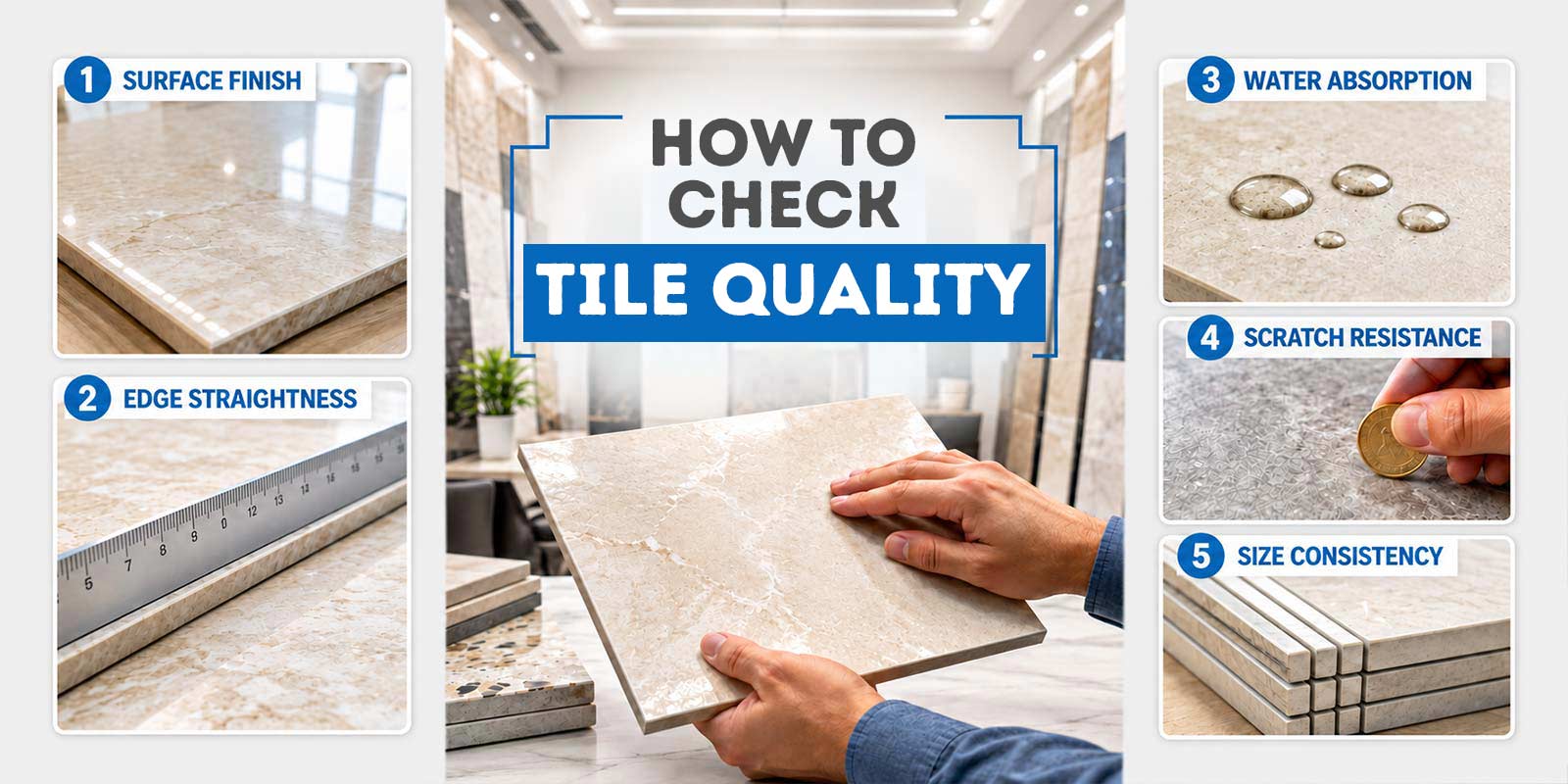
8 Checks You Can Do Standing in the Showroom
You don’t need special tools to check tile quality before buying. These eight simple checks can help you spot visible defects and compare tiles in the showroom.
1. Check Tile Flatness
Press the surfaces of two tiles together and look along the joint for light or rocking. Try a few more pairs.
Visible gaps may indicate uneven surfaces, but this check cannot accurately measure tile flatness. Uneven tiles can contribute to raised edges, called lippage, after installation.
2. Check Edges and Corners
Inspect at least five tiles for chipped corners, cracks, rough edges and visible damage. If possible, check tiles from different boxes.
If several tiles have damaged edges, ask the dealer to inspect more tiles before you buy.
3. Compare Tile Sizes
Stack four or five tiles on a flat surface and align their edges. Check whether they appear to be the same size.
You can also place two tiles side by side to compare them. Consistent tile sizes help maintain even grout lines. Accurate measurements are needed to confirm dimensional tolerances.
4. Try the Sound Test
Support the tile in one hand and knock the middle gently with a knuckle. Compare the sound across several tiles.
A clear sound does not guarantee good tile quality, and a dull sound does not always mean the tile is cracked. If one tile sounds different, inspect it more closely.
5. Inspect the Back of the Tile
Turn the tile over and check for cracks, damage or excessive loose powder. Look for the manufacturer’s name or product markings, if available.
The colour and texture of the back may vary depending on how the tile is made. Check the manufacturer’s details to confirm the tile type and specifications.
6. Check Batch and Calibre Codes
Look for the batch, shade and calibre codes printed on the cartons. These codes help identify the tile’s production lot, shade grouping and size category.
Make sure the codes match across your order wherever possible. Different shade batches can cause visible colour differences, while different calibres can affect grout line alignment.
Ask the dealer to explain any differences before accepting the tiles.
7. Try the Water Drop Test
Put a little water on the bare, unglazed underside of the tile. Watch whether it soaks in fast or stays on top.
This simple test gives only a rough indication of water absorption. It cannot tell you the exact percentage.
Ask the dealer for the manufacturer’s datasheet or a suitable test report to confirm the tile’s water absorption.
8. Check the Surface Finish
Hold the tile at an angle to the light and look for scratches, pinholes, uneven gloss, patchy glaze or visible marks.
If the tile has a printed design, compare three or four pieces side by side. This helps you check the shade and pattern before buying.
If possible, view the tiles in natural light, as showroom lighting may change how their colour and finish appear.
The checklist at a glance
| Check | What you are looking for | Fail signal |
| 1. Flatness | Tiles sit flush against each other | Visible gaps or uneven contact |
| 2. Edges and corners | Clean, undamaged edges | Chips, rough spots or visible damage |
| 3. Size consistency | A flush stack and aligned edges | Overhang or noticeable size differences |
| 4. Sound | Consistent sound when comparable tiles are tapped | An unusual difference that needs further inspection |
| 5. Back surface | No visible cracks, damage or excessive residue | Damage or unusual surface conditions |
| 6. Batch and calibre | Compatible codes across the order | Unexplained differences in codes |
| 7. Water drop | How water behaves on the unglazed back | Rapid absorption that prompts a request for test results |
| 8. Surface finish | An even finish suitable for the product | Pinholes, scratches or patchy glaze |
The Three Numbers Worth Asking For
Ask the dealer for these three figures to compare tiles. What counts as “good” depends on the tile’s type, thickness, finish, and intended use.
| What to ask for | What it tells you | What good looks like | Why it matters to you |
| Water absorption | How much water the tile soaks up in testing | 0.5% or less on average; no single tile above 0.6% (vitrified tiles) | Shows how porous the tile is, as declared or tested. |
| Breaking strength | Load the tile withstands before breaking | Check the standard for your tile’s thickness | Shows if the tile meets the required strength |
| Abrasion resistance | How well the surface resists wear | PEI rating for glazed tiles; deep abrasion of 175 mm³ or less for unglazed tiles (different tests, don’t compare) | Helps match the tile to your foot traffic |
The figures above are typical limits for vitrified (Group BIa) tiles under IS 15622:2017 (as amended).
One important point is that PEI ratings apply to glazed surface abrasion. Deep abrasion testing is used for unglazed tiles. These are different tests, and the appropriate result depends on the tile’s construction and classification.
What to Ask Your Dealer For — and How to Read It?
Ask for the product datasheet or test report. It should name the product, give water absorption, breaking strength and abrasion resistance figures, and list the test methods.
Ask which batch, shade and calibre your tiles come from, and whether the dealer can supply your whole order from matching stock.
“ISO certified” alone doesn’t confirm performance. Ask which standard is claimed and what it covers.
Asking for paperwork before buying is reasonable, especially for large orders. The dealer may need to get it from the manufacturer, so ask when you’ll receive it.
What a Real Test Report Looks Like?
A test report records results from tests on a sample. It should name the product or sample and may give the test date, laboratory, methods and measured values.
A datasheet lists the manufacturer’s declared specifications. It may not be an independent test.
Both are useful for different purposes. For independent proof, check that a qualified laboratory issued the report and that it covers the exact tile you’re getting.
“ISO certified” on a single line doesn’t replace technical details.
Four Questions That Tell You What Kind of Dealer You Are Dealing With
- What is the water absorption of this tile? Ask for the declared figure and supporting documents.
- Can I see the datasheet or test report? Check that it names the product and gives the key specifications.
- What batch and calibre is this stock, and can you supply my whole order from matching stock? Ask the dealer to confirm the codes before delivery.
- What happens if tiles arrive damaged or the shades don’t match? Ask the dealer to explain the replacement, return and complaint process, preferably in writing.
What the Marks on the Box Actually Mean?
Tile cartons may carry certification marks, manufacturer details, quality-management references and other identification. Each marking does a different job.
A BIS Standard Mark (ISI mark) shows certification under the applicable Indian standard and licence. Check the standard number and certification details, not just the logo.
A genuine ISI mark should show a licence number (CM/L), and the standard number should match the product. You can check the licence in the BIS Care app.
ISO 9001 covers a quality-management system. It doesn’t prove that any tile meets a particular water absorption, strength, abrasion or slip-resistance requirement.
A manufacturer’s own quality seal isn’t necessarily third-party certification. Check whether it names a recognised standard and whether you can verify the claim.
| Mark on the box | What it actually means | What it does NOT tell you |
| BIS Standard Mark (ISI) | BIS certification and the Indian standard cover the product, subject to licence details | That every tile is defect-free or suits every application |
| ISO 9001 | The organisation or facility has a certified quality-management system within the stated scope | The measured performance of the tiles in your order |
| Water absorption class marking | The product carries a particular classification, where the marking system specifies one | Breaking strength, abrasion resistance or slip resistance |
| The manufacturer’s own quality seal | A claim the manufacturer makes | Independent verification, unless the seal names a supporting standard or certification |
Product certification and management-system certification are different things. Both have a purpose, but they don’t prove the same things.
Red Flags: How Seconds Get Sold as First Quality
Tile grades vary between brands. Dealers can sell seconds at a discount, but they should tell you the grade. What matters is whether the tiles you get match what the dealer promised.
Watch for these eight signs:
- Grade markings on the carton are removed or overwritten.
- The price is unusually low for the claimed premium grade.
- The dealer won’t let you open more than one carton.
- Your order has several unexplained batch codes.
- The cartons don’t clearly show the product or size.
- The delivered stock doesn’t match the approved sample.
- The dealer discloses return limits only after payment.
- An ISI mark with no CM/L licence number, or one you cannot verify in the BIS Care app.
These signs don’t prove the tiles are seconds, but they’re reasons to ask questions first.
If the delivery doesn’t match what you agreed, document the problem and contact the dealer promptly. Report any damage before installation, and check the written delivery terms.
Different Room, Different Checks
Choose the tile for where it will go. A rating that suits one installation may not suit another.
For floors that may get wet, check that the slip-resistance test matches your conditions. A slip-resistance result applies only to the conditions it was tested for, and no single rating guarantees safety on every wet floor or outdoors.
For walls, flatness, edge quality and shade consistency matter more than walking-surface ratings. PEI describes the surface abrasion resistance of glazed tiles, so match it to the use.
| Where the tile goes | The check that matters most | The number to ask for | What to ignore |
| Interior floor (living, bedroom) | Flatness and batch consistency | Breaking strength and PEI class for glazed tiles | Slip rating as the main measure for a dry room |
| Wall (dry areas) | Flatness and edge quality | Specifications suitable for walls | Floor slip and wear ratings |
| Bathroom and wet-area floor | Wet-condition suitability, surface texture, low absorption where required | Water absorption class and relevant slip-resistance information; COF 0.42 or more when wet | Gloss level alone |
| Bathroom and wet-area wall | Edge quality and shade match | Water absorption and other applicable specifications | Floor slip ratings as the main criterion |
| Kitchen floor | Foot traffic, cleaning and likely spills | Relevant slip-resistance information, and abrasion class for glazed tiles; COF 0.42 or more when wet | Back-surface appearance as the main measure |
| Balcony, terrace and outdoor | Wet grip and outdoor suitability | Manufacturer’s suitability guidance, water absorption class and relevant slip-resistance results; COF 0.42 or more when wet | Gloss level and decorative finish alone |
| High-traffic commercial | Wear resistance and strength | PEI class for glazed tiles, or deep abrasion results for unglazed tiles | Price per box as a quality signal |
The main point is to choose a tile according to its intended use. A rating that applies to one type of installation should not automatically be treated as suitable for another.
The Spec Sheet Decoder
For home buying, the checks above are a good starting point. For comparing specifications or writing a project specification, use IS 15622:2017 (as amended), the Bureau of Indian Standards specification for ceramic tiles. It sets the test methods and the classification of each tile type.
The limits below are for vitrified (Group BIa) tiles.
| Property | Test method | Requirement | What it means in practice |
| Water absorption | Water absorption test | 0.5% or less average; no tile above 0.6% | How much water the tile absorbs |
| Modulus of rupture | Bending strength test | 35 N/mm² or more average; no tile below 32 | Resistance to bending stress |
| Breaking strength | Breaking load test | 1,300 N or more (7.5 mm or thicker); 700 N or more (thinner) | Load the tile takes before breaking |
| Deep abrasion (unglazed only) | Deep abrasion test | 175 mm³ or less | Material removed from an unglazed tile |
| Surface abrasion, PEI class (glazed only) | Surface abrasion test | Class 0-5 is declared; there is no pass mark | How well the glaze resists wear |
| Dimensional tolerance | Dimensions and surface quality test | Depends on size and rectification | Whether dimensions and surface quality meet tolerances |
| Slip resistance (floors only) | Slip resistance test | COF 0.42 or more when wet (reference value) | Suitability for the conditions the test covers |
Typical limits for vitrified (Group BIa) tiles under IS 15622:2017 (as amended). Standards change, so check the current edition.
PEI applies only to glazed tiles and deep abrasion only to unglazed tiles.
How Aparna Enterprises Tiles Are Tested?
Aparna Enterprises says it tests raw materials and finished tiles in an in-house laboratory at its Vitero tile plant. According to the company’s catalogue, the lab uses an XRF machine, a dilatometer, a modulus of rupture (MOR) machine, and crazing resistance, surface abrasion and deep abrasion testing machines.
What the lab equipment is used for
- XRF analysis checks the chemical makeup of raw materials such as clay and feldspar.
- A dilatometer measures how a material expands and contracts with temperature.
- MOR machine measures bending strength.
- Crazing, surface abrasion, and deep abrasion machines test the glaze and body of finished tiles.
If you need tiles for your home or office, get in touch with Aparna Enterprises Limited for additional details.
Key Takeaways
- Simple showroom checks can spot visible defects in about ten minutes.
- Ask for water absorption, breaking strength, and the abrasion rating. Check the tile’s classification and thickness, and use PEI for glazed tiles and deep abrasion for unglazed ones.
- Compare batch and calibre codes across your order before you accept delivery.
- No single slip rating guarantees safety on every wet floor.
- A BIS mark shows product certification, and ISO 9001 shows a quality-management system. Neither covers more than its stated scope.
Disclaimer: This page is general information, not technical, engineering or legal advice. Showroom checks don’t replace laboratory testing. Standards and specifications change, so rely on the manufacturer’s documentation for your exact product and the current edition of the applicable standard.
Frequently Asked Questions
Press two tiles together to look for gaps, look at edges across several boxes, and compare size, finish, and batch codes. Ask for the water absorption figure and its documentation. These checks don’t replace laboratory testing.
Only partly. Look for pinholes, uneven gloss, scratches, and chipped edges. Appearance can’t confirm water absorption, strength or abrasion resistance, so ask for the specifications.
Not as proof. A clear ring or a dull sound doesn’t confirm quality, so use tapping only to pick out tiles for a closer look. Rely on the datasheet or test report for strength and density.
Vitrified tiles fall in Group BIa under IS 15622:2017 (as amended). Water absorption should be 0.5% or less on average, with no single tile above 0.6%. Ask for the declared figure and the test report, not a showroom water-drop test.
In practice, yes. Porcelain is the international term and vitrified is the Indian trade term. Both describe low-absorption tiles at 0.5% or less (Group BIa). The declared figure matters more than the name.
They are different grades of stock, and grading varies by manufacturer. Lower grades may have more defects and sell at a discount. Ask the dealer to name the grade in writing.
Usually not. PEI describes the surface abrasion of glazed tiles and mainly matters for floors. For walls, check flatness, edges, shade and finish. See Different Room, Different Checks.
Batch identifies the production lot, and calibre generally shows the size category. Mixed batches can differ in shade, and mixed calibres can affect joint alignment. Compare codes across your order before delivery.
Not automatically. Price also reflects brand, size, design and finish. Compare declared specifications and test results.
Check product name, size, batch, shade, and calibre codes on every carton, and count the boxes. Inspect several tiles for chips and cracks. Photograph any problems and report them promptly, following the dealer’s delivery terms before installation.
Start Your Project with the Right Materials
We provide everything you need for modern construction. Connect with our experts to discuss your requirements and get the best solution for your project. Submit your details and our team will contact you soon.
CORPORATE OFFICE
8-2-293/82/A, Plot No-1214, Road No-60,
Jubilee Hills, Hyderabad-500 033.