
Types of Building Materials and Their Uses in Construction
In This Article
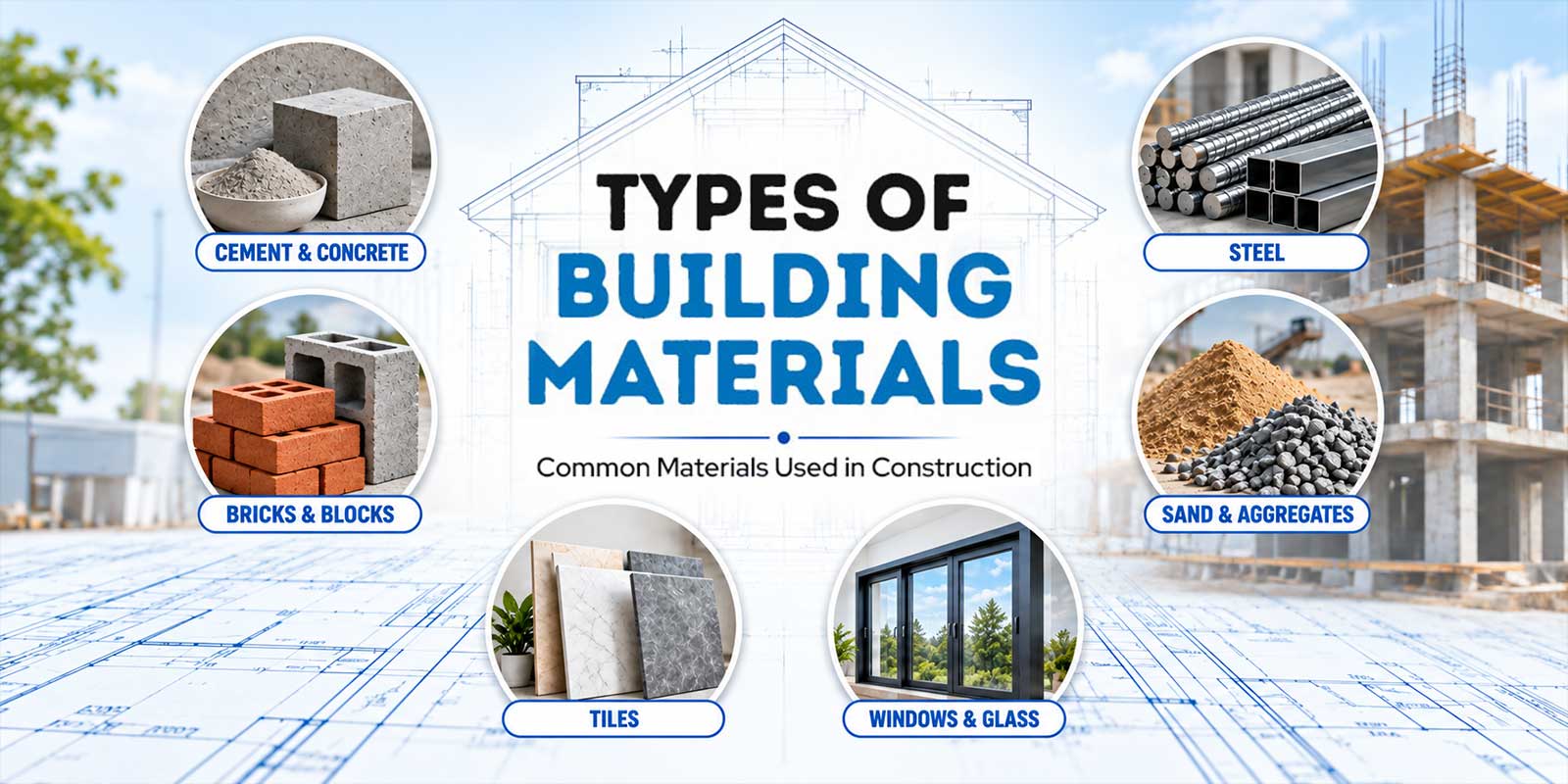
Building materials are easiest to understand by the job they do in a structure. This guide groups them into seven functional families: binding materials, aggregates and concrete, reinforcement and structural metals, walling and masonry units, roofing and waterproofing, openings and glazing, and finishing materials. This is the grouping used in this article for clarity, not an official or fixed classification — Indian standards specify materials product by product rather than under a single taxonomy. Most materials on an Indian construction site fall into one of these seven.
What Are Building Materials?
A building material is any substance used to form a permanent part of a structure — from the cement in a foundation to the paint on a parapet. The list runs to hundreds of products, which is why a flat list of ten is rarely useful.
Building materials or construction materials?
In Indian practice, the two terms are used interchangeably. Where a distinction is drawn, construction materials is the wider term and includes road, bridge and infrastructure inputs such as bitumen and pavement aggregates; building materials refers to what goes into buildings. This guide covers building materials.
Types of Building Materials At-a-Glance
The table below lists the materials in common use on Indian building sites, what each is for, and — the part most guides leave out — what each one cannot do well.
Material |
Group |
Key property |
Common use |
Typical application |
Key limitation |
| Cement (OPC / PPC / PSC) | Binder | Sets and hardens with water | Binds concrete and mortar | Foundations, RCC, plaster, masonry | Grade and freshness matter; loses strength in storage |
| Lime | Binder | Breathable | Mortar and plaster | Restoration, traditional masonry | Slow strength gain |
| Gypsum | Binder | Fast-setting, smooth | Plaster and boards | Internal walls and ceilings | Not for wet or external areas |
| Construction chemicals | Admixture | Modifies workability and set | Plasticisers, accelerators, bonding agents | RMC, repairs, waterproofing | Dosage-sensitive; needs supplier data |
| River sand | Aggregate | Rounded, natural grading | Fine aggregate | Plaster, mortar | Supply is restricted and variable in silt content |
| Manufactured sand (M-sand) | Aggregate | Controlled, consistent grading | Fine aggregate | Concrete, plaster, masonry | Angular particles need mix adjustment |
| Coarse aggregate | Aggregate | Compressive load transfer | Body of concrete | All concrete work | Quality depends on the source rock and on grading, particle shape, cleanliness and processing |
| Concrete (PCC / RCC) | Concrete | High compressive strength | Structure | Footings, columns, beams, slabs | Weak in tension without steel |
| Ready-mix concrete | Concrete | Batch-controlled, consistent | Structure | Slabs, rafts, large pours | Time-bound placement window |
| Precast elements | Concrete | Factory-made, fast to erect | Structure and enclosure | Walls, slabs, boundary units | Needs handling and crane access |
| TMT reinforcement bars | Metal | High tensile strength, ductility | Reinforces concrete | Footings, columns, beams, slabs | Needs protection from corrosion — adequate cover, dense well-compacted concrete, proper curing and crack control |
| Structural steel | Metal | Very high strength-to-weight | Frames and long spans | Industrial sheds, warehouses | Needs fire and corrosion protection |
| Aluminium sections | Metal | Light, corrosion-resistant | Frames and facades | Windows, doors, curtain walls | Higher thermal conductivity than uPVC |
| Burnt clay brick | Walling | Thermal mass, familiar trade skill | Walls | Load-bearing and infill walls | Heavy; quality varies kiln to kiln |
| Fly-ash brick | Walling | Check dimensional uniformity and water absorption against the product’s test report | Walls | Infill walls | Needs a reliable ash source |
| AAC block | Walling | Light, insulating | Walls | Framed structures, upper floors | Needs the correct thin-bed adhesive and fixings |
| Concrete block | Walling | High strength, fast to lay | Walls | Boundary and heavy-duty walls | Heavy; higher thermal conductivity |
| Natural stone | Walling | Very durable | Walls, floors, cladding | Plinths, elevations, flooring | Heavy, and finish varies between blocks |
| Roofing sheet (metal) | Roofing | Light, fast to install | Roof cover | Sheds, warehouses, canopies | Noisy in rain; needs insulation |
| Waterproofing membrane | Roofing | Blocks water ingress | Protection | Terraces, basements, wet areas | Depends on substrate preparation, application and junction detailing, not the membrane alone |
| Insulation board | Roofing | Low thermal conductivity | Thermal control | Roofs, cavity walls | Needs protection from moisture |
| uPVC windows and doors | Opening | Thermal and acoustic sealing | Openings | Residential and commercial glazing | Reinforcement depends on window size, wind loads and the manufacturer’s requirements. |
| Timber | Opening | Workable, warm finish | Doors, frames, joinery | Internal doors, furniture | Needs treatment against moisture and termites |
| Glass (float / toughened / laminated) | Glazing | Daylight and transparency | Glazing | Windows, facades, partitions | Safety glass required in specified locations |
| Vitrified tile | Finish | Very low water absorption | Flooring | Living areas, commercial floors | Slip resistance must be specified for wet areas |
| Ceramic tile | Finish | Wide decorative range | Wall and floor | Bathrooms, kitchen walls | Higher water absorption than vitrified |
| Plaster and putty | Finish | Smooth substrate | Surface preparation | Internal and external walls | Can crack if curing or substrate preparation is inadequate |
| Paint and coatings | Finish | Protection and appearance | Surface finish | All exposed surfaces | Exterior grades needed outside; repainting cycle |
| Facade cladding | Finish | Weather protection with appearance | External envelope | Commercial elevations | Performance depends on the complete system — panel properties, fixings, joints, installation and fire performance |
How Building Materials Are Grouped?
Most guides split building materials into natural (stone, timber, clay, sand) and synthetic (cement, steel, glass, plastics). It is a correct classification and a nearly useless one: it puts concrete and polythene in the same bucket and tells you nothing about where either belongs in a building.
Grouping by function — what the material does once it is in place — is more useful, because it matches the order in which decisions are actually made. You do not choose “a natural material”; you choose a walling material, then a roofing material, then a floor finish.
| Group | What it does | Materials |
| 1. Binding materials | Hold everything else together | Cement, lime, gypsum, mortar, construction chemicals |
| 2. Aggregates and concrete | Provide bulk and compressive strength | River sand, M-sand, coarse aggregate, PCC, RCC, ready-mix, precast |
| 3. Reinforcement and structural metals | Carry tension and span | TMT bars, structural steel, aluminium sections |
| 4. Walling and masonry units | Enclose and divide space | Clay brick, fly-ash brick, AAC block, concrete block, stone |
| 5. Roofing, waterproofing and insulation | Keep weather and heat out | RCC slab, metal sheet, clay tile, membranes, insulation |
| 6. Openings and glazing | Admit light and air; provide security | uPVC, aluminium, timber, steel frames; glass |
| 7. Finishing and surface materials | Give durable, usable surfaces | Tiles, stone, plaster, putty, paint, cladding, false ceiling |
-
Binding Materials
Binders are the materials that set and hold other materials in position. Cement is the dominant one; lime and gypsum serve narrower roles.
| Material | What it is | Used for |
| OPC 33 / 43 / 53 | Ordinary Portland Cement, now covered by a single specification, IS 269:2015 | General concrete and mortar; 53 grade for higher-strength structural work |
| PPC | Portland Pozzolana Cement, fly-ash based (IS 1489 Part 1:2015) | Mass concrete, plaster, marine and aggressive exposure; slower early strength |
| PSC | Portland Slag Cement (IS 455) | Structures exposed to sulphates and chlorides |
| Lime | Calcium-based binder | Restoration, breathable plaster, traditional masonry |
| Gypsum | Calcium sulphate binder | Internal plaster and boards; not for wet or external use |
| Construction chemicals | Admixtures and bonding agents | Workability, set control, repair mortars, waterproofing |
A note on cement grade. A higher grade is not automatically better. OPC 53 gains strength quickly and generates more heat, which is unhelpful in large pours; PPC generally develops early strength more slowly. Its suitability for aggressive exposure depends on the cement properties and the project’s concrete specification.
Match the cement to the exposure condition, not to the highest number available.
-
Aggregates and Concrete
Aggregates are the inert bulk of concrete and mortar — roughly 60–75% of the volume. IS 383 divides them at the 4.75 mm IS sieve: material passing it is fine aggregate, material retained on it is coarse aggregate.
| Material | What it is | Used for | Watch for |
| River sand | Naturally graded fine aggregate | Plaster and mortar | Restricted extraction; silt content varies by source |
| Manufactured sand | Crushed rock fine aggregate, screened and washed | Concrete, plaster, masonry | Angular particle shape; mix design needs adjusting |
| Coarse aggregate | Crushed stone, commonly 10 mm and 20 mm nominal size | All concrete | Source rock quality, grading, particle shape and flakiness, cleanliness, and how it has been processed |
| PCC | Plain cement concrete, unreinforced | Levelling courses, bedding, flooring base, and suitably designed foundations and similar elements | Low tensile capacity — suitable only where the design does not rely on tensile strength |
| RCC | Concrete with steel reinforcement | Footings, columns, beams, slabs | Adequate cover helps protect the reinforcement, but concrete quality, permeability, compaction, curing and crack control matter as well |
| Ready-mix concrete | Batched at a plant and delivered | Slabs, rafts, large or continuous pours | Placement window; site access for transit mixers |
| Precast | Factory-cast elements delivered ready to erect | Walls, slabs, boundary units, drains | Handling, crane access, joint detailing |
Concrete is designated by grade — M20, M25, M30 and upwards — where the number is the characteristic compressive strength in N/mm² at 28 days. IS 456:2000, Clause 6.1.2 sets the minimum grade for plain and reinforced concrete by reference to its Table 5, which ties the requirement to the exposure condition. M20 is the minimum for reinforced concrete in mild exposure only. As exposure becomes more severe, the minimum grade and the minimum cement content both rise — and the maximum water-cement ratio comes down.
| Exposure condition | Minimum cement content (kg/m³) | Maximum free water-cement ratio | Minimum grade of concrete |
| Mild | 300 | 0.55 | M20 |
| Moderate | 300 | 0.50 | M25 |
| Severe | 320 | 0.45 | M30 |
| Very severe | 340 | 0.45 | M35 |
| Extreme | 360 | 0.40 | M40 |
Values are for reinforced concrete with normal-weight aggregate of 20 mm nominal maximum size, as set out in Table 5 of IS 456:2000. Cement content is independent of cement grade and includes the mineral additions permitted under Clause 5.2. Plain concrete has its own, lower set of values in the same table. The grade for any particular structure is set by the structural engineer, not by the minimum.
AEL produces aggregates at its own crushing operations in Telangana and Andhra Pradesh, and supplies ready mix concrete through its batching plants.
-
Reinforcement and Structural Metals
Concrete is strong in compression and weak in tension. Steel supplies the tension capacity, which is why almost every concrete building in India is a composite of the two.
| Grade | Minimum 0.2% proof stress / yield stress | Minimum elongation | Typical use |
| Fe 415 | 415 N/mm² | 14.5% | General reinforcement; older specifications |
| Fe 415D | 415 N/mm² | 18.0% | Where enhanced ductility is specified |
| Fe 500 | 500 N/mm² | 12.0% | The common grade for residential and commercial RCC |
| Fe 500D | 500 N/mm² | 16.0% | Where enhanced ductility is specified, including ductile detailing |
| Fe 550 | 550 N/mm² | 10.0% | High-load structural work |
| Fe 550D | 550 N/mm² | 14.5% | High-load with ductility requirement |
| Fe 600 | 600 N/mm² | 10.0% | Specialised high-strength applications |
Values are as specified in IS 1786:2008. The letter D denotes the same specified strength with enhanced and additional ductility requirements. Which grade to use is not a general rule of thumb: reinforcement grade, quantity and detailing must follow the structural engineer’s specification for the project, together with the applicable seismic design and ductile-detailing requirements.
Structural steel (IS 2062) is used where spans are long or speed matters — industrial sheds, warehouses, mezzanines. It needs fire protection and a maintained coating system. Aluminium appears mainly in window, door and facade framing, where its corrosion resistance and light weight matter more than its structural capacity.
-
Walling and Masonry Units
Walling is where the widest genuine choice exists, and where the five common options behave very differently.
| Unit | Governing standard | Strength / density | Best suited to | Trade-off |
| Burnt clay brick | IS 1077:1992 — classified by compressive strength class from 3.5 N/mm² upwards | Class 3.5 and above | Load-bearing and infill walls; good thermal mass | Heavy; quality varies between kilns |
| Fly-ash / PFA-lime brick | IS 12894:2002 | Uniform, factory-produced | Infill walls where consistency matters | Depends on a steady fly-ash supply |
| AAC block | IS 2185 (Part 3):1984; laid to IS 6041:1985 | 551–650 kg/m³; min. 4.0 (Grade 1) / 3.0 (Grade 2) N/mm² | Framed structures, upper floors, fast builds, hot climates | Needs thin-bed adhesive and the right fixings |
| Concrete block | IS 2185 (Part 1):2005 | Higher strength, higher density | Boundary walls, heavy-duty, and load-bearing walls | Heavy; conducts heat more readily |
| Natural stone | — | Very high durability | Plinths, retaining walls, elevations | Heavy; appearance varies block to block |
Why AAC density is the number that matters: IS 2185 (Part 3) specifies minimum compressive strengths by density band and grade. Density alone does not guarantee strength. Thermal conductivity moves the same way, from about 0.21 to 0.42 W/m·K. A lighter block insulates better and carries less load. Specify both the density band and the compressive-strength grade — not just “AAC”.
-
Roofing, Waterproofing and Insulation
On low-rise buildings the roof is usually the largest single heat-gain surface, though in taller buildings the walls and glazing dominate — how much each contributes depends on building height, roof exposure, glazing area, orientation, insulation and shading. The roof is also a common source of long-term water damage. Materials here work as a system, not individually.
| Material | Function | Used on |
| RCC slab | Structural roof and floor | Most residential and commercial buildings |
| Metal roofing sheet | Lightweight roof cover | Sheds, warehouses, factories, canopies |
| Clay or concrete roof tile | Pitched roof cover | Sloped residential roofs |
| Bituminous membrane | Sheet waterproofing | Terraces, podiums, basements — performance depends on substrate preparation and application as much as on the sheet |
| Liquid-applied and crystalline systems | Seamless or integral waterproofing | Wet areas, water tanks, basement rafts |
| Insulation board | Reduces heat transfer | Roofs, cavity walls, under metal sheeting |
Waterproofing performance depends on the whole system rather than the membrane alone. Junctions are a common failure point — parapets, drain outlets and pipe penetrations — but failures also arise from unsuitable material selection, poor substrate preparation, workmanship during application, later damage from other trades, and structural movement. The specification should cover substrate preparation, application and junction detailing, not just the membrane and the area it covers.
-
Openings and Glazing
Windows and doors decide how a building performs on heat, noise, dust and rain. The frame material and the glass are separate decisions.
| Frame material | Strengths | Limitations |
| uPVC | Low maintenance, good thermal and acoustic sealing, unaffected by termites and moisture | Reinforcement requirements depend on the profile system, opening dimensions, wind loads and manufacturer’s specifications. |
| Aluminium | Slim sightlines, strong, suits large spans and facades | Conducts heat more readily unless thermally broken |
| Timber | Warm appearance, workable | Needs treatment and periodic maintenance |
| Steel | Strong and secure | Corrosion protection required; heavier |
| Glass type | What it does | Where it is used |
| Float glass | Standard clear glass | General glazing |
| Toughened glass | Several times stronger than float glass; breaks into blunt granules | Doors, low-level glazing, shower screens |
| Laminated glass | Interlayer holds fragments in place | Horizontal, sloped and overhead glazing, facades, security glazing |
| Insulated glazing (double glazing) | Sealed cavity can reduce heat and sound transfer | Air-conditioned and noise-exposed buildings |
| Reflective and low-E coated | Heat control depends on the coating used. | Commercial facades in hot climates |
Not all glass performs the same way. Thermal and acoustic performance depend on the glass configuration, the cavity width and fill, the quality of the seals, the frame and the installed window as a whole — not on the fact that a unit is double-glazed. Ask for the performance figures for the specific configuration, tested as a system.
Safety glass — toughened and laminated — is specified as a product under IS 2553 (Part 1):2018. Where it is required is governed separately, by the application codes: IS 16231 (Part 4):2014, Use of Glass in Buildings — Safety Related to Human Impact, and the National Building Code of India 2016, which covers glass and glazing in Part 6, Section 8. For horizontal, sloped or overhead glazing, where the risk is glass falling, those codes call for laminated safety glass rather than toughened glass on its own. Confirm the requirement for the specific location and configuration with the project’s design team.
AEL manufactures uPVC windows and doors and aluminium windows and doors, and its roll-formed steel channels reinforce uPVC profiles from the inside.
-
Finishing and Surface Materials
Finishes are the materials most occupants actually see and touch, and they have a large influence on how much a building costs to maintain.
| Material | Property that matters | Used for |
| Vitrified tile | Water absorption not exceeding 0.5% (group BIa under IS 15622) | Living areas, commercial floors, high-traffic surfaces |
| Ceramic tile | Higher water absorption, wider decorative range | Bathroom and kitchen walls, light-traffic floors |
| Natural stone | Granite, marble, kota — very durable, non-uniform | Flooring, staircases, counters, cladding |
| Cement plaster | Substrate for paint | Internal and external walls |
| Wall putty | Fills and smooths | Preparation before painting |
| Paint and coating | Protection and appearance | All exposed surfaces; exterior grades outside |
| Facade cladding | Weather protection with a designed appearance | Commercial and institutional elevations — performance depends on the complete system, not the panel alone |
| False ceiling (gypsum, mineral fibre) | Conceals services, improves acoustics | Offices, retail, residential living areas |
For flooring, the practical choice is usually between vitrified and ceramic tile — see vitrified vs ceramic tiles for the full comparison. AEL manufactures vitrified tiles and delivers facade systems as a designed and installed package.
Which Materials Are Used for Walls, Roofs, Floors and Elevations?
Building element |
Common material options |
How to choose |
| Walls | Burnt clay brick, fly-ash brick, AAC block, concrete block, stone | Framed structure and hot climate → AAC is a common choice. Load-bearing or boundary → concrete block or clay brick. Confirm against the structural design. |
| Roof | RCC slab, metal sheet, clay or concrete tile | Roof structure → select according to span, loads and intended use. Large clear span, single storey → consider metal roofing with insulation. |
| Floors | Vitrified tile, ceramic tile, natural stone, cement finishes | High traffic and low maintenance → vitrified. Wet areas → specify slip resistance. |
| Elevation and facade | Cladding panels, stone, textured paint, glazing | Commercial → engineered cladding or glazing systems. Residential → stone or exterior paint. |
| Openings | uPVC, aluminium, timber, steel | Thermal and acoustic performance → compare tested ratings for the complete window system. |
| Wet areas | Waterproofing systems, ceramic tile, sanitaryware | Specify substrate preparation, application and junction detailing, not just the membrane. |
Choosing Materials for Indian Conditions
The same material list performs very differently across India. Three conditions change the answer.
Condition |
What it does to materials |
What to favour |
| Hot and dry — much of central and western India | High daytime heat gain; large day-night temperature swing | Thermal mass in walls, insulation at the roof, lighter external colours, shaded and insulated glazing |
| Warm and humid, coastal — Kerala, coastal Andhra, Konkan, coastal Tamil Nadu | Persistent moisture and salt-laden air; corrosion of embedded and exposed steel | Cement type selected for the assessed exposure conditions |
| Seismic zones III to V | Cyclic loading; brittle failure is the risk | Reinforcement grade and detailing to the structural engineer’s specification and the applicable seismic design and ductile-detailing code; lighter walling can reduce mass where the design allows; confinement detailing as designed |
Weight is a structural cost. A lighter wall system reduces the load on frame and foundation, which is why AAC blocks are common in framed multi-storey buildings and rare in load-bearing single-storey construction, where the wall itself has to carry the roof.
Choosing Materials by Building Type
Building type |
What drives the material choice |
Typical selection |
| Residential | Comfort, maintenance cost, appearance | RCC frame, AAC or brick infill, vitrified flooring, uPVC or aluminium windows |
| Commercial and office | Speed, services integration, appearance | RCC or steel frame, glazed or clad facade, false ceilings, large-format vitrified flooring |
| Industrial and warehouse | Clear span, speed of erection, durability | Structural steel frame, metal roofing sheet, precast or concrete block walls, hardened concrete floors |
| Institutional — hospitals, schools | Hygiene, durability, acoustics | Low-porosity finishes, seamless flooring where required, acoustic ceilings |
| Repair and renovation | Bonding to existing substrate | Repair mortars, crack-filling compounds, bonding agents, protective coatings |
Building Repair Materials
Repair uses a different set of materials from new construction, because everything has to bond to something already in place. The main categories are polymer-modified repair mortars for spalled concrete, low-viscosity injection grouts for structural cracks, corrosion-inhibiting primers for exposed reinforcement, and protective anti-carbonation coatings applied after the repair. Compatibility with the substrate matters alongside headline strength: a repair mortar substantially stiffer than the parent concrete can crack at the interface, so stiffness, thermal movement and bond should be considered together with the repair product’s own strength.
Indian Standards for Common Building Materials
Every material below is governed by a published Indian Standard. Asking a supplier which standard their product is tested to — and for the test certificate — is the fastest way to separate a specified material from an unspecified one.
| Material | Indian Standard | What the standard controls |
| Ordinary Portland Cement | IS 269:2015 | OPC 33, 43 and 53 grades in a single specification |
| Portland Pozzolana Cement | IS 1489 (Part 1):2015 | Fly-ash based PPC |
| Portland Slag Cement | IS 455 | Slag-blended cement |
| Coarse and fine aggregate | IS 383 | Grading, the 4.75 mm fine/coarse boundary, permitted deleterious content |
| Plain and reinforced concrete | IS 456:2000 | Grade designation, minimum grades, cover, durability and exposure |
| Ready-mixed concrete | IS 4926 | Batching, delivery and acceptance of RMC |
| Reinforcement bars | IS 1786:2008 | Fe 415 to Fe 600 grades, proof stress, elongation, D and S categories |
| Structural steel | IS 2062 | Hot-rolled structural steel grades |
| Burnt clay bricks | IS 1077:1992 | Compressive strength classes, dimensions, tolerances |
| Fly-ash lime bricks | IS 12894:2002 | Pulverised fuel ash-lime brick specification |
| Concrete blocks | IS 2185 (Part 1):2005 | Hollow and solid concrete blocks |
| AAC blocks | IS 2185 (Part 3):1984 | Density bands, grades and compressive strength |
| AAC block masonry | IS 6041:1985 | Construction practice for AAC block walls |
| Ceramic and vitrified tiles | IS 15622 | Water-absorption groups, dimensions, surface quality |
| Safety glass | IS 2553 (Part 1):2018 (product); IS 16231 (Part 4):2014 and NBC 2016 Part 6 Section 8 (where it is required) | Toughened and laminated glass for architectural use, and the applications that call for it |
How to Check a Material’s Quality Before You Buy?
Five checks, in the order they are worth doing.
- Ask which IS code the product is made to — and get it in writing on the invoice or delivery challan, not just verbally.
- Ask for the batch test certificate, not a generic company brochure. A real certificate carries a batch or lot number and a test date.
- Check the BIS mark where the product falls under mandatory certification, and check that the licence number is current.
- Check the manufacturing or packing date — cement in particular loses strength in storage, and site-stored bags absorb moisture.
- Match the grade to the exposure, not to the price list. Choosing a material that does not meet the required exposure and design specifications can lead to higher repair and maintenance costs.
Sustainable and Modern Building Materials
Sustainable materials. Fly-ash bricks, AAC blocks, manufactured sand, blended cements and recycled aggregate can reduce the environmental cost of a build, though the actual benefit depends on sourcing, transport distance, mix design and the specific product. Several are governed by the same IS codes as their conventional equivalents. IS 383 sets out exactly how much recycled aggregate is permitted in each type of concrete work. See sustainable building materials for the detail.
Modern materials. Precast systems, engineered facade panels, insulated glazing units, fibre-reinforced concrete and self-compacting concrete are moving from specialist to routine on Indian projects, mostly because they cut site time.
Disclaimer: This article provides general information, not project-specific engineering advice. Material selection, grades, structural design and installation should follow a qualified engineer’s recommendations, applicable Indian Standards and local building requirements, and manufacturer specifications. Verify current standards, amendments and product test reports before use.
Frequently Asked Questions
There is no single official classification. Grouped by the job they do — the approach used in this guide — building materials fall into seven functional families: binding materials such as cement and lime; aggregates and concrete; reinforcement and structural metals; walling and masonry units; roofing, waterproofing and insulation; openings and glazing; and finishing materials such as tiles, plaster and paint.
There is no fixed number — a large project can use several hundred distinct products. Grouping them by function, as this guide does, is more useful than counting them, because the group tells you what the material is for. Other classifications exist — by source, by composition or by material family — and none of them is the official one.
Cement binds; aggregates and concrete carry compression; steel carries tension; bricks and blocks enclose space; roofing and waterproofing keep weather out; windows, doors and glass admit light and air; tiles, plaster and paint provide durable surfaces.
There is no single answer, because durability is a property of the design and the execution as much as of the material. Well-specified reinforced concrete and natural stone both perform well over long periods when correctly detailed, built and maintained. Specification, cover, compaction, curing, workmanship and exposure conditions all affect the outcome, so the same material can last for decades on one project and fail early on another.
There is no single cheapest material, and the rate per brick or per block is a poor guide. The installed cost of a wall includes the unit itself plus transport, labour, mortar or adhesive, plaster and wastage, and those vary by region, by season and by project. Compare installed cost per square metre using local quotations rather than headline material rates. Over the life of the building, the cheaper option is usually the one that needs least maintenance, and lighter walling can also reduce structural cost by reducing load.
Walls with useful thermal mass or insulation, insulated roofs, shaded or solar-control glazing, and light-coloured external finishes. How much each one contributes depends on building height, roof exposure, glazing area, orientation, insulation and shading: on a low-rise building the roof is usually the largest single heat-gain surface, while in a taller building the walls and glazing dominate.
Coastal humidity and salt attack embedded steel. Use a cement type and reinforcement cover specified by the structural engineer for the assessed exposure conditions
Ductility matters alongside raw strength, and the choices are design decisions rather than general rules. Reinforcement grade and detailing must follow the structural engineer’s specification and the applicable seismic design and ductile-detailing requirements; IS 1786:2008 sets the higher elongation that the D grades must meet. Reducing the mass of the structure, for example with lighter walling, can help where the design allows it.
Principally AAC blocks, hollow concrete blocks, metal roofing sheet, gypsum partitions and aluminium framing. Lighter materials reduce the load on the frame and foundation, which is why they are common in multi-storey framed construction.
Burnt clay bricks, fly-ash bricks, AAC blocks, concrete blocks and natural stone for masonry walls; gypsum and cement boards for internal partitions; and precast panels where speed matters.
Polymer-modified repair mortars, injection grouts for cracks, corrosion-inhibiting primers for exposed reinforcement, bonding agents, and protective coatings applied after repair. The repair material should be close in stiffness to the parent concrete.
Ask which IS code the product is manufactured to, ask for a batch test certificate with a lot number and date, check the BIS mark and licence where certification is mandatory, and check the manufacturing date.
Start Your Project with the Right Materials
We provide everything you need for modern construction. Connect with our experts to discuss your requirements and get the best solution for your project. Submit your details and our team will contact you soon.
CORPORATE OFFICE
8-2-293/82/A, Plot No-1214, Road No-60,
Jubilee Hills, Hyderabad-500 033.