
Types Of Vitrified Tiles: A Complete Guide To Choosing The Right One
In This Article
Vitrified tiles are ceramic tiles fired at extremely high temperatures until the clay, silica, quartz and feldspar in the mix fuse into a dense, glass-like body. That fusion — vitrification — is what gives these tiles a water absorption of 0.5% or less, and it is the single property that separates them from ordinary ceramic tiles.
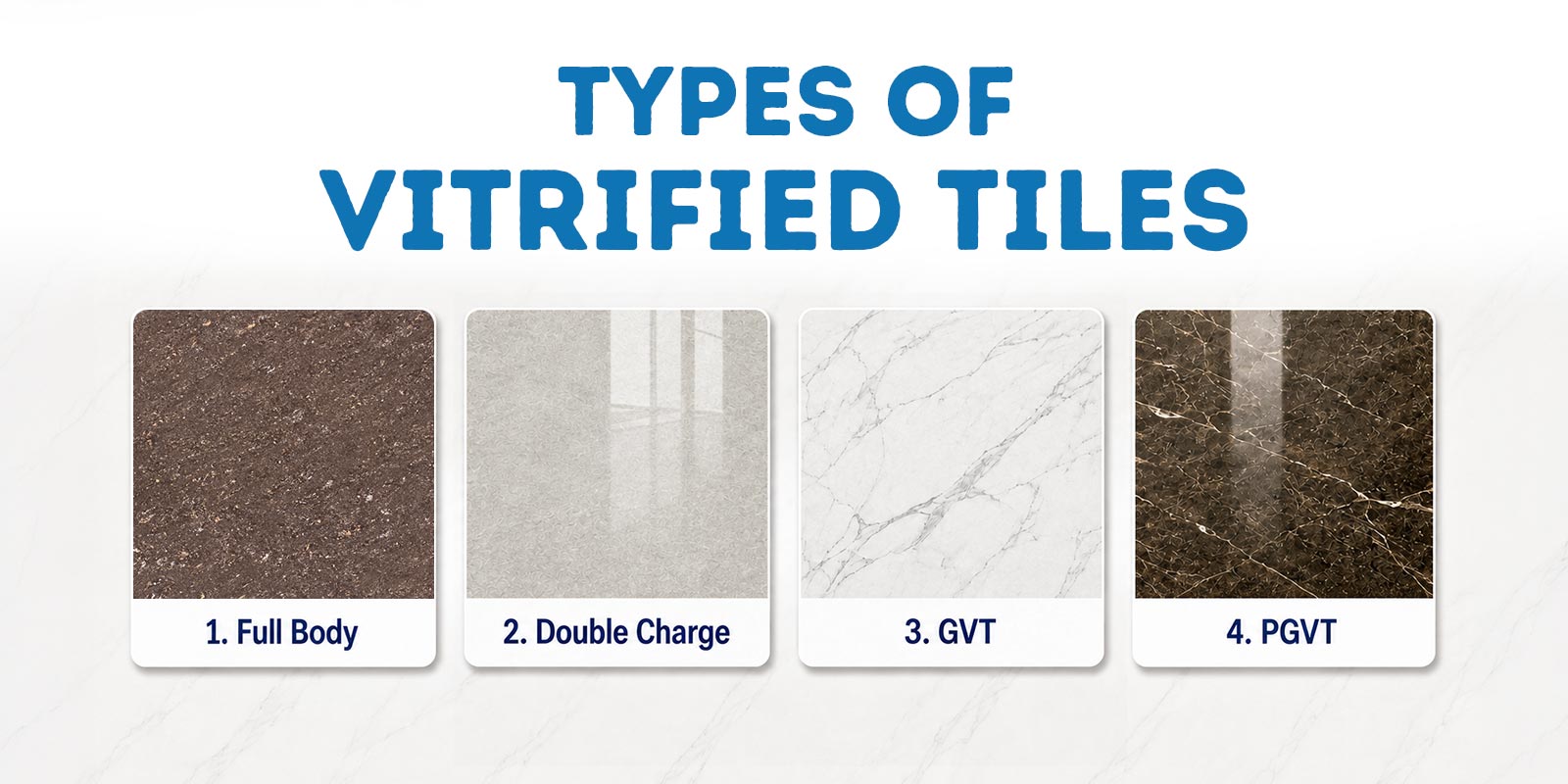
But “vitrified tile” is a category, not a product. Walk into any showroom and you will be shown full body, double charge, GVT, PGVT, DGVT, soluble salt and nano tiles, often with very little explanation of how they actually differ. Two tiles that look identical on a display board can behave very differently after five years on a floor.
This guide covers all types of vitrified tiles, how each one is manufactured, where each performs best, and how to match the right type to your space.
Quick Answer
The main types of vitrified tiles are Full Body, Double Charge, Glazed Vitrified (GVT), Polished Glazed Vitrified (PGVT), Digital Glazed Vitrified (DGVT), Soluble Salt and Nano.
These types are defined by how the design is built into the tile — not by finish, colour or size.
Full body and double charge are the strongest choices for heavy traffic. GVT, PGVT and DGVT offer by far the widest design range for homes.
What Makes a Tile “Vitrified”?
During firing at roughly 1,200°C and above, a glassy phase forms inside the tile body and fills the microscopic pores between the raw material particles. The result is a tile that is almost non-porous, dimensionally stable and mechanically strong.
Under Indian Standard IS 15622 — which is aligned with ISO 13006 and EN 14411 — dry-pressed tiles with water absorption of 0.5% or less fall into Group BIa. That is the technical definition of a vitrified tile. Internationally, the same body is sold as porcelain, which is why the two terms are used interchangeably in export catalogues.
Low porosity is what drives every practical advantage: stain resistance, freeze-thaw resistance, hygiene, and the ability to use the same tile indoors and outdoors.
Vitrified Tiles vs Ceramic Tiles vs Natural Stone
| Property | Vitrified (Group BIa) | Ceramic (Group BIII) | Marble / Granite |
| Water absorption | ≤ 0.5% | Above 10% | Approx. 0.2–0.6% |
| Surface strength | High | Moderate | Varies by stone |
| Suitable for floors | Yes, including heavy traffic | Light traffic only | Yes |
| Outdoor use | Yes, with correct finish | Generally no | Yes |
| Design flexibility | Very high | High | Limited to natural veining |
| Maintenance | Low | Low | Periodic sealing / polishing |
How Vitrified Tiles Are Classified (and Where Buyers Get Confused)
Most guides present the different types of vitrified tiles as one flat list — full body, glossy, 600×600, matt, double charge — mixing three completely separate things. That is exactly why buyers end up comparing tiles that are not comparable.
There are three independent axes:
- Construction — how the colour and design are built into or onto the tile. This is what “type” properly refers to.
- Surface finish — glossy, matt, satin, carved, sugar, rustic.
- Size and format — 600×600 mm, 800×1600 mm, planks, pavers, elevation tiles.
A single tile can be double charge + matt finish + 800×800 mm. Once you separate the three axes, choosing becomes straightforward.
Types of Vitrified Tiles
-
Full Body Vitrified Tiles (FBVT)
The colour and composition run uniformly through the entire thickness of the tile. Cut the tile and the exposed edge looks the same as the face. Chips, deep scratches and years of abrasion do not expose a different-coloured layer underneath.
Best for: airports, metro stations, shopping malls, factories, hospitals, showrooms, staircases and outdoor paving.
Trade-off: design range is limited to solids, salt-and-pepper and stone-like effects. Full body tiles cannot reproduce fine marble veining. They are also the most raw-material-intensive to manufacture.
Typical formats: 600×600 mm, 600×1200 mm, 800×1200 mm, plus 15 mm and 20 mm thicknesses for exterior and paving applications.
-
Double Charge Vitrified Tiles (DC)
Two layers of pigment are fed into the press simultaneously. The upper layer — typically 3 to 4 mm thick — is compacted onto the base body under very high pressure and fired as one piece. There is no glaze involved, so the design is part of the tile body itself.
That 3–4 mm of design depth is the whole point: the pattern survives heavy abrasion, and the surface can even be re-polished years later without losing the design.
Best for: corporate offices, retail showrooms, hotel lobbies, corridors, and high-footfall residential areas.
Trade-off: because the design is created by pigment feeding rather than printing, patterns are limited to linear, salt-and-pepper and broad stone effects.
-
Glazed Vitrified Tiles (GVT)
A vitrified body with a fired glaze layer on top that carries the design. Because the glaze can be printed with anything, GVT is where the design freedom lives — marble, wood, natural stone, concrete, terrazzo, fabric and abstract patterns are all possible.
Best for: residential floors, bedrooms, living rooms, wall cladding and feature surfaces.
Trade-off: the design sits in a relatively thin glaze layer. A deep gouge exposes the body beneath. For busier areas, choose a higher abrasion class rather than assuming all GVT is equal.
-
Polished Glazed Vitrified Tiles (PGVT)
A GVT tile that is mechanically polished after firing to produce a mirror-like gloss. PGVT is the closest tile equivalent to polished marble, and it is the most popular choice for premium Indian living rooms.
Best for: living and dining rooms, master bedrooms, reception areas, feature walls.
Trade-off: a polished surface is slippery when wet and shows footmarks and scuffs. Avoid PGVT on bathroom floors, kitchen floors, balconies and outdoor areas.
-
Digital Glazed Vitrified Tiles (DGVT)
DGVT is GVT where the design is applied by high-resolution inkjet printing before the glaze is fired. In practice, most GVT and PGVT sold in India today is digitally printed — DGVT describes the printing technology rather than a separate body type.
Digital printing is what makes book-matched marble panels, high face-count wood planks and photo-realistic stone reproductions possible. If a tile range claims twenty or more different faces with no visible repetition, it is digital.
-
Soluble Salt Vitrified Tiles
Soluble metallic salts are applied to the surface of a polished vitrified body and penetrate roughly 0.4 to 1 mm. This is the oldest and most economical vitrified tile category.
Best for: low-traffic, budget-sensitive residential flooring.
Trade-off: with under a millimetre of design depth, abrasion and repeated cleaning gradually wear the pattern away. Soluble salt tiles also need sealing after installation and are being steadily replaced by GVT and double charge in most of the market.
-
Nano Vitrified Tiles
This is the most misunderstood entry on any list of vitrified tile types. “Nano” is not a construction method — it is a nano-silica treatment applied to an already-polished tile to fill surface micropores. It raises gloss and reduces the tile’s tendency to absorb stains.
The treatment is usually applied to soluble salt or double charge bodies. So the correct question in a showroom is not “is it nano?” but “nano applied to what body?” The answer determines how the floor will look in five years.
Types of Vitrified Tiles by Surface Finish
The same tile body can be supplied in several finishes, and the finish drives safety and maintenance far more than the construction does.
Finish |
Appearance |
Slip resistance |
Best suited to |
| High gloss / polished | Mirror-like reflection | Low | Living rooms, feature walls, lobbies |
| Matt | Flat, non-reflective | High | Kitchens, bathrooms, balconies, commercial floors |
| Satin / semi-polish | Soft, low sheen | Medium | Bedrooms, corridors, offices |
| Carving / structured | Raised relief texture | High | Wet areas, terraces, feature walls |
| Sugar | Fine grainy sparkle | Medium–high | Bathroom and kitchen walls |
| Rustic | Irregular, stone-like | Very high | Courtyards, pathways, terraces |
| Metallic / book-match | Decorative, high impact | Low–medium | Feature walls, TV units, cladding |
All Types of Vitrified Tiles: Master Comparison
Type |
Design depth |
Design range |
Traffic capacity |
Best application |
| Full Body | Entire thickness | Limited | Very heavy | Commercial, industrial, outdoor |
| Double Charge | 3–4 mm | Moderate | Heavy | Offices, showrooms, lobbies |
| GVT | Glaze layer | Very wide | Light to moderate | Residential floors and walls |
| PGVT | Glaze + polish | Very wide | Light to moderate | Living rooms, premium interiors |
| DGVT | Printed in glaze | Widest | Light to moderate | Realistic marble and wood looks |
| Soluble Salt | 0.4–1 mm | Limited | Light | Budget residential flooring |
| Nano (treatment) | Surface coating | Depends on base tile | Depends on base tile | Low-stain polished floors |
Types of Vitrified Tiles by Size and Format
- 600×600 mm — the default residential size; works in rooms of every scale.
- 600×1200 mm — fewer joints and a more contemporary look; now the most common large format in Indian homes.
- 800×800 mm and 800×1200 mm — suited to large living and dining areas.
- 800×1600 mm and larger slabs — luxury interiors, countertops, table tops and wall cladding.
- Plank formats such as 195×1200 mm — wood-look flooring with realistic proportions.
- 400×400 mm pavers in 15–20 mm thickness — parking areas, driveways and pathways.
- 300×450 mm and 300×600 mm — wall tiles and exterior elevation tiles.
Rectified vs non-rectified: rectified tiles are mechanically cut after firing to an exact size, allowing joints as narrow as 2 mm. Non-rectified tiles need wider grout lines. In large formats, always confirm which one you are buying — it changes how the finished floor looks more than the tile design does.
Which Type of Vitrified Tile Should You Choose?
Match the tile to how the space is used, then choose the design. Doing it the other way round is the most common and most expensive mistake in tile selection.
Space |
Recommended type |
Finish |
Why |
| Living / dining room | PGVT or DGVT | High gloss or satin | Maximum design impact, moderate traffic |
| Bedroom | GVT | Matt or satin | Warm underfoot, low glare |
| Kitchen floor | GVT | Matt | Grease and water demand grip |
| Bathroom floor | GVT | Matt or carving | Wet-area slip safety |
| Balcony / terrace | Full body or GVT | Rustic or carving | UV, rain and thermal movement |
| Staircase | Full body or double charge | Matt | Concentrated abrasion at the nosing |
| Parking / driveway | Full body pavers (15–20 mm) | Rustic | Vehicle point loads |
| Office / retail | Double charge or full body | Matt or glossy | Continuous footfall |
| Building elevation | GVT elevation tiles | Textured | Weather exposure and visual depth |
| Hospitals / labs | Full body | Matt | Hygiene and chemical resistance |
Manufacturers with a wide portfolio across all these categories are worth shortlisting, because it lets you specify one supplier across an entire project. Aparna Enterprises, for example, produces double charge, GVT, PGVT, full body, paver and elevation ranges under its Vitero brand from its Kakinada and Morbi manufacturing units — a spread that covers residential interiors through to parking decks.
How to Verify Quality Before You Buy?
Design is easy to judge on a display board. Quality is not. These checks take a few minutes each and prevent most post-installation complaints:
- Ask for the water absorption test report. A genuine vitrified tile should be 0.5% or lower (Group BIa under IS 15622). Many premium tiles test well below 0.1%.
- Confirm whether the tile is rectified or non-rectified before finalising the grout line width with your contractor.
- For glazed tiles, check the abrasion class (PEI I–V, tested per ISO 10545-7). PEI IV or V is appropriate for high-traffic floors.
- For wet and outdoor areas, ask for the slip resistance rating (R9–R13 under DIN 51130). R10 and above is sensible for bathrooms and balconies.
- Check thickness against use: 8–10 mm is standard indoors; 15–20 mm is required for paving and vehicular loads.
- Test flatness by placing two tiles face to face — any gap at the centre or corners indicates warpage that will show up as lippage on the floor.
- Buy the entire quantity from one batch and one shade code. Mixing batches produces visible tonal banding.
- Order 8–10% extra for cuts, wastage and future replacement. Batch-matched tiles are rarely available later.
- Look for BIS/ISI marking and a written manufacturer warranty.
Common Mistakes to Avoid
- Choosing high-gloss PGVT for bathroom or kitchen floors, then adding anti-skid mats to compensate.
- Specifying GVT for high-footfall commercial floors where double charge or full body is required.
- Comparing tiles on design alone, without asking how the design is built into the tile.
- Using 8 mm indoor tiles in parking areas.
- Ignoring rectification, then being surprised by 5 mm grout lines on a large-format floor.
- Assuming “nano” or “premium” on a box indicates a construction type. It does not.
Key Takeaways
Choosing in three steps:
- Decide by traffic first. Heavy footfall calls for full body or double charge; residential interiors are well served by GVT, PGVT and DGVT.
- Choose the finish for safety, not looks. Matt or structured in every wet area; save high gloss for dry, low-traffic rooms.
- Verify the specification. Water absorption of 0.5% or less, correct abrasion and slip class, right thickness, one batch, 8–10% extra.
Understood this way, the long list of vitrified tile types stops being confusing. There are really only a handful of construction methods, and each one exists to solve a specific problem. Once you know which problem your floor has, the right type of vitrified tile is usually obvious.
Frequently Asked Questions
The main types are full body, double charge, glazed vitrified (GVT), polished glazed vitrified (PGVT), digital glazed vitrified (DGVT), soluble salt and nano. They differ in how the design is built into the tile, which determines durability and design range.
GVT and PGVT are the usual choice for Indian homes because they offer the widest design range at residential traffic levels. Use matt GVT in kitchens, bathrooms and balconies, and polished PGVT in living and dining rooms.
Full body vitrified tiles are the strongest, followed by double charge. Both carry the design deep into the tile body, so wear does not expose a different layer underneath.
They are the same tile. PGVT is a GVT tile that has been mechanically polished after firing to create a high-gloss surface. GVT is typically supplied matt, carved or textured.
Neither is universally better. Full body is stronger and the design runs through the full thickness, making it the right choice for industrial and outdoor use. Double charge offers a better balance of durability and appearance for offices, showrooms and premium residential floors.
Broadly yes. Both refer to tiles with water absorption of 0.5% or less (Group BIa). “Vitrified” is the common term in India; “porcelain” is used internationally.
All vitrified tiles have very low water absorption, so the tile body itself is effectively waterproof. The joints are not — correct grouting and waterproofing beneath the tile still matter in wet areas.
Only polished and high-gloss surfaces are. Matt, carving, structured and rustic finishes provide good grip and are the correct specification for bathrooms, kitchens, balconies and outdoor areas.
Full body and double charge tiles do not fade because the design runs deep into the body. Soluble salt tiles can lose their pattern to abrasion since the design is under a millimetre thick.
Yes, provided you choose a rustic, structured or matt finish and adequate thickness. Use 15–20 mm full body pavers for parking and driveways.
8–10 mm covers most indoor floors and walls. Move to 15 mm or 20 mm for terraces, pathways, parking and any surface carrying vehicle loads.
It is a polished vitrified tile treated with nano-silica to fill surface micropores, increasing gloss and stain resistance. It is a surface treatment, not a separate construction type — always ask which tile body it has been applied to.
All of them. Indian manufacturers produce full body, double charge, GVT, PGVT, DGVT, soluble salt and nano-treated tiles, in formats from 400×400 mm pavers to 800×1600 mm slabs, from manufacturing clusters including Morbi in Gujarat and plants across South India.
Start Your Project with the Right Materials
We provide everything you need for modern construction. Connect with our experts to discuss your requirements and get the best solution for your project. Submit your details and our team will contact you soon.
CORPORATE OFFICE
8-2-293/82/A, Plot No-1214, Road No-60,
Jubilee Hills, Hyderabad-500 033.