
What Is Dry Mix Concrete? Uses, Ratio & How It Differs from Wet Mix
In This Article
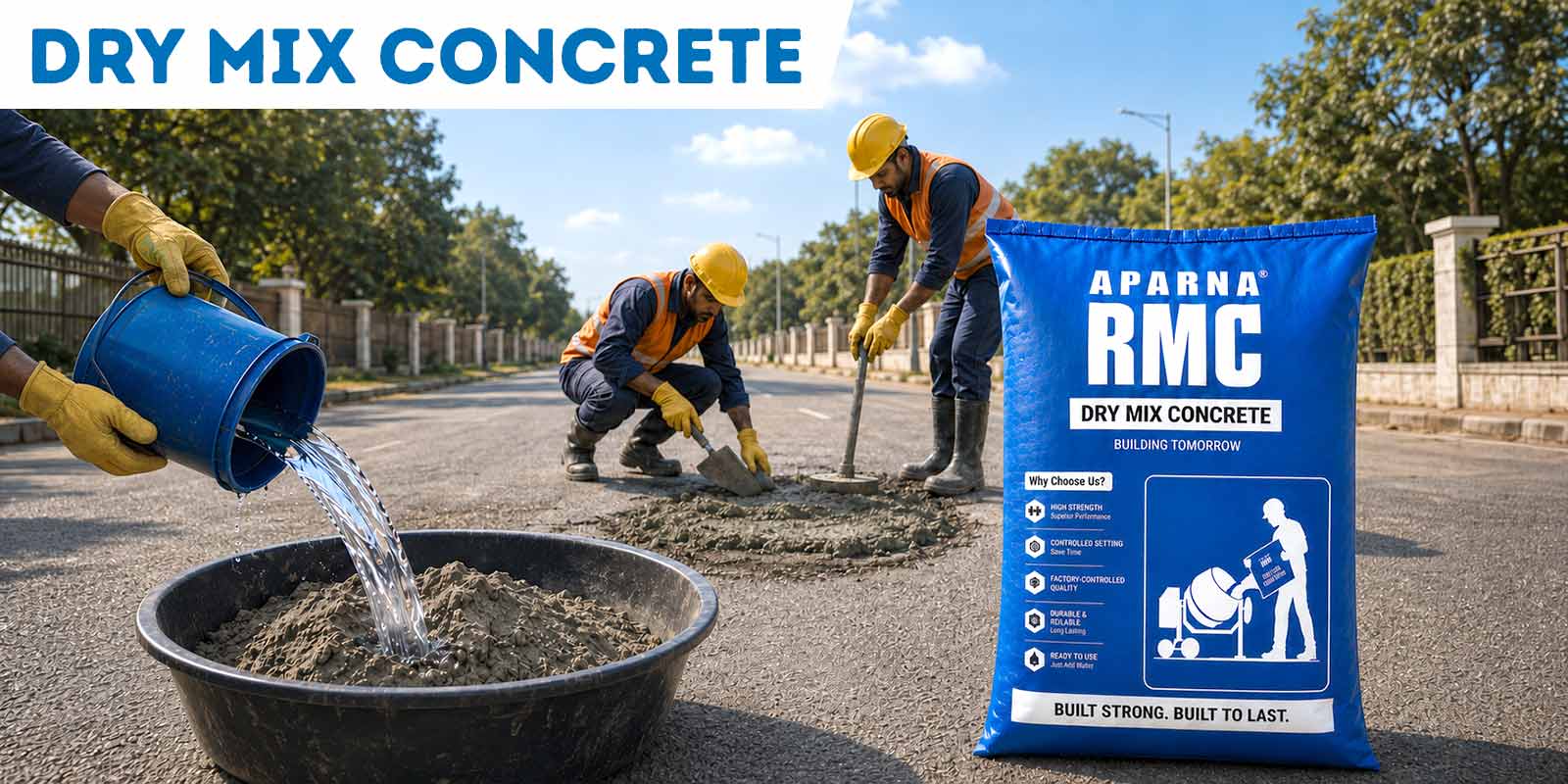
Dry mix concrete is a pre-blended mixture of cement, sand, and aggregate, which is supplied dry in bags. It becomes ready to use after water is added to it at the site. Dry-mix concrete is used where mixing concrete becomes difficult. It is used for small pours, repairs, and hard-to-reach sites. Dry mix concrete eliminates the guesswork of on-site batching because the bag contains pre-measured dry ingredients to exact formulas.
This article covers what dry-mix concrete is made of, how to use it, the recommended water quantity, where it is used, and how different it is from wet ready-mix concrete.
Key Takeaways
- Dry mix concrete = cement + sand + aggregate, pre-blended and bagged. Only water is added on the site.
- It is different from ready-mix concrete or dry-mix mortar.
- Add 3.5 litres of clean water per bag; follow the bag’s instructions.
- Best for small jobs, repairs, and remote sites. Large structural pours need wet ready-mix concrete.
What Is Dry Mix Concrete?
Dry mix concrete is a blend of cement, sand, and aggregate that is proportioned and factory-blended and then bagged dry. The hydration process starts only when water is added to it.
Unlike site mixing, where sand quality and water quantity are guessed, every dry-mix concrete bag remains consistent.
Dry Mix Concrete Vs Similar Terms
Dry-mix concrete is often confused with other terms like ready-mix concrete, dry-mix mortar, dry-mix plaster, and dry-mix shotcrete. However, these are different products with different applications.
- Not ready-mix concrete: Ready-mix concrete (RMC) is time-sensitive, and it is batched wet in a plant. RMC is delivered via transit mixer, within about 90 minutes of batching. On the other hand, dry mix concrete is a dry bag with no timeline because it is dry. It is mixed with water only on the site.
- Not dry-mix mortar/plaster: Dry-mix mortar contains only cement and sand. It lacks coarse aggregate. Mortar is used for plastering, tiling, and blockwork, but dry-mix concrete contains coarse aggregate and is a structural material.
- Dry-mix shotcrete: Dry-mix shotcrete is a specialised sprayed concrete process in which water is added at the nozzle. It is different from bagged Dry Mix Concrete.
What Dry Mix Concrete Is Made Of?
The composition of dry-mix concrete consists of cement, sand, and aggregate in dry form. The table below shows ingredients and their role.
Dry Mix Concrete Ratio and Grades
Here, ratio means how much cement, sand, and stone go into the mix, which determines the grade — the concrete’s strength. In a dry bag, the ratio is factory-fixed, eliminating the need for the buyer to calculate or measure it on site.
Concrete Grade Ratios
| Grade | Ratio (Cement: Sand: Aggregate) |
| M7.5 | 01:04:08 |
| M10 | 01:03:06 |
| M15 | 01:02:04 |
| M20 | 01:05.5 |
| M25 and above | Design mix (custom proportions) |
Nominal mix proportions shown above are based on IS 456 guidelines. Grades M25 and above are generally produced as design mixes.
Aparna RMC manufactures factory-controlled dry concrete bags in grades up to M35 using carefully proportioned materials. However, achieving the intended strength depends on following the specified water addition, mixing procedure, placement, and curing instructions.
How to Use Dry Mix Concrete?
Using dry mix concrete correctly comes down to a few simple, disciplined steps:
- First, clean the surface, mixing tray, or mechanical concrete mixer
- Wear appropriate personal protective equipment (PPE), including safety gloves, protective eyewear, and a dust mask.
- Pour the dry concrete mixture directly on the surface or into the drum
- Add 3.5 litres of clean water per bag.
- Blend the water and dry material until the texture remains uniform, smooth, and lump-free
- Use the concrete immediately after mixing. Do not add extra water after mixing.
- Proper curing must be done for several days
Safety Precautions While Using Dry Mix Concrete
Follow these basic safety practices while handling Dry Mix Concrete:
- Wear safety gloves, protective eyewear, and a dust mask while handling the dry material.
- Avoid direct contact with the eyes and prolonged contact with the skin.
- If the material comes into contact with the eyes, rinse immediately with plenty of clean water and seek medical attention if irritation persists.
- Always work in a well-ventilated area and keep the product out of reach of children.
Where Dry Mix Concrete Is Used?
Dry-mix concrete is used wherever a small, controlled quantity of concrete is needed. It is used for small repairs, post fixing, quick roadworks, securing bolts, and other applications.
- Small Repairs: It is suitable for fixing potholes, footpaths, driveways, and broken staircases
- Post Fixing: Used for setting gate posts, fences, signboards, and clothesline poles
- Small Blocks: Used to manufacture manhole covers, kerb stones, and drain blocks
- Hard-to-Reach Sites: Suitable for remote villages, hills, or interiors where trucks cannot go
- Home Projects: Handy for small slab extensions, ramps, and water tank bases
- Quick Roadworks: Used by municipal teams for overnight repairs, so that the roads can be reopened quickly
- Drainage and Utility Works: Used for small drainage structures, chambers, and similar repair works.
- Securing Bolts: Excellent for anchoring heavy machines, base plates, and structural bolts.
- Solar Setup: Used to make solar panel installation bases.
What Affects the Quality of Dry Mix Concrete?
The strength and durability of dry mix concrete depend on factors such as water quantity, ingredient quality, mixing thoroughness, freshness, working time, curing, grade selection, and others.
- Water quantity: Adding more water than required is the most common cause of weak concrete. So strictly follow the bag’s ratio.
- Ingredient quality & proportion: High-quality inputs like cement, sand, and aggregates, and their precise ratios ensure maximum strength and durability.
- Mixing: A smooth and lump-free mix is important because under-mixing leaves weak pockets.
- Bag freshness & storage: Water damages the concrete powder before you even open the bag. Check the expiration date because older ones lose strength and do not perform well.
- Working time: Placing and compacting must be performed within the prescribed time before the mix stiffens
- Curing: Keeping the concrete moist after placing. Poor curing weakens even a perfectly mixed batch.
- Selection of Grade: Matching the grade to the job is important, whether it’s a minor repair or a structural element. This is important to make sure the structure supports its intended load and resists environmental wear and tear.
A controlled, factory-blended bag from a known plant removes most of these risks before the concrete ever reaches the site.
Dry Mix vs Wet (Ready-Mix) Concrete
Dry mix and wet ready-mix concrete suit different jobs. Know how to choose the right one.
Factor |
Dry mix concrete (bagged) |
Wet ready-mix concrete |
| Form | Dry bag; add water on site | Delivered wet, ready to place |
| Best for | Small jobs, repairs, remote/low-access sites | Medium-to-large structural pours |
| Quantity | Small, flexible | Bulk, by the cubic metre |
| Working time | Mix as needed | ~90 minutes from batching |
| Equipment | Hand or small mixer | Transit mixer, sometimes pump |
| Wastage | Low — mix only what you need | Planned volume |
| Price | Per bag; higher per unit | Per m³; cheaper at volume |
Advantages and Limitations of Dry Mix Concrete
Advantages
- Consistent Quality: Dry Mix Concrete is factory-batched using accurately proportioned materials to help deliver consistent quality and the intended strength when mixed, placed, and cured correctly.
- Ideal for Small Quantities: You do not have to wait for a full Ready-Mix Concrete (RMC) truck delivery for small jobs.
- Reduced Wastage: Less wastage because you only open and mix the needed bags for your work.
- Faster Application: Only water must be added on-site just before use, saving time.
- High Accessibility: Transportation to remote sites, hills, villages, or interior areas is easy, even where heavy RMC trucks cannot reach.
- Restricted Spaces: Concrete can be moved into tight areas, including narrow roads, where vehicles cannot fit, or workers cannot manually carry it. It is also used in places where pump access is restricted for pouring.
Disadvantages
- Higher Unit Cost: It is priced per bag, making it more expensive per cubic meter than bulk wet RMC for large-scale projects.
- Labor Intensive: Requires manual mixing (by hand or a small mixer) and physical handling of multiple bags.
- Not for Large Pours: Inefficient and slow for medium-to-large structural pours like full-house slabs compared to transit mixers.
Both RMC and dry mix concrete suit different jobs. Concrete strength depends on its mix design, water content, placement, and curing—not on whether it is supplied as bagged dry mix or wet ready-mix concrete.
How Aparna RMC Supplies Dry Concrete Bags?
Mixing concrete is the biggest challenge on a job site, as too much water makes concrete weak, and too little makes it hard to use. So factory-made bagged mixes prevent these human errors.
Aparna RMC supplies dry concrete bags in grades up to M35. Each bag is factory-batched to a fixed proportion, helping deliver consistent quality and performance when used according to the recommended instructions. If you are looking for small works for your project, get in touch with us today.
Choosing the Right Concrete for the Job
Dry mix concrete is suitable for repairs, maintenance work, and small construction projects where convenience and controlled quantities matter. For larger structural pours requiring continuous placement and high productivity, Ready-Mix Concrete remains the preferred solution. Choosing the appropriate concrete depends on the project’s size, structural requirements, and site conditions.
Frequently Asked Questions On Dry Mix Concrete
Always start by adding 3.5 litres of clean water per bag and mix thoroughly until the concrete is uniform and lump-free. Add up to 0.5 litre more only if required to achieve the desired workability. Avoid adding excess water, as it can reduce concrete strength.
No. Dry Mix Concrete should always be mixed with the recommended quantity of clean water before use. Pouring the dry material directly and adding water afterwards can result in uneven hydration, inconsistent strength, and poor durability.
Yes. When the correct amount of water is added and the concrete is properly mixed, placed, and cured, Dry Mix Concrete can achieve the same strength as conventional concrete of the same grade. Its strength depends on the mix design, water content, placement and curing—not on whether it is supplied in bags or delivered as Ready-Mix Concrete.
Under normal conditions, dry mix concrete has an initial setting time of 120–180 minutes and a final setting time of 480–600 minutes. Actual setting times may vary depending on ambient temperature, humidity, and site conditions.
The shelf life of a dry mix concrete is 2 months from the date of packing. Refer to the packaging instructions or contact us for more information.
The number of bags depends on the size of the work and the required concrete volume. For small repairs, two or three bags may be sufficient. For larger projects, calculate the required concrete volume and refer to the yield mentioned on the bag or contact Aparna RMC for guidance.
No, not for a load-bearing house foundation. Structural footings need engineered design-mix concrete placed as a monolithic, well-compacted, properly cured pour. You can’t reliably achieve that by hand-mixing individual bags one at a time, as it can result in cold joints, inconsistent compaction, and variable curing.
Start Your Project with the Right Materials
We provide everything you need for modern construction. Connect with our experts to discuss your requirements and get the best solution for your project. Submit your details and our team will contact you soon.
CORPORATE OFFICE
8-2-293/82/A, Plot No-1214, Road No-60,
Jubilee Hills, Hyderabad-500 033.