
uPVC Bathroom Doors: Designs, Sizes, Price & Buying Guide
In This Article
A bathroom door has the hardest job of any door in the house. It stands in steam for an hour a day, gets splashed, gets cleaned with detergent, and is opened and shut more often than almost anything else in the home. Most doors are not built for that. Wooden ones swell at the bottom edge, the veneer lifts, and within a few monsoons the door stops closing cleanly.
uPVC bathroom doors exist because of that specific problem.
uPVC bathroom doors are made from unplasticised polyvinyl chloride, a rigid plastic that does not absorb water. Because the material cannot swell, rot or feed termites, a uPVC door holds its shape in a wet bathroom where a wooden one will not. It comes as a solid panel, with frosted glass, louvered, or in a wood-finish laminate.
uPVC Bathroom Door Designs
The main uPVC bathroom door designs are solid panel, frosted glass, panelled, louvered, wood-finish laminate and sliding. Solid panel gives the most privacy and the lowest cost. Frosted glass brings in daylight without a view through. Louvered doors let air move continuously. Wood-finish laminates match timber joinery elsewhere in the house.
Solid panel
A single flat uPVC panel with no glazing. The most private option, the least expensive, and the easiest to clean because there is nothing but flat surface. Suits guest bathrooms, staff toilets and any bathroom with its own window.
Frosted glass
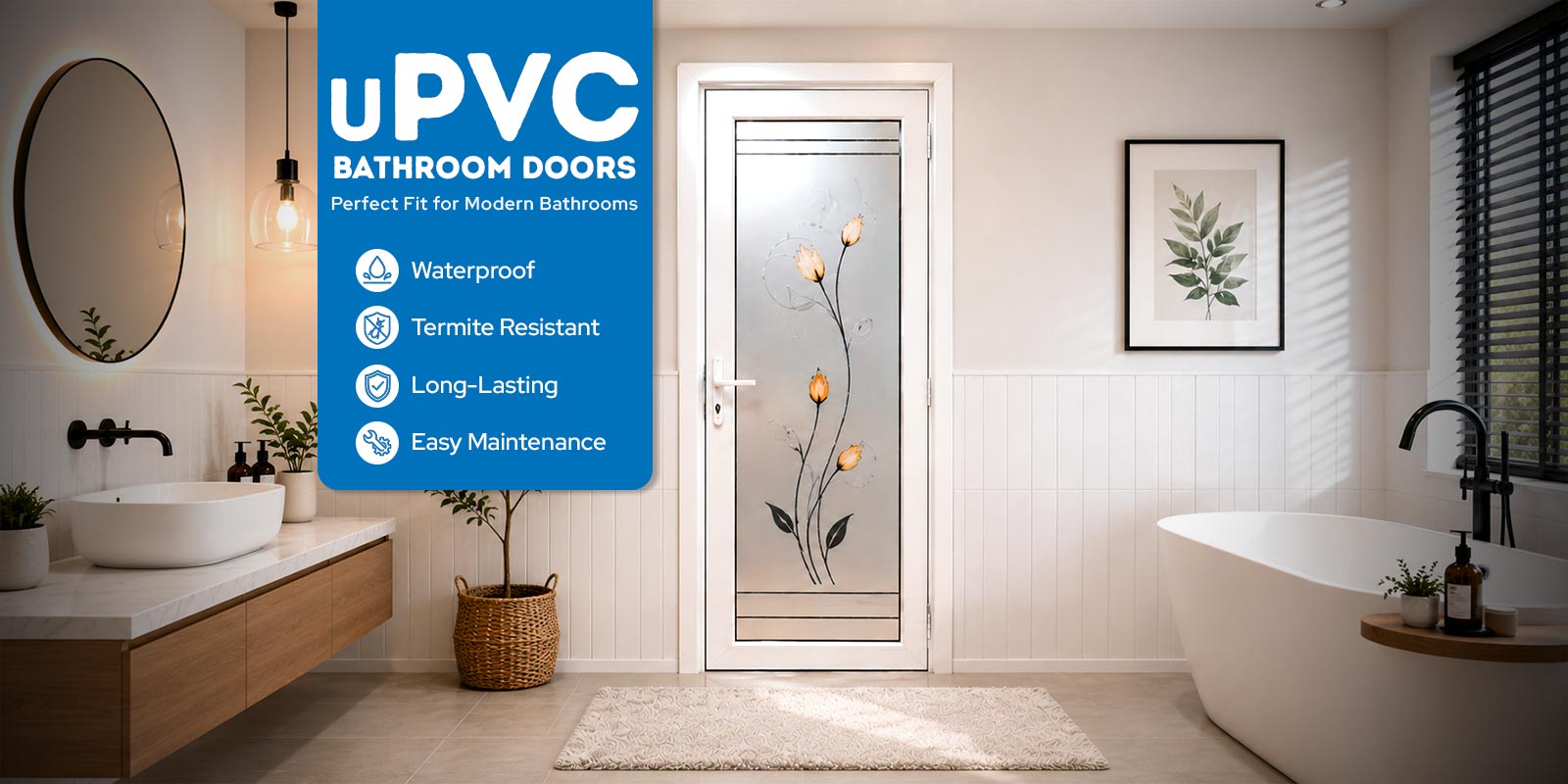
A uPVC frame with an obscured glass panel — usually a horizontal band at mid-height, or a full-height panel. It lets daylight through into an internal bathroom without letting anyone see in. This is the design people search for most after solid panel, and it is the one that transforms a windowless bathroom.
Panelled
Moulded raised or recessed panels in the door face, echoing traditional timber joinery. Chosen where the rest of the house has classic detailing and a flat modern door would look out of place.
Louvered / ventilated
Angled slats across part or all of the door face, so air moves through even when the door is closed. Worth considering for a bathroom with no exhaust fan or window, or a shower room that stays damp. The trade-off is honest: louvres let sound and some light through, so they suit a family bathroom better than a guest one.
Wood-finish laminate
A woodgrain foil or laminate over the uPVC — teak, walnut, oak. Chosen when the bathroom door sits in a corridor alongside wooden bedroom doors and needs to match them. This is the design that answers the “do plastic doors look cheap?” objection, and it is worth showing rather than describing.
Sliding
Runs along a track instead of swinging, which returns the floor area a swing door needs. In a small bathroom that clearance is often the difference between a usable layout and an awkward one. Top-hung tracks keep the floor clear of a bottom channel that would otherwise collect water and hair.
Choosing between them:
| If your bathroom… | Consider |
| Has no window | Frosted glass, or louvered |
| Is small or tight on swing space | Sliding |
| Stays damp after showers | Louvered, or frosted with a vent |
| Sits among wooden doors | Wood-finish laminate |
| Is a guest bathroom | Solid panel or panelled |
| Needs maximum privacy | Solid panel |
Do uPVC Bathroom Doors Actually Handle Water?
uPVC does not absorb water. The material has effectively no water uptake, so a uPVC door cannot swell, rot, delaminate or grow mould the way a wooden door does. What still needs attention is the rest of the assembly — the frame, the hardware and the frame-to-wall joint are where bathroom doors usually fail.
This distinction matters, and most pages about bathroom doors skip it.
What the material does: uPVC is a rigid, non-porous plastic. Splash it, steam it, wipe it — the panel is unchanged. There is no grain to lift, no core to swell, no coating to peel, and nothing for termites to eat. Over a decade in a wet bathroom, that is the difference between a door that still closes properly and one that catches on the frame every monsoon.
What still needs specifying:
- The frame. A uPVC door in a timber or MDF frame will fail at the frame. See sizes and frames.
- The bottom edge. This is where standing water sits after a shower. uPVC handles it; the floor junction and the gap under the door still need to be right.
- Hinges, lock and handle. These are metal. In a bathroom they need to be corrosion-resistant, or they will seize and stain long before the door gives up.
- The frame-to-wall joint. Water tracks through a badly sealed joint regardless of what the door is made of.
A note on “100% waterproof.” You will see that phrase on almost every bathroom door page, and it is not quite right. The uPVC panel is non-absorbent — that part is true and it is the reason to choose it. A door assembly is a different thing: it has hardware, seals and a junction with the wall. A well-made uPVC door in a uPVC frame, fitted properly, will handle a bathroom for its full service life. That is a stronger claim than “100% waterproof” because it is one that holds up.
What a uPVC Bathroom Door Is Made Of?
uPVC stands for unplasticised polyvinyl chloride — rigid PVC made without the plasticisers that make ordinary PVC soft and flexible. Bathroom door panels are extruded as multi-chamber sections, which makes them rigid without being heavy. The chambers also give a small amount of sound and thermal separation.
The construction points that matter to a buyer:
- Multi-chamber profile. Hollow internal chambers give stiffness for the weight. A solid slab of plastic the same size would be heavier and no stronger.
- Larger doors and doors carrying glass may need internal reinforcement to stay rigid over time. Worth asking about on anything above standard width.
- Lead-free formulation. Older uPVC used lead-based heat stabilisers; calcium-zinc systems have replaced them.
- A Ethylene Propylene Diene Monomer (EPDM) gasket around the closing edge seals the door and softens the closing action.
One thing uPVC bathroom doors do not need: UV stabilisation is a headline feature on uPVC windows because they face the sun for decades. An internal bathroom door does not. If a supplier leads with UV resistance on a bathroom door, they are reading from the windows brochure.
PVC or uPVC for a Bathroom Door?
PVC and uPVC are not the same thing, and for a bathroom door the difference is worth understanding. PVC contains plasticisers that make it flexible. uPVC contains none, which makes it rigid and dimensionally stable. Both resist water. The rigid one holds its shape better over years of daily use.
Most people shopping for a bathroom door say “PVC door” or “plastic door” and mean any moulded plastic door. That is a reasonable shorthand, but there are genuinely different products behind it:
Moulded PVC door |
uPVC door |
|
| Material | Flexible PVC, often hollow-moulded | Rigid unplasticised PVC, multi-chamber profile |
| Rigidity | Lower — can flex on larger sizes | Higher — holds shape |
| Typical build | Single moulded shutter | Profile-and-panel construction |
| Design range | Limited | Wider — glass, louvres, laminates |
| Water performance | Good | Good |
| Typical cost | Lower | Higher |
When a moulded PVC door is genuinely the right call: a small servant’s toilet, a utility washroom, a rental property, or anywhere the budget is tight and the door is not on show. It will keep water out perfectly well.
When uPVC is worth the difference: a bathroom door that is visible from a bedroom or corridor, a wider-than-standard opening, or anywhere you want glass, louvres or a wood finish. Rigidity matters more as the door gets bigger, and the design range is where the gap really shows.
For the full material distinction — composition, properties and where each is used — see the difference between PVC and uPVC.
uPVC vs WPC, FRP, Wood and Aluminium
For a wet bathroom, the realistic shortlist is uPVC, WPC, FRP and moulded PVC. All four resist water in a way solid wood does not. uPVC offers the widest design range, WPC feels closest to timber, FRP is the toughest against impact, and moulded PVC is the cheapest. Solid wood remains the best-looking option but needs sealing and upkeep.
uPVC |
Moulded PVC |
WPC |
FRP / fibre |
Solid wood |
Aluminium |
|
| Water resistance | Non-absorbent | Non-absorbent | Good | Non-absorbent | Poor without sealing | Non-absorbent |
| Termite resistance | Immune | Immune | Immune | Immune | Vulnerable | Immune |
| Rigidity | High | Moderate | High | Very high | High | Very high |
| Impact resistance | Moderate | Lower | Good | Highest | Good | High |
| Design range | Widest — glass, louvres, laminates | Limited | Good woodgrain | Limited, utilitarian | Widest overall | Limited |
| Looks like timber | Laminate finishes come close | No | Closest | No | Is timber | No |
| Maintenance | Wipe clean | Wipe clean | Wipe clean | Wipe clean | Sealing, polishing | Wipe clean |
| Typical relative cost | Mid | Lowest | Mid to high | Mid | Highest | Mid to high |
| Best suited to | Most home bathrooms | Budget and utility bathrooms | Where a timber look matters | Schools, hospitals, high-abuse | Dry areas, heritage interiors | Commercial washrooms |
Reading the table honestly:
- WPC is the closest to real timber in feel and weight. If matching solid wood joinery is the priority and budget allows, WPC is a fair choice.
- Moulded PVC is genuinely cheaper and perfectly adequate for a utility bathroom.
- uPVC’s advantage is range. It is the only one of the four that comfortably gives you frosted glass, louvres, woodgrain and sliding operation from the same system, while performing like a plastic door in water.
For a full uPVC and WPC comparison, see uPVC vs WPC: key differences.
Sizes and Frames
Typical bathroom doors in India are around 700–750 mm wide and 2000–2100 mm high — approximately 2’3” to 2’6” wide and 6’6” to 7’0” high. These dimensions are indicative and may vary based on the door system, frame configuration and site requirements.
Specification |
Width |
Height |
| Typical bathroom / WC door | 700–750 mm | 2000–2100 mm |
| NBC 2016 internal door minimum | 750 mm | Not applicable |
| NBC 2016 bathroom / WC reference | 700 mm | Not applicable |
| Custom sizes | Subject to selected system and requirements | Subject to selected system and requirements |
| Panel thickness | Not applicable | Not applicable |
Disclaimer: The sizes and dimensions mentioned above are indicative reference ranges only and should not be considered as confirmed AEL product specifications. Actual door, frame and panel dimensions may vary depending on the selected system, configuration and project requirements. Please confirm the applicable dimensions and specifications with AEL before finalising the product or installation.
The frame is half the decision
This is the part most bathroom door guides leave out, and it is where bathroom doors most often fail.
A uPVC shutter hung in a timber or MDF frame will still fail, because the frame is doing the absorbing. The bottom 100 mm of a bathroom door frame sits in the wettest place in the house — it takes splashes, mop water and standing water after every shower.
| Frame material | In a wet bathroom |
| uPVC | Matches the shutter; does not absorb water. The consistent choice |
| Timber | Swells and rots at the base unless very well sealed and maintained |
| Steel | Durable, but rusts at the floor junction without good galvanising and sealing |
| Granite / cement | Very durable at the base; often used for the bottom section only |
| WPC | Water-resistant; heavier |
If you are replacing a door in an existing frame, check the frame’s base before you spend on a new shutter. A new door in a rotting frame is money spent twice.
What Drives the Price of a uPVC Bathroom Door?
uPVC bathroom doors are quoted per door, and the price is driven by four things: size, design, whether glass is included, and the hardware specified. A plain solid-panel door in a standard size is the least expensive. Frosted glass, louvres, laminates and sliding hardware each add to it. Frame and installation may be quoted separately.
What you are paying for |
Why it moves the price |
What to ask |
| Size | Non-standard sizes need custom tooling or extra material | Is my size standard or custom? |
| Design | Solid panel < panelled < wood-finish < frosted glass < louvered < sliding | What does each design option add? |
| Glass | Type, thickness and obscuration all vary | What glass is specified? |
| Hardware | Lock type, hinges and handle vary widely in grade | What is included, and what is its warranty? |
| Frame | Sometimes excluded from the door price | Is the frame included, and in what material? |
| Installation | Often quoted separately | Does the quote include fitting and sealing? |
| Finish | Plain white is cheapest; laminates and prints cost more | Is my finish standard or an upgrade? |
What a complete quote should list:
- Door size in mm (width × height) against the measured opening
- Design and finish
- Glass specification, if any
- Frame — material, size, included or not
- Hardware — lock type, hinges, handle
- Installation and sealing — included or extra
- Warranty, stated separately for the door and the hardware
- Lead time
Hardware, Locks and Fitting
- Bathroom door hardware needs to survive constant humidity: Choose a privacy lock — one that locks from inside and can be released from outside in an emergency — and corrosion-resistant hinges. The lock is the part that fails first on most bathroom doors, and it is the cheapest part to specify properly.
- Locks: Bathroom doors generally use privacy-oriented locking hardware rather than keyed locks. A thumb-turn or snib on the inside, combined with an emergency release on the outside, can provide privacy while allowing access in an emergency. The exact lock type and hardware should be selected based on the door system and manufacturer’s recommendations
- Hinges: Standard hinges rust and stain the door face. Stainless or well-plated hinges are worth the small difference.
- Handles: Wet hands, constant use. Solid mounting matters more than the finish.
- Fitting: A uPVC door is made to size, so the opening must be measured before manufacture, not after. The frame is fixed plumb and square, then the joint between frame and wall is sealed — that seal is what keeps water out of the wall, and it is the step most likely to be rushed. Ask who does the installation and whether sealing is in the scope.
Can you fit it yourself? Hanging the shutter is straightforward if the frame is already true. Fitting the frame is not — plumb, square and properly sealed are the difference between a door that works for a decade and one that catches within a year. If the frame is being replaced, use a fitter.
Looking After a uPVC Bathroom Door
A uPVC bathroom door needs cleaning, not maintenance. Wipe it with a soft cloth and mild detergent. Avoid scouring powders, abrasive pads and solvent cleaners, which scratch the surface and dull the finish. Check the hinges and lock once a year and lubricate them if they feel stiff.
- Clean with mild detergent and a soft cloth. Nothing abrasive, nothing solvent-based.
- Wipe the bottom edge and the frame base occasionally — that is where water sits.
- Once a year, work the lock and hinges and lubricate if stiff. This is the only part that needs attention.
- Don’t hang weight on the door — over-door hooks loaded with wet towels put constant strain on the hinges.
There is no painting, sealing, polishing or varnishing. That is the practical difference from a wooden door, and it is the reason the material is used in bathrooms.
For general uPVC care, see how to maintain uPVC windows and doors.
Choosing Your Bathroom Door: A Short Checklist
- Measure the structural opening — width, height and wall thickness
- Decide privacy vs light: solid, frosted or louvered
- Check swing clearance; if it is tight, consider sliding
- Decide whether the door needs to match timber joinery nearby
- Specify the frame material, not just the shutter
- Specify a privacy lock and corrosion-resistant hinges
- Confirm whether frame and installation are in the quote
- Get the warranty in writing, separately for door and hardware
uPVC Bathroom Doors from Aparna Enterprises
Aparna Enterprises manufactures uPVC doors and windows in India, including doors made for bathrooms and other wet areas. Doors are made to the measured opening rather than cut down from stock sizes, and supplied with matching uPVC frames.
To discuss a bathroom door for your project — or to get an itemised quote against your measured opening — talk to our team or see the uPVC doors and windows range.
Disclaimer: The information in this article is for general guidance only. Product details, sizes, designs, materials, hardware, pricing and availability may vary. Please confirm the latest specifications and requirements with AEL before purchase or installation.
Frequently Asked Questions On uPVC Bathroom Doors
Yes. uPVC does not absorb water, so it cannot swell, rot or warp the way a wooden door does in a steamy bathroom. It is also immune to termites and needs no sealing or painting. For a wet area, it is a more practical material than timber.
Plain white uPVC looks like what it is — functional. Wood-finish laminates, panelled mouldings and frosted glass change that considerably, and a wood-grain uPVC door sitting alongside timber bedroom doors reads as part of the set rather than an odd one out.
PVC contains plasticisers and stays flexible; uPVC has none and is rigid. Both resist water. uPVC holds its shape better at larger sizes and comes in a wider range of designs. Moulded PVC doors are cheaper and fine for a small utility bathroom.
The uPVC panel does not absorb water at all. The assembly as a whole depends on the frame, the hardware and how well the frame-to-wall joint is sealed. A uPVC door in a uPVC frame, properly fitted, handles a bathroom without trouble.
Bathroom and WC doors in India are typically around 700–750 mm wide and 2000–2100 mm high, depending on the door system and site requirements. These are indicative dimensions, not confirmed AEL product sizes. Always measure the opening and confirm the required door and frame dimensions before ordering.
uPVC does not degrade in humidity, so the door itself is not the limiting factor — hardware and installation quality usually are. A good manufacturer offers a warranty of 20 years on profiles.
The price depends on size, design, glass, hardware and whether the frame and installation are included. A plain solid-panel door in a standard size is the least expensive; frosted glass, louvres and sliding hardware each add to it. Ask for an itemised quote against your measured opening.
Both resist water and termites. WPC feels and looks closer to solid timber and is usually heavier. uPVC offers a wider design range — glass, louvres and sliding — and is generally lighter on hardware. For most home bathrooms either works; the choice usually comes down to appearance and budget.
Yes. Frosted or obscured glass is one of the most common uPVC bathroom door designs, either as a mid-height band or a full-height panel. It brings daylight into an internal bathroom without any view through.
They are worth considering if the bathroom has no window or exhaust fan, since they let air move continuously even when the door is shut. The trade-off is that louvres pass sound and some light, so they suit a family bathroom better than a guest one.
Bathroom-grade uPVC doors are made for internal use. Entrance doors need a different specification for security and weather exposure. If you want uPVC at the main entrance, ask for a door built for that purpose rather than adapting a bathroom one.
Hanging the shutter in an existing true frame is manageable. Fitting a new frame is not a DIY job — it has to be plumb, square and sealed to the wall, and getting that wrong is what causes most bathroom door problems later.
Start Your Project with the Right Materials
We provide everything you need for modern construction. Connect with our experts to discuss your requirements and get the best solution for your project. Submit your details and our team will contact you soon.
CORPORATE OFFICE
8-2-293/82/A, Plot No-1214, Road No-60,
Jubilee Hills, Hyderabad-500 033.