
What Is The Difference Between PVC And uPVC?
In This Article
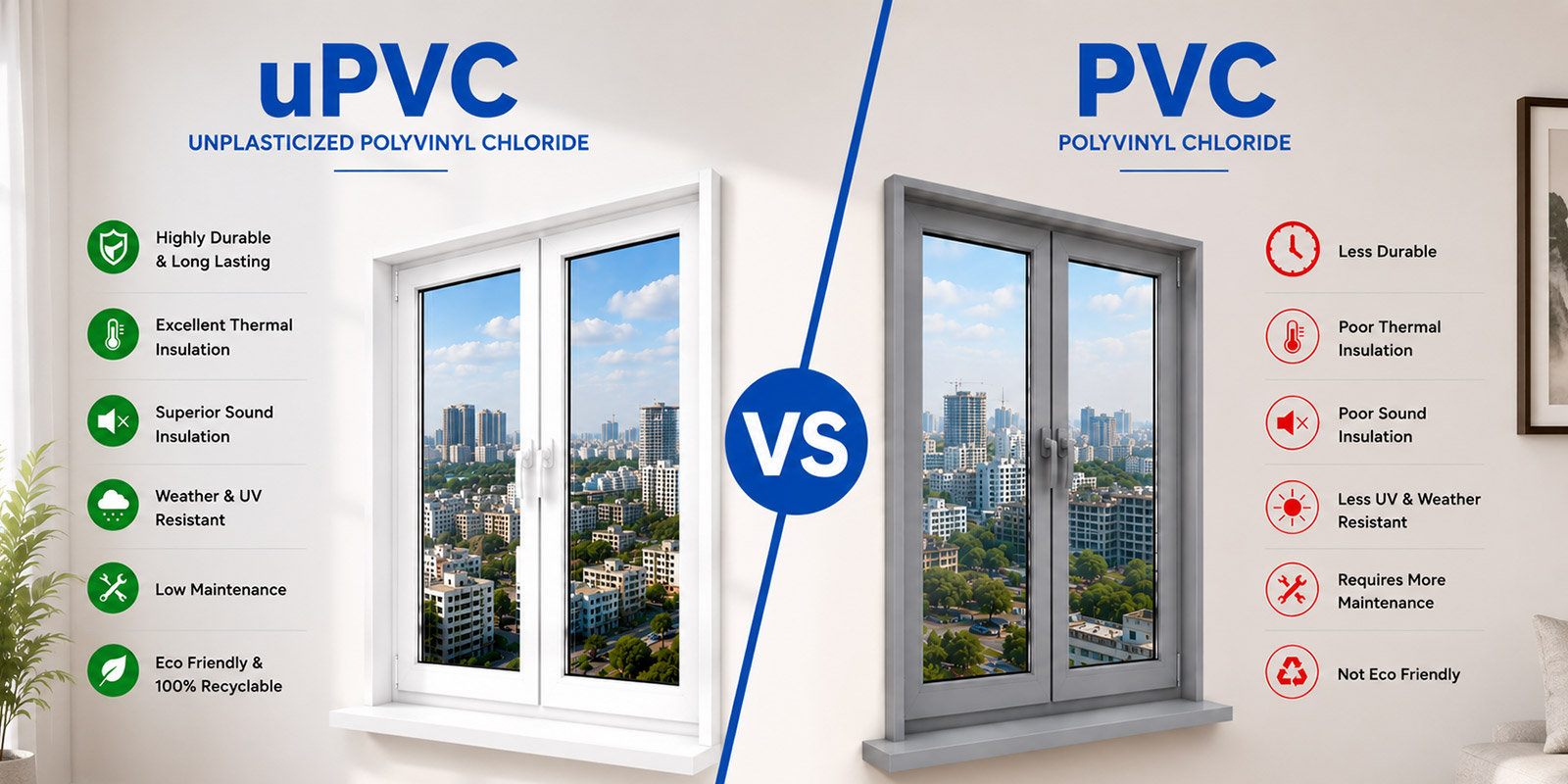
PVC (Polyvinyl Chloride) and uPVC (unplasticized polyvinyl chloride) are made from the same base polymer, i.e., polyvinyl chloride, but they are formulated differently. All uPVC is a form of PVC, but not all PVC is uPVC. PVC contains plasticisers that make it more flexible, and uPVC is made without these plasticisers, giving it a rigid structure that is suited to window and door frames.
This difference in formulation affects their strength, rigidity, weather resistance, structural stability, and suitability for different applications. The difference is particularly important when the material must form a window or door frame, support glazing, and maintain its shape during regular use and exposure to weather.
So understanding these differences can help homeowners determine where both PVC and uPVC are the appropriate choices.
Key Takeaways
- PVC and uPVC share a polymer family but differ in rigidity and use cases.
- Flexible PVC is generally suited to applications where structural rigidity is not the primary requirement.
- uPVC is rigid, weather-resistant, and ideal for external doors and windows.
- Final performance relies heavily on design, hardware, glazing, and proper installation.
- Choosing established manufacturers ensures the system matches specific household opening requirements.
What are PVC and uPVC?
What is PVC?
PVC stands for polyvinyl chloride. It is a thermoplastic material that can be manufactured by adding plasticisers to make it softer and more flexible. Because of this flexibility, PVC is commonly suited to applications where structural rigidity is not the main requirement.
What is uPVC?
uPVC stands for unplasticised polyvinyl chloride. It uses the same base polymer as PVC, but it does not contain plasticisers used to make conventional PVC flexible.
As a result, uPVC is rigid, stable, and suitable for manufacturing structural profiles for windows and doors. uPVC window and door systems will also incorporate multi-chamber profiles, reinforcement, glazing, and sealing components required for exterior openings.
PVC vs uPVC: Side-by-Side Comparison
Feature |
Plasticised PVC |
uPVC |
| Full name | Polyvinyl chloride | Unplasticised polyvinyl chloride |
| Plasticisers | Commonly added | Not added |
| Structure | More flexible | Rigid |
| Dimensional stability | Lower for structural framing | Higher |
| Window frame suitability | Generally not preferred | Widely used |
| Exterior door suitability | Limited | Suitable |
| Profile construction | Simple or non-structural profiles | Can use multi-chamber profiles |
| Reinforcement | Generally not used as a structural frame system | Profiles may include steel reinforcement |
| Weather exposure | Depends heavily on formulation and application | Designed for exterior fenestration applications |
| Thermal performance | Limited as a basic flexible material | Multi-chamber systems can improve insulation |
| Typical door application | Lightweight internal doors | Interior and exterior door systems |
| Best suited for | Non-structural applications | Window and door frames |
The core difference remains rigidity. A window or external door frame must hold glazing, hardware, and seals while maintaining its dimensions. uPVC is suited to performing that structural role.
uPVC, PVC-U, PVCu and Vinyl: What Do the Different Names Mean?
Several terms used in the door and window industry can make the PVC-versus-uPVC comparison more confusing than it needs to be.
uPVC, PVC-U, PVCu and U-PVC generally refer to the same unplasticised form of PVC. PVC-U is commonly used as a formal material designation, while PVCu is another trade spelling used in some markets.
Rigid PVC is also commonly used to describe unplasticised PVC.
The term vinyl window is widely used in North America for windows manufactured using rigid PVC profiles. In this context, vinyl and uPVC generally refer to the same basic window material.
mPVC, or modified PVC, should not be treated as another spelling of uPVC. It refers to PVC whose formulation has been modified, typically to alter properties such as impact behaviour.
CPVC is another distinct PVC-based material primarily associated with hot-water plumbing applications and is not a window or door framing material.
Which Is Better for Windows and Doors, PVC or uPVC?
For external window and door frames, uPVC is the more appropriate material.
Window and door frames need much more than moisture resistance. They must support glass, hardware, locking systems, and repeated opening and closing while maintaining alignment and a reliable seal.
uPVC profiles are designed for this purpose. Depending on the system, they can incorporate multi-chamber sections and reinforcement to improve structural stability.
Plain flexible PVC does not provide the same framing characteristics. Under structural load or prolonged thermal movement, insufficient rigidity can result in deflection or poor alignment.
For windows and external doors exposed to Indian weather conditions, dimensional stability becomes particularly important because frames face strong sunlight, seasonal temperature changes, humidity, and monsoon conditions.
This does not mean PVC has no place in a home. It means PVC and uPVC should be selected according to the application rather than treated as interchangeable materials.
How To Check The Quality Of A uPVC Profile?
If you’re choosing a window or door profile, don’t just look at the product name. Check what material and system it uses:
- Check the rigidity: A good uPVC window profile should feel firm and sturdy. It should not feel soft or bend easily when you apply normal hand pressure.
- Look at the cross-section: Check the inside of the profile. Good window-grade uPVC profiles usually have multiple internal chambers that help improve strength, stability, and insulation.
- Check for reinforcement: A good uPVC profile is fitted with strong reinforcement inside to provide extra strength and support.
- Inspect the corners: Look closely at the frame corners. uPVC frames are commonly joined using welded corner joints, which help create a strong and sealed frame.
- Ask for the profile details: Don’t choose a window based only on terms like “PVC window” or “plastic window.” Ask the supplier about the exact profile material, system, and specifications.
- Consider the overall profile quality: The profile’s wall thickness, internal construction, reinforcement, stabilisers, and manufacturing quality can all affect how the finished window performs over time.
These checks are especially useful when quotations use PVC and uPVC loosely or interchangeably.
When PVC Is Still the Right Choice?
uPVC is not automatically necessary for every door or interior application.
PVC can remain a practical choice for internal, lightweight, and non-structural applications where the door does not carry heavy glazing or face direct outdoor exposure.
Bathroom and utility-area doors are common examples where moisture resistance may be more important than the structural performance expected from an exterior door frame.
PVC may also be considered for economical internal partitions, temporary installations or spaces where long-term exterior weather resistance is not required.
A useful distinction is:
PVC can suit internal, non-structural applications. uPVC is the stronger choice when the frame supports glazing, requires greater rigidity, or is exposed to outdoor weather.
How Long Do PVC And uPVC Last?
The durability of any PVC- or uPVC-based product depends on its formulation, profile quality, manufacturing, installation, hardware, exposure, and maintenance.
For window and door applications, uPVC generally offers better dimensional stability because its rigid formulation is intended to maintain the shape of the frame.
Performance in Indian Weather
Indian homes can expose windows and doors to different weather conditions throughout the year. Heat, sunlight, humidity, and monsoon rains can all affect how a window performs over time.
- Summer heat: Exterior frames are exposed to high temperatures and repeated changes in temperature. This can cause materials to expand and contract. A properly designed uPVC system is made to handle these changes while maintaining its shape and alignment.
- UV exposure: Windows and doors that are exposed to direct sunlight need profiles that can handle prolonged UV exposure. Exterior-grade uPVC profiles use stabilisers in their formulation for this purpose, so the quality of the profile is important when comparing different products.
- Monsoon and humidity: uPVC does not absorb moisture in the same way that many natural materials do. However, the complete window still needs proper drainage and sealing. Good installation is also important to prevent water-related problems.
- Termites: PVC-based materials are not a food source for termites. This can be an advantage in areas where termite resistance is an important consideration.
- Coastal conditions: uPVC itself does not corrode like metal, which can make it suitable for coastal areas. However, the hardware, fasteners and other components used with the window should also be checked, as these can affect the overall durability of the system.
Is uPVC More Expensive Than PVC?
In similar door applications, uPVC systems usually cost more upfront than basic PVC options. However, the price of the raw material alone does not give the complete picture.
A complete uPVC window or door system can include engineered profiles, internal chambers, reinforcement, glazing, gaskets, locks, and other hardware. All these parts work together to provide better strength, sealing, and day-to-day performance.
Therefore, the initial price should be compared with the complete system specification, including the profile, glazing, hardware, reinforcement, sealing, and installation requirements.
Are PVC and uPVC Safe?
PVC and uPVC are broad material categories, so their safety and environmental characteristics depend partly on the formulation used by the manufacturer.
Plasticisers, Lead, BPA, and Stabilisers
PVC formulations can contain different additives depending on the intended application. uPVC profiles are formulated without plasticisers used to create flexibility, while stabilisers and other additives can vary between manufacturers and formulations.
For uPVC window and door profiles, buyers can ask the supplier for applicable product specifications and test documentation. Relevant references include IS 17953:2023 for uPVC profiles used in windows and doors and EN 12608 for PVC-U profile classification, requirements, and testing.
The quality and composition of the finished profile matter more than relying on the acronym alone.
Recyclability
Rigid uPVC profiles can be recycled and reprocessed through appropriate recycling systems. Actual recyclability depends on collection, segregation, recycling infrastructure, and the composition of the finished product.
For environmentally conscious buyers, it is useful to ask the manufacturer about material sourcing, production practices, and recycling processes rather than relying only on broad claims such as eco-friendly.
Choosing The Right Material For Your Windows And Doors
When comparing options, look beyond the material name or raw material used. Profile design, reinforcement, glazing, hardware, sealing, fabrication, and installation all influence how the window or door performs.
For homeowners planning new windows or doors, choose a properly designed uPVC system from an established manufacturer to ensure that the material, profile configuration and hardware are suited to the actual opening and usage requirements. The right choice depends on the application, required structural performance, and exposure conditions rather than price alone.
Aparna Enterprises manufactures lead-free and RoHS-certified uPVC profiles using German technology for precision. If you are an architect or fabricator and are looking for uPVC profiles, get in touch with AEL today.
Frequently Asked Questions
Flexible PVC cannot be used for window frames because it is soft and lacks structural integrity. So, uPVC profiles are a preferred choice for windows and doors. uPVC also comes with reinforced steel to offer additional strength.
uPVC profiles are formulated with stabilisers and other additives to help improve resistance to UV exposure and discolouration. The actual performance depends on the profile formulation, manufacturing quality, and exposure conditions
uPVC doesn’t absorb water, and it is suitable for moisture-prone and exterior applications. But the resistance of a window or door depends on fabrication quality, drainage design, gaskets, glazing, hardware, and proper installation.
Yes, rigid uPVC profile material can be recycled. The clean frame or profile is melted and shaped into new pellets or a fine powder.
In North America, vinyl refers to windows and doors manufactured from rigid PVC profiles. So, vinyl window material and uPVC generally describe the same basic unplasticised PVC material.
For a standard internal bathroom door, PVC may be sufficient where basic moisture resistance is the main requirement. uPVC can be a better choice when greater rigidity, heavier hardware, glazing, or exposure to outdoor conditions is involved.
uPVC profiles need no repainting as the colour lasts for several years with minimal maintenance. A reputed manufacturer offers a warranty on discolouration for several years.
No, all uPVC is a form of PVC, but not all PVC is uPVC. Their formulations and physical properties are different.
Start Your Project with the Right Materials
We provide everything you need for modern construction. Connect with our experts to discuss your requirements and get the best solution for your project. Submit your details and our team will contact you soon.
CORPORATE OFFICE
8-2-293/82/A, Plot No-1214, Road No-60,
Jubilee Hills, Hyderabad-500 033.