
Vitrified Tiles Manufacturers in India: Who Makes Them and How to Choose
In This Article
Vitrified tiles in India are produced by manufacturers operating at different scales and in different regions. These include companies with plants and distribution networks across multiple states, manufacturers concentrated in the Morbi cluster of Gujarat, and producers serving regional markets from facilities in other parts of the country.
A vitrified tiles manufacturer is the company responsible for producing tiles at a manufacturing facility. A brand may manufacture its own products or source them from another manufacturer, while suppliers, distributors and dealers primarily handle their sale and distribution. There is no single official, industry-wide ranking of tile manufacturers based on product quality. The right manufacturer for your project is one whose product specifications, test reports, available quantity and delivery arrangements meet your requirements.
Key Takeaways
Vitrified describes pressed ceramic tiles with water absorption of 0.5% or less, the group the standards call BIa (IS 15622 and ISO 13006).
A manufacturer produces tiles at a manufacturing facility. A brand may manufacture its own products or source them from another producer, while suppliers, distributors and dealers handle sales and distribution.
No body ranks manufacturers on quality. BIS certifies a product against a standard; it does not rank companies. “Top 10” lists are editorial.
Check the evidence: the BIS Standard Mark and licence number, a water-absorption test report, shade and calibre codes, and the supplier’s capacity to deliver from one batch.
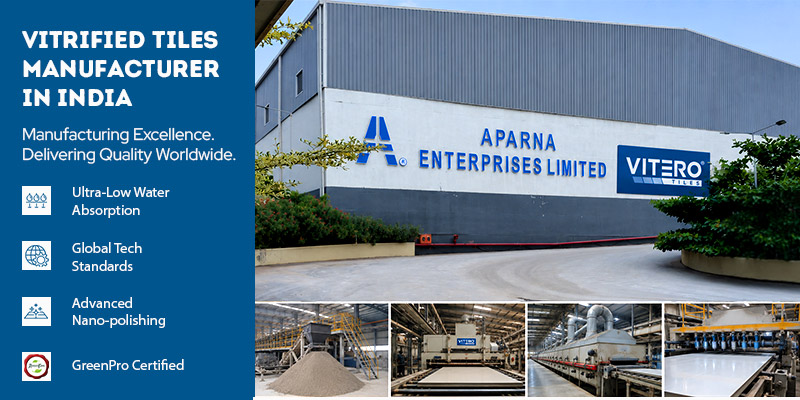
Aparna Enterprises manufactures vitrified tiles in its own plants at Peddapuram, Andhra Pradesh, and Morbi, Gujarat.
What Is a Vitrified Tiles Manufacturer?
A vitrified tiles manufacturer is a company that processes raw materials such as clay, feldspar and silica into finished tiles through pressing and firing at a manufacturing facility.
The raw materials are processed into a fine body composition, converted into granules, pressed into shape and fired at high temperatures. During firing, vitrification reduces the porosity of the tile body, resulting in low water absorption.
You can follow each stage in our guide to how vitrified tiles are manufactured.
“Vitrified” is a market term rather than a category name in the standards. IS 15622, the Indian Standard for pressed ceramic tiles, and the international standard ISO 13006 group tiles by water absorption. Tiles sold as vitrified fall in Group BIa, with water absorption of 0.5% or less. That is very low, but it is not zero. Many vitrified tiles are also sold as porcelain; the porcelain and vitrified tiles comparison explains where the two terms overlap.
Not every tile in a manufacturer’s catalogue is vitrified. Wall-tile ranges, for example, are often ceramic tiles with higher water absorption. Check the classification on the carton or product sheet rather than assuming it from the company name. Our guide to vitrified vs ceramic tiles covers the practical differences.
Manufacturer, Brand, Supplier or Dealer: What Is the Difference?
Search results and directory listings use these words interchangeably, but each describes a different role in the supply chain. Knowing which one you are dealing with tells you what evidence to ask for.
| Role | What it does | What to ask for |
| Manufacturer | Is responsible for producing tiles at a manufacturing facility, including pressing, firing and sorting | Plant address, applicable BIS licence details, and test reports for the batch you are buying |
| Brand | The name the tiles are sold under. A brand may make its tiles in its own plants or source some ranges from other manufacturers | Which company manufactures the specific range, and at which plant |
| Supplier or distributor | Buys from one or more manufacturers and supplies dealers, builders and projects in bulk | Which manufacturers it represents, stock depth for the range and dispatch timelines |
| Dealer or showroom | Sells to homeowners and contractors from display and warehouse stock | Batch and shade availability for your full quantity, delivery terms, and written terms on breakage and returns |
| Exporter | Sells to overseas buyers, usually in container loads | Export documentation, container loading and the destination market’s product requirements |
For a homeowner, buying through a dealer is normal. What matters is that the dealer can tell you which manufacturer made the tile and can supply your full quantity from a single batch.
Who Manufactures Vitrified Tiles in India?
India’s vitrified tile production comes from three broad kinds of manufacturer:
- National manufacturers: established companies with plants in more than one location and dealer networks across the country.
- Morbi cluster manufacturers: a dense concentration of tile plants in Morbi, Gujarat. Many make tiles for other brands as well as their own. Our vitrified tiles manufacturer in Morbi guide explains how to assess them.
- Regional manufacturers: plants outside Morbi, including in South India, that mainly serve nearby markets where freight costs are lower.
Is There an Official Ranking of the Best Vitrified Tiles Manufacturers?
No. There is no official ranking of the best vitrified tiles manufacturers in India. The Bureau of Indian Standards (BIS) certifies products against a standard; it does not rank companies. Rankings by revenue or capacity measure the size of a company, not whether a particular tile suits your floor. Most “top 10” lists are editorial opinions, and some are published by manufacturers about their own market. Use a list to build a shortlist, then compare the companies on evidence you can check.
How to Choose the Best Vitrified Tiles Manufacturer for Your Project?
A suitable vitrified tiles manufacturer should be able to supply products that meet your project specifications, confirm the available quantity and maintain consistency in shade, calibre and finish across the required supply.
| What to check | Why it matters | What acceptable evidence looks like |
| Own manufacturing plant | A trader can change its source between orders. A manufacturer controls the body, firing and sorting. | Plant address that matches the plant named on the BIS licence |
| BIS Standard Mark | Check whether the specific tile product is covered by the applicable BIS certification requirements. Look for the BIS Standard Mark, the relevant Indian Standard number and the licence details on the product packaging. Verify the applicable requirements and licence status through official BIS resources before purchasing. | Standard Mark with a licence number in the format CM/L- and the IS number on the carton. Verify the licence on the BIS Care app |
| Water absorption | Water absorption helps classify a tile. For dry-pressed tiles in Group BIa, the water absorption limit is 0.5% or less. Ask for the relevant test report rather than relying only on a product description or catalogue claim. | Test report showing 0.5% or less (Group BIa) |
| Breaking strength and modulus of rupture | They indicate how well the tile resists cracking under load. | Breaking strength requirements as per the applicable tile classification and thickness. Modulus of rupture requirements as per the applicable standard |
| Surface wear rating | Glazed and unglazed tiles are tested differently, so the right test depends on the tile type. | Ask for the applicable surface-abrasion test result. Glazed tiles are assessed for resistance to surface abrasion using the relevant glazed-tile test, while unglazed tiles are assessed using the applicable deep-abrasion test. The appropriate test depends on the tile’s surface construction, not just its marketing name. |
| Range that fits the use | Different vitrified types and finishes suit different traffic levels, moisture and looks. | Type, size, thickness, finish and rectified edges available in the quantity you need |
| Batch consistency | Tiles from different production runs can differ slightly in shade and size. | Shade and calibre codes on every carton, and written confirmation that your order ships from one batch |
| Capacity, lead time and freight | Tiles are heavy and require careful handling during transport. Freight distance, packaging, loading practices and delivery arrangements can all affect the final landed cost and the condition in which the tiles arrive. | Written dispatch schedule, nearest plant or depot, and packing standard. |
| Written commercial terms | Common disputes involve transit breakage, shade variation and short supply. | Terms covering breakage, shade complaints and replacement, agreed before payment |
Water absorption is only one measure of tile quality. A tile can meet the specified absorption limit and still differ in surface quality, dimensions, strength, finish and shade consistency. Buyers should review the relevant test reports and product specifications before making a decision.
Which Type of Vitrified Tile Should You Ask For?
Vitrified tiles are available in different constructions, surface treatments and finishes. Some terms describe the tile body, while others describe how its design or surface is created. Understanding this difference helps you compare products more accurately.
| Type | How the design is made | Typical use |
| Full body | The colour and material characteristics extend through the tile body | Considered for areas where edge visibility and surface wear are important |
| Double charge | A decorative layer is pressed onto the tile body during manufacturing | Used in residential and commercial flooring, depending on the product specification |
| Glazed vitrified (GVT) | A glaze layer provides the surface on which the design is created | Available in different designs and finishes for floors and walls |
| Polished glazed vitrified (PGVT) | Glazed vitrified tiles with a polished surface | Used where a glossy appearance is preferred |
| Soluble salt | A soluble-salt printing process creates the surface design | Generally associated with simpler designs and product ranges |
For a fuller comparison of strength, finish and cost, see the guide to types of vitrified tiles, or read about double charge vitrified tiles and glazed vitrified tiles in detail.
Buying Direct From a Manufacturer, Supplier or Dealer
Manufacturers use different sales and distribution models. Homeowners generally purchase through dealers or showrooms, while builders, contractors and distributors may be able to enquire about direct project or bulk supply. The right route depends on who you are and how much you need.
- Homeowners: buy through a dealer or showroom. See full tiles, not only samples, and ask which manufacturer and batch the stock comes from.
- Builders and contractors: ask for direct project supply, with samples matched to the specification and a dispatch schedule tied to the project timeline.
- Dealers and distributors: approach the manufacturer about a partnership covering territory, display support and supply terms.
Buying direct does not automatically mean paying less. Freight, minimum order quantities and payment terms often decide the final landed cost. For indicative market rates, see our guide to vitrified tiles price per sq ft. If you are sourcing locally in Telangana, our guide to choosing a tiles manufacturer in Hyderabad covers local supply.
Aparna Enterprises: Vitrified Tiles Manufacturer With Plants in Andhra Pradesh and Gujarat
Aparna Enterprises Limited (AEL) is a Hyderabad-based building materials manufacturer with vitrified tile manufacturing facilities in Peddapuram, Andhra Pradesh, and Morbi, Gujarat.
| Aparna Enterprises tile manufacturing | Details |
| Plants | Peddapuram, near Kakinada, Andhra Pradesh; Morbi, Gujarat (commissioned February 2026) |
| Peddapuram plant | A facility of about 1 million sq ft and a nano-polishing unit |
| Production capacity | Morbi: 7.2 million sq m a year. Both plants together: about 18 million sq m a year |
| Vitrified tile types | Full body, double charge, glazed vitrified (GVT), polished glazed vitrified (PGVT) and soluble salt |
| Formats (Morbi plant) | A range of vitrified floor tile sizes and large-format full-body slabs. |
| Raw materials | Materials from the group’s own mines, plus imported clays from countries including Turkey and Malaysia |
| Quality control | Raw-material testing before pressing, process control at the press and kiln, and finished-tile testing for water absorption, breaking strength and shade before dispatch |
| In-house laboratory | Equipment includes an XRF analyser, a dilatometer and a modulus-of-rupture (MOR) testing machine |
| Standards | Aparna Enterprises states that its vitrified tiles are manufactured in accordance with IS 15622 |
| Project reference | Aparna Enterprises reports supplying double-charged vitrified tiles for the international terminal at Chennai airport and for Airports Authority of India residential quarters at Trichy and Coimbatore |
Buyers can evaluate Aparna Enterprises’ vitrified tile range by checking the product type, size, finish, applicable test details and availability for their project. Homeowners can enquire through dealers and showrooms, while builders and other institutional buyers can discuss project requirements and supply schedules with the company.
Looking for vitrified tiles for your project? Contact Aparna Enterprises to enquire about product specifications, availability and project supply.
Frequently Asked Questions
No single company is best for every project, and there is no official quality ranking of tile manufacturers in India. Shortlist manufacturers that make the tile type you need, then compare their BIS licence, water-absorption and strength test reports, batch consistency and delivery capacity for your location.
Companies named most often in published lists include Asian Granito (AGL), Cera, H & R Johnson, Kajaria Ceramics, Nitco, Orientbell, RAK Ceramics, Simpolo, Somany Ceramics and Varmora. These lists are editorial, not official rankings. Aparna Enterprises manufactures vitrified tiles at its own plants in Peddapuram, Andhra Pradesh, and Morbi, Gujarat.
A manufacturer is responsible for producing tiles at a manufacturing facility and overseeing production and quality control. A manufacturer is responsible for producing tiles at a manufacturing facility and overseeing production and quality control. A supplier or distributor buys tiles from one or more manufacturers and sells them on in bulk. A supplier should be able to name the manufacturer and plant behind each range.
Ask the company for the manufacturing facility’s address, the name of the company responsible for production and the relevant product test reports. Where BIS certification applies, check the Standard Mark and licence details against the manufacturing facility and product scope. You can also request manufacturing information or arrange a facility visit for large project requirements.
Vitrified tiles should have water absorption of 0.5% or less, which places them in Group BIa under IS 15622 and ISO 13006. Ask for the test report for the batch you are buying rather than relying on a catalogue claim.
Check the carton for the manufacturer’s name, product type, size, grade, shade and calibre details. Where BIS certification is applicable, also check the Standard Mark, licence number and relevant Indian Standard. Make sure the shade and calibre details match across the cartons supplied for your project.
Not always. Manufacturers usually supply project and dealer volumes directly and sell retail quantities through dealers. Freight, minimum order quantities and payment terms often matter more to the final cost than buying direct.
No. Many manufacturers also make ceramic wall tiles and other products with higher water absorption. Check the classification and water-absorption figure for the specific product, not the company name.
Aparna Enterprises manufactures vitrified tiles at its plant in Peddapuram, near Kakinada in Andhra Pradesh, and at its Morbi plant in Gujarat, commissioned in February 2026.
Start Your Project with the Right Materials
We provide everything you need for modern construction. Connect with our experts to discuss your requirements and get the best solution for your project. Submit your details and our team will contact you soon.
CORPORATE OFFICE
8-2-293/82/A, Plot No-1214, Road No-60,
Jubilee Hills, Hyderabad-500 033.