
What is uPVC Material? Composition, Properties & Uses
In This Article
uPVC (unplasticised polyvinyl chloride) is a rigid form of PVC made without plasticisers — the additives that make ordinary PVC soft and flexible. Because it stays rigid, uPVC is strong, weather-resistant and dimensionally stable, which is why it has become the most widely used framing material for windows and doors in India and worldwide. This guide explains what uPVC is made of, its measurable properties, where it performs well, where it does not, and how to judge quality before you buy.
What Is uPVC Material?
uPVC stands for unplasticised polyvinyl chloride. It is chemically the same polymer as PVC — repeating units of vinyl chloride, (C2H3Cl)n — but formulated without plasticisers, so it remains hard and holds its shape. You will also see it called rigid PVC, PVC-U, or (in the US) vinyl.
- Rigid and dimensionally stable: does not sag, warp or soften under normal outdoor temperatures.
- Safe for homes: modern uPVC uses lead-free calcium-zinc stabilisers and contains no phthalate plasticisers.
- Built for the outdoors: resistant to moisture, salt air, termites and UV when properly stabilised.
What is uPVC Made Of? Composition and Raw Materials
uPVC is a compound, not a single ingredient. PVC resin is blended with a small set of functional additives, and the ratio between resin and filler is one of the clearest separators between a quality profile and a cheap one.
Component |
Typical share |
What it does |
| PVC resin | ~80–85% | The base polymer; provides strength and rigidity |
| Calcium carbonate (filler) | ~5–10% | Improves stiffness and dimensional stability; excess filler cuts cost but makes profiles brittle |
| Titanium dioxide (TiO2) | ~3–5% | UV shielding and whiteness — critical under Indian sunlight |
| Calcium-zinc stabilisers | ~2–4% | Prevent heat degradation during extrusion and over the product’s life; lead-free |
| Impact modifiers (acrylic / CPE) | ~3–6% | Toughness against cracking and impact |
| Lubricants and pigments | <2% | Smooth processing and integral colour that cannot peel |
Note: Proportions are indicative and vary by manufacturer’s formulation.
How uPVC Profiles Are Made?
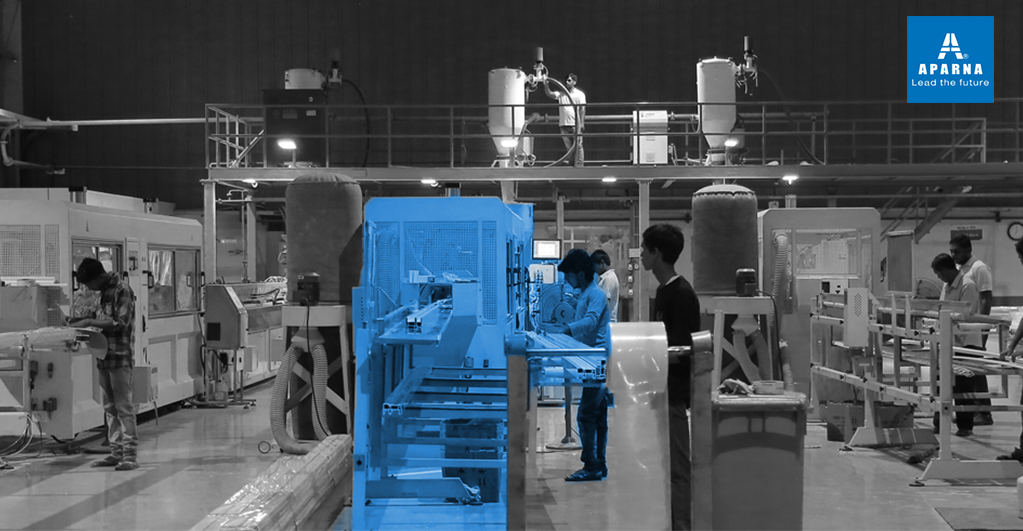
The dry-blended compound is melted and forced through a die in a twin-screw extruder at roughly 180–200°C, then calibrated, vacuum-cooled and cut into profile lengths. Window and door profiles are designed with multiple sealed internal chambers that trap air for insulation. During fabrication, galvanised steel sections are inserted into the main chamber for structural strength, and frame corners are fusion-welded — not screwed — to create an airtight, one-piece frame.
uPVC vs PVC: What Is the Difference?
The only formulation difference is plasticisers. PVC contains them and is soft and flexible — used for cable insulation, flexible hoses and films. uPVC omits them and is rigid — used for window and door profiles, cladding and rigid pipes. Because it needs no phthalate plasticisers, uPVC also avoids the additive-leaching concerns associated with flexible PVC.
A note on plumbing: pipe-grade uPVC (used in plumbing pipes, fittings and reducer bushings) is a separate product class engineered for water pressure and chemical resistance. This article covers window- and door-grade uPVC, which is formulated for UV stability and structural rigidity instead.
Properties Of uPVC Material
Property |
Typical value |
Why it matters |
| Density | 1.35–1.46 g/cm³ | Lighter than aluminium and glass; easy to fabricate and install |
| Tensile strength | 40–50 MPa | Handles wind loads on standard residential openings with steel reinforcement |
| Thermal conductivity | 0.14–0.17 W/m·K (aluminium: ~160) | The frame does not become a heat bridge; keeps interiors cooler |
| Water absorption | <0.1% | No swelling, rotting or warping in monsoon humidity or coastal air |
| Vicat softening temperature | 75°C or higher | Stays rigid through Indian summer surface temperatures |
| Fire behaviour | Flame-retardant material | Does not support combustion once the flame source is removed |
| Linear thermal expansion | ~6–8 × 10⁻⁵ /K | Expands slightly in heat; managed by steel reinforcement and installation clearances |
| Sound insulation | ~30–35 dB reduction with standard double glazing; up to ~40 dB with acoustic laminated glazing | Meaningful noise cut for homes near traffic; the glazing does most of the work, the airtight uPVC frame makes it possible |
What Are uPVC Windows And Doors Made Of?
A uPVC window or door is a system, and the profile is only one part of it. When people search for “uPVC windows material”, this full assembly is the real answer:
- uPVC profile frame and sash: the extruded multi-chamber sections that form the visible frame.
- Galvanised steel reinforcement: inserted inside the main chambers to carry structural and wind loads.
- Glazing: single, double (DGU) or laminated glass; the biggest driver of thermal and acoustic performance.
- Gaskets and seals: EPDM or TPE rubber gaskets in double sealing lines block air, water and dust.
- Hardware: multi-point locks, handles, hinges, rollers — typically stainless steel or zinc alloy.
- Mesh (optional): stainless steel or fiberglass insect mesh on a dedicated track or shutter.
Benefits Of uPVC Material
- Durability of 25–35 years: immune to termites, rust and salt-air corrosion, which makes it a strong choice for coastal cities.
- Very low maintenance: no painting or polishing ever; soap-and-water cleaning is enough because colour is integral to the material.
- Energy efficiency: uPVC conducts roughly a thousandth of the heat aluminium does, so frames don’t leak cooling — a measurable difference in air-conditioning load.
- Acoustic comfort: an airtight welded uPVC frame with double glazing cuts outside noise by around 30–35 dB — enough to turn a main-road bedroom quiet.
- Sustainability: recyclable up to about 10 times without significant loss of properties, with lower embodied energy than aluminium; A few arecompatible with LEED and GRIHA green-building credits.
Limitations of uPVC — What It Is Not Good At
- Thermal expansion: uPVC expands more than metal in heat. Reinforcement and correct installation clearances manage it, but dark laminated profiles in harsh direct sun need extra care.
- Structural limits: for very large openings, tall facades and ultra-slim sightlines, aluminium systems remain the better engineering choice.
- Finish, not paint: colours come from laminates and foils applied at manufacture; you cannot repaint uPVC later.
- Quality variance in the market: unbranded profiles with high filler content yellow and crack within a few years — this created uPVC’s early reputation problem in India. The standards checklist below is how you avoid it.
Applications of uPVC Material
In fenestration, uPVC is used for casement and sliding windows, tilt-and-turn windows, ventilators, sliding and French doors, and villa entrance doors — across homes, apartments, hotels, schools, hospitals and offices. Its airtightness suits clean environments, and its salt resistance suits coastal projects. (Rigid uPVC is also used in plumbing pipes and fittings, but that is a separate, pressure-rated product category.)
uPVC vs Aluminium vs Wood vs WPC
Factor |
uPVC |
Aluminium |
Wood |
WPC |
| Typical service life | 25–35 years | 30–40+ years | 15–30 years (maintenance-dependent) | 15–25 years |
| Maintenance | Very low | Low | High (polish/paint cycles) | Low–moderate |
| Thermal insulation | Excellent | Poor unless thermally broken (costlier) | Good | Moderate |
| Acoustic (with DGU) | Very good | Good | Good | Moderate |
| Termite / moisture | Immune | Immune | Vulnerable | Largely resistant |
| Cost | Moderate | Higher | Wide range; hardwood is highest | Moderate |
| Best suited for | Homes, mid-rise, coastal, noise-prone sites | Large spans, facades, slim sightlines | Heritage aesthetics | Interiors and wet areas |
The honest summary: aluminium outlasts uPVC and wins on very large openings; wood wins on warmth of aesthetics. uPVC wins on insulation, acoustic sealing and total cost of ownership for standard residential and commercial openings — which is why it dominates that segment.
How To Identify High-Quality uPVC?
- Standard compliance: ask for profiles conforming to IS 17953:2023 (the Indian standard for uPVC window and door profiles) or EN 12608.
- Wall thickness class: Class A profiles have visible walls of 2.8 mm or more; Class B, 2.5 mm or more. Thinner unclassified profiles compromise screw retention and weld strength.
- Multi-chamber design: more sealed chambers means better insulation and stiffness; look for at least a multi-chamber section for exterior use.
- Galvanised steel reinforcement: confirm it is actually present in frames and sashes — its omission is a common corner cut.
- TiO2-stabilised formulation: essential for colourfastness in Indian sun.
- Double sealing with EPDM/TPE gaskets: the difference between airtight and merely closed.
- Branded hardware and warranty: multi-point locking, tested rollers, and a manufacturer who will still exist when you claim the warranty.
Choosing uPVC Sliding Doors With Mesh For A Balcony
A frequent buying question: what should you look for in a uPVC sliding door with an insect mesh for a balcony? Check these seven points:
- Track configuration: choose a 3-track (or 2.5-track) profile with a dedicated mesh track, so the mesh shutter slides independently of the glass shutters.
- Mesh material: SS304 stainless-steel mesh resists pets, monkeys and coastal corrosion; fiberglass mesh is cheaper and easily replaceable but tears sooner.
- Reinforced interlocks: the vertical meeting sections of sliding shutters flex first in wind — steel-reinforced or heavy-duty interlocks matter on open balconies.
- Rollers rated for shutter weight: double glazing makes shutters heavy; underspecified rollers are the most common failure point.
- Drainage slots: the outer frame must have concealed drainage so monsoon rain hitting the balcony track drains out, not in.
- Glazing: double glazing if the balcony faces traffic noise or strong sun; toughened glass for high floors.
- Wind-load check for high-rises: above roughly the 10th floor, ask the fabricator for a wind-load calculation rather than a standard section.
Maintaining uPVC
- Wipe frames with mild detergent and water twice a year; never use abrasive or solvent cleaners.
- Clear track drainage slots before each monsoon.
- Lubricate locks, hinges and rollers annually.
- Inspect gaskets every few years and replace if hardened.
uPVC Profiles And Windows From Aparna Enterprises
Aparna Enterprises manufactures uPVC profiles and complete uPVC window and door systems engineered for Indian conditions — UV-stabilised formulations, multi-chamber designs with galvanised steel reinforcement, and sliding, casement and tilt-and-turn ranges. Talk to our team to specify the right system for your project.
Frequently Asked Questions On uPVC Material
Unplasticised polyvinyl chloride. It is also called rigid PVC, PVC-U or vinyl.
PVC resin (~80–85%) compounded with calcium carbonate filler, titanium dioxide for UV protection, lead-free calcium-zinc stabilisers, impact modifiers, lubricants and pigments.
The same as PVC: (C2H3Cl)n — polymerised vinyl chloride, without plasticiser additives.
25–35 years for quality profiles with basic cleaning; gaskets and hardware may need replacement earlier.
Yes. Modern window-grade uPVC is lead-free (calcium-zinc stabilised) and contains no phthalate plasticisers.
Yes — up to around 10 times, with the recyclate typically used in the core of new co-extruded profiles.
Quality profiles stabilised with titanium dioxide stay colourfast for decades; cheap high-filler profiles are the ones that yellow.
It stays rigid up to its softening range (Vicat 75°C+), well above frame surface temperatures in Indian summers, and it is self-extinguishing in fire.
IS 17953:2023 covers uPVC profiles for windows and doors in India; EN 12608 is the equivalent international standard.
uPVC profiles fall under HSN heading 3916; finished uPVC doors, windows and their frames fall under 3925.
No. Both are rigid PVC, but pipe-grade uPVC is formulated for water pressure and chemical resistance, while window-grade uPVC is formulated for UV stability and structural rigidity.
Start Your Project with the Right Materials
We provide everything you need for modern construction. Connect with our experts to discuss your requirements and get the best solution for your project. Submit your details and our team will contact you soon.
CORPORATE OFFICE
8-2-293/82/A, Plot No-1214, Road No-60,
Jubilee Hills, Hyderabad-500 033.