
West Facing House Vastu: Entrance, Plan, Remedies And The Truth About The Myth
In This Article
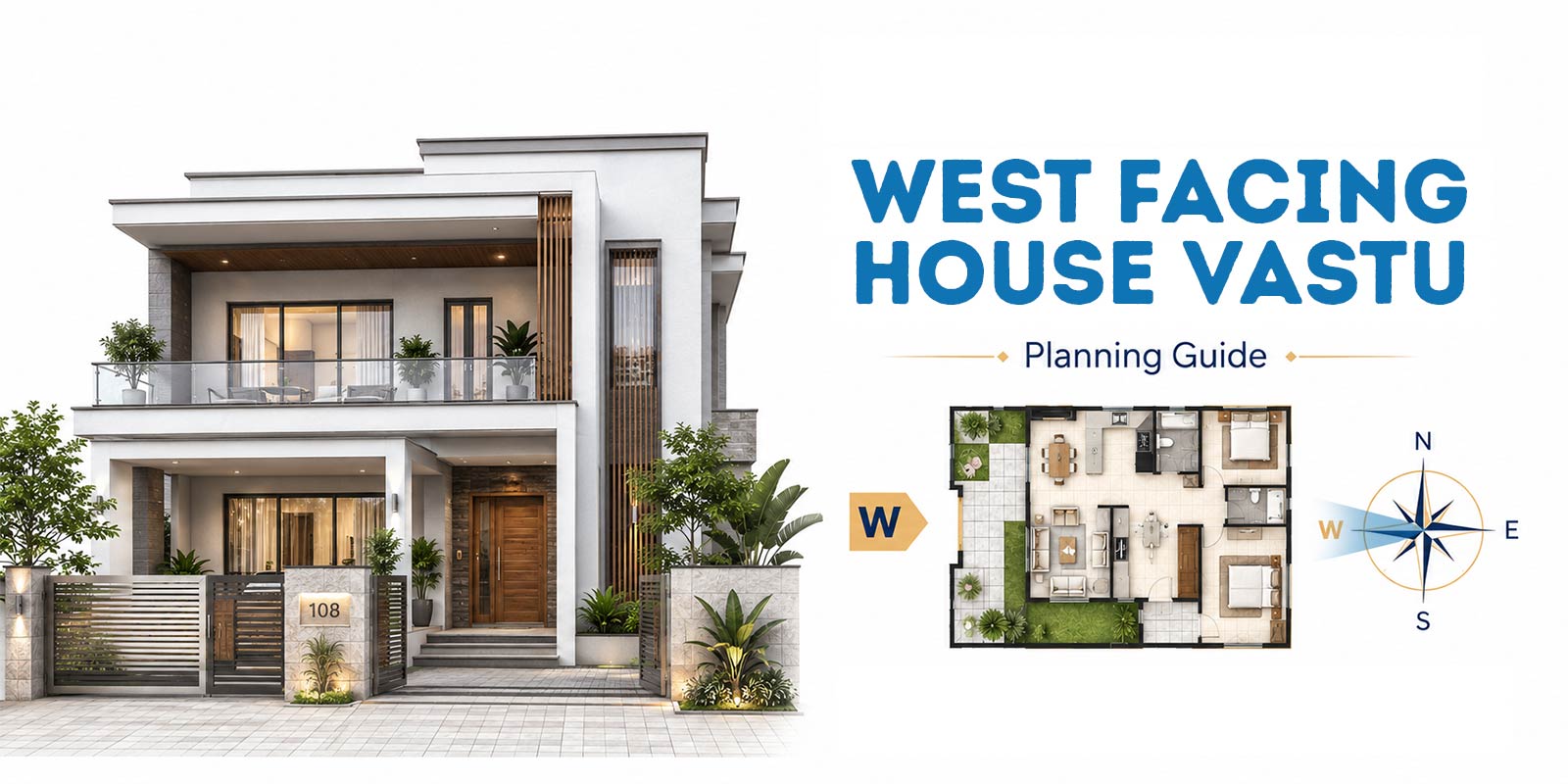
A west facing house is not inauspicious in Vastu Shastra. What matters is where the main door sits on the west wall. Divide that wall into eight equal padas from the north-west corner and place the entrance in the fifth or sixth pada — Puṣpadanta and Sugrīva. Keep the kitchen south-east, master bedroom south-west and pooja room north-east.
West facing house vastu attracts more hesitation than it deserves. Buyers pass on well-located properties over a belief that no classical Vastu text actually contains, and the discount that follows is real money changing hands over folklore. This guide sets out what Vastu genuinely says about a west-facing home, gives the entrance rule as a measurement you can take with a tape, covers the full room-by-room plan and remedies, and deals honestly with the one genuine drawback — the afternoon sun.
Key Takeaways
- No classical Vastu text declares the west inauspicious. The west is governed by Varuna, associated with gains, fame and stability.
- The entrance decides most of the outcome. Divide the west wall into eight padas from the north-west corner and place the door in the fifth or sixth.
- Avoid the last three padas at the south-west end — that is where genuine entrance doshas sit.
- Kitchen south-east, master bedroom south-west, pooja room north-east, staircase south or west, centre of the plan left open.
- The real challenge of a west-facing home is afternoon heat, not fortune — and it is a solvable design problem.
What Counts as a West Facing House?
Step out through your main door and note the direction you face. If you are facing west, you live in a west facing house. The direction the building looks at from the road determines the facing, not the longest side of the plot and not where the balcony points. On a compass, west facing means a reading between 247.5° and 292.5°.
- Use a compass, not the sunset: The sun sets due west only twice a year, at the equinoxes. For most of the year it sets noticeably north or south of west, so judging by the sunset will put you in the wrong sector.
- West side facing house vastu is the same topic: Different phrasing, same rules.
- South-west and north-west are separate: Outside the 247.5°–292.5° band you are south-west or north-west facing, and the entrance rules change. Those have their own guides.
West Facing House Vastu Good or Bad? The Direct Answer
Vastu Shastra for west facing house planning is clear on this: a west facing house is neither good nor bad by itself. Asking whether it is west facing house vastu good or bad has the same answer as for every other orientation: it depends on the entrance position, the internal zoning, the slope and where water and fire sit. No classical Vastu text — not the Mayamatam, not the Manasara, not the Vishwakarma Prakash — declares any of the four facings inauspicious.
Where the hesitation comes from?
The reasoning behind the myth is simple and, on inspection, weak: the sun rises in the east so the east is associated with light, and the sun sets in the west so the west is associated with darkness. That is an association, not a Vastu rule. In the dikpala system that assigns a guardian to each direction, the west belongs to Varuna — lord of water, the cosmic order and fate — and is linked with gains, reputation and stability rather than decline. In the planetary layer of the tradition the west is associated with Shani (Saturn), which brings connotations of discipline, patience and long-term reward.
| What people believe | What Vastu actually holds |
| The west is the direction of darkness and decline because the sun sets there. | The west is Varuna’s direction, associated with water, fate, gains and reputation. The sunset association is folklore layered on later. |
| A west facing house brings misfortune or financial loss. | Financial guidance in Vastu attaches to the north staying open and light, and to the placement of water and fire — not to the facing. |
| You should avoid buying a west facing property. | The texts direct attention to the entrance pada, the slope, weight distribution and zoning. Facing is one variable among many. |
| Nothing can be done once the house faces west. | The entrance pada, boundary wall heights, slope and internal zoning are all adjustable, and most corrections are inexpensive. |
| West facing homes are harder to sell. | This is a real market perception in many Indian cities, and it is the only concrete cost. It is also why west facing properties often come at a lower asking price. |
Please note: The observation about pricing and resale describes a widely reported market perception, not a valuation or a forecast. Property values depend on many factors. This is not property, investment or financial advice — speak to a qualified valuer or property adviser before any purchase decision.
West Facing House Entrance Vastu and Main Door Vastu: The Eight-Pada Rule
This is the part that decides most of the outcome. West entrance house vastu — and west entry house vastu, the same rule under a different name — turns entirely on this. Main door vastu for west facing house layouts, and vastu for west facing house main door placement, does not say “somewhere on the west wall” — it specifies which portion of that wall, and the difference between the right portion and the wrong one is a few feet.
How to find the right position?
- Measure the full west wall. Corner to corner, north-west end to south-west end.
- Divide it into eight equal parts. Each part is a pada — an energy field with its own presiding deity in the Vastu Purusha Mandala.
- Count from the north-west corner. Pada 1 sits at the north-west end, pada 8 at the south-west end.
- Place the main door in the fifth or sixth pada. These are Puṣpadanta and Sugrīva, the two positions the sources treat as most favourable for a west entrance.
- Keep the door out of the last two padas. Dauvārika and Pitṛ run into the south-west corner and are the positions consistently advised against.
Worked Example
- A west wall 30 feet long divides into eight padas of 3 ft 9 in each.
- The fifth pada runs from 15 ft 0 in to 18 ft 9 in from the north-west corner; the sixth runs from 18 ft 9 in to 22 ft 6 in. Together they form the middle band of the wall, which is where the main door should sit.
- On a 40 ft wall each pada is 5 ft, so the target band runs from 20 ft to 30 ft from the north-west corner.
| Pada (from NW corner) | Name | Position along the wall | Suitability for the main door |
| 1 | Papayakshma | 0 – 1/8 | Avoid |
| 2 | Shosha | 1/8 – 2/8 | Avoid |
| 3 | Asura | 2/8 – 3/8 | Not preferred |
| 4 | Varuna | 3/8 – 4/8 | Acceptable |
| 5 | Pushpadanta | 4/8 – 5/8 | Most favourable — first choice |
| 6 | Sugriva | 5/8 – 6/8 | Most favourable — first choice |
| 7 | Dauvarika | 6/8 – 7/8 | Avoid |
| 8 | Pitru | 7/8 – 8/8 | Strongly avoid — south-west end |
The named padas of the west wall
The Vastu Purusha Mandala is a nine-by-nine grid of 81 padas. Its perimeter holds 32 of them — eight to a wall — and it is those eight that carry the doorway consequences. On the west wall, read from the north-west corner, they are Papayakshma, Shosha, Asura, Varuna, Pushpadanta, Sugriva, Dauvarika and Pitru. Of these, Puṣpadanta and Sugrīva are the two the sources treat as favourable for a main entrance: the Bṛhatkālottara records vṛddhida — giving increase — against Puṣpadanta, and kṛṣisaukhya — agricultural prosperity and well-being — against Sugrīva. They sit in the middle band of the wall, which is why the fifth and sixth padas are the target. Dauvarika and Pitru sit at the south-west end and are the positions to avoid.
Please note: Two things to hold in mind. First, the canonical listings run the west wall from the south-west corner, where the same two padas are the third and fourth; counting here starts at the north-west corner, so the numbers differ while the physical position is the same. Second, schools differ on how the corner padas are assigned — some listings place Pitṛ and Dauvārika on the adjoining south wall rather than at the south-west end of the west wall. Pada boundaries are also angular divisions taken from the geometric centre of the building, so an equal linear division of a wall is an approximation for marking a drawing, not the method a practitioner uses. On an irregular or non-rectangular plot the divisions should be set out on site by a qualified practitioner.
Other entrance rules that matter
- West facing house main door vastu asks that the main door be the largest in the house, and that it opens inwards, clockwise.
- Avoid an entrance in the south-west corner entirely — this is where genuine west-facing entrance doshas sit, and it is the one point every source agrees on.
- Keep the threshold slightly raised and the approach well lit and free of clutter.
- Avoid a T-junction or a road ending directly at the west entrance.
- Metal detailing on a west-facing door — a metal nameplate or fittings — is traditionally considered favourable, as the west is associated with the metal element in some readings.
- Avoid two doors in a straight line running from the entrance through the house.
West Facing House Vastu Plan: Zone by Zone
The organising principle of any west facing house plan as per vastu is the same as for every other orientation: keep the south and west heavy, high and closed, and the north and east light, low and open. This is the vastu map for west facing house layouts in one table — laid out according to Vastu, it covers every element of a normal plan for a west facing house according to Vastu principles.
| Element | Ideal zone | Acceptable alternative | Avoid |
| Main entrance | West wall, 4th or 5th pada | 3rd or 6th pada | 7th–9th pada; south-west corner |
| Living room | North, north-east | East, north-west | South-west |
| Kitchen | South-east | North-west | North-east; south-west |
| Master bedroom | South-west | West, south | North-east |
| Children’s bedroom | West, north-west | South | South-west |
| Guest bedroom | North-west | West | South-west |
| Pooja room | North-east | East, north | South; under a staircase; beside a toilet |
| Dining room | West | East, north | South-west corner |
| Study | North-east, east | North, west | South-west |
| Staircase | South, south-west, west | North-west | North-east; centre (Brahmasthan) |
| Toilet / bathroom | West-north-west | North-west | North-east; south-east; centre |
| Overhead water tank | South-west, west | South | North-east |
| Sump, borewell, underground water | North-east, north | East | South-west; south |
| Septic tank | South of south-west, or north-west | West | North-east; south-east; centre |
| Car parking, garage | North-west, north-east | East | South-west |
| Open space and garden | North, east | North-west | South-west corner |
| Centre of the house (Brahmasthan) | Left open and light | Light furniture only | Staircase, toilet, heavy structure, pillar |
Room-by-Room Vastu in West Facing House Interiors
Pooja Room Vastu for West Facing House
Pooja room vastu for west facing house plans places the room in the north-east, exactly as it would for any other facing — the orientation of the house does not move it. Face north or east while praying. A west facing house vastu plan with pooja room in the north-east is the arrangement most often drawn, and where a dedicated room is not possible a north-east corner of the living room serves. Keep it on the ground floor, out from under a staircase, and never sharing a wall with a toilet.
Kitchen Vastu for West Facing House
Kitchen vastu for west facing house plans puts the kitchen in the south-east, the fire zone, with the cook facing east while working. The north-west is the accepted second position. Keep the sink and the stove apart rather than side by side — water and fire are opposing elements in Vastu, and separating them also happens to be sound kitchen ergonomics. The north-east and the south-west are both ruled out.
Master Bedroom Vastu for West Facing House
Master bedroom vastu for west facing house plans points to the south-west corner, on the highest floor if the house has more than one. Within the room, place the bed in the south-west portion with the head pointing south. Children’s rooms go west or north-west, guest rooms north-west. Avoid a bedroom in the north-east.
Living Room Vastu for West Facing House
North and north-east first, east or north-west second. Heavy furniture and storage belong against the south and west walls; keep the north and east sides lighter and more open. Mirrors are best on a north or east wall.
Staircase Vastu for West Facing House
Staircase vastu for west facing house plans allows the south, south-west or west, rising clockwise. Keep the staircase out of the north-east and never place it in the Brahmasthan at the centre of the plan. Avoid creating a room, toilet or pooja space in the void underneath. External staircases follow the same zoning, and spiral staircases are discouraged.
Toilet Vastu for West Facing House (and Bathroom)
Toilet vastu for west facing house plans favours the west-north-west zone, with the north-west as an alternative. Keep toilets out of the north-east, out of the south-east and out of the centre, and never adjacent to the pooja room or directly above or below it. Ensure proper ventilation and fix leaks promptly.
Vastu Remedies for West Facing House
Most guides list vastu remedies for west facing house problems as an undifferentiated jumble. In practice you want to know what to do first and what it costs. Every vastu solution for west facing house defects below is ordered by effort — start at the top and stop when the problem is resolved.
| Level | Remedy | Addresses |
| Free — do this week | Clear clutter from the south-west and from the entrance approach. Keep the main door area swept and well lit. Move heavy storage into the south-west. Keep the centre of the plan open. | Weight distribution, entrance energy and a blocked centre |
| Low cost | Fit a bright light at the entrance and keep it on after dark. Add a raised threshold. Add metal detailing — a metal nameplate or fittings — on the west-facing door. | A weak or wrongly positioned entrance |
| Low cost | Use neutral, light colours on the west facade and the west wall: white, cream, beige, silver, pale yellow or a light shade of blue. Avoid heavy dark tones and an excess of bright red. | Colour balance for the west zone |
| Low cost | Place a mirror on a north or east wall rather than facing the entrance, and keep water features in the north-east rather than the south or south-west. | Water and reflection placement |
| Moderate | Reposition the gate in the boundary wall so the approach path enters through the fifth or sixth pada, even where the door itself cannot move. Raise the south and west boundary walls. | Wrong entrance pada — the most effective non-structural fix |
| Moderate | Reassign rooms rather than rebuild: move the master bedroom into the south-west and the study or living space into the north-east. | Wrong internal zoning |
| Renovation level | Add a porch or portico that redirects the entry line. Relocate the kitchen to the south-east. Correct the plot slope so it falls towards the north-east. | Entrance position, fire zone and slope defects |
Please note: Remedies are traditional corrective practices. They are not guaranteed to produce any particular result for health, wealth, relationships or wellbeing. Any remedy involving structural work — moving an opening, altering a wall, changing plot levels or drainage — must be assessed by a licensed structural engineer or architect and comply with local building approvals before it is carried out.
West Facing House Vastu Benefits and Disadvantages
The west facing house pros and cons vastu question is best answered side by side rather than as two separate lists.
| West facing house vastu benefits | West facing house vastu disadvantages |
| Long, warm evening light — the house stays naturally bright well into the evening, which suits households that are out during the day. | Strong afternoon heat gain on the west facade, which is the most difficult of the four orientations to shade. |
| Traditionally associated with Varuna and with gains, reputation and stability, and considered well suited to those in trade, law, teaching, media and public-facing work. | The favourable entrance band is narrow — roughly two eighths of the west wall. |
| Often available below the price of an equivalent north or east facing property, because of the belief this guide is correcting. | Softer resale demand in many Indian markets — the same belief working against you when you sell. |
| Morning shade on the front of the house keeps entrances and front rooms cool early in the day. | West-facing doors and window frames weather faster under sustained afternoon sun and UV, so material choice matters more. |
The Heat Question: What a West Facade Actually Does in India?
This is the one genuine drawback of a west-facing home, and it is worth understanding properly because it is the part with a measurable effect on comfort and running cost. It is also the point where Vastu’s instruction to keep the west heavy and closed lines up with building science for entirely separate reasons.
- The west facade is the hardest one to shade: In the afternoon the sun sits low in the western sky. A horizontal projection — a chajja, an overhang, a balcony — works well on a south wall because the midday sun is high overhead, but low-angle western sun slides straight under it. This is why west-facing rooms overheat more than south-facing ones, and why the popular fear about the south is aimed at the wrong direction.
- What works instead: Vertical fins, deep reveals, external louvres, a screen wall or a planted buffer to the west. Smaller openings on the west, with the glazing area moved to the north and east.
- Thermal mass helps: Vastu’s instruction to build thicker and higher on the west has a real thermal effect — a heavier wall lags the heat, so the indoor peak arrives later and lower.
- Glazing is where the money is: The window is the weakest point in a west envelope. Sealed, multi-chambered frames with appropriate glass do more for afternoon comfort than any amount of wall thickness, and they resist the UV and thermal cycling that degrades west-facing frames.
None of this is offered as proof of Vastu, and it is not the reason the tradition gives. It is simply that a west-facing house planned along Vastu lines — heavy and closed to the west, open to the north and east — is also a well-oriented house for the Indian climate. Where the two frameworks agree, you can act with some confidence.
Please note: This section describes general principles of building orientation and shading. It is not a site-specific thermal or energy assessment. Actual performance depends on your location, plot, construction and materials, and should be evaluated by a qualified architect or building services consultant.
Who Is a West Facing House Suitable For?
Traditional guidance links each facing to particular temperaments and occupations. This is one of the most searched questions about west-facing homes, so it is worth setting out plainly — with the caveat that follows it.
- By rashi. West facing house good for which rashi is one of the most asked questions on this topic. Traditionally, west-facing homes are considered favourable for Gemini (Mithuna), Libra (Tula), Aquarius (Kumbha) and, in some readings, Capricorn (Makara).
- By profession. Traditionally associated with those in trade and business, law, teaching, medicine, media and public communication, food and hospitality, financial services and research — broadly, work that depends on dealing with people and on sustained effort.
Please note: Rashi and profession associations are traditional beliefs drawn from Vastu and Vedic astrology. They are shared here because they are widely asked about, not as a basis for a purchase decision, and they are not predictive of any outcome. No one should be advised for or against a property on this basis alone.
West Facing House Colour as per Vastu
West facing house colour as per vastu runs to neutral and light. White, cream, beige, silver and pale yellow are the standard recommendations for the facade and the main door, with a light shade of blue considered particularly suitable where the house extends further west than in other directions. Avoid heavy dark tones and large expanses of strong red, which are read as overwhelming in a zone that already receives intense afternoon light.
- West wall inside the house: Light neutrals, or a soft blue or grey. Paintings on a west wall are traditionally chosen for calm subjects rather than aggressive or turbulent imagery.
- Mirrors: Keep mirrors off the west wall facing the entrance; a north or east wall is the preferred position.
- Practical overlap: Light exterior colours also reflect more solar radiation than dark ones, so the Vastu recommendation and the thermal recommendation point the same way here.
Common Mistakes in West Facing House Vastu and Design
| Mistake | Fix |
| Main door in the south-west end of the west wall | The 7th to 9th padas are the positions to avoid. Shift the door towards the middle of the wall, or redirect the approach through the boundary gate. |
| Judging the facing by where the sun sets | Use a compass. The sun sets due west only at the equinoxes. |
| Large glass panels on the west facade | Reduce the opening size, move glazing area to the north and east, and add vertical shading or external louvres. |
| Kitchen in the north-east or south-west | Relocate to the south-east. If it cannot move, keep the cooking position facing east and the north-east corner clear and light. |
| Toilet in the north-east | Relocate where possible. Otherwise keep it dry, ventilated, lightly used and the door closed. |
| Master bedroom in the north-east | Swap it with a study or living space and move the master bedroom to the south-west. |
| Sump, borewell or water motor in the south-west | Move underground water to the north-east. Keep the overhead tank in the south-west. |
| Staircase in the centre or the north-east | Relocate to the south, south-west or west, and keep the Brahmasthan clear. |
| Plot sloping down towards the south or west | Correct the levels so the ground falls towards the north-east, with the south-west the highest point. |
| Extension or projection at the south-west corner | A south-west extension is one of the more firmly discouraged plot conditions. Avoid at purchase stage where possible. |
West Facing House Vastu Checklist
These are the vastu tips for west facing house planning that carry the most weight, in the order they matter. If you can tick the first six, the house is fundamentally sound.
- The main door sits in the 4th or 5th pada of the west wall, measured from the north-west corner.
- The entrance is not in the last three padas and not in the south-west corner.
- The main door is the largest in the house and opens inwards, clockwise.
- The kitchen is in the south-east, with the cooking position facing east.
- The master bedroom is in the south-west, on the top floor if there is more than one.
- The pooja room is in the north-east, not under a staircase and not against a toilet wall.
- The living room is in the north or north-east.
- The staircase is in the south, south-west or west, and rises clockwise.
- Toilets are out of the north-east, the south-east and the centre.
- The sump and borewell are in the north-east; the overhead tank is in the south-west.
- The centre of the plan is open — no staircase, toilet, column or heavy structure.
- The plot slopes down towards the north-east, with the south-west the highest point.
- The boundary wall is higher on the south and west than on the north and east.
- West-facing glazing is limited and shaded; most window area is on the north and east.
- Facade and main door colours are light neutrals rather than heavy dark tones.
- The south-west zone and the entrance approach are free of clutter.
Conclusion
West facing house vastu comes down to one decision made well and a handful made sensibly. Divide the west wall into eight padas from the north-west corner and put the main door in the fifth or sixth. Keep the south and west heavy and closed, the north and east light and open, the kitchen south-east, the master bedroom south-west, the pooja room north-east and the centre of the house empty. Then treat the afternoon sun as the design problem it actually is. The west’s reputation is inherited rather than textual — and a west-facing house planned this way is a sound house by the standards of both Vastu and the Indian climate.
Disclaimer:Vastu Shastra is a traditional Indian system of architecture and design with deep cultural and religious significance. The guidance in this article reflects long-established Vastu principles and is provided for general information and planning purposes only.
Pada systems, zone definitions, rashi associations and remedies vary between Vastu schools, regions and practitioners. This article does not represent any single authoritative reading, and for a specific property the divisions should be set out on site by a qualified Vastu practitioner.
Nothing in this article is architectural, engineering, legal, financial or property investment advice. Any structural change — relocating an opening, altering walls, changing plot levels or drainage — must be designed and approved by a licensed architect or structural engineer and comply with local building regulations and approvals.
No arrangement of a building guarantees any outcome for health, wealth, relationships or wellbeing. Where a statement reflects traditional belief rather than an evidenced effect, this article says so. Aparna Enterprises accepts no liability for decisions taken on the basis of this article.
Frequently Asked Questions On West Facing House Vastu
Yes, provided the entrance and internal zoning follow the rules. No classical Vastu text declares the west inauspicious. The west is governed by Varuna and associated with gains, reputation and stability.
The position of the main door on the west wall, the internal zoning, the slope and the placement of water and fire. Facing alone decides nothing.
Divide the west wall into eight equal padas starting from the north-west corner and place the main door in the fifth or sixth pada — Puṣpadanta and Sugrīva. The fourth pada, Varuṇa, is an acceptable alternative.
The seventh and eighth, counting from the north-west corner. These run into the south-west end of the wall, which is where west-facing entrance doshas are traditionally located.
Entrance in the fifth or sixth pada of the west wall, kitchen in the south-east, master bedroom in the south-west, pooja room in the north-east, living room in the north, staircase in the south or west, and the centre of the plan left open.
The north-east, facing north or east while praying. The facing of the house does not change this. Keep it on the ground floor, out from under a staircase and not sharing a wall with a toilet.
The south-east, which is the fire zone, with the cook facing east. The north-west is the accepted alternative. Avoid the north-east and the south-west.
South, south-west or west, rising clockwise. Keep it out of the north-east and never place it at the centre of the plan.
The west-north-west zone, with the north-west as an alternative. Avoid the north-east, the south-east and the centre.
Start with the free ones: clear the south-west and the entrance approach, light the main door, move heavy storage to the south-west, keep the centre open. If the entrance pada is wrong, repositioning the boundary gate so the approach enters through the correct band is the most effective non-structural fix.
Long warm evening light, morning shade at the front of the house, a traditional association with gains and stability, and often a lower purchase price than an equivalent north or east facing property.
Strong afternoon heat on the west facade, which is the hardest orientation to shade; a narrow favourable entrance band; faster weathering of west-facing frames; and softer resale demand in markets where the myth persists.
Traditional guidance considers west-facing homes favourable for Gemini, Libra and Aquarius, and in some readings Capricorn. This is a traditional association rather than a basis for a purchase decision.
Light neutrals — white, cream, beige, silver or pale yellow — with a light blue considered particularly suitable. Avoid heavy dark tones and large areas of strong red.
Generally yes. The afternoon sun is low in the western sky, so horizontal shading such as a chajja does not block it the way it blocks high midday sun on a south wall. Vertical shading and smaller west openings are the usual answers.
In many Indian markets the perception persists and can soften demand. That is the flip side of the price advantage when buying, and it is a market perception rather than a property valuation.
Start Your Project with the Right Materials
We provide everything you need for modern construction. Connect with our experts to discuss your requirements and get the best solution for your project. Submit your details and our team will contact you soon.
CORPORATE OFFICE
8-2-293/82/A, Plot No-1214, Road No-60,
Jubilee Hills, Hyderabad-500 033.