
North Facing House Vastu: Entrance Pada, Plan & Remedies
In This Article
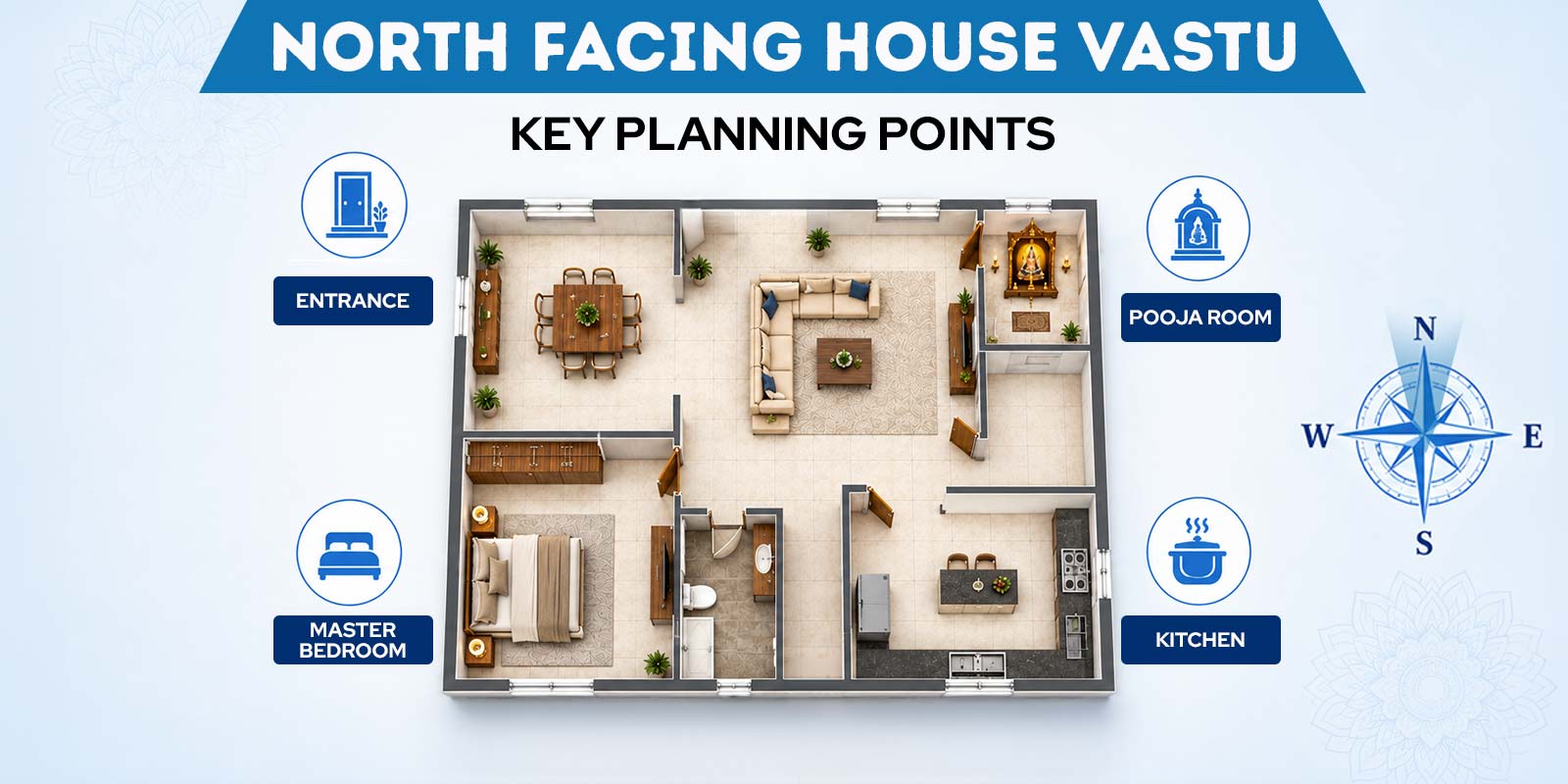
In north facing house vastu the main door belongs on the north wall in the third, fourth or fifth energy field counted from the north-east corner — the Mukhya, Bhallat and Soma padas. Soma is Kubera’s own field, which is where the north’s wealth association actually sits. Keep the north and north-east open and light, kitchen south-east, master bedroom south-west, pooja room north-east, staircase south or west.
North facing is the orientation Indian buyers chase hardest, and the reason is almost always the same: the north is the direction of Kubera, so a north facing house is assumed to bring money. That assumption is doing a lot of unearned work. The association is real in Vastu, but it is far more specific than the folklore suggests — it attaches to one energy field on the north wall, not to the building’s orientation. This guide sets out where that field is, how to place the main door against it, and what the rest of the plan has to do for the facing to mean anything.
Key Takeaways
- North facing is a favourable orientation, but it does not by itself carry the Kubera association.
- That association traditionally belongs to the Soma pada — the fifth energy field of the north wall, counted from the north-east corner.
- The main door belongs in the third, fourth or fifth field: Mukhya, Bhallat or Soma. Avoid the first (Roga) and the sixth (Bhujang).
- Keep the north and north-east open, light and low; keep the south and west closed, heavy and high.
- A kitchen, toilet or staircase in the north or north-east is the defect that most often undoes this orientation.
What Is a North Facing House?
North facing house means one thing only: you face north as you step out through the main door. It is decided by the position of the main entrance, measured with a compass from the centre of the building. It is not decided by which side the road runs on, not by the balcony, and not by where the plot is longest.
- A road to the north does not make it north facing. This is the single most common misidentification. The road matters to the approach; the door decides the facing.
- True north is a band. Roughly 337.5° to 22.5° on a compass. Outside that you are drifting into north-north-west or north-north-east, and the entrance rules shift.
- Use magnetic north consistently. Take the reading from the centre of the building, looking out through the main door, and use the same method every time you check.
Is a North Facing House Good or Bad? The Kubera Question
North facing house vastu good or bad has a short answer and a longer one. The short answer: a north facing house as per vastu is a favourable orientation. The longer answer, and the one that matters, is that the specific thing people are buying when they pay a premium for north facing — the Kubera association — is not something the facing delivers on its own.
What the tradition actually says?
In the dikpala system, the north is governed by Kubera, treasurer of the gods and the figure associated with wealth and accumulation. That much is settled and every source agrees. But Vastu does not stop at the direction. The north wall of a building is divided into eight energy fields or padas, each with its own presiding deity, and Kubera’s field is one of them — the Soma pada. The wealth association belongs to that field. A north facing house whose main door happens to fall in the Roga pada at the north-east end, or the Bhujang pada past the middle, has not touched Kubera’s field at all. It simply faces the same direction.
This is why the plain observation holds — not everyone living in a north facing house is wealthy — without the tradition being wrong. The tradition was always more specific than the shorthand.
| The common assumption | What Vastu actually holds |
| A north facing house brings wealth. | The north is Kubera’s direction, and the wealth association attaches to the Soma pada on the north wall. Facing north does not place your door in that field. |
| North facing is the best orientation, full stop. | It is favourable. Compliance still depends on the entrance pada, the internal zoning, the slope and the use of the north and north-east zones. |
| A north facing house needs no further checking. | The defects that most often undo this orientation — a kitchen, toilet or staircase in the north or north-east — are common builder defaults and all need checking. |
| Any north facing plot is worth the premium. | A premium is commonly paid for north facing property in Indian markets. It buys a favourable starting condition, not a compliant house. |
| North facing suits everyone. | Traditional guidance links the north to finance, trade, accountancy and advisory work, and treats suitability as depending on the occupant as well as the building. |
Please note: This section describes traditional beliefs about wealth and prosperity. It is not a prediction and carries no assurance of any financial outcome. The reference to market premiums describes a widely reported perception, not a valuation or forecast. Nothing here is financial, investment or property advice — speak to a qualified valuer or financial adviser before any purchase decision.
Main Door Vastu for North Facing House: The Pada That Carries Kubera
North facing house entrance vastu is where the whole orientation is won or lost. North entrance house vastu — or north entry house vastu, the same rule under a different name — specifies which portion of the north wall the door occupies, and the favourable band is narrow.
The eight energy fields of the north wall
| Field (from NE corner) | Name | Traditional association | Suitability for the main door |
| 1 | Roga | roga — illness. The Devyāmata records “At Roga is bondage” | Avoid |
| 2 | Naga | Sources conflict — pradhānatva (pre-eminence) in the Bṛhatkālottara; “At Nāga is an enemy” in the Devyāmata | Schools differ — not recommended without advice |
| 3 | Mukhya | The principal deity; manifestation and capability | Favourable |
| 4 | Bhallat | Abundance and increase | Favourable |
| 5 | Soma | Kubera’s own field. The Bṛhatkālottara records sampatkara — wealth-producing | Most favourable — first choice |
| 6 | Bhujang | Traditionally linked to ill health | Strongly avoid |
| 7 | Aditi | Mixed; not preferred for a main entrance | Avoid |
| 8 | Diti | Treated as favourable by some schools | Acceptable fallback |
How to locate it in practice?
- Measure the full north wall: Corner to corner, north-east end to north-west end.
- Divide it into eight equal padas: The Vastu Purusha Mandala is a nine-by-nine grid of 81 padas; its perimeter carries 32 of them, eight to a wall. Eight is the number that matters here.
- Count from the north-east corner: Pada 1 sits at the north-east end, pada 8 at the north-west end.
- Target padas three to five: This is where the Mukhya, Bhallat and Soma fields fall — with Soma, the Kubera field, at the middle of that band.
- Keep the door out of pada one and pada six: Roga at the north-east end and Bhujang past the middle are the two positions the sources are most consistent about avoiding — the Devyāmata records “At Roga is bondage”.
Worked ExampleA north wall 36 feet long divides into eight padas of 4 ft 6 in each.
The target band — padas three to five — runs from 9 ft 0 in to 22 ft 6 in measured from the north-east corner. The Soma field is the last of those three, from 18 ft 0 in to 22 ft 6 in.
On a 32 ft wall each pada is 4 ft, so the target band runs from 8 ft to 20 ft from the north-east corner.
Please note: An important limitation. The eight-part division above is a practical approximation for marking a drawing, not the method practitioners actually use. In the Vastu Purusha Mandala the padas are angular divisions taken from the geometric centre of the building, so they do not fall as equal linear segments along a wall — and the boundaries shift with the building’s proportions. Pada names and ordering also vary between schools. Use the grid to understand roughly where the favourable band sits and to avoid the obvious errors; for a specific property, have the divisions set out on site by a qualified practitioner.
Other entrance rules
- The main door should be the largest in the house and open inwards, clockwise.
- Nothing should obstruct it — no electric pole, large tree or bin directly in front.
- Avoid trees directly on the north side of the house, which block the zone that should stay open.
- Keep the threshold slightly raised and the entrance well lit.
- Avoid two doors in a straight line running from the entrance through the house.
North Facing House Vastu Plan: Zone by Zone
Use this as the vastu map for north facing house layouts. Every north facing house plan as per vastu — every north face house plan with vastu applied, and every north facing house design as per vastu — rests on one principle: keep the north and east open, light and low; keep the south and west closed, heavy and high.
Element |
Ideal zone |
Acceptable alternative |
Avoid |
| Main entrance | North wall, padas 3–5 from the NE corner | Pada 8 | Pada 1 (Roga); pada 6 (Bhujang) |
| Living room | North, north-east | East | South-west |
| Kitchen | South-east | North-west | North; north-east |
| Master bedroom | South-west | South, west | North-east; north |
| Children’s bedroom | West, north-west | East | South-west |
| Pooja room | North-east | East, north | South; under a staircase; beside a toilet |
| Study | North-east, north, east | — | South-west |
| Dining room | West | North, east | South-west corner |
| Staircase | South, south-west, west | South-east | North; north-east; centre (Brahmasthan) |
| Toilet / bathroom | West-north-west | North-west | North-east; north; centre |
| Overhead water tank | South-west, west | South | North-east |
| Sump, borewell, underground water | North, north-east, east | — | South-west |
| Septic tank | North-west, or south of south-west | West | North-east; north; centre |
| Car parking, garage | North, north-east, north-west | East | South-west |
| Open space, garden | North, north-east, east | — | South-west; large trees on the north side |
| Kubera sthan (locker or safe) | South-west cupboard opening towards the north | North wall | South-east; centre |
| Centre of the house (Brahmasthan) | Left open and light | Light furniture only | Kitchen, toilet, staircase, heavy structure |
Room-by-Room Vastu for a North Facing House
Staircase Vastu for North Facing House
Staircase vastu for north facing house plans is the most searched sub-topic on this subject, and the rule is clear: south, south-west or west, with the south-east acceptable in some layouts. The specific trap here is that in a north facing house the stairs naturally get drawn rising from the entrance hall, which puts them in the north — the zone that should stay open and light. A staircase in the north-east is discouraged more firmly still. Staircase as per vastu for north facing house layouts should rise clockwise in most zones, anti-clockwise in the south and south-west. External staircase vastu for north facing house designs follows the same zoning as internal, and nothing — toilet, pooja space or store — should occupy the void beneath.
Pooja Room Vastu for North Facing House
Pooja room vastu for north facing house plans places the room in the north-east, with the east or north acceptable where that is not possible. A north facing house vastu plan with pooja room in the north-east is the standard arrangement. On the question of which way the deity faces: the common arrangement places the idols on the west wall so worshippers face east, following the pattern of many temples; idols facing west with the worshipper facing east is also accepted. Keep the room on the ground floor, out from under a staircase, and never sharing a wall with a toilet. Keep strong reds and bright yellows restrained here.
Kitchen Vastu for North Facing House
Kitchen vastu for north facing house plans places the kitchen in the south-east, the zone of Agni, with the cook facing east. The north-west is the accepted second position. The mistake specific to this orientation is putting the kitchen in the north or north-east because that side is bright and near the entrance — which places fire in the water and intake zone. That is the conflict Vastu treats most seriously in a north facing plan, and it is a common builder default in compact homes.
Toilet and Bathroom Vastu for North Facing House
Toilet vastu for north facing house layouts favours the west-north-west zone, with the north-west as an alternative. Bathroom vastu for north facing house plans follows the same zoning, and vastu for bathroom in north facing house designs makes no separate exception. Keep both out of the north-east, the north and the centre. A toilet in the north is treated as working directly against the zone the orientation depends on, and a toilet in the north-east is the defect most consistently identified as disqualifying.
Bedroom and Living Room
Master bedroom vastu for north facing house plans points to the south-west, on the highest floor if there is more than one, with the bed in the south-west portion of the room and the head pointing south or west. Children’s and guest rooms go west or north-west. Living room vastu for north facing house layouts favours the north and north-east, which keeps the brightest, most open part of the plan in daily use rather than shut behind a bedroom door.
Water, Septic Tank and Utilities
These are decided late and moved expensively. Septic tank as per vastu for north facing house plans is worth settling before excavation begins.
Element |
Ideal |
Avoid |
Note |
| Borewell / sump | North, north-east, east | South-west, south | Vastu for borewell in north facing house plans keeps clean water in the intake zone. |
| Overhead tank | South-west, west | North-east | The opposite rule to the sump — the overhead tank counts as weight, not water. |
| Septic tank | North-west, or south of south-west | North-east, north, centre | Waste does not belong in the zone the orientation depends on. |
| Sewage line | Outflow following the natural fall, towards north or east | Across the south-west | Should follow the slope rather than fight it. |
| Plot slope | Falling from south towards north | Falling towards the south | The south and south-west should be the highest point. |
| Boundary wall | Lower on the north and east | Tall walls on the north | A high north boundary works against an open north zone. |
The Kubera Sthan: Where the Locker Goes
Because the north is Kubera’s direction, traditional practice places the household safe, locker or cash cupboard so that it relates to the north. The usual arrangement is a heavy cupboard standing against the south or south-west wall with its doors opening towards the north — the weight sits in the grounding zone while the opening faces Kubera’s direction. A locker on the north wall itself is also used. The south-east and the centre of the house are both avoided for this purpose.
Please note: This describes a traditional practice, not a financial strategy. It carries no assurance of any outcome relating to savings, income or wealth.
North Road Hit and Approach
North road facing house vastu covers two different situations: a road simply running along the north edge, which is ordinary and fine, and a road hit. A road hit, or vedha, is where a road runs directly at a building rather than past it — a T-junction terminating at the plot. Traditional guidance treats a north road hit as among the more benign versions, because the north is an intake direction, and some schools treat it as actively favourable where the road meets the north-east portion. It is still worth keeping the entrance itself out of the direct line and setting the approach so it enters through the favourable band of the north wall. A road hit on the south or south-west is the version traditional guidance treats as genuinely adverse.
North Facing House Plans at Different Plot Sizes
The zoning does not change with plot size; what changes is how much has to be compromised. These are the priorities as space tightens.
- Narrow plots (20×40, 20×50). Protect the entrance pada and the south-west master bedroom first. Combine living and dining rather than surrendering the north-east to a bedroom, and stack the staircase against the south or west wall.
- 30×40, the most searched size by a wide margin. This proportion usually allows full compliance: entrance in padas three to five of the north wall, kitchen south-east, master bedroom south-west, pooja north-east, staircase south or west, clear centre.
- 30×50 and 30×60. Enough depth to keep the Brahmasthan genuinely open and to place parking on the north without crowding the entrance approach.
- Duplex and multi-storey. Master bedroom on the top floor in the south-west; keep the staircase out of the north and north-east on every floor, not just the ground.
- Apartments and flats. You cannot move the door, so concentrate on keeping the north and north-east clear and light and getting the kitchen out of them.
Please note: These are layout principles, not architectural drawings. Any plan must be prepared by a qualified architect and comply with local building regulations, setbacks and approvals.
Vastu Remedies for North Facing House
Ordered by effort — start at the top and stop when the problem is resolved.
Level |
Remedy |
Addresses |
| Free — do this week | Clear the north and north-east of storage, clutter and heavy furniture. Remove anything obstructing the entrance. Open the centre of the plan. Move heavy storage to the south-west. | A blocked north zone and a blocked centre — the two commonest defects here |
| Low cost | Add or enlarge north and north-east windows where the structure allows. Keep the north side lit and unobstructed, and cut back planting that blocks it. | A closed or dark north wall |
| Low cost | Use light, cool colours in north-facing rooms and on the main door — white, cream, warm grey, pale blue, light green. Avoid maroon, deep red and heavy yellow on the north face. | Colour balance for the north zone |
| Low cost | Where a kitchen or toilet sits in the north or north-east and cannot move: keep it clean, dry and well ventilated, limit use where possible, keep the door closed, and use the metal-strip isolation practitioners commonly advise. | The defining defects of this orientation |
| Moderate | Reposition the boundary gate so the approach enters through padas three to five, even where the door itself cannot move. Lower the north boundary wall; raise the south and west. | Wrong entrance position; height imbalance |
| Moderate | Reassign rooms rather than rebuild — master bedroom to the south-west, study or living space to the north-east. | Wrong internal zoning |
| Renovation level | Relocate a north kitchen to the south-east. Move a north or north-east staircase to the south or west. Correct plot levels so the ground falls towards the north. | Structural defects in the north zone |
Please note: Remedies are traditional corrective practices. They are not guaranteed to produce any particular result for health, wealth, relationships or wellbeing, and no timeframe for any outcome should be inferred. Any remedy involving structural work — moving an opening, altering a wall, relocating drainage or changing plot levels — must be assessed by a licensed structural engineer or architect and comply with local building approvals before it is carried out.
North Facing House Vastu Benefits and Trade-offs
North facing house vastu benefits |
Trade-offs to plan for |
| Even, diffuse, low-glare daylight on the front facade for most of the year, with far less direct solar gain than a west or south-west front. | Less direct sunlight into front rooms, which can read as dull in cooler months or in north-Indian winters. |
| The front of the house stays cooler through the day than a west or south-west facing equivalent. | Rooms on the north side may need more artificial lighting through the day. |
| Traditionally associated with Kubera, and with finance, trade and advisory work. | The favourable entrance band is narrow — roughly three eighths of the north wall. |
| Consistently the most sought-after orientation in Indian markets, which supports resale demand. | That demand is priced in, so the plot costs more for a favourable starting condition rather than a compliant house. |
Who Is a North Facing House Suitable For?
- By profession. Traditional guidance links the north to money and its handling — bankers, accountants, traders, stockbrokers, financial advisers and business owners — and extends it to healthcare, travel, publishing and media.
- By rashi. Practitioner guidance most commonly names Karka (Cancer), Vrishchik (Scorpio) and Meen (Pisces) as suited to north facing homes. Note that different schools give different lists, so treat any single list as indicative.
Please note: Rashi and profession associations are traditional beliefs drawn from Vastu and Vedic astrology. They are included because they are widely asked about, not as a basis for a purchase decision, and they are not predictive of any outcome. No one should be advised for or against a property on this basis alone.
Colours and Finishes for a North Facing House
Vastu colour for north facing house exteriors and north-facing rooms runs cool and light: white, cream, off-white, warm grey, pale blue and light green. The north is associated with the water element, which is why blues and greens sit comfortably here. Avoid maroon, deep red and heavy yellow on the north facade and main door. On the north wall inside the house, mirrors are traditionally considered well placed — the north and east are the preferred walls for them — and paintings are chosen for calm, flowing subjects rather than turbulent ones. Light exterior colours also reflect more solar radiation than dark ones, so the traditional and practical recommendations agree.
Common Mistakes in North Facing House Vastu
Mistake |
Fix |
| Assuming the facing delivers the Kubera association | Check which field the door actually occupies. The association attaches to the Soma pada, not to the orientation. |
| Main door at the north-east end of the north wall | Pada one is the Roga field. Move the door into padas three to five. |
| Main door just past the middle of the wall | Pada six is the Bhujang field, the position most firmly discouraged on this wall. |
| Kitchen in the north or north-east | Relocate to the south-east. Fire in the intake zone is the specific north-facing error. |
| Toilet or septic tank in the north or north-east | Relocate if possible; otherwise isolate, ventilate and limit use. |
| Staircase rising from the entrance hall in the north | Move it to the south, south-west or west. This needs deciding at plan stage. |
| Tall boundary wall or large trees on the north side | Keep the north low and open. Move planting to the south and west. |
| Master bedroom in the north or north-east | Swap with a study or living space; move the master bedroom to the south-west. |
| Plot sloping down towards the south | Correct levels so the ground falls towards the north, with the south-west highest. |
| Judging the facing by the road position | Use a compass through the main door, from the centre of the building. |
North Facing House Vastu Checklist
Vastu tips for north facing house planning, in the order they matter. If the first five are right, the house is fundamentally sound.
- The facing has been confirmed with a compass through the main door, not by the road.
- The main door sits in padas three to five of the north wall, counted from the north-east corner.
- The door is not in pada one (Roga) or pada six (Bhujang).
- No kitchen, toilet, septic tank or staircase sits in the north or north-east.
- The north and north-east are open, light, low and free of clutter.
- The kitchen is in the south-east, with the cook facing east.
- The master bedroom is in the south-west, top floor if there is more than one.
- The pooja room is in the north-east, not under a staircase and not against a toilet wall.
- The staircase is in the south, south-west or west.
- The borewell or sump is in the north or north-east; the overhead tank is in the south-west.
- The septic tank is in the north-west or south of south-west.
- The centre of the plan is open — no kitchen, toilet, staircase or heavy structure.
- The plot slopes down from south towards north, with the south-west the highest point.
- The north boundary wall is lower than the south and west, with no large trees blocking the north.
- Nothing obstructs the main entrance — no pole, tree or bin.
- Facade and north-room colours are light and cool rather than deep red or maroon.
Conclusion
North facing house vastu is worth getting right precisely because so many people assume it comes right by itself. The Kubera association that makes this the most sought-after orientation in India belongs to one energy field on the north wall — the Soma pada — not to the direction the building happens to face. Put the main door in the third, fourth or fifth field counted from the north-east corner, keep the north and north-east open and light, put the kitchen south-east, the master bedroom south-west and the staircase south or west, and leave the centre of the plan empty. The facing is a good start. The plan is what makes it a good house.
Disclaimer:Vastu Shastra is a traditional Indian system of architecture and design with deep cultural and religious significance. The guidance in this article reflects long-established Vastu principles and is provided for general information and planning purposes only.
Pada systems, zone definitions, rashi associations and remedies vary between Vastu schools, regions and practitioners, and pada boundaries are angular divisions that cannot be determined precisely from a simple linear measurement. This article does not represent any single authoritative reading, and for a specific property the divisions should be set out on site by a qualified Vastu practitioner.
References to wealth, prosperity and Kubera describe traditional beliefs. They are not predictions and carry no assurance of any financial outcome. Nothing in this article is architectural, engineering, legal, financial or property investment advice. Any plan must be prepared by a qualified architect, and any structural change — relocating an opening, altering walls, moving drainage or changing plot levels — must be designed and approved by a licensed architect or structural engineer and comply with local building regulations and approvals.
No arrangement of a building guarantees any outcome for health, wealth, relationships or wellbeing, and no timeframe for any outcome should be inferred. Where a statement reflects traditional belief rather than an evidenced effect, this article says so. Aparna Enterprises accepts no liability for decisions taken on the basis of this article.
Frequently Asked Questions On North Facing House Vastu
Yes, north facing is a favourable orientation. But it is not automatically compliant — the entrance pada, internal zoning, slope and the use of the north and north-east zones decide the outcome.
The north is Kubera’s direction, and traditional guidance attaches the wealth association to the Soma pada on the north wall rather than to the facing itself. This is a traditional belief and not a prediction of any financial outcome.
In the third, fourth or fifth energy field of the north wall counted from the north-east corner — the Mukhya, Bhallat and Soma padas. Soma is Kubera’s own field and the usual first choice.
The first field, Roga, at the north-east end, and the sixth, Bhujang, just past the middle. Both are traditionally linked to ill health and depletion.
Entrance in padas three to five of the north wall, living room north or north-east, pooja room north-east, kitchen south-east, master bedroom south-west, staircase south or west, toilets west-north-west, and the centre of the plan left open.
South, south-west or west, with the south-east acceptable in some layouts. Keep it out of the north and north-east — the common error is drawing it rising from the entrance hall.
The south-east, with the cook facing east. North-west is the accepted alternative. Avoid the north and north-east, which places fire in the intake zone.
The north-east, with the east or north acceptable. Keep it on the ground floor, out from under a staircase and away from toilet walls.
It is discouraged. Toilets belong in the west-north-west or north-west. A toilet in the north or north-east works against the zone the orientation depends on.
The north-west, or south of south-west. Keep it out of the north, the north-east and the centre.
The north, north-east or east. Clean water belongs in the intake zone; the overhead tank follows the opposite rule and belongs in the south-west.
Start free: clear the north and north-east of storage and clutter, open the centre, move heavy storage to the south-west and unblock the entrance. If a kitchen or toilet sits in the north and cannot move, keep it clean, dry, ventilated and lightly used.
Light and cool — white, cream, warm grey, pale blue and light green, reflecting the north’s association with the water element. Avoid maroon, deep red and heavy yellow on the north facade.
Practitioner guidance most often names Karka, Vrishchik and Meen. Lists differ between schools, and this is a traditional association rather than a basis for a purchase decision.
Less direct sunlight into front rooms, which can feel dull in cooler months and may mean more daytime lighting. The favourable entrance band is also narrow, so the door position needs care.
Stand at the centre of the building with a compass and take a reading through the main door. Roughly 337.5° to 22.5° is north. A road on the north side does not by itself make a house north facing.
Start Your Project with the Right Materials
We provide everything you need for modern construction. Connect with our experts to discuss your requirements and get the best solution for your project. Submit your details and our team will contact you soon.
CORPORATE OFFICE
8-2-293/82/A, Plot No-1214, Road No-60,
Jubilee Hills, Hyderabad-500 033.