
Types of Aluminium Windows: Sections, Styles, Glass & Sizes
In This Article
The main types of aluminium windows are sliding, casement, fixed, sliding-folding, tilt-and-turn, top-hung (awning), louvred or ventilator, combination, and bay aluminium windows. These window types are classified by how they open and the ventilation they offer.
The right type for your home depends on the room, available space outside the opening, ventilation needs, and cleaning access.
This article covers window types, the section and glass options, size considerations, and applications.
Key Takeaways
Sliding windows are a popular option in India because they save space and come with 3-track versions that accommodate a mosquito mesh shutter.
Casement windows offer good sealing and ventilation, and fixed windows maximise light but do not open.
Louvred and ventilator windows are good for bathrooms, utility areas and exhaust-fan openings.
The windows are differentiated based on how they open. The section (profile) type and glass determine strength, insulation and noise control.
Types of Aluminium Windows at a Glance
Before knowing each type in detail, this table offers a side-by-side comparison of how each window opens, the ventilation they offer, and where they are used.
Window Type |
How It Opens |
Airflow / Ventilation |
Best Used For |
Mesh/Grill Friendly? |
| Sliding | Slides sideways | Medium ~50% (2-track); up to ~66% (3-track) | Balconies, Bedrooms | Yes |
| Casement | Swings out like a door | High (100% open) | Bedrooms, Kitchens | Yes, but need extra frame |
| Fixed | Does not open | None (0% open) | Stairwells, Views | No |
| Bi-fold | Folds and stacks | High (Full width) | Large Patio openings | Yes, but need add-on frame |
| Tilt & Turn | Tilts top or swings in | Tilt (partial) or turn (full) | High-rises, Kids’ rooms | Yes |
| Awning | Opens out from bottom | Medium (Rain-safe) | Bathrooms, Kitchens | Yes |
| Louvred | Angled tilting slats | High (Continuous) | Utility areas, Toilets | No, low security |
| Combination | Mix of fixed & moving | Varies | Large window walls | Varies by section |
| Bay | Projects outward | Varies | Living room nooks | Varies by section |
Types of Aluminium Windows by Opening Style
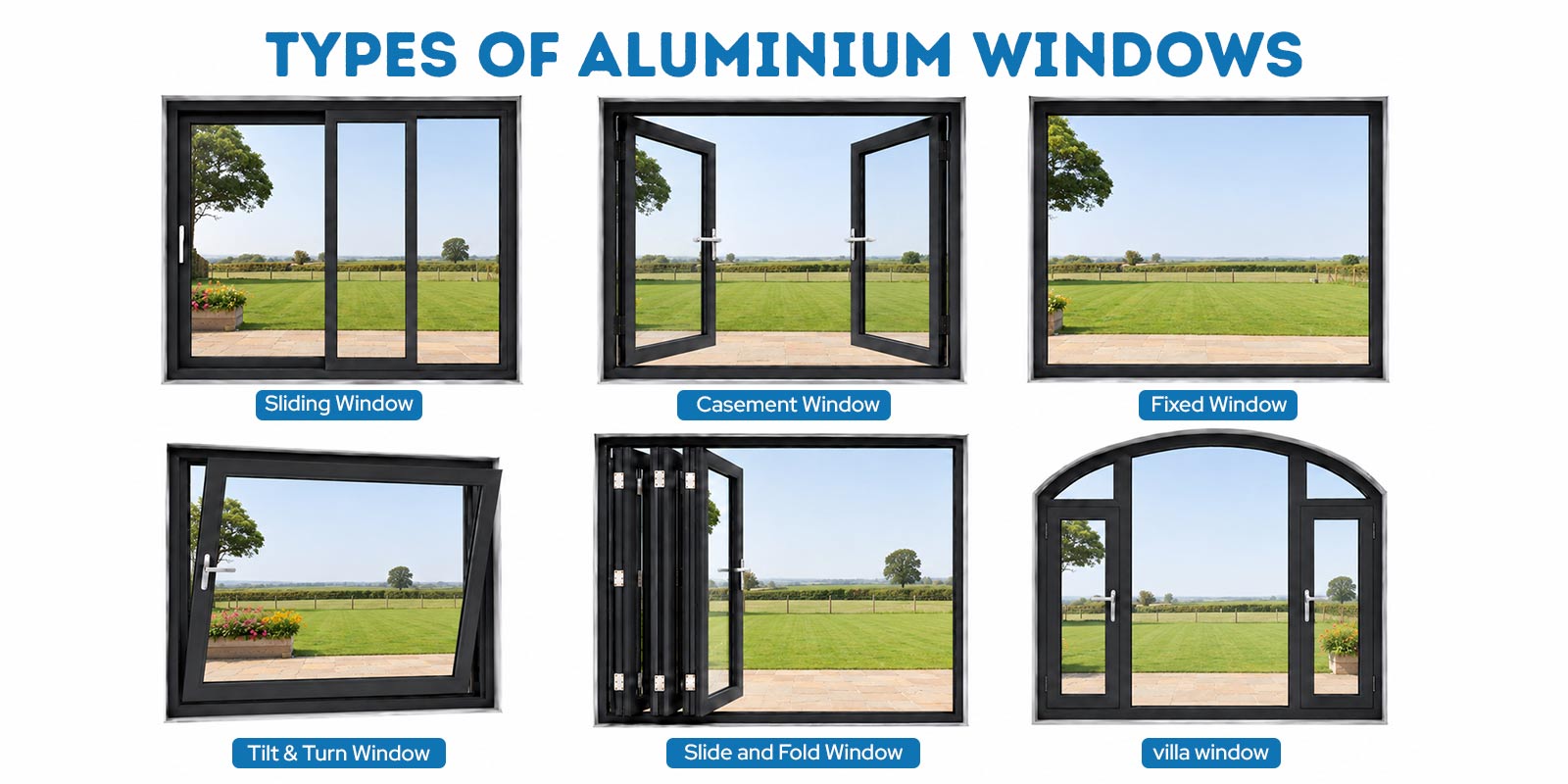
Sliding aluminium windows
Sliding aluminium windows feature horizontal shutters that glide on the tracks. Sliding aluminium windows are the most common window type in Indian homes. They come in 2-track and 3-track configurations. A 2-track window holds two glass shutters, and a 3-track version features a dedicated track to hold a mosquito-mesh shutter. The mesh also slides alongside the glass.
Features:
- Compact, saves space because it does not need swing clearance
- Available in various configurations
- Smooth glide hardware
- Low maintenance
Best for:
- Balconies and living rooms
- Bedrooms
- Tight external spaces where a shutter cannot swing out
Watch out for: A standard 2-track sliding window opens only about half, and a 3-track system can open up to approximately two-thirds. The tracks need regular cleaning to keep them running smoothly.
Casement aluminium windows
Casement windows are hinged on the side and open outward or inward like a door. They offer one of the best weather seals and ventilation when compared to other types.
Features:
- They open fully, offering maximum airflow
- Multi-point locking system for a tighter seal
- Available as single or twin-shutter units
Best for:
- Bedrooms
- Kitchens
- Locations exposed to wind-driven rain
Watch out for: Casement windows need enough space to swing open fully. Also, an external mosquito mesh requires a separate openable frame.
Fixed aluminium windows
Fixed windows remain fixed and do not open at all. With no moving parts, these windows feature a large glass area within the frame.
Features:
- No hardware, hinges or tracks
- Maximum glass-to-frame ratio for light and views
- Paired with an operable window nearby
Best for:
- Stairwells
- High-level openings
- Picture windows and scenic views
- Pairing with sliding or casement units for light and ventilation
Watch out for: Fixed windows alone do not provide any ventilation and no access for external cleaning, so if you want to go with fixed windows, keep these points in mind.
Sliding-folding (bi-fold) aluminium windows
Bi-fold windows feature multiple panels that fold and stack to one side, which opens the full width of the frame.
Features:
- Opens the entire width of the opening
- Panels stack neatly to one or both sides
- Suits wide, uninterrupted openings
Best for:
- Balcony openings
- Servery or pass-through counters
- Wide, view-facing openings
Watch out for: It requires more hardware, increasing the cost. The panels need stacking space on one side of the opening.
Tilt-and-turn aluminium windows
Tilt-and-turn windows offer dual action. The sash tilts inwards from the top for secure trickle ventilation, or swings fully inward (on a separate hinge) for cleaning and full airflow.
Features:
- Two operating modes from a single sash
- Secure ventilation
- Difficult to force open
- Allows cleaning from inside
Best for:
- High-rise apartments
- Homes with children, where secure ventilation matters
- Rooms that require controlled airflow
Watch out for: The inward swing needs internal space, so curtains, blinds and furniture placement need proper planning.
Top-hung / awning aluminium windows
Top-hung windows are hinged from the top and open outward from the bottom. They can remain partially open to provide ventilation even when raining.
Features:
- Rain-safe ventilation when partially open
- Hinged at the top, projecting outward at the base
- Used above fixed or sliding units
Best for:
- Bathrooms and kitchens
- Monsoon-exposed walls
- High-level openings
Watch out for: The opening angle is limited. The sash needs clearance over walkways or planters below.
Louvred and ventilator aluminium windows
Louvred windows use adjustable angled slats, or a fixed louvre panel to give continuous airflow and maintain privacy at the same time. In India, they are used above doors and for bathroom or kitchen exhaust fans.
Features:
- Continuous airflow even when closed
- Adjustable slats or fixed louvre panels
- Compact sizing for door and exhaust-fan openings
Best for:
- Bathrooms
- Utility areas
- Staircases
- Above-door ventilators
Watch out for: Louvred windows offer lower security and weaker weather sealing than glazed types.
Combination aluminium windows
A combination window combines two or more types into a single frame. For example: A fixed glass piece next to sliding parts or a top vent above a main window.
Features:
- Mixes fixed, operable, and ventilator sections in one frame
- Balances light with controlled ventilation
- Flexible layout for large or irregular openings
Best for:
- Large openings that need both light and ventilation
- Living rooms
- Open-plan spaces
Watch out for: Heavy combination windows need smart planning for unit weight, frame depth, and mullion positions.
Bay aluminium windows
Bay windows project outward from the wall line. They combine a fixed centre panel with operable units on the sides.
Features:
- Projects beyond the wall line
- Offers extra depth and light
- Creates a natural seating nook
Best for:
- Living rooms
- Spaces where a panoramic view is required
Watch out for: Bay windows need structural support and careful waterproofing at the projection point.
Types of Aluminium Window Sections (Profiles)
A window type describes how it opens, and the section type is about the aluminium profile design.
- Sliding sections are available in 2-, 3-, or 4-track options to hold glass shutters.
- Casement sections are designed to open inward or outward, using hinges and multi-point locks.
- Slim Profiles use ultra-narrow frames to maximize glass area and views.
- Heavy-duty and thermal profiles are designed to offer insulation and handle high-rise wind loads.
Glass Types Used in Aluminium Windows
Glass offers safety, privacy, and insulation. So the main types of glass used in aluminium windows are single glazing, double glazing, toughened glass, laminated glass, frosted and textured, and tinted and reflective glass.
- Single Glazing: It is a budget-friendly option for areas with mild weather.
- Double Glazing (DGU): It features two panes of glass that help reduce heat transfer and outside noise.
- Toughened Glass: It is a strong safety glass used for large windows or low areas near the floor.
- Laminated Glass: It is an extra-secure glass that stays together even when broken, and it also helps reduce outside noise.
- Frosted & Textured Glass: This type of glass blurs the view to provide privacy in bathrooms.
- Tinted & Reflective Glass: Helps reduce solar heat gain and glare.
Size Considerations for Aluminium Window Types
Aluminium windows come in different sizes, and each style has practical limits. Sliding windows suit wide spaces because horizontal tracks support heavy glass. Casement windows must remain smaller so the weight or wind does not damage the hinges. Fixed windows do not open, so they can hold the largest glass panels. Ventilators and louvres are always built small to offer airflow in areas like bathrooms.
How to Measure Your Window Opening?
- For Height: Always measure left, middle, and right
- For Width: Measure from top, middle, bottom
Share the exact measurements with the manufacturer or fabricator to ensure they fit perfectly inside the opening
Which Type of Aluminium Window Is Best for Each Room?
Aluminium windows can be used in various places like living rooms, bedrooms, kitchens, balconies, and other areas. But specific window styles suit different rooms.
Living room:
- Sliding or sliding-folding for easy balcony access
- Fixed or bay panels where airflow is not needed
Bedroom:
- Sliding for space efficiency
- Casement where cross-ventilation and sealing matter
- Tilt-and-turn in high-rise flats
Kitchen:
- Casement or top-hung for strong extraction of heat and fumes
- Ventilator or exhaust-fan unit where an extractor is fitted
Bathroom:
Louvred/ventilator or top-hung with obscured glass
Balcony:
Sliding or sliding-folding to open the full width
Staircase and lobby:
Fixed or louvred at high level for light and airflow
Study or home office:
Tilt-and-turn or casement for quiet ventilation with double glazing.
Types of Aluminium Windows Commonly Used in India
Sliding windows are a popular option in Indian residential construction, especially apartments. This is because they offer space efficiency and can be integrated with mosquito mesh. On the other hand, casement windows need a separate openable mesh frame fitted alongside them.
Ventilator and exhaust-fan window units are a popular choice for Indian bathrooms and kitchens.
Safety grills remain common across Indian homes, and modern sections now allow integrated grill options. In monsoon, top-hung and louvred windows can stay open and ventilate even when it is raining. Powder-coated or anodised aluminium frames offer corrosion resistance, making them suitable for coastal regions. For high-rise buildings, aluminium window systems must be tested to meet the applicable wind-load requirements under IS 875 (Part 3).
Aluminium Windows from Aparna Enterprises
Window longevity depends on the chosen section, hardware, mesh, and installation quality. Aparna Enterprises manufactures aluminium window systems built to handle Indian weather like heat, monsoons, humidity, and coastal conditions. We offer sliding, casement, fixed, tilt and turn, villa windows, ventilators, and combination styles. These windows come with factory finishes, integrated mesh, and grill options.
Choosing the Right Aluminium Window Type
Choose the window types based on the size of the room, space available, ventilation needs, mesh requirements, and other factors. You can also go with combination windows if a specific type you like does not suit the room.
If you are planning windows for a new home or renovating an existing one, contact the Aparna Enterprises team about the right window type for each room.
Frequently Asked Questions
There is no such best aluminium window. But sliding windows are widely seen in modern construction. Casement windows are better for ventilation, and fixed windows increase natural light. The right type depends on each room’s ventilation needs and the space available.
A 2-track sliding window holds two glass shutters. A 3-track adds a track for a sliding mosquito-mesh shutter, which slides along the track.
Louvred or ventilator windows and top-hung (awning) windows, fitted with obscured or frosted glass, are best for bathrooms.
Yes, aluminium windows are customised as per the opening. Each type has a span limit, and beyond which a deeper section or an additional mullion is used to carry the load.
Yes. When different windows are combined together in one frame, it is called a combination window.
Casement windows offer the most ventilation when the shutters are swung, it opens entirely. A standard 2-track sliding window opens about half the opening. And a 3-track system can open up to approximately two-thirds. Louvred windows give continuous airflow but less total volume.
Start Your Project with the Right Materials
We provide everything you need for modern construction. Connect with our experts to discuss your requirements and get the best solution for your project. Submit your details and our team will contact you soon.
CORPORATE OFFICE
8-2-293/82/A, Plot No-1214, Road No-60,
Jubilee Hills, Hyderabad-500 033.