
How uPVC Windows & Doors Are Made: Manufacturing & Fabrication
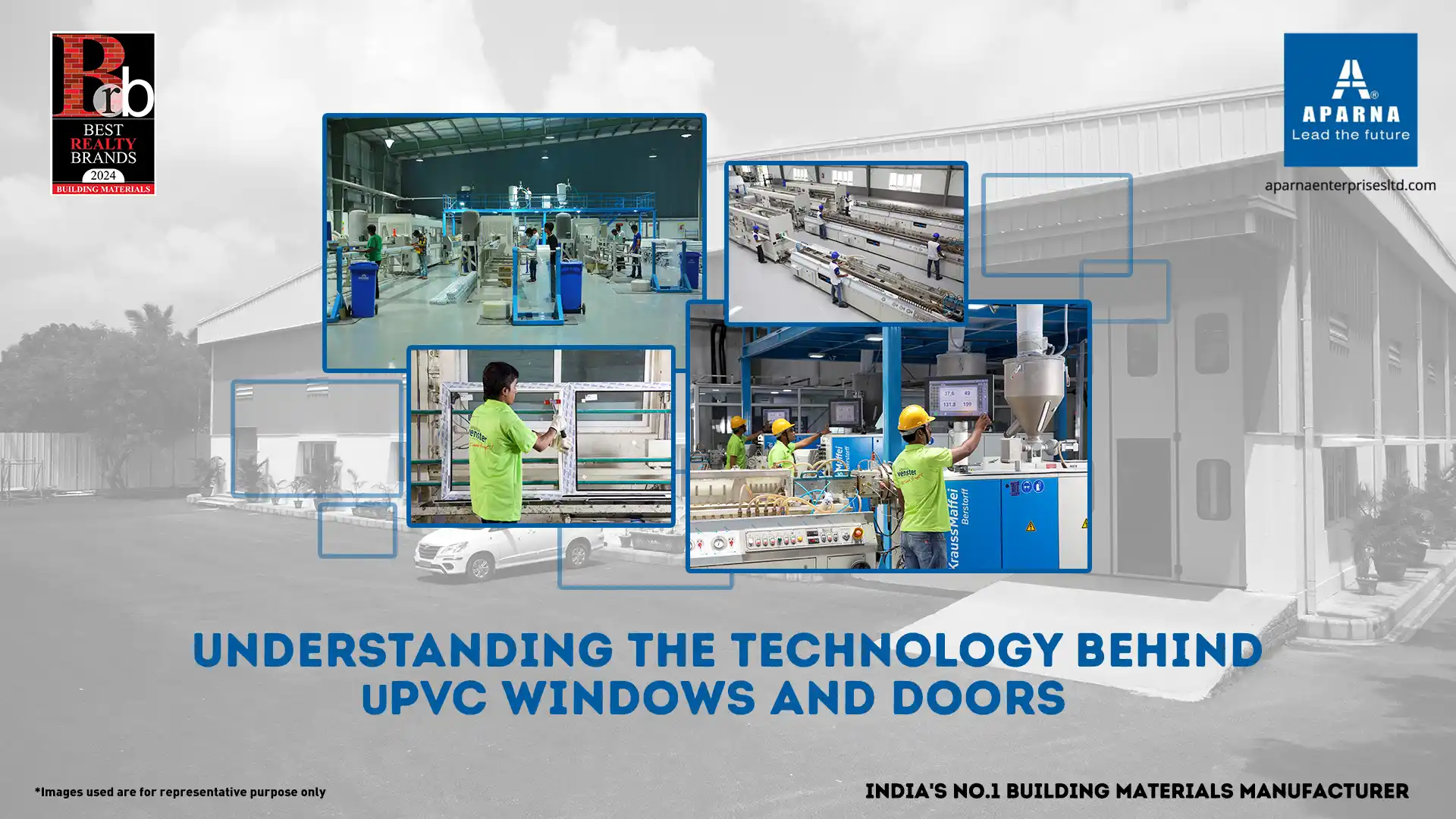
In This Article
uPVC doors and windows are made in two distinct stages. First, PVC resin is compounded with stabilisers and additives and extruded into hollow multi-chamber profiles. Second, those profiles are cut, reinforced with galvanised steel, welded, fitted with hardware and glazed to become a finished window or door.
Most descriptions of the process skip the first half, because most window companies do not perform it — they buy profiles from an extruder and start at the cutting table. Understanding both stages is what allows you to judge a uPVC window properly: the profile determines how the window survives fifteen Indian summers, and the fabrication determines whether it seals, locks and operates correctly on day one. This guide walks through both, in sequence, in plain language.
Key Takeaways
- uPVC manufacturing has two stages: profile extrusion, then window and door fabrication.
- uPVC is un-plasticised PVC — rigid rather than flexible, which is what makes it suitable for window frames.
- The compound formulation, particularly the stabiliser and UV package, decides how the profile handles heat and sunlight.
- Galvanised steel reinforcement inside the hollow chambers is what carries structural load — the plastic alone does not.
- Welding fuses the profile corners into a single continuous frame; it is not glued or screwed together.
What Is uPVC?
uPVC stands for un-plasticised polyvinyl chloride. Ordinary PVC contains plasticisers that make it soft and flexible — the material used for cables and hoses. Removing those plasticisers leaves a rigid, dimensionally stable polymer that holds its shape under load and weather, which is exactly what a window frame needs.
That rigidity is the whole reason uPVC works for fenestration. It does not rot like timber, does not corrode like mild steel, and does not need painting. What it does need is a carefully engineered compound and correct processing — which is where the manufacturing process begins.
The Two Stages of uPVC Manufacturing
Before going into detail, it helps to see how the whole process fits together. These two stages are often performed by two different companies — an extruder makes the profiles, and a fabricator turns them into windows.
Stage 1: Profile Extrusion |
Stage 2: Window & Door Fabrication |
|
| Input | PVC resin and additives | Extruded uPVC profiles |
| Output | Hollow multi-chamber profile lineals | Finished, glazed windows and doors |
| Key operations | Mixing, extrusion, calibration, cooling, cutting | Cutting, routing, reinforcing, welding, corner cleaning, hardware fitting, glazing |
| What it determines | Weather resistance, UV stability, structural capability, chamber design | Sealing, operation, locking, glazing performance, dimensional accuracy |
| Who does it | Profile extrusion plants | Window fabricators |
Stage 1: How uPVC Profiles Are Made
Step 1: Raw Materials and the uPVC Compound
uPVC profiles are not made from a single material. They are made from a compound — PVC resin blended with a precise set of additives, each performing a specific job. The proportions are expressed in parts per hundred resin, and the recipe is one of the most closely guarded variables in the industry, because it decides how the finished profile behaves in sunlight and heat.
| Component | What it does |
| PVC resin | The base polymer — provides the body and rigidity of the profile |
| Heat stabiliser (commonly calcium-zinc) | Prevents the PVC from degrading at extrusion temperatures; lead-free calcium-zinc systems are the current standard |
| Titanium dioxide (TiO2) | Provides UV resistance and whiteness retention — critical in Indian sunlight |
| Impact modifier | Improves resistance to knocks and impact, particularly important in cold conditions |
| Processing aids and lubricants | Control melt flow and prevent the compound sticking to the machinery |
| Fillers (typically calcium carbonate) | Add stiffness and manage cost |
| Pigments | Colour, where a profile is not standard white |
Why this matters to a buyer: an under-stabilised or over-filled compound produces a profile that looks identical when new and yellows, chalks or becomes brittle after a few years of direct sun. This is the single biggest quality variable in uPVC, and it is invisible at the point of purchase — which is why the manufacturer matters more than the material name.
Step 2: Mixing and Blending
The weighed ingredients go into a high-speed hot mixer, where friction raises the temperature and disperses the additives evenly through the resin. The blend then transfers to a cold mixer, which brings the temperature down in a controlled way and prevents the mixture from clumping or pre-gelling.
The result is a free-flowing dry blend — still a powder, not a melt. Good plants control weighing, mixing time and discharge temperature automatically, because a batch that is unevenly mixed produces a profile with inconsistent properties along its length, and that inconsistency cannot be corrected downstream.
Step 3: Extrusion
The dry blend is fed into a twin-screw extruder. Two intermeshing screws convey the powder forward while heat from external barrel heaters and the friction of the screws themselves gradually melts it into a homogeneous molten mass. Twin-screw machines are used rather than single-screw because they mix as they convey, which is what rigid PVC needs.
The melt is then forced through a precision-machined extrusion die. The die is the negative of the profile shape — it is what creates the hollow multi-chamber cross-section that gives a uPVC frame its insulation and its rigidity. Die design and temperature control are what determine whether the chamber walls come out at uniform thickness along the whole length.
Step 4: Calibration and Cooling
The profile leaves the die hot and soft, and would lose its shape immediately without support. It passes straight into a vacuum calibration unit, where suction holds the outer surfaces against precisely machined calibrator plates while water cooling begins to set the shape.
It then travels through cooling tanks that bring the temperature down gradually and uniformly. Cooling too quickly locks internal stresses into the profile, which show up later as bowing or as cracking during welding. A haul-off unit maintains constant tension throughout, controlling the wall thickness and preventing the still-soft profile from stretching.
Step 5: Cutting, Marking and Profile Testing
A flying cut-off saw travels with the moving profile and cuts it to standard lengths without stopping the line. Profiles are usually marked with batch and production data at this point, which is what makes traceability possible if a quality question arises months later.
Samples are drawn for testing. Typical profile checks include dimensional accuracy and wall thickness, impact resistance, heat reversion (how much the profile shrinks when reheated, which indicates whether internal stresses were properly managed), Vicat softening temperature, and weathering performance under accelerated UV exposure.
Stage 2: How uPVC Windows and Doors Are Fabricated
This is the stage most people picture when they think of a window factory — and the stage where the profile becomes a product. Fabrication is where dimensional accuracy and sealing are won or lost.
Step 6: Cutting to Size
Profiles are cut to the exact dimensions of the window being made, on a double mitre saw that cuts both ends at a 45-degree angle simultaneously. The 45-degree cut is what allows four pieces to form a rectangular frame with fused corners.
Accuracy here is unforgiving: an error of a millimetre or two in the cut translates into a frame that is out of square, and a frame out of square never seals properly no matter how well the rest of the process is executed.
Step 7: Routing and Drainage
Routing is the machining of slots and holes into the profile, and it is a step almost no article explains. A copy router cuts the openings for the locking mechanism, handle spindle and keeps. A drainage router cuts the drainage slots — small angled channels that let any water that gets past the outer gasket escape back outside rather than collecting inside the frame.
Those drainage slots are one of the most important and least visible features of a uPVC window. A window with badly cut or missing drainage will hold water in its chambers during monsoon, and that water eventually finds its way inside. Routing quality is a good proxy for a fabricator’s overall standard.
Step 8: Steel Reinforcement
Galvanised steel sections are cut to length and inserted into the main hollow chamber of the profile, then fixed with screws at regular intervals. This is not optional detailing — it is the structural core of the window.
uPVC on its own is rigid but not strong enough to carry large glass, resist wind load on upper floors, or hold hardware securely over decades. The steel does that work; the uPVC provides the weather barrier, the insulation and the finish. The gauge of the steel and the spacing of the fixing screws are real specification items, and skimping on either is a common way to cut cost invisibly.
Step 9: Welding the Corners
The cut and reinforced profiles are placed in a welding machine, which heats the two mitred faces against a heated plate until the material begins to melt, withdraws the plate, and presses the two faces together under controlled pressure. The polymer fuses and cools into a single continuous piece.
This is the step that makes a uPVC window fundamentally different from an aluminium or timber one. The corners are not screwed, bracketed or glued — they are fused, so the frame becomes one continuous body with no joint for air or water to pass through. Weld temperature, pressure and dwell time all have to be right; an under-welded corner looks acceptable and fails under load.
Step 10: Corner Cleaning
Welding squeezes a small amount of molten material out of the joint, forming a raised bead known as flash. A corner cleaning machine trims this away and restores the profile’s original contour and surface finish.
It sounds cosmetic and is partly structural: badly cleaned corners leave ridges that prevent gaskets and beads from seating correctly, which creates exactly the small gaps that sealing is meant to eliminate.
Step 11: Hardware Fitting and Gasketing
With the frame and sash complete, the working parts go in: hinges or rollers depending on the window type, the locking system — commonly multi-point locking that engages at several places around the sash — handles, and friction stays or restrictors where specified.
Gaskets are fitted into their grooves around the frame and sash. These are usually EPDM rubber, chosen because it stays flexible and does not perish under UV and heat the way cheaper alternatives do. The gasket is the actual air and water seal of the finished window, and it is another item where a substitution is invisible on delivery and obvious in three years.
Step 12: Glazing
The glass unit is set into the frame and secured with glazing beads, which snap into a groove in the profile and hold the glass against the inner gasket. Glazing options range from single glass to double glazed units with an insulating air or gas cavity, and to laminated or toughened glass where security, acoustics or safety require it.
Correct glazing includes setting blocks positioned to transfer the glass weight into the frame at the right points. Badly supported glass distorts the sash over time and causes the window to bind when operated.
Step 13: How uPVC Doors Are Made
Doors follow the same sequence, with differences that reflect what a door has to do. Door profiles are deeper and heavier than window profiles, and the steel reinforcement inside them is correspondingly heavier, because a door carries its own weight on hinges through many thousands of operations.
Door leaves may be glazed, part-glazed or fitted with solid infill panels. The hardware is different too — heavier hinges, door-specific multi-point locks with a central deadbolt, threshold sections at the base, and on sliding and lift-and-slide doors, roller assemblies and track sections engineered for the weight involved. The welding, routing and reinforcement principles are identical; the scale is not.
Step 14: Final Inspection and Packing
Finished units are checked before dispatch: overall dimensions and squareness, smooth operation of every moving part, correct engagement of the locking points, gasket seating, weld appearance, and glass condition. Water and air infiltration tests are performed on samples in plants equipped to do so.
Packing then protects what has just been built. Corners are the most vulnerable part in transit, so they are protected with foam or corner guards, surfaces are covered with protective film, and units are stacked and secured so they cannot rub against each other. A window damaged in transit is indistinguishable, to the customer, from a window badly made.
The Complete Process at a Glance
Stage |
Step |
What happens |
Why it matters |
| Profile | 1. Raw materials | PVC resin blended with stabiliser, TiO2, impact modifier, fillers, lubricants | Decides UV and heat performance over the profile’s life |
| Profile | 2. Mixing | Hot mixing then controlled cooling to a dry blend | Uneven mixing means inconsistent profile properties |
| Profile | 3. Extrusion | Twin-screw extruder melts the blend and forces it through a die | Creates the multi-chamber cross-section |
| Profile | 4. Calibration & cooling | Vacuum calibration sets the shape; cooling tanks stabilise it | Prevents bowing and locked-in stress |
| Profile | 5. Cutting & testing | Cut to length, batch marked, samples tested | Traceability and profile conformity |
| Fabrication | 6. Cutting | Double mitre saw cuts 45-degree ends to size | Squareness of the finished frame |
| Fabrication | 7. Routing | Copy router and drainage router cut hardware and drainage slots | Locking function and water escape |
| Fabrication | 8. Reinforcement | Galvanised steel inserted and screwed into chambers | Structural strength and hardware holding |
| Fabrication | 9. Welding | Mitred faces heat-fused under pressure | Creates a continuous, sealed frame |
| Fabrication | 10. Corner cleaning | Weld flash trimmed and contour restored | Gasket and bead seating |
| Fabrication | 11. Hardware & gaskets | Locks, hinges, handles and EPDM gaskets fitted | Operation and the actual weather seal |
| Fabrication | 12. Glazing | Glass set on blocks and secured with beads | Thermal, acoustic and safety performance |
| Fabrication | 13. Inspection & packing | Dimensional, operational and seal checks; protected packing | Last chance to catch a defect |
Quality Control Through the Process
Quality in uPVC manufacturing is built in stage by stage, not inspected at the end. By the time a window reaches final inspection, the decisions that determine how long it lasts were made in the compounding room.
Where |
What is checked |
Why |
| Compound | Formulation ratios, additive weighing, blend uniformity | Determines UV and heat stability for the profile’s whole life |
| Extrusion | Wall thickness, overall dimensions, chamber geometry, surface finish | Out-of-tolerance profiles will not weld or seal correctly |
| Profile testing | Impact resistance, heat reversion, Vicat softening, accelerated weathering | Predicts long-term behaviour in service |
| Cutting | Length accuracy and mitre angle | Frame squareness |
| Welding | Weld strength on sample corners, visual weld integrity | The corner is the frame’s structural and sealing weak point |
| Reinforcement | Steel gauge, insertion, screw spacing | Structural capacity and hardware retention |
| Finished unit | Squareness, operation, lock engagement, gasket seating, water and air tests | Final conformity before dispatch |
Standards That Govern uPVC Windows and Doors
Several standards apply to different parts of the process rather than to the finished window as a whole. Knowing which governs what lets you write a specification that can actually be enforced.
Standard |
What it governs |
| IS 17953 | The Indian standard covering uPVC profiles for windows and doors — material and profile requirements |
| EN 12608 | The European standard for unplasticised PVC profiles for windows and doors, widely referenced by Indian manufacturers, including classification for climatic exposure |
| ISO 9001 | Quality management systems at the manufacturing organisation |
A practical note on using these: naming a standard is only half a specification. “uPVC profiles conforming to IS 17953, with test certificates for the supplied batch” is enforceable; “ISI-standard uPVC” is not. Ask which standards a manufacturer’s profiles are actually tested against, and for the certificate scope — a certificate covering one profile series is sometimes presented as covering an entire range.
What Separates a Well-Made uPVC Window from a Poor One
Most of the quality differences described above are invisible when the window is new. These are the ones you can actually check:
- Ask whether the manufacturer extrudes its own profiles or buys them in. A company that controls both stages can answer questions about the compound; one that only fabricates cannot.
- Ask about the stabiliser system — lead-free calcium-zinc is the current standard, and it is a fair question to ask directly.
- Look at the corner welds on a finished sample. They should be cleanly trimmed with the profile contour restored, not ridged or over-ground.
- Ask to see the steel reinforcement — its gauge, and whether it runs through every structural member or only some of them.
- Check the drainage slots exist and are clear. Their absence is a genuine monsoon risk.
- Ask what the gaskets are made of. EPDM is the answer you want.
- Ask for profile test certificates for the batch being supplied, not a generic brochure claim.
How Aparna Enterprises Manufactures uPVC Windows and Doors?
Almost every uPVC window company in India starts at fabrication. Profiles arrive from a third-party extruder, and the company’s control begins at the cutting table — which means it can stand behind the fabrication but not behind the compound that determines how the window ages.
Aparna Enterprises operates across both stages: uPVC profile extrusion and window and door fabrication within the same group. In practice that means the compound formulation, chamber design, steel reinforcement specification and fabrication tolerances are all decided inside one organisation rather than negotiated across a supply chain — and it is why the technical questions in the checklist above can be answered directly rather than referred to a supplier.
If you are specifying uPVC windows or doors for a project, the useful conversation happens before the order — about profile series, reinforcement for your opening sizes and floor height, glazing for your climate and noise levels, and the test documentation that will accompany the supply. Talk to the Aparna Enterprises team about your requirement.
Conclusion
A uPVC window looks like a simple product, which is exactly why manufacturing quality varies so widely. The decisions that determine whether a window still seals, locks and looks right in fifteen years are made long before it reaches a site — in the compound formulation, the extrusion tolerances, the steel gauge, the weld parameters and the gasket material.
Understanding the two stages tells you what to ask, and the questions themselves reveal a great deal about who you are dealing with.
Planning uPVC windows or doors for a home or project? Talk to the Aparna Enterprises team about profile specification, reinforcement, glazing and the documentation that should come with your supply.
Frequently Asked Questions
In two stages. PVC resin is compounded with stabilisers and additives and extruded into hollow multi-chamber profiles. Those profiles are then cut to size, routed for hardware and drainage, reinforced with galvanised steel, heat-welded at the corners, cleaned, fitted with hardware and gaskets, and glazed.
PVC resin blended with a heat stabiliser (commonly calcium-zinc), titanium dioxide for UV resistance, an impact modifier, processing aids and lubricants, and fillers such as calcium carbonate. The exact proportions differ between manufacturers and largely determine long-term performance.
Because uPVC alone is rigid but not structurally strong enough to carry large glass, resist wind load or hold hardware securely for decades. Galvanised steel inside the main chamber carries the structural load while the uPVC provides the weather barrier, insulation and finish.
Routing is the machining of slots and holes into the profile. A copy router cuts openings for the locking mechanism and handle; a drainage router cuts angled channels that let water escape back outside instead of collecting inside the frame. Missing or poorly cut drainage causes monsoon leaks.
Welded. The mitred faces are heated against a plate until the material melts, then pressed together and allowed to fuse. This creates one continuous frame with no mechanical joint — which is why a correctly welded uPVC window seals better at the corners than a bracketed one.
Fabrication of an individual window is a matter of hours across the cutting, welding, hardware and glazing stations. Realistic order lead times are driven by profile availability, glass procurement, batch scheduling and the size of the order rather than by machine time.
PVC contains plasticisers that make it soft and flexible, which suits cables and hoses. uPVC is un-plasticised — rigid and dimensionally stable, which is what a window frame requires. They are the same base polymer processed for opposite properties.
Well-formulated profiles with adequate titanium dioxide and a sound stabiliser system retain their colour and impact strength for many years in Indian sunlight. Under-stabilised or heavily filled compounds yellow, chalk and embrittle — and the difference is invisible when the window is new.
Usually not. Profile extrusion and window fabrication are typically separate businesses, and most fabricators buy profiles from an extruder. Companies that operate both stages control the compound as well as the assembly, which is why they can answer material questions directly.
Compound formulation control, extrusion dimensional checks, profile testing for impact, heat reversion and weathering, cut accuracy, weld strength on sample corners, reinforcement verification, and final checks on squareness, operation, lock engagement and seals — with water and air infiltration tests on samples.
Start Your Project with the Right Materials
We provide everything you need for modern construction. Connect with our experts to discuss your requirements and get the best solution for your project. Submit your details and our team will contact you soon.
CORPORATE OFFICE
8-2-293/82/A, Plot No-1214, Road No-60,
Jubilee Hills, Hyderabad-500 033.