
RMC Grades Explained | M5 to M80 Ready Mix Concrete Grade Scale & Uses
In This Article
- What Is a Concrete Grade? Understanding the RMC Grade System
- RMC Grade Scale: Full Comparison Table
- Concrete Grades by Application: Which Grade Do You Need?
- Nominal Mix vs Design Mix: Why the Distinction Matters
- High Grade Ready Mix Concrete: M40 and Above
- How Concrete Grade Strength Is Tested?
- Factors That Affect Choosing the Right RMC Grade
- Choosing Your Grade With Confidence
Ready mix concrete (RMC) grades classify concrete by its characteristic compressive strength at 28 days, measured in newtons per square millimetre (N/mm², also written as MPa). In India, grades are designated with the letter “M” followed by a number — for example, M20 or M40 — where “M” stands for Mix and the number is the minimum compressive strength the concrete must achieve. Grades range from M5 (low-strength, non-structural) up to M80 and beyond (high-performance structural concrete). The higher the number, the stronger and more durable the concrete.
This guide explains every common RMC grade used in Indian construction, the mix behind each one, and exactly which grade you should specify for your project.
What Is a Concrete Grade? Understanding the RMC Grade System
A concrete grade is a standardised label for how much load concrete can safely carry. The number that follows the “M” is the characteristic compressive strength in N/mm² of a 150 mm cube, tested 28 days after casting, so the grade tells you the exact strength the mix is designed to reach.
So M25 concrete is engineered to achieve a compressive strength of at least 25 N/mm² at 28 days. This single number tells engineers, contractors and suppliers everything they need to know about the concrete’s structural capacity.
In short, the definition of a concrete grade is the minimum compressive strength that concrete is designed to achieve at 28 days. It is what people mean when they ask about the grade of concrete or refer to the grades of cement concrete. Every grade in the Indian system is specified under IS 456:2000.
Concrete grades fall into two broad categories:
- Nominal mix grades: Uses fixed, prescribed proportions of cement, sand and aggregate. These apply to lower grades (up to M20) and small projects where a standard recipe is acceptable.
- Design mix grades: Engineered in a laboratory for a specific strength, using calculated proportions, admixtures and a controlled water-cement ratio. All grades above M20 are design mixes, and modern RMC plants supply almost everything as a design mix for consistency.
RMC Grade Scale: Full Comparison Table
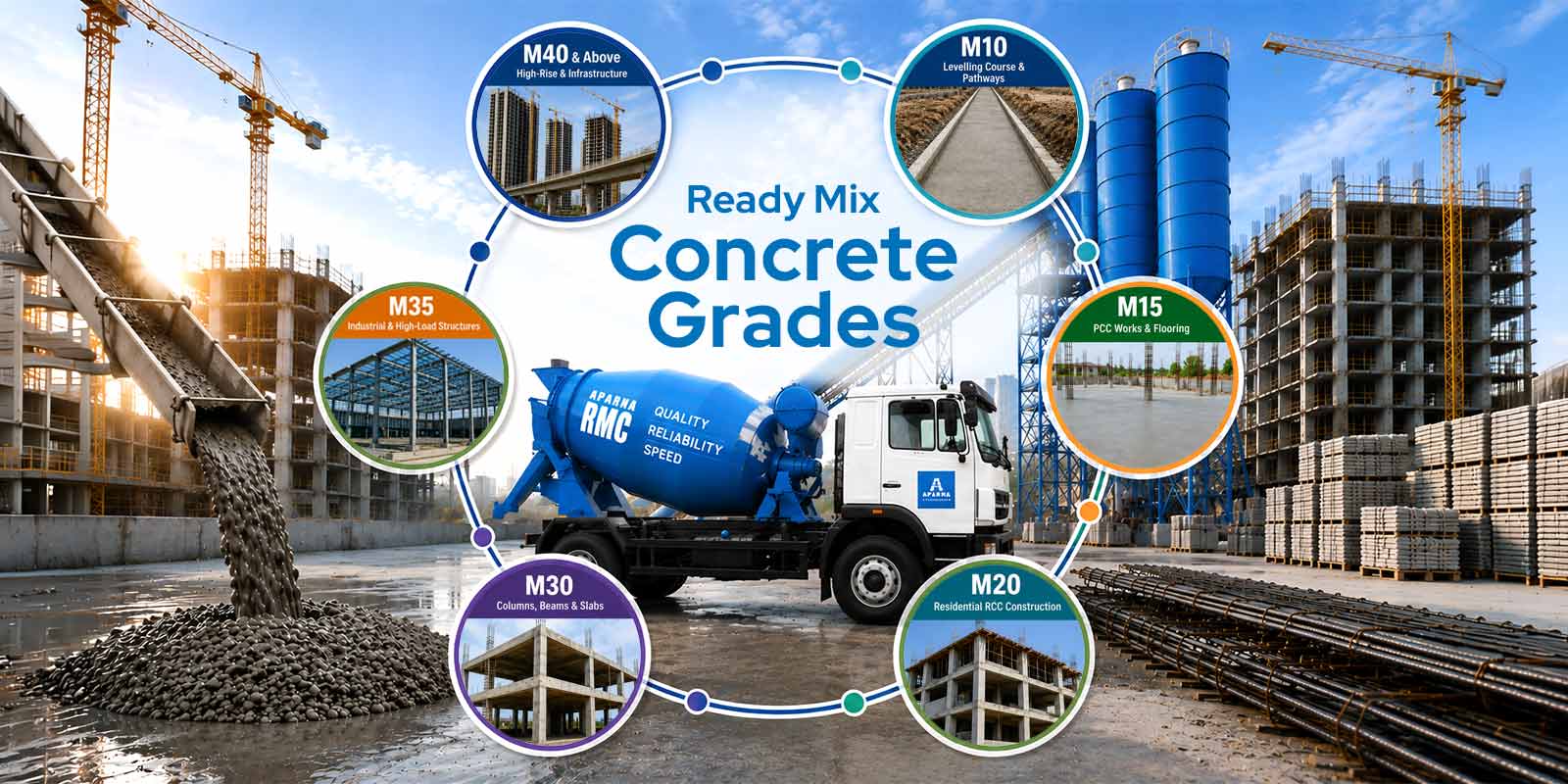
The table below is the complete RMC grade scale used across Indian construction, mapping each grade to its strength, typical mix proportion and common application. Use it as a quick reference when specifying concrete:
Grade |
Strength (N/mm²) |
Nominal Mix Ratio (C : S : A) |
Mix Type |
Common Application |
| M5 | 5 | 01:05:10 | Nominal | Levelling course, non-structural fill |
| M7.5 | 7.5 | 01:04:08 | Nominal | Bedding, mass filling |
| M10 | 10 | 01:03:06 | Nominal | Plain cement concrete (PCC), flooring base |
| M15 | 15 | 01:02:04 | Nominal | Pavements, flooring, non-load-bearing work |
| M20 | 20 | 01:05.5 | Nominal | Residential slabs, beams and columns |
| M25 | 25 | Design mix | Standard | RCC for homes and small commercial buildings |
| M30 | 30 | Design mix | Standard | Slabs, columns, footings in mid-rise buildings |
| M35 | 35 | Design mix | Standard | Commercial structures, water-retaining works |
| M40 | 40 | Design mix | Standard / High | High-rise columns, bridges, heavy footings |
| M45 | 45 | Design mix | Standard / High | Piling, industrial flooring, infrastructure |
| M50 | 50 | Design mix | Standard / High | Pre-stressed elements, large spans |
| M55 | 55 | Design mix | Standard / High | Heavily loaded columns, marine works |
| M60–M80 | 60–80 | Design mix | High strength | Skyscrapers, long-span bridges, special structures |
Under IS 456:2000, these grades are grouped as: Ordinary Concrete (M10–M20), Standard Concrete (M25–M55) and High Strength Concrete (M60–M80). M5 and M7.5 sit below the structural range and are used only for non-load-bearing purposes.
Concrete Grades by Application: Which Grade Do You Need?
Choosing the right RMC grade comes down to the loads your structure will carry and the conditions it will face. Here is the grade most commonly specified for each type of work:
-
Best grade for residential house construction
For most independent houses and low-rise residential buildings, M20 to M25 is the standard choice. M20 suits slabs, beams and columns in ordinary conditions, while M25 is preferred where slightly higher durability or load capacity is needed. Reinforced concrete (RCC) in homes should never fall below M20.
-
Best grade for foundations and footings
Foundations typically use M20 for the structural footing sitting on a PCC bed of M10 or M15. Larger buildings with heavier column loads move up to M25–M30 for the footings to manage the increased pressure on the soil.
-
Best grade for slabs, columns and beams
In RCC frames, M25 is the workhorse grade for slabs, beams and columns in residential and small commercial projects. As building height and loads increase, columns are upgraded first — often to M30–M40 — while slabs may remain at M25.
-
Best grade for commercial and high-rise structures
Commercial buildings and high-rises demand M35 to M50 for columns and structural members, because lower floors carry the cumulative weight of everything above them. The tallest towers use M60 and above in their lowest columns and core walls.
-
Best grade for pavements, roads and flooring
Concrete roads and heavy-duty pavements use M30 to M40 to withstand traffic loading and abrasion. Industrial flooring that bears machinery and forklift traffic typically calls for M30–M45 depending on the load.
-
Grade of concrete for DPC, PCC, water tanks and infrastructure
Beyond the main structural elements, specific works call for specific grades. The grade of concrete used in DPC (damp-proof course) is typically M15, laid as a thin impervious layer to stop rising moisture. Plain cement concrete (PCC) bases use M10 to M15 under footings and floors. Water tanks and other liquid-retaining structures require a minimum of M30 under IS 3370 for water-tightness. Piles are commonly cast in M30–M40, while bridges and dam construction use M35 and above for the structural members carrying dynamic and hydrostatic loads. Road infrastructure has its own grades — dry lean concrete (DLC) sub-base is usually M10–M15 and pavement quality concrete (PQC) is M40, with kerb stones and concrete sleepers cast in M25–M40 depending on the specification.
Nominal Mix vs Design Mix: Why the Distinction Matters
The line between nominal mix and design mix sits at M20. Up to M20, IS 456:2000 permits nominal mixes — fixed ratios like 1:1.5:3 — that are simple to batch on small sites.
From M25 upwards, design mix is mandatory because achieving higher strengths reliably requires precise control of the water-cement ratio, aggregate grading and admixture dosage. Design mixes are proportioned in a laboratory following IS 10262:2019, then validated by trial batches and cube testing before full production.
Minimum grades are also fixed by code rather than choice. Under IS 456:2000 the minimum grade of concrete for reinforced (RCC) work is M20, rising with exposure. For prestressed concrete, IS 1343 sets a higher floor — M30 for pre-tensioned and M40 for post-tensioned members — because these elements carry high concentrated forces. In seawater and severe marine exposure, the minimum climbs further, typically M40 or above, where durability rather than load governs the choice.
This is the core advantage of ready mix concrete over site-mixed concrete: every cubic metre is produced from a verified design mix in a computer-controlled batching plant, eliminating the inconsistency of hand-mixing on site.
High Grade Ready Mix Concrete: M40 and Above
High-grade ready mix concrete generally refers to grades of M40 and higher, with M60–M80 classified as high-strength concrete under IS 456:2000. These grades are engineered for the most demanding applications:
- High-rise and skyscraper columns that carry enormous cumulative loads
- Long-span and cable-stayed bridges
- Pre-stressed and post-tensioned structural elements
- Marine and industrial structures exposed to aggressive environments
Producing high-grade concrete reliably is far harder than mixing ordinary grades. It depends on a very low water-cement ratio, high-performance superplasticisers, supplementary materials such as fly ash or silica fume, and rigorous quality control on every batch. This is precisely why high-grade work is almost always sourced from established RMC suppliers rather than mixed on-site.
These are the highest grades of concrete in practical use. In India, grades up to M80 are produced for premium high-rise and infrastructure projects. For the vast majority of Indian construction, however, anything above M60 is already specialised, high-performance work.
For example, Aparna Enterprises supplies grades across the M30 to M80 range, using fully computerised Schwing Stetter batching plants and IS-code-compliant design mixes. For high-grade and specialised requirements, suppliers with dedicated R&D and consistent quality control are best placed to deliver concrete that performs exactly to specification.
How Concrete Grade Strength Is Tested?
A concrete grade is only meaningful if it is verified. Strength is confirmed through a 28-day compressive strength test on standard cube samples:
- Fresh concrete samples are cast into 150 mm cubes at the time of pouring.
- The cubes are cured in water under controlled conditions.
- They are crushed in a compression testing machine at 7 days (for an early indication) and at 28 days (for the final result).
- The recorded strength must meet or exceed the grade’s characteristic value.
Reputable RMC suppliers run additional checks — slump tests for workability, flakiness index and sieve analysis for aggregate quality — so that the concrete leaving the plant matches what was specified on paper.
Mix parameters also shift with the grade. The slump value chosen depends on the grade and placement method — typically 25–75 mm for ordinary work and higher, controlled slumps for pumped high-grade concrete using superplasticisers. Minimum cement content likewise rises with grade and exposure under IS 456, ranging from around 300 kg/m³ for mild exposure up to 360 kg/m³ or more for severe and very severe conditions, balanced against a maximum to control heat and shrinkage.
Factors That Affect Choosing the Right RMC Grade
Selecting a grade is a balance of structural need, durability and cost. The main factors are:
- Structural load: Heavier loads and taller structures require higher grades.
- Exposure conditions: Coastal, marine or chemically aggressive environments demand higher grades and durability provisions, regardless of load.
- Element type: Columns generally need higher grades than slabs in the same building.
- Durability and lifespan: Higher grades resist cracking, water ingress and weathering better over time.
- Cost efficiency: Over-specifying wastes money; under-specifying risks the structure. A good supplier helps you match the grade precisely to the requirement.
A reliable RMC partner does more than deliver concrete — they advise on the correct grade for your loads and exposure, so you neither overpay nor compromise on safety.
Choosing Your Grade With Confidence
Understanding ready mix concrete grades is the difference between a structure that lasts decades and one that develops problems early. The right grade depends on what you are building, the loads involved and the environment it will face — from M20 for a family home to M60-plus for a high-rise tower.
When you source concrete from a supplier that controls quality from mix design to delivery, you get the strength you specified, every single time. Aparna Enterprises, with three decades of building-materials expertise, supplies quality-tested concrete across standard and high-performance grades through its network of automated plants and transit-mixer fleet across South and West India. If you are planning a project, request a mix recommendation to get the exact grade your structure needs.
Frequently Asked Questions On RMC Grades
Ready mix concrete should generally be placed within three to three-and-half hours of batching, before it begins to set. Transit mixers keep the concrete agitated during transport to maintain workability, but the exact window depends on the mix, temperature and any retarding admixtures used. In hot Indian summers, this window shortens, which is why plant-to-site distance and delivery timing matter.
Under IS 456:2000, the minimum grade for reinforced concrete is M20 for mild exposure conditions. For more aggressive environments the minimum rises — typically M25 for moderate exposure, M30 for severe, and higher still for very severe and marine conditions — because durability, not just strength, drives the requirement.
The grade is defined by the target strength, not the cement type, so both Ordinary Portland Cement (OPC) and Portland Pozzolana Cement (PPC) can produce the same grade. However, they behave differently: PPC gains strength more slowly but offers better long-term durability and resistance to chemical attack, while OPC develops early strength faster. The mix design is adjusted accordingly to hit the specified grade.
At minimum, ask for a slump test at the point of delivery to confirm workability, and ensure cube samples are cast from your pour for 7-day and 28-day compressive testing. A credible supplier will share batch records and test certificates, giving you documented proof that the concrete delivered matches the grade ordered.
Yes, and it is common practice. A single building often uses M10 for the PCC base, M20–M25 for slabs and beams, and M30–M40 for heavily loaded columns. Using a higher grade only where the structure demands it is both safe and cost-efficient, which is why mix design is planned element by element.
Characteristic strength is the value below which no more than 5% of test results are expected to fall. So M25 does not mean every cube hits exactly 25 N/mm² — it means at least 95% of samples meet or exceed 25 N/mm². This statistical definition builds a safety margin into every grade, accounting for the natural variation in concrete production.
For residential roof and floor slabs, M20 to M25 is the standard grade. M20 is the minimum for RCC slabs in ordinary conditions, while M25 is preferred for added durability or slightly higher loads. In commercial and high-rise buildings, slabs may use M25–M30, with the columns supporting them specified higher.
Footings and foundations typically use M20 to M25 for ordinary residential construction, sitting on a PCC base of M10–M15. Larger buildings with heavier column loads move up to M25–M30, and piled foundations are commonly cast in M30–M40 to handle concentrated loads.
In Indian construction, concrete up to M80 is produced for premium high-rise towers, long-span bridges and specialised infrastructure. Grades above M60 are classified as high-strength concrete under IS 456:2000 and require strict quality control, low water-cement ratios and admixtures such as silica fume to achieve reliably.
Water tanks and other liquid-retaining structures require a minimum of M30 as per IS 3370, because water-tightness and durability — not just strength — govern the design. The mix is also controlled for low permeability and crack resistance to prevent leakage over the structure’s life.
Start Your Project with the Right Materials
We provide everything you need for modern construction. Connect with our experts to discuss your requirements and get the best solution for your project. Submit your details and our team will contact you soon.
CORPORATE OFFICE
8-2-293/82/A, Plot No-1214, Road No-60,
Jubilee Hills, Hyderabad-500 033.