
Types of Tiles: A Complete Guide to Materials, Sizes, Finishes & Uses
In This Article
Choosing the right tile is one of the most consequential decisions in any home or commercial project in India. The different types of tiles available today range from budget-friendly ceramic tiles for bathroom walls to large-format vitrified slabs for premium living rooms, and each type serves a specific purpose. India is also one of the world’s largest tile manufacturing hubs — Morbi in Gujarat alone produces over 70% of the country’s tiles, supplying both domestic and global markets.
This guide breaks down every type of tile available in India by material, application, finish, and size — with specifications, ideal uses, and price ranges in Indian Rupees per square foot. By the end, you will know exactly which type of tile suits your space, your climate, and your budget.
Quick Reference: Types of Tiles at a Glance
Before diving into each type of tile in detail, this comparison table summarizes the most common types of tiles in India along with their primary uses, water absorption, durability, price, and maintenance level.
Type of Tile |
Best Use |
Water Absorption |
PEI Rating |
Price (₹/sq ft) |
Maintenance |
| Vitrified Tiles | Floors, walls (indoor) | < 0.5% | PEI 4–5 | ₹40–₹200 | Low |
| Ceramic Tiles | Walls, dry rooms | 3–7% | PEI 1–3 | ₹30–₹120 | Low |
| Porcelain Tiles | Wet areas, outdoor | < 0.5% | PEI 4–5 | ₹60–₹250 | Very Low |
| Marble Tiles | Living rooms, foyers | 0.5–2% | Varies | ₹150–₹800+ | High |
| Granite Tiles | Kitchens, staircases | < 0.4% | High | ₹100–₹400 | Medium |
| Mosaic Tiles | Accent walls, pools | 1–3% | PEI 2–3 | ₹80–₹500 | Medium |
| Glass Tiles | Backsplashes, accents | 0% | Low | ₹150–₹600 | Low |
| Cement Tiles | Patios, feature walls | 5–10% | PEI 3–4 | ₹80–₹300 | Med-High |
| Terracotta Tiles | Outdoor, rustic interiors | 7–15% | PEI 2–3 | ₹40–₹150 | High |
| Quartz Tiles | Premium floors, counters | < 0.5% | High | ₹200–₹600 | Low |
| Metal Tiles | Decorative accents | 0% | Low–Med | ₹300–₹1000+ | Medium |
NOTE:
The prices mentioned above and throughout this article are provided for informational purposes only. These prices do not apply to the tile ranges manufactured by Aparna Enterprises.
Explore our exclusive tile range and connect with our team for detailed product information and pricing.
Types of Tiles Based on Material
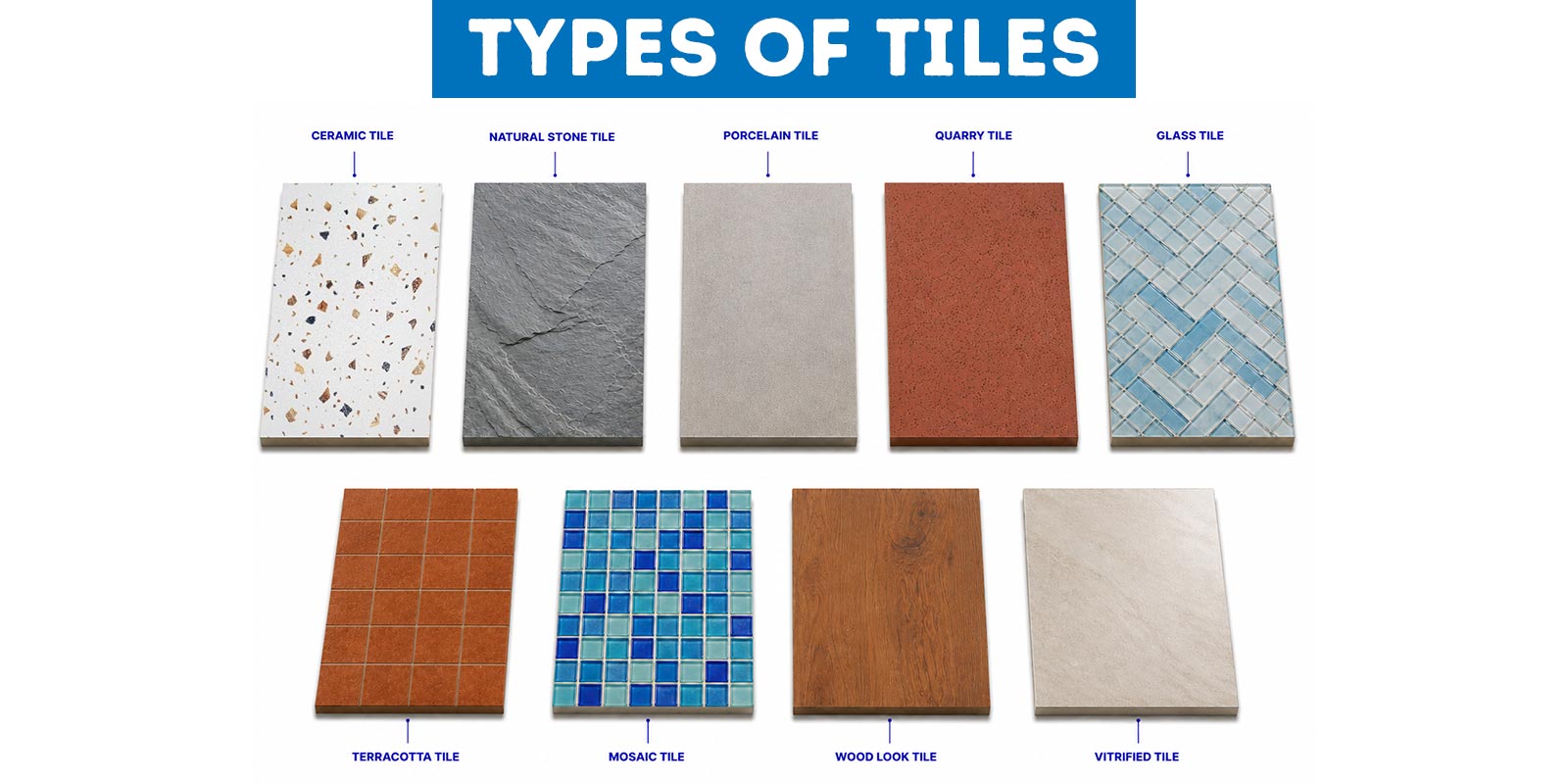
The most common way to classify the different types of tiles is by the material used to make them. Each material has unique properties around strength, water absorption, finish options, and price. The ten major types of tiles by material used across Indian homes and projects are described below.
Vitrified Tiles — India’s Most Popular Choice
Vitrified tiles are the most widely used type of tile in Indian homes today. They are manufactured by hydraulically pressing a mixture of clay, silica, quartz, and feldspar, then firing the tiles at temperatures above 1,200°C. This vitrification process makes the tile body extremely dense, with water absorption below 0.5%, which is why vitrified tiles dominate Indian flooring across living rooms, bedrooms, and kitchens.
Specifications:
- Water absorption: Below 0.5%
- Thickness: 8–12 mm (standard), 18–20 mm (heavy-duty)
- Standard sizes in India: 600×600 mm, 800×800 mm, 800×1600 mm, 1200×1800 mm
- Price range: ₹40–₹200 per sq ft
- Best uses: Living rooms, bedrooms, kitchens, commercial spaces
Vitrified tiles in India come in four major subtypes: Full Body Vitrified (uniform colour throughout the tile body), Glazed Vitrified (GVT) with printed surface designs, Double Charged Vitrified (DVT) with a 3–4 mm deep pigment layer, and Polished Glazed Vitrified (PGVT) with a high-gloss finish.
Ceramic Tiles — Affordable and Versatile
Ceramic tiles are one of the oldest and most affordable types of tiles in India. Made from natural clay, sand, and water, they are kiln-fired at lower temperatures (around 1,000°C) than vitrified tiles. Ceramic tiles are softer and more porous (3–7% water absorption), and are widely used for bathroom walls, kitchen backsplashes, and bedroom floors across Indian homes.
Specifications:
- Water absorption: 3–7%
- Thickness: 6–10 mm
- Standard sizes in India: 300×450 mm, 300×600 mm, 600×600 mm
- Price range: ₹30–₹120 per sq ft
- Best uses: Bathroom walls, kitchen backsplashes, bedroom floors
Porcelain Tiles — Premium Durability for Wet Areas
Porcelain tiles are a denser, premium subtype of ceramic tiles, manufactured from purer kaolin clay and fired at higher temperatures. With water absorption below 0.5%, porcelain tiles are highly suitable for Indian wet areas like bathrooms, balconies, and outdoor spaces. Technically, porcelain falls under the vitrified category, but it is sold separately in India as a premium choice for moisture-prone areas.
Specifications:
- Water absorption: Below 0.5%
- Thickness: 8–20 mm
- Standard sizes in India: 600×1200 mm, 800×1600 mm, slab formats up to 1600×3200 mm
- Price range: ₹60–₹250 per sq ft
- Best uses: Bathrooms, balconies, outdoor patios, kitchens, commercial flooring
Natural Stone Tiles — Timeless Luxury
Natural stone tiles are cut and polished directly from quarried rock. India is a global leader in natural stone production, with Rajasthan supplying marble and granite to the world. Each piece offers unique veining and colour variation that no manufactured tile can replicate. The most common natural stone tiles in Indian homes include:
- Marble Tiles: Elegant veining; Makrana marble from Rajasthan is world-renowned. Used in luxury Indian interiors. Requires periodic sealing.
- Granite Tiles: Extremely hard and scratch-resistant; ideal for Indian kitchens, staircases, and high-traffic floors.
- Slate Tiles: Naturally textured and slip-resistant; suited for outdoor and rustic Indian interiors.
- Travertine Tiles: Warm earthy tones; popular for patios and luxury bathrooms.
- Limestone Tiles: Soft, neutral tones; mostly used for decorative purposes.
Mosaic Tiles — Small Tiles, Big Impact
Mosaic tiles are small tiles, typically under 50×50 mm, assembled on mesh sheets to form patterns. Made from ceramic, glass, stone, or metal, mosaic tiles are used in Indian homes for accent walls, swimming pools, bathroom features, and decorative borders. They allow intricate design work that larger tiles cannot achieve.
Glass Tiles — Light-Reflecting Accents
Glass tiles are made from recycled or new glass, fired to create translucent or opaque finishes. They reflect light beautifully and are commonly used in small Indian bathrooms and kitchens as backsplashes and accent walls. Glass tiles are non-porous (0% water absorption) but more fragile than ceramic or vitrified tiles.
Cement Tiles — Handmade Pattern Statements
Cement tiles, also called encaustic tiles, are handmade from pigmented cement pressed into molds. They feature bold geometric patterns and are popular in Indian boutique cafes, heritage restoration projects, and bohemian interiors. Cement tiles require sealing to prevent staining from spills and humidity.
Terracotta Tiles — Traditional Earthy Warmth
Terracotta tiles are made from natural red clay, sun-dried or low-fired. With their warm, earthy appearance, terracotta tiles are commonly used in traditional South Indian homes, Mediterranean-style interiors, and outdoor courtyards. They are highly porous and need regular sealing to last in Indian climate conditions.
Quartz / Engineered Stone Tiles — Modern Premium
Engineered quartz tiles are manufactured from 90–95% crushed natural quartz bound with resins and pigments. They combine the look of natural stone with higher durability and lower maintenance, making them an ideal premium choice for kitchen countertops, vanities, and high-end floors in Indian homes.
Metal Tiles — Decorative Statements
Metal tiles are made from stainless steel, copper, brass, or aluminium and are used primarily for decorative accents — backsplashes, borders, and feature walls. In Indian interiors, metal tiles are most commonly used in modern industrial-style kitchens and luxury commercial spaces.
Types of Tiles Based on Application and Their Uses
Another common way to classify the different types of tiles is by application — that is, where the tile is meant to be used. Choosing the right tile by application ensures it matches the specific demands of the room: water exposure, foot traffic, temperature variation, and slip resistance. Below are the major types of tiles and their uses across Indian homes and commercial spaces.
Bathroom Tiles
Bathroom tiles are the most safety-critical type of tile because they are constantly exposed to water. In India, bathroom floors should use porcelain or anti-skid vitrified tiles with a matte or textured finish to prevent slips. Walls can use glossy ceramic or glass tiles for easier cleaning. Recommended bathroom tile sizes in India are 300×300 mm or 600×600 mm for floors, and 300×600 mm or larger for walls.
Kitchen Tiles
Indian kitchens need tiles that resist stains, oil splashes, turmeric stains, and thermal shock from hot pans and pressure cookers. Use vitrified or porcelain for kitchen floors and glossy ceramic, glass, or subway tiles for backsplashes. Matte finishes hide stains better than glossy on kitchen floors — a real consideration in Indian cooking environments.
Living Room Tiles
Living rooms in Indian homes call for tiles that balance aesthetics with everyday durability. Large-format vitrified tiles (800×1600 mm or 1200×1800 mm) in polished, glossy, or marble-look finishes create a seamless, premium appearance. Book-matched and double-charged vitrified tiles are popular premium options for upscale Indian living rooms.
Bedroom Tiles
Bedroom tiles prioritise warmth and comfort underfoot. Matte vitrified tiles, wood-look porcelain, or rustic finish tiles work well for Indian bedrooms. Sizes between 600×600 mm and 800×800 mm suit most bedroom dimensions in Indian apartments and houses.
Outdoor and Parking Tiles
Outdoor tiles in India face extreme conditions — monsoon rains, summer heat above 45°C, and constant UV exposure. They need high strength, slip resistance, and weather resistance. Use full-body vitrified tiles (20 mm thickness), heavy-duty porcelain, or natural stone like granite and slate. Look for PEI Class 5 rating and anti-skid R10–R11 rating, both critical for Indian outdoor conditions.
Wall Tiles
Wall tiles are thinner (6–10 mm) and lighter than floor tiles. Common wall tile choices in Indian homes include ceramic, glass, and glazed vitrified, available in glossy, matte, or textured finishes depending on the desired look.
Staircase and Riser Tiles
Staircase tiles require anti-skid surfaces and durable edges. In India, step tiles typically come with bullnose edges or anti-skid grooves and are usually made of full-body vitrified or porcelain in matte or textured finishes for safety.
Commercial and High-Traffic Tiles
Commercial spaces like offices, malls, showrooms, and airports in India require double-charged vitrified or full-body porcelain tiles with PEI Class 5 rating. These tiles withstand heavy daily foot traffic for decades without showing visible wear.
Types of Tiles Based on Finish
A tile’s finish refers to its surface treatment — the texture and appearance applied during manufacturing. The finish affects the tile’s look, slip resistance, light reflection, and maintenance. The different types of tile finishes available in India fall into three broad groups: smooth and reflective, subtle and functional, and textured designer.
Smooth & Reflective Finishes
- Glossy Finish: A highly reflective, shiny surface that bounces light and makes spaces feel larger. Ideal for bathroom walls, kitchen backsplashes, and small rooms in Indian apartments. Can become slippery when wet.
- Polished Finish: Mechanically polished to a mirror-like shine on vitrified and natural stone tiles. Premium look, popular for living rooms and foyers in upscale Indian homes.
- Mirror / High-Gloss Finish: The highest level of reflectivity, often used in luxury Indian interiors and commercial showrooms.
Subtle & Functional Finishes
- Matte Finish: Non-reflective surface that hides scratches and watermarks. The most recommended finish for Indian bathroom floors, balconies, and bedrooms. Naturally slip-resistant.
- Satin / Matt-Satin Finish: A soft sheen between matte and glossy. Balanced look, easy to maintain, suitable for Indian living rooms and bedrooms.
- Anti-Skid Finish: Textured surface engineered for grip in wet conditions. Mandatory for bathroom floors, balconies, pool surrounds, and outdoor areas in India. Always check for R10–R11 anti-skid ratings.
Textured & Designer Finishes
- Sugar Finish: A grainy, crystalline texture resembling sugar crystals; soft underfoot and naturally slip-resistant.
- Carving / Texture Finish: 3D carved patterns that add depth and visual interest; popular for feature walls in Indian homes.
- Lappato / Semi-Polished Finish: Partially polished surface combining shiny and matte areas. Modern look with slightly better slip resistance than fully polished tiles.
- Rustic / Natural Finish: Mimics natural stone or aged wood; ideal for traditional Indian, Mediterranean, or earthy interiors.
- Metallic Finish: Has a metallic sheen — gold, copper, or silver — for accent walls and luxury spaces.
- Book match Finish: Two or four tiles arranged to mirror each other, creating a continuous veining pattern. A premium choice for Indian living rooms, hotel lobbies, and feature walls.
Types of Tiles and Their Sizes in India
Tile size directly affects a room’s visual proportions, installation cost, and structural suitability. Indian tile manufacturers produce a wide range of sizes catering to everything from compact apartment bathrooms to expansive commercial floors. Here are the standard types of tiles and their sizes available in India.
Standard Tile Sizes in India
| Size Category | Dimensions (mm) | Best Application |
| Small Format | 100×100, 200×200, 300×300 | Mosaics, small bathrooms, kitchens |
| Medium Format | 300×450, 300×600, 600×600 | Bathroom walls, standard floors |
| Large Format | 800×800, 800×1600, 1200×1800 | Living rooms, lobbies, commercial floors |
| Slab Format | 1200×2400, 1600×3200 | Seamless walls, premium floors, kitchen counters |
Small Format vs Large Format Tiles
Smaller tiles offer more grout lines, providing better grip and easier replacement, but they make rooms feel busier. Large-format tiles create a seamless, premium look and are easier to clean because of fewer grout lines, but they require flatter substrates and skilled installation. For small Indian apartments, 600×600 mm or 800×800 mm tiles strike the best balance.
GVT vs DVT Tile Sizes
- GVT (Glazed Vitrified Tiles): Vitrified body with a glazed printed surface. Wide design variety, including wood-look, marble-look, and fabric-look options. Available in all sizes from 600×600 mm up to large slabs.
- DVT (Double Charged Vitrified Tiles): Two layers of pigment fused under high pressure, creating a 3–4 mm deep design layer. More durable than GVT but with limited design range. The most common sizes are 600×600 mm and 800×800 mm.
Recommended Tile Thickness by Application
- Wall tiles: 6–8 mm
- Indoor floor tiles: 8–10 mm
- Heavy-duty / outdoor / parking tiles: 15–20 mm
- Slabs and feature walls: 12–20 mm
Vitrified vs Ceramic vs Porcelain: Which Type of Tile Is Best?
This is the most common dilemma for tile buyers in India. The short answer: vitrified and porcelain tiles are best for floors and wet areas, while ceramic tiles are best for walls and low-traffic dry zones. Here is a detailed comparison of these three popular types of tiles.
| Feature | Vitrified Tiles | Ceramic Tiles | Porcelain Tiles |
| Water Absorption | Below 0.5% | 3–7% | Below 0.5% |
| Strength | Very High | Medium | Very High |
| Outdoor Suitability | Some (full body) | No | Yes |
| Stain Resistance | High | Medium | Very High |
| Cost (₹/sq ft) | ₹40–₹200 | ₹30–₹120 | ₹60–₹250 |
| Best For | Indoor floors | Walls, dry rooms | Wet & outdoor |
| Lifespan | 20–25 years | 10–15 years | 25+ years |
Verdict: For walls or dry bedrooms on a budget, ceramic tiles work well. For most floors in Indian homes, vitrified offers the best balance of cost and durability. For bathrooms, balconies, kitchens, or any wet/outdoor space, porcelain is the safest, longest-lasting choice.
Marble vs Granite vs Vitrified: Which Suits Indian Homes?
Another common question Indian buyers ask is whether to choose marble, granite, or vitrified tiles. Each of these has distinct advantages depending on budget, aesthetic, and intended use.
| Feature | Marble | Granite | Vitrified |
| Appearance | Veined, luxurious | Speckled, uniform | Customizable |
| Durability | Medium (scratches) | Very High | Very High |
| Maintenance | High (sealing) | Low | Very Low |
| Heat Resistance | High | Very High | High |
| Cost (₹/sq ft) | ₹150–₹800+ | ₹100–₹400 | ₹40–₹200 |
| Best For | Living rooms, foyers | Kitchens, staircases | All-purpose |
Verdict: Marble suits luxury aesthetics but needs regular upkeep. Granite is ideal for high-use surfaces. Vitrified offers the most flexibility and value for the average Indian home, with marble-look and granite-look options now widely available at a fraction of the cost.
Matte vs Glossy Tiles: Which Finish Should You Choose?
| Feature | Matte Tiles | Glossy Tiles |
| Appearance | Subtle, modern | Bright, reflective |
| Slip Resistance | High | Low (slippery when wet) |
| Maintenance | Hides stains and scratches | Shows watermarks and smudges |
| Light Reflection | Low | High (makes rooms feel larger) |
| Best For | Bathroom floors, bedrooms, outdoor | Walls, kitchens, small rooms |
| Cost | Similar to glossy | Similar to matte |
Verdict: Use matte for floors in wet or high-traffic areas. Use glossy for walls, small rooms, and spaces where you want to amplify natural light. Many Indian homeowners combine both — matte on the floor, glossy on the walls — for the best of both finishes.
How to Choose the Right Tile for Indian Homes?
Choosing the right type of tile in India comes down to five key factors: the room and its usage, foot traffic, climate and moisture conditions, style preferences, and budget.
Match the Tile to the Room and Usage
The room’s function should dictate the tile choice. Bathrooms need anti-skid matte finishes. Indian kitchens need stain-resistant and grease-resistant surfaces. Living rooms allow more aesthetic freedom. Outdoor spaces in India need weather-resistant, full-body tiles to handle monsoon and summer extremes.
Check the PEI Rating for Foot Traffic
The PEI (Porcelain Enamel Institute) rating measures a tile’s resistance to surface abrasion on a scale of 1 to 5:
- PEI 1: Wall use only
- PEI 2: Light residential traffic (bedrooms, bathrooms)
- PEI 3: Moderate traffic (most residential rooms)
- PEI 4: Heavy residential / light commercial (kitchens, entryways)
- PEI 5: Heavy commercial (malls, airports, offices)
Factor in Indian Climate and Moisture
Climate matters significantly in tile selection in India. In humid coastal areas like Mumbai, Chennai, Goa, and Kochi, prioritize low water-absorption porcelain or vitrified tiles to prevent mold and warping. In dry climates of Rajasthan or interior North India, ceramic and natural stone work well indoors. For outdoor areas exposed to monsoon rains across India, use only tiles with water absorption below 0.5%.
Align with Your Style and Aesthetic
- Modern minimalist: Large-format matte or polished vitrified tiles in neutral tones
- Luxury Indian interiors: Marble, bookmatch slabs, or polished natural stone
- Traditional Indian / rustic: Terracotta, cement tiles, rustic finishes
- Industrial: Concrete-look tiles, metallic accents
- Scandinavian / contemporary: Wood-look porcelain, light matte finishes
Plan Your Budget Realistically
- Budget (₹30–₹80/sq ft): Ceramic tiles, basic vitrified tiles
- Mid-range (₹80–₹200/sq ft): GVT, double-charged vitrified, standard porcelain
- Premium (₹200–₹500/sq ft): Large-format porcelain, marble-look slabs, engineered quartz
- Luxury (₹500+/sq ft): Natural marble, bookmatch slabs, imported porcelain
Always factor in installation costs in India (₹40–₹80 per sq ft) and additional costs for grout, adhesive, and skirting tiles separately when budgeting.
Common Mistakes to Avoid When Choosing Tiles
Many Indian homeowners regret their tile choices within a few years. The most common mistakes include:
- Choosing glossy tiles for wet floors. Causes slips and accidents in bathrooms and balconies — a serious concern in Indian homes with elderly family members.
- Ignoring PEI ratings. Using low-PEI tiles in high-traffic areas leads to premature wear within a few years.
- Buying without checking water absorption. High-absorption tiles fail rapidly in Indian wet zones and monsoon conditions.
- Underestimating tile quantity. Always buy 10% extra for cuts, breakage, and future repairs.
- Picking tiles from small samples only. Always view full-size displays; patterns and tones look very different at scale.
- Mismatching tile size to room size. Large tiles in small Indian apartment rooms look cramped; tiny tiles in large rooms look busy.
- Forgetting grout colour. Grout dramatically changes the final look; choose colour deliberately.
- Skipping skirting or transition tiles. Leaves unfinished-looking edges in Indian homes.
- Choosing trendy over timeless. Floor tiles last 20+ years; avoid hyper-trendy patterns that may date quickly.
- Not verifying batch numbers. Tiles from different production batches can have slight colour variations, especially in Indian-manufactured tiles.
Why Tile Quality Matters?
-
Durability and Longevity
Premium tiles last 20–25 years or more without replacement. Low-quality tiles crack, chip, or fade within 5–8 years, costing more in repairs and replacements in the long run.
-
Safety: Slip Resistance and Load Bearing
Quality tiles meet anti-skid ratings (R9 to R13) and load-bearing standards (above 35 N/mm² for floors). Poor-quality tiles can crack under heavy furniture or cause slips — both common issues in Indian homes.
-
Ease of Maintenance and Cleaning
Premium vitrified and porcelain tiles have non-porous surfaces that resist stains, mold, and bacteria — important in India’s humid climate. Low-grade tiles absorb spills, develop discoloration, and harbour germs.
-
Long-Term Cost Savings
A higher upfront investment in quality tiles eliminates years of repair, replacement, and refinishing expenses. Quality tiles also help maintain home resale value in the Indian real estate market.
How to Maintain and Care for Tiles?
Daily care:
- Sweep or vacuum to remove grit that can scratch tile surfaces.
- Mop with a damp cloth using a pH-neutral cleaner.
Weekly care:
- Clean grout lines with a soft brush and mild detergent.
- Wipe down wall tiles in bathrooms and kitchens to prevent build-up.
Tile-specific care tips:
- Vitrified / porcelain tiles: Avoid acidic cleaners; standard floor cleaner is sufficient.
- Marble / natural stone: Use pH-neutral cleaners only; reseal every 1–2 years to protect against staining.
- Terracotta / cement tiles: Apply sealant annually to prevent staining in Indian humidity.
- Glass / mosaic tiles: Use glass cleaner; avoid abrasive scrubbers.
Stain removal tips:
- Oil and turmeric stains: Baking soda paste, leave 10 minutes, then rinse — works well on common Indian kitchen stains.
- Hard water stains: White vinegar diluted 1:1 with water; never use on natural stone.
- Grout discolouration: Hydrogen peroxide and baking soda paste.
Premium Tile Solutions from Aparna Enterprises
When sourcing the right type of tile for your project, the manufacturer and supplier matter as much as the tile category. Aparna Enterprises is one of India’s leading building materials companies, offering a comprehensive range of premium tiles for residential, commercial, and architectural projects across the country.
The Aparna Enterprises tile portfolio is built around the needs of Indian homes and businesses — covering every major category discussed in this guide:
- Wide material range: Vitrified tiles, GVT, DVT, full-body porcelain, large-format slabs, and designer collections
- Comprehensive size offering: From 300×300 mm bathroom tiles to 1200×1800 mm large-format living room tiles
- Multiple finishes: Glossy, matte, polished, lappato, sugar, carving, bookmatch, rustic, and metallic
- Application coverage: Floor tiles, wall tiles, outdoor tiles, parking tiles, commercial-grade tiles, and designer collections
- Quality assurance: Low water absorption, high PEI ratings, anti-skid certifications, and consistent batch quality
Whether you’re a homeowner renovating a single bathroom, an architect specifying tiles for a project, or a builder sourcing tiles for an entire development, Aparna Enterprises offers the right type of tile for every application. Contact us today to explore tile designs that perfectly complement your space, style, and project requirements.
Takeaway
Choosing the right type of tile for your Indian home comes down to matching the tile’s properties — material, finish, size, and rating — to the specific demands of each room. For most Indian homes, vitrified or porcelain tiles offer the best combination of durability, design variety, and value. Use matte or anti-skid finishes for floors and wet areas, glossy for walls and bright spaces, and large-format tiles for a seamless, premium look. Always check water absorption, PEI rating, anti-skid rating, and batch consistency before buying.
Whether you’re selecting bathroom tiles, kitchen tiles, living room tiles, or outdoor tiles, the right type of tile will look beautiful and perform reliably for decades. Take time to compare types of tiles and their uses, sizes, and finishes — and partner with a trusted Indian tile brand like Aparna Enterprises to ensure quality, consistency, and the right design for your space.
Frequently Asked Questions
Yes, mixing tile types is a popular design choice in Indian homes — for example, vitrified flooring with a glass mosaic feature wall in the bathroom, or wood-look porcelain in the living room with marble-look vitrified in the foyer. The key rule: keep one type as the dominant tile (around 70% coverage) and the second as an accent. Also ensure both tiles share the same thickness at transitions, or use a transition strip to bridge any height difference.
A 10×12 ft room has an area of 120 sq ft. Always add 10% for cuts, wastage, and future repairs, bringing the total to 132 sq ft. The number of tiles depends on tile size: 600×600 mm tiles cover roughly 3.87 sq ft each (about 34 tiles), 800×800 mm tiles cover about 6.89 sq ft each (about 20 tiles), and 1200×600 mm tiles cover about 7.75 sq ft each (about 17 tiles). Most Indian dealers will calculate the exact quantity using your room dimensions and chosen tile size.
No, vitrified tiles come pre-finished from the factory and do not need polishing after installation. Polishing is only required for natural stone tiles like marble and granite. If your vitrified floor looks dull after a few years, it’s usually due to surface dirt build-up in grout lines or improper cleaning agents — a deep clean with a pH-neutral cleaner usually restores the shine.
Most reputable Indian tile brands offer warranties ranging from 5 years to 10 years on manufacturing defects, with some premium ranges offering up to 15 years. The warranty typically covers cracks, colour fading, and surface defects — but excludes damage from installation errors, heavy impacts, or improper cleaning agents. Always retain your purchase invoice and batch details for warranty claims.
Tiles are fragile and should be transported on wooden pallets, stacked vertically (not flat), and secured with stretch wrap. For long-distance transport across India, use enclosed trucks with shock absorbers and avoid loading more than 5–6 boxes per stack. On arrival, inspect each box for cracks before signing the delivery receipt — most suppliers will not entertain breakage complaints after delivery is accepted.
Branded tiles from established Indian manufacturers go through standardised quality checks for water absorption, PEI rating, dimensional accuracy, and colour consistency across batches. Unbranded or local tiles can be 30–50% cheaper but often vary in thickness, have higher water absorption, and lack warranty coverage. For permanent installations meant to last 20+ years, branded tiles offer significantly better long-term value.
Yes, vitrified tiles can be installed over existing tiles, cement floors, or marble — provided the existing surface is structurally sound, level, and clean. The existing floor should be roughened with a grinder for adhesive bonding, and a high-quality polymer-modified adhesive should be used instead of traditional cement mortar. This approach saves demolition cost and time but raises the floor height by 12–15 mm, so check door clearances first.
Yes. Tiles, adhesives, and substrates expand and contract with India’s wide temperature swings — especially in outdoor and rooftop applications. This is why expansion joints (2–3 mm gaps filled with flexible sealant) are essential at room perimeters, doorways, and every 6–8 meters of continuous flooring. Skipping expansion joints is a common cause of tiles popping up or cracking in Indian homes during peak summers.
Large-format tiles (800×1600 mm and above) require C2-grade polymer-modified tile adhesive — not traditional cement-sand mortar. The adhesive ensures even bonding across the full tile area and prevents the hollow-sound issue common with large tiles installed on cement mortar. Apply the adhesive using a notched trowel on both the substrate and the back of the tile (back-buttering) for best results.
Start Your Project with the Right Materials
We provide everything you need for modern construction. Connect with our experts to discuss your requirements and get the best solution for your project. Submit your details and our team will contact you soon.
CORPORATE OFFICE
8-2-293/82/A, Plot No-1214, Road No-60,
Jubilee Hills, Hyderabad-500 033.