
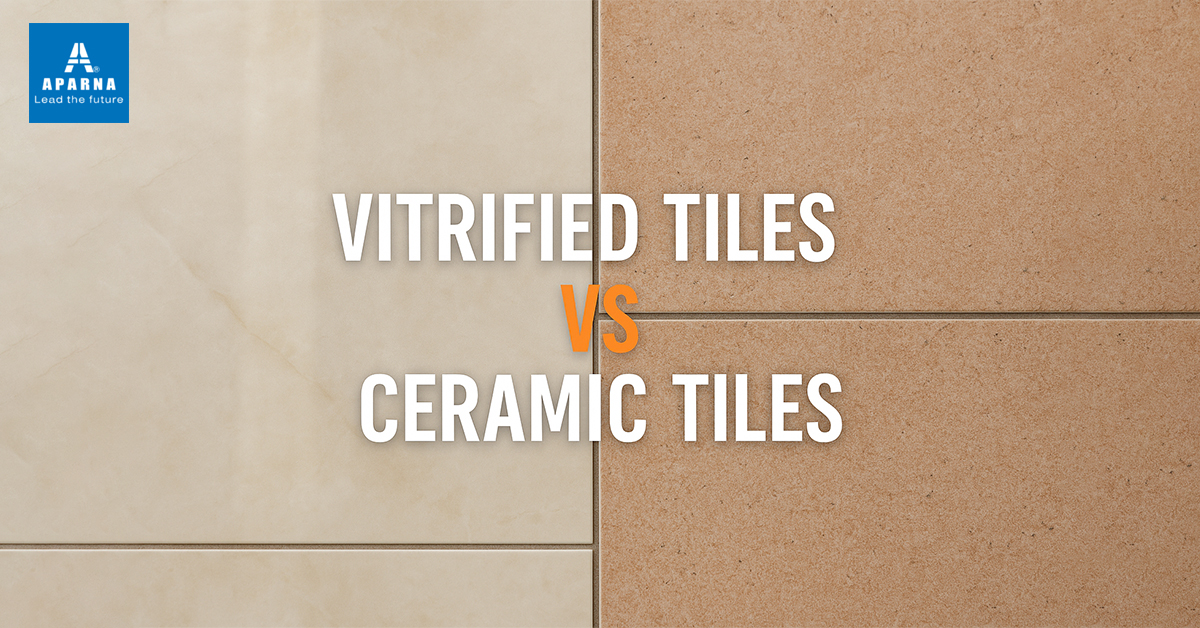
Ceramic Tiles vs Vitrified Tiles: Differences, Advantages & Which Tiles Are Better
Tiles are an important part of modern buildings because they protect surfaces from damage and add to the overall design and appearance.
When people choose tiles, there is always confusion about which type to choose: ceramic or vitrified? Though they both fulfil a functional purpose, they differ in strength, water resistance, and appearance.
This guide explains both tile types, differences, advantages, and how to choose the right one.
What Are Vitrified Tiles?
Vitrified tiles are a type of durable, low-porosity tile produced by hydraulic pressing a mixture of clay, silica, quartz, and feldspar, resulting in a glass-like substance. It is then passed into a kiln and fired at a temperature of 1200°C to 1300°C. This extreme heat melts minerals and fuses them with the clay, resulting in a vitreous structure.
What Are Ceramic Tiles?
Ceramic tiles are a type of tile manufactured through a process called sintering, in which clay, sand, and water are mixed to form a powder. It is then pressed into moulds and fired at temperatures of 900°C and 1100°C in a kiln to achieve a hard, porous body.
The heat causes particles to bond only at a molecular level (sintering) without completely melting, which leaves small air pockets and makes the tile porous.
How To Identify Ceramic And Vitrified Tiles?
One can identify the major difference between ceramic and vitrified tiles based on these characteristics:
- Water Absorption: Vitrified tiles absorb very little water (less than 0.5%), while ceramic tiles soak up moisture easily because of to their high porosity.
- Back Colour: Vitrified tiles have a white or light grey backing, while ceramic tiles have a red-brown or terracotta-coloured underside.
- Density & Weight: Vitrified tiles are thicker and heavier, while ceramic tiles are lighter and thinner.
What Is The Difference Between Ceramic And Vitrified Tiles?
There are a few major differences between the two types of tile. The table below will give you an in-depth understanding:
Feature |
Ceramic Tiles |
Vitrified Tiles |
| Material Composition | Natural earthen clay, sand, and water | 60% silica and 40% clay (mixed with quartz & feldspar) |
| Manufacturing Process | Shaped and fired at in a kiln at low temperatures | Fired at very high temperatures (minerals fuse into a glass-like structure) |
| Water Absorption | High (3% – 7%) | Very low (less than 0.5%) |
| Strength & Durability | Moderately strong; prone to chipping & cracking | Extremely strong, durable & resists heavy foot traffic |
| Scratch Resistance | Can scratch over time on floors | Superior resistance to scratches |
| Stain Resistance | Low resistance and can stain easily | High resistance |
| Surface Finish | Natural, earthy, or glazed | Smooth, glossy, or matte |
| Porosity | High | Low |
| Maintenance | High upkeep | Minimal upkeep |
| Area of Use | Walls, backsplashes, and low-traffic areas | Kitchens, bathrooms, and high traffic areas |
| Installation | Easy and DIY | Required skilled labour |
What Are The Advantages Of Vitrified Tiles?
- Vitrified tiles are highly resistant to cracks, scratches, stains, and fading.
- They are nearly waterproof (less than 0.5% absorption) and prevent the growth of moulds.
- They are available in various finishes that mimic marble, stone and wood.
- These tiles do not fade because they are resistant to frost and UV rays.
- The non-porous surface doesn’t trap allergens or pollen.
- Vitrified tiles can withstand harsh cleaners, acids, and alkalis.
Ceramic Tiles Vs Vitrified Tiles: Which One Should You Choose?
Selecting the right tile depends on your needs and application. If you are working with a tight budget and focusing on wall installations, ceramic tiles are an ideal choice because of their cost-effectiveness. However, for high-traffic areas, vitrified tiles are best. They are also more reliable and a premium investment option.
In modern homes, offices, and commercial settings, vitrified tiles offer superior long-term performance and value.
Also, if you are planning to build your dream home, and have enough budget, go with vitrified tiles to combine the aesthetics and functional strength.
Why Aparna Enterprises is the Best Choice for Vitrified Tiles?
Aparna Enterprises Limited differentiates itself from the rest by its combination of different technical specifications. Have a look at those specifications here:
- Italian Technology: Aparna used advanced equipment imported from Italy, including high-tonnage presses and a high gas-fired kiln, to ensure uniform density and consistent quality.
- Nano-Polished Surface: AEL uses advanced Nano Polishing Technology to offer excellent sheen and make tiles resistant to damage.
- Eco-Friendly (GreenPro): Aparna Enterprises’ tiles are environmentally friendly beacuse of implementation of green measures to reduce carbon emissions. Aparna is also certified by the CII as GreenPro.
- Uniformity: To ensure steady thickness and exact dimensions, Aparna follows Statistical Process Control (SPC). This accuracy also helps in the easy installation of tiles.
Takeaway
Vitrified tiles offer durability, resistance against scratches, and low porosity, making them ideal for high-traffic, heavy-duty applications like kitchen and bathroom floors. While ceramic tiles are more porous and fragile, they serve as a cost-effective choice for walls and low-traffic areas. So, the major difference between them is the porosity.
Need detailed tile specifications for your project? Contact Aparna Enterprises Limited for specialised product lines for different architectural needs.
Start Your Project with the Right Materials
We provide everything you need for modern construction. Connect with our experts to discuss your requirements and get the best solution for your project. Submit your details and our team will contact you soon.
CORPORATE OFFICE
8-2-293/82/A, Plot No-1214, Road No-60,
Jubilee Hills, Hyderabad-500 033.
CIN no.: U51109TG1994PLC018950